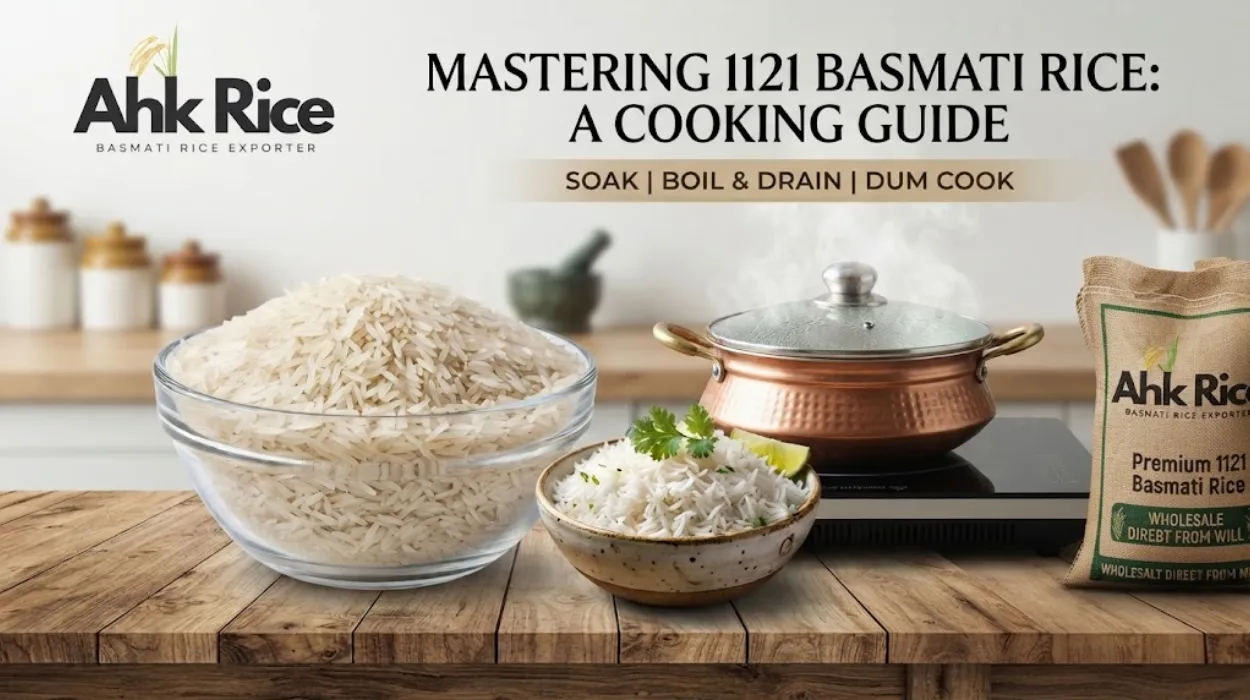
1121 Basmati Rice Cooking Guide for Perfect Results
1121 Basmati Rice produces long, separate, aromatic grains when you control rinsing, soaking, water, heat, and resting time. Here is why: 1121 has exceptional grain elongation, with cooked kernels reaching about 21–22 mm in documented quality studies.
The cooking result depends on the processing type, rice age, water ratio, and cooking method. White, Steam, and Sella 1121 Basmati respond differently to heat and hydration. A controlled method preserves grain length, aroma, texture, and separation.
What Is 1121 Basmati Rice and Why Does It Cook Differently?
1121 Basmati is an extra-long aromatic rice variety with approximately 8–9 mm milled grain length and exceptional cooked elongation. Its slender structure creates long, separate grains after controlled cooking.
1121 Basmati belongs to the long-grain Basmati rice category. The grain has a high length-to-breadth ratio and distinctive aroma. Basmati characteristics include linear elongation, soft texture, and limited breadth-wise swelling.
Research on Pusa Basmati 1121 records an average milled kernel length of about 9.00 mm. Cooked kernel length reaches approximately 21.5 mm in the cited study. The research also records an elongation ratio of 2.69.
Pakistan also cultivates 1121 Basmati, particularly within Punjab’s Basmati-growing belt. Commercial Pakistani export specifications commonly identify 1121 by its extra-long grain, aroma, and cooking expansion.
The number 1121 identifies the variety rather than a cooking method. White, Steam, and Sella describe processing forms of the rice.
With the grain defined, the next step is understanding how processing changes its cooking behavior.
How Is 1121 Basmati Rice Processed Before Cooking?
1121 Basmati passes through cleaning, dehusking, milling, polishing, grading, sorting, and quality inspection. Steam and Sella processing add controlled steaming or parboiling before final milling.
White 1121 Basmati
White 1121 is milled from cleaned paddy after removing the husk. The milling process removes the outer layers and produces the familiar white kernel.
White rice generally delivers a softer cooked texture and strong aroma. It suits pulao, steamed rice, biryani, and household meals.
Steam 1121 Basmati
Steam 1121 receives controlled steaming during processing before final milling. The treatment changes the grain structure and improves firmness.
Steam processing helps the cooked grains retain their shape. The result suits dishes that require long, separate kernels.
Sella 1121 Basmati
Sella 1121 is parboiled through soaking, steaming, drying, and milling. The process changes the physical structure of the grain.
Sella generally produces firmer cooked grains with strong separation. Golden Sella has a distinctive golden or amber appearance after parboiling and drying.
The three processing types explain why identical cooking instructions do not produce identical results.
What Are the Key Components of Perfect 1121 Basmati Cooking?
The five critical components are rice quality, rinsing, soaking, water control, and heat management. Resting after cooking completes the process and protects the long grain structure.
Rice Quality
Rice quality begins before the cooking pot. Grain uniformity affects hydration because similar-sized kernels absorb water at similar rates.
Broken grains cook faster than whole kernels. A high broken percentage therefore changes the final texture.
Moisture also affects cooking behavior. Properly stored rice provides more predictable hydration and expansion.
Rinsing
Rinsing removes surface starch and loose particles. Clean water also helps prevent excessive surface starch from producing a sticky texture.
Rinse the rice 2–3 times using clean water. Stop when the water becomes noticeably clearer.
Avoid aggressive rubbing. Excessive mechanical movement increases the risk of breaking slender grains.
Soaking
Soaking hydrates the grain before cooking. It reduces the amount of hydration required inside the cooking pot.
Soak standard 1121 Basmati for approximately 20–30 minutes as a practical starting point. Some commercial cooking instructions recommend 30 minutes.
Sella rice can require adjusted soaking and cooking treatment based on its processing specification. Follow the pack or supplier specification for commercial preparation.
Water Control
Water quantity controls softness and separation. A practical starting ratio for soaked 1121 Basmati is approximately 1 cup rice to 1.5–2 cups water for absorption cooking.
Commercial instructions also use ratios around 1:2 or higher. The exact ratio changes with rice age, processing type, soaking time, cookware, and heat.
Heat Management
High heat starts the cooking process. Low heat finishes hydration without excessive agitation.
Bring the water to a controlled boil. Add the drained rice. Cover the pot and reduce heat to low.
Resting then completes the cooking cycle.
How Should You Cook 1121 Basmati Rice on a Stovetop?
Use rinsed and soaked rice, controlled water, a covered pot, and low finishing heat. Cook absorption-style 1121 Basmati for about 15–20 minutes, then rest before fluffing.
Stovetop Absorption Method
- Measure 1 cup of 1121 Basmati rice.
- Rinse the rice 2–3 times.
- Soak the rice for 20–30 minutes.
- Drain the soaked rice completely.
- Add approximately 1.5–2 cups water.
- Boil the water under controlled heat.
- Add the drained rice.
- Cover the pot with a tight-fitting lid.
- Reduce the heat to low.
- Cook for approximately 15–20 minutes.
- Rest the rice for 5–10 minutes.
- Fluff gently with a fork.
The resting stage matters because trapped steam continues to distribute moisture through the grains.
Do not stir repeatedly during cooking. Stirring damages slender grains and releases additional surface starch.
This method provides the basic cooking framework before adapting the process to different 1121 grades.
Which 1121 Basmati Processing Type Gives the Best Cooking Result?
White 1121 gives soft, aromatic grains; Steam 1121 gives firmer grains; Sella 1121 gives firm, highly separate grains. The correct type depends on the dish and required texture.
| 1121 Type | Processing | Cooked Texture | Typical Uses |
|---|---|---|---|
| White | Milled raw rice | Soft, fluffy | Steamed rice, pulao |
| Steam | Lightly steamed before milling | Firm, separate | Biryani, pulao |
| Sella | Soaked, steamed, dried, milled | Firm, highly separate | Biryani, catering |
| Golden Sella | Parboiled and dried | Firm with strong separation | Large-scale foodservice |
White 1121 focuses on aroma and softness. Steam provides a balance between aroma and firmness. Sella focuses strongly on grain integrity and separation.
The choice therefore starts with the required plate texture rather than grain length alone.
What Are the Main Benefits of 1121 Basmati Rice?
1121 Basmati provides exceptional grain elongation, aromatic cooking, visual presentation, and separate cooked kernels. These characteristics support household meals, restaurants, catering operations, biryani production, and premium rice dishes.
Grain Elongation
Grain elongation is the defining cooking feature. Research records cooked kernel lengths around 21.5 mm, with an elongation ratio near 2.69 for Pusa Basmati 1121.
Aroma
Basmati aroma comes partly from volatile compounds such as 2-acetyl-1-pyrroline (2AP). The EU specification identifies 2AP as a major contributor to the characteristic Basmati aroma.
Grain Separation
Proper rinsing, soaking, water control, and heat management help maintain separation. Steam and Sella processing also support firm grain structure.
Visual Presentation
Long grains create strong visual presentation in dishes such as biryani and pulao. The cooked grain remains visibly elongated when preparation is controlled.
Cooking Volume
Pusa Basmati 1121 research reports volume expansion above 4 times under tested conditions. This characteristic increases the cooked volume obtained from the dry grain.
With these benefits established, the cooking method can now be matched to practical food applications.
Where Is 1121 Basmati Rice Commonly Used?
1121 Basmati serves household cooking, restaurants, catering, biryani production, pulao, premium retail, and foodservice applications. Its long cooked grain makes presentation-focused dishes particularly suitable.
Household Cooking
Households use 1121 for steamed rice, pulao, fried rice, and biryani. White processing fits softer rice dishes, while Steam and Sella fit firmer preparations.
Restaurants
Restaurants use 1121 when long grain presentation matters. Biryani kitchens especially benefit from controlled elongation and grain separation.
Catering
Catering operations prioritize consistency across larger batches. Sella and Steam grades provide firm grain structure that supports batch cooking.
Premium Retail
Retail products often position 1121 around extra-long grains, aroma, and cooking performance. Packaging specifications then identify the processing type and pack size.
Export Markets
Pakistani Basmati is supplied across international markets. European imports also operate under specific Basmati authenticity and food-control requirements. The European Commission recognizes authenticity certificates for Basmati rice from Pakistan and India.
These applications explain why processing type matters as much as variety during procurement.
Which Certifications and Documents Apply to Exported 1121 Basmati?
Export documentation depends on the destination market. Common requirements include phytosanitary certification, commercial documents, packing information, and destination-specific food-safety or authenticity documentation.
Pakistan’s Trade Information Portal identifies phytosanitary certification as an export requirement for regulated plant products. Rice appears under relevant rice tariff classifications.
Pakistan’s Department of Plant Protection states that export certification involves inspection, sampling, treatment where required, and certification against importing-country requirements. Documents include commercial invoices, packing lists, container information, and applicable treatment or traceability documents.
European Basmati imports have additional authenticity requirements. EU rules identify Pakistan’s competent authority for Basmati authenticity certification under the applicable framework.
Food-safety testing also matters. Pakistan’s government has documented controls involving aflatoxin and pesticide-residue testing for rice exports to European markets.
Certification therefore depends on the destination rather than the 1121 variety alone.
What Are the Common Problems When Cooking 1121 Basmati Rice?
Common problems include sticky grains, broken kernels, excess water, undercooking, and uneven texture. Each problem usually connects to rinsing, soaking, water measurement, heat, or handling.
Sticky Rice
Excess surface starch and excessive water create stickiness. Rinse 2–3 times and measure water accurately.
Broken Grains
Aggressive rinsing and repeated stirring damage slender kernels. Handle soaked rice gently and minimize movement during cooking.
Mushy Texture
Too much water produces excessive hydration. Start with the specified water ratio and adjust only after testing the exact rice batch.
Hard Centers
Insufficient water or cooking time leaves the grain undercooked. Maintain a covered pot and allow the rice to finish steaming.
Uneven Cooking
Mixed grades, inconsistent grain sizes, or uneven heat produce different textures. Use uniform rice and maintain steady low heat.
These problems become easier to diagnose once cooking variables are treated as measurable specifications.
What Is the Most Common Misconception About 1121 Basmati Cooking?
Longer grain does not automatically mean better cooking. 1121 achieves its characteristic result through coordinated control of grain quality, processing type, hydration, heat, and resting time.
A longer raw grain does not guarantee separate cooked kernels. Poor water control can make premium long-grain rice sticky.
A high-quality 1121 also does not require excessive water. Overhydration reduces grain definition.
Sella should not receive identical treatment to White 1121. Parboiling changes the grain structure and therefore changes cooking behavior.
Aroma also depends on processing and storage. Cooking cannot restore aroma lost through poor storage or unsuitable processing.
The practical lesson is simple. Treat variety, processing, water, heat, and time as connected specifications.
How Should Buyers Compare 1121 Basmati With Super Kernel?
Compare 1121 and Super Kernel through grain length, cooked elongation, aroma, processing options, intended dish, and price. These attributes determine practical value more accurately than variety names alone.
1121 generally emphasizes extra-long grain presentation and strong elongation. Super Kernel also provides aromatic Basmati characteristics but has a different grain-length profile.
The comparison becomes important when buyers select rice for retail, restaurants, catering, or wholesale channels. Cooking performance should remain part of the procurement specification.
For a deeper consideration-stage comparison, the planned article 1121 Basmati vs Super Kernel: Aroma and Price Comparison should examine aroma intensity, grain dimensions, processing, price, and end-use suitability.
With the cooking fundamentals established, the next step is comparing the two varieties against measurable buying criteria.
Frequently Asked Questions About Cooking 1121 Basmati Rice
How much water does 1121 Basmati need?
Start with approximately 1.5–2 cups water per 1 cup soaked rice for absorption cooking. Adjust the ratio according to processing type, rice age, soaking duration, and cookware.
How long should 1121 Basmati Rice soak?
Soak standard 1121 Basmati for approximately 20–30 minutes before absorption cooking. Longer soaking changes hydration and therefore requires water adjustment.
How long does 1121 Basmati take to cook?
Absorption cooking generally takes around 15–20 minutes after the water reaches a controlled boil. Rest the rice for another 5–10 minutes before fluffing.
Why does my 1121 Basmati Rice become sticky?
Excess water, surface starch, and repeated stirring cause stickiness. Rinse the rice 2–3 times and control the water ratio.
Is Sella 1121 different from White 1121?
Yes. Sella is parboiled through soaking, steaming, drying, and milling. White 1121 is milled without the same parboiling process. Sella generally produces firmer, more separate cooked grains.
Why does 1121 Basmati become longer after cooking?
The slender kernel structure allows strong linear expansion during hydration and heating. Research records cooked kernel lengths around 21.5 mm for Pusa Basmati 1121.
Can 1121 Basmati be used for biryani?
Yes. 1121 suits biryani because its long slender grains provide strong visual presentation and separation. Steam and Sella forms are particularly suited to firm-grain biryani preparation.
Does rinsing reduce 1121 Basmati aroma?
Rinsing primarily removes surface starch and particles. Gentle rinsing 2–3 times avoids unnecessary grain handling while preparing the rice for controlled cooking.
What makes 1121 different from ordinary long-grain rice?
1121 combines extra-long slender grains with distinctive Basmati aroma and strong cooked elongation. These characteristics distinguish it from standard long-grain rice.
Does rice age affect cooking?
Yes. Storage age changes moisture distribution and cooking behavior. Buyers should therefore treat crop year, moisture, processing type, and cooking test results as connected quality variables.