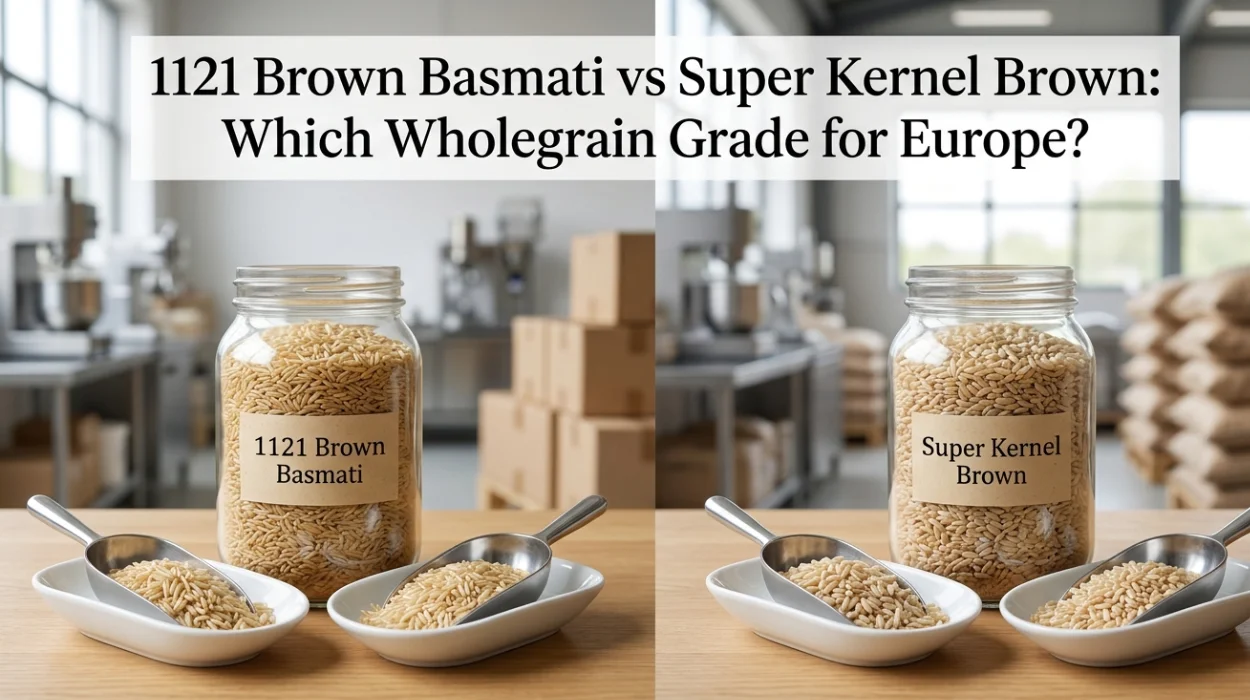
1121 Brown Basmati vs Super Kernel Brown: Which Wholegrain Grade for Europe?
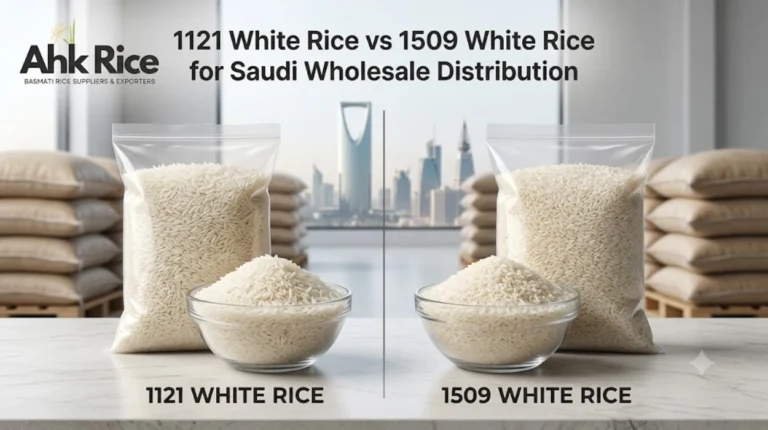
1121 brown basmati and Super Kernel brown show clear differences: 1121 gives longer, lighter grains suited to premium EU wholegrain markets, while Super Kernel gives slightly shorter, fuller grains that trade at lower prices but match certain industrial uses.
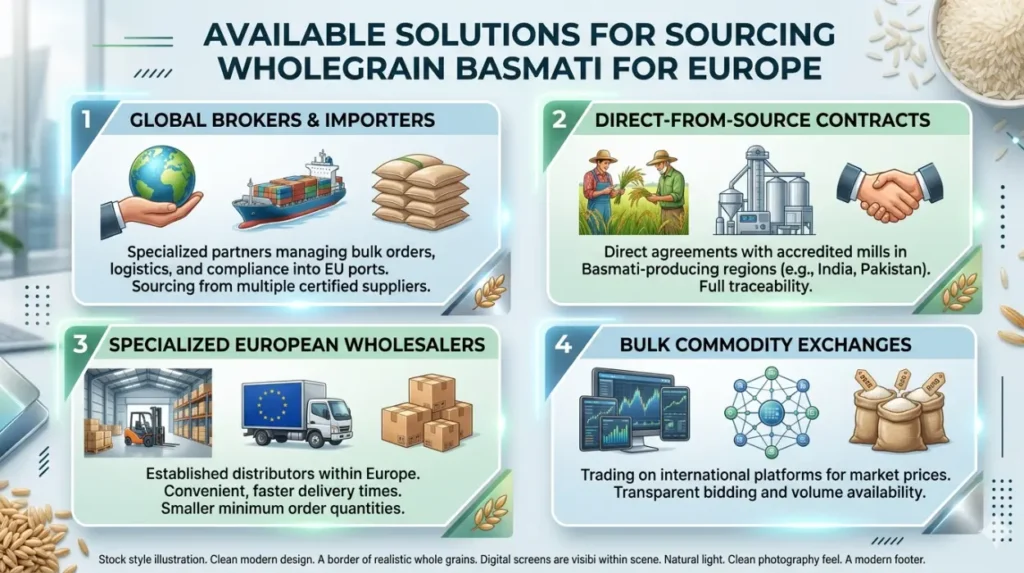
What are the available solutions for sourcing wholegrain basmati for Europe?
Buyers choose 2 main solutions: premium single-variety 1121 brown basmati or economy Super Kernel brown, each available as raw, parboiled (sella), steam, or aged lots for wholegrain supply chains.
Define 1121 brown basmati. It is a very long-grain basmati variety known for dramatic grain elongation and light texture after cooking. It is sold as raw, steam, golden sella, and aged lots.
Define Super Kernel brown. It is a Pakistani basmati class with long grains, high kernel length, and substantial milling yield, supplied in raw, sella, or steam formats.
Solution 1: Source 1121 brown basmati for premium retail and gourmet wholegrain SKUs. Examples: private-label 5 kg bags for UK supermarkets.Solution 2: Source Super Kernel brown for blended wholegrain mixes, foodservice, and industrial packing. Examples: bulk 25–50 kg sacks for contract caterers.
Processing options: raw (minimum processing), steam (gentle steam and drying), sella (parboiled, increased milling strength), and aged (moisture-reduced, flavour-developed). Each option changes water-absorption and shelf life.
How do the two approaches compare across key attributes?
1121 and Super Kernel compare across grain length, kernel weight, cooking elongation, milling yield, price per metric ton, shelf life, and preferred EU grade demand—this table forces precise specification for sourcing decisions.
| Attribute | 1121 brown basmati | Super Kernel brown |
|---|---|---|
| Grain length (uncooked mm) | Typically 7.5–8.5 mm (raw) [example: 7.8 mm lot] | Typically 6.8–7.8 mm (raw) [example: 7.1 mm lot] |
| Kernel weight (g/1000) | Higher, 22–24 g per 1000 kernels (longer grain) [example: export lot] | Moderate, 19–21 g per 1000 kernels [example: local mill lot] |
| Cooking elongation (%) | High elongation, 2.5–3.0× length after cooking [example: premium aged lot] | Moderate elongation, 2.0–2.4× length after cooking [example: commercial lot] |
| Milling yield (%) | 65–70% depending on processing and age [example: sella 68%] | 67–72% depending on processing and age [example: high-yield domestic milling] |
| Price per MT (FOB range, indicative) | USD 1,050–1,200 per MT for premium 1121 brown (raw/steam) [example: ex-mill quotes] | USD 960–1,020 per MT for Super Kernel brown (raw/steam) [example: FOB Karachi range] |
| Shelf life (uncooked storage) | 6–12 months under ambient; up to 18 months refrigerated/vacuum sealed [example: vacuum-packed 25 kg] | 6–9 months ambient; up to 12–18 months refrigerated/vacuum sealed [example: commercial packaging] |
| EU market preference | High in UK and premium Western European retail for wholegrain and private-label organic lines [example: 5 kg retail SKU] | Strong in mass-market, foodservice, and industrial blends in Central Europe [example: bulk institutional supply] |
Which method works best for different buyer cases?
Choose 1121 brown basmati for premium retail and private-label wholegrain products; choose Super Kernel brown for cost-sensitive, high-volume foodservice and blended wholegrain applications.
Case 1 — Premium retail wholegrain (UK, Germany). Buyers require long grains, pronounced elongation, and visual appeal. 1121 brown meets these needs. It supports higher shelf prices and premium positioning. Example: a 5 kg private-label bag for specialty retailers.
Case 2 — Foodservice and institutional supply. Buyers require stable cooking results and lower cost per kilogram. Super Kernel brown fits these needs. It gives consistent yields and lower FOB per MT. Example: catering contracts for schools and hospitals.
Case 3 — Blended wholegrain product lines. Buyers need predictable milling yield and supply continuity. Super Kernel brown blends with shorter or parboiled basmati to control cost while preserving wholegrain label claims. Example: blended ready-meal rice bases for frozen meals.
Case 4 — Private label premium (decision-focused). Buyers need traceability, processing choices, and tailored packaging. Use aged 1121 brown basmati cooking ratio in vacuum-sealed retail units to extend shelf life and enhance aroma. See product decision example in our private-label case study.
What are the pros and cons of each wholegrain grade?
1121 brown: pros include superior elongation and retail appeal; cons include higher price and slightly more sensitivity to storage oils in the bran; Super Kernel brown: pros include cost-efficiency and milling yield; cons include shorter elongation and lower premium retail draw.
1121 brown pros. It elongates 2.5–3.0× when cooked. It creates visually distinct plates. EU premium shoppers value long-grain appearance. Example: gourmet biryani served in fine dining.
1121 brown cons. Higher FOB price increases landed cost per MT. Its bran requires careful cold-chain or vacuum packaging to avoid rancidity after 6–12 months. Example: ambient 12-month storage in Southern Europe increases risk of off-odour.
Super Kernel pros. It has strong milling yields. It lowers cost per MT. It supplies stable bulk volumes for institutional buyers. Example: central kitchen contract requiring 200 MT annually.
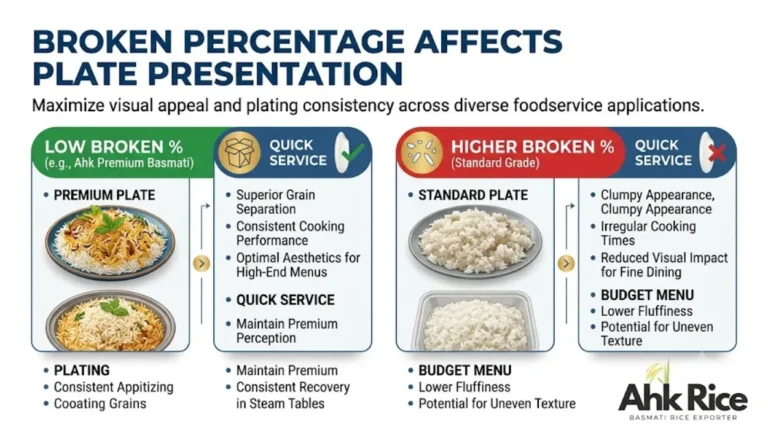
Super Kernel cons. It elongates less. It provides less visual luxury for premium retail. It requires careful grading to avoid mixed kernel lengths which affect appearance. Example: private-label premium SKU fails visual audit due to mixed lot.
What decision factors should buyers weigh?
Buyers must assess seven decision factors: target retail positioning, required grain appearance, cost per MT landed, storage plans, processing format, certification needs, and supply continuity; weight each factor numerically before contracting.

Decision-factor framework (5-row table)
Use numerical scoring to compare totals and sensitivity. Example: a retail buyer prioritizing premium would weight retail positioning at 10 and cost at 6, which tips the decision toward 1121.
How should buyers approach price, shelf life, and regional grade preference in Europe?
Compare price per MT, shelf life expectations, and regional grade demand; UK and Germany favor long-grain premium 1121 for retail, while Central and Eastern Europe favor cost-efficient Super Kernel for institutional channels.
Price per MT comparison. Indicative FOB ranges show a USD 80–200 difference per MT between Super Kernel and 1121 for comparable processing (raw or steam). Example: quoted ex-mill ranges show 1121 at roughly USD 1,050–1,200 per MT and Super Kernel at USD 960–1,020 per MT.
Shelf life comparison. Brown rice shelf stability is limited by bran oils. Ambient storage gives 6–12 months quality. Vacuum or refrigeration extends shelf life to 12–18 months. Example: retailers requiring 12-month shelf life must specify vacuum-sealed packaging and possible cold-chain storage.
Regional grade preferences. In the UK and Western Europe, consumer demand rewards pronounced elongation and aroma; 1121 outperforms for private-label wholegrain. In Central and Eastern Europe, cost and bulk availability dominate; Super Kernel is commonly used in institutional supply chains.
What strategies ensure the right purchase decision?
Apply a three-step procurement strategy: define end-use requirements; run a graded sensory and lab test on sample lots; contract with processing and packaging specifications that lock shelf life and certification terms.
Step 1 — Define end-use. Document whether the rice is for retail, foodservice, or industrial blending. Include required pack sizes, label claims, and target shelf life. Example: 5 kg retail with 12-month ambient shelf life.
Step 2 — Test sample lots. Order 500–1,000 kg samples of 1121 brown and Super Kernel brown in the intended processing type (raw, sella, steam). Perform sensory cooking tests and lab moisture/fatty-acid analysis. Example: cook 50 g samples for evaluation across 5 chefs.
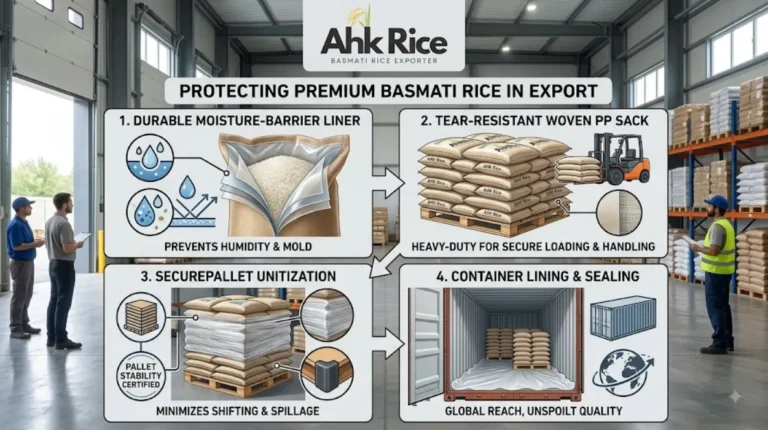
Step 3 — Contract with specifications. Specify grain length distribution, moisture limit, free fatty acid limit, allowed impurities, processing type, packaging (vacuum/oxygen absorber), and certification requirements (organic, non-GMO, pesticide residue reports). Include delivery schedule and penalties for off-spec shipments. Example: require max moisture 12% and FFA <0.5% for 12-month ambient shelf claims.Final evaluative guidance and next steps
For premium retail and gastronomy in Western Europe choose 1121 brown basmati; for high-volume contracts and blended wholegrain use Super Kernel brown—document your priorities and test lots before contracting.
Action checklist:
- Weight decision factors numerically and run the 5-row decision framework above.
- Request 500–1,000 kg samples in the requested processing type.
- Specify vacuum packaging or refrigerated storage if shelf life over 9 months is required.
- Confirm certifications and residue reports with your exporter prior to purchase.