How 1509 Basmati Rice Is Processed for Export
1509 Basmati rice is processed for export through a controlled sequence of harvesting, drying, milling, grading, sorting, polishing, testing, packaging, and shipment preparation. Here is why: every processing stage preserves grain length, aroma, appearance, and food safety standards required by international buyers.
1509 Basmati rice has become one of the most traded rice varieties from Pakistan. Exporters supply it to catering companies, wholesalers, supermarkets, food service distributors, and government procurement agencies across multiple continents. Its extra-long grain, strong cooking performance, and competitive pricing make it a preferred choice in international markets.
Pakistan cultivates 1509 Basmati mainly in Punjab. The variety delivers high yield, uniform grain structure, and excellent elongation after cooking. These characteristics support large-scale export programs and commercial food operations.
What Is 1509 Basmati Rice?
1509 Basmati rice is an extra-long grain aromatic rice variety with grain lengths of approximately 8.2–8.5 mm before cooking and significant elongation after cooking.
1509 Basmati rice is a hybrid Basmati variety developed to combine traditional aroma with improved agricultural productivity. Farmers cultivate it extensively because it matures earlier than several traditional Basmati varieties and produces higher yields per acre.
1509 Basmati rice belongs to the aromatic rice category. The grain develops a distinct fragrance because of naturally occurring aromatic compounds. Importers select this variety for commercial kitchens, retail packaging programs, and institutional food supply contracts.
Pakistan produces large export volumes of 1509 Basmati rice every year. International buyers value the variety because it offers consistent cooking quality at a competitive price point compared to premium aged Basmati categories.
Understanding the product itself creates the foundation for understanding how exporters prepare it for international shipment.
How Does 1509 Basmati Rice Processing Work?
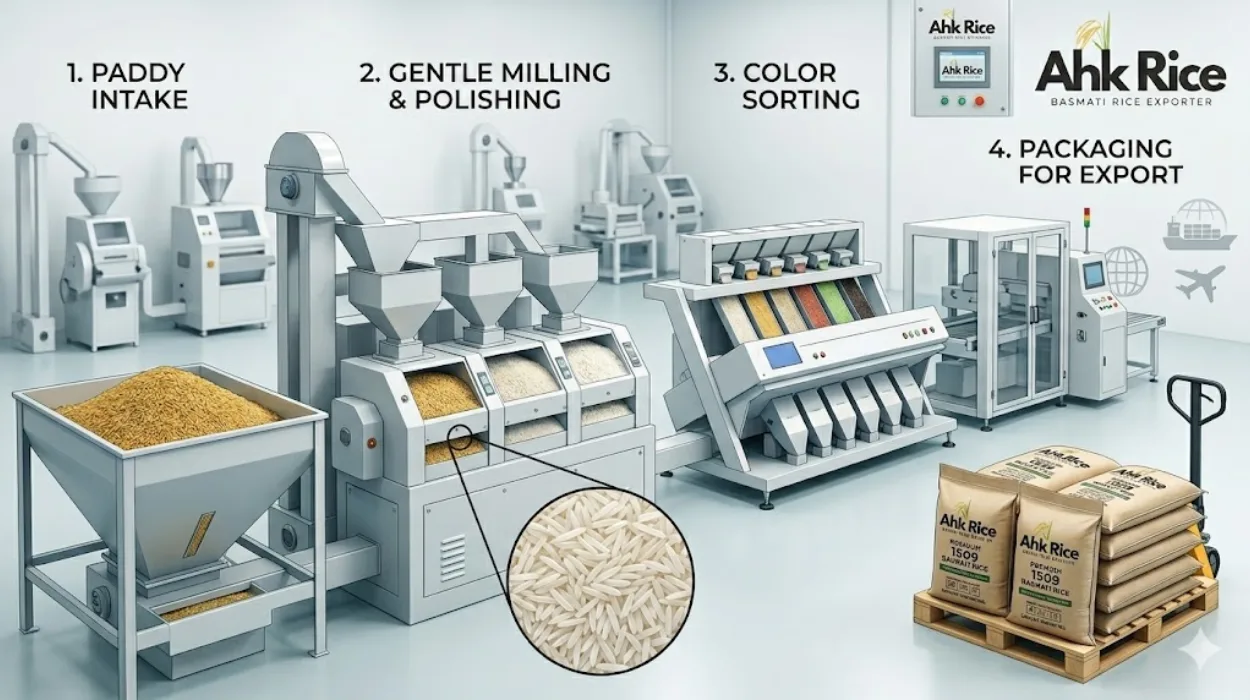
Export processing follows 9 main steps: harvesting, drying, cleaning, dehusking, milling, grading, sorting, quality testing, and packaging.
1509 Basmati processing begins immediately after harvest. Export quality depends on controlling moisture, minimizing broken grains, and maintaining grain integrity throughout the supply chain.
Harvesting and Drying
Harvest the mature paddy at the correct moisture level.
Dry the harvested paddy until moisture reaches export processing requirements. Controlled drying prevents cracking and preserves grain structure.
Cleaning and Pre-Processing
Remove stones.
Remove dust.
Remove straw particles.
Remove foreign materials.
Cleaning protects milling equipment and improves final product quality. Modern processing plants use vibrating screens, magnetic separators, and aspiration systems.
Dehusking and Milling
Dehusk the paddy.
Separate husk from rice kernels.
Mill the grain to remove bran layers according to the required specification.
Milling transforms raw paddy into edible rice. Processors adjust milling intensity based on customer requirements and destination market standards.
Grading and Sorting
Grade the rice by length.
Separate broken kernels.
Sort grains by size.
Sort grains by color.
Optical color sorters identify defective kernels and remove discolored grains. Length grading systems create uniform product specifications for export buyers.
Quality Testing and Packaging
Inspect moisture levels.
Test grain dimensions.
Verify purity percentages.
Certify food safety parameters.
Pack rice into approved packaging formats.
Quality control laboratories test every production batch before shipment. Exporters package rice in PP bags, BOPP bags, non-woven bags, paper bags, or retail consumer packs.
The processing sequence explains how the rice moves from farm production to export-ready inventory, which leads directly to the equipment and systems involved.
What Are the Key Components of Export Processing?
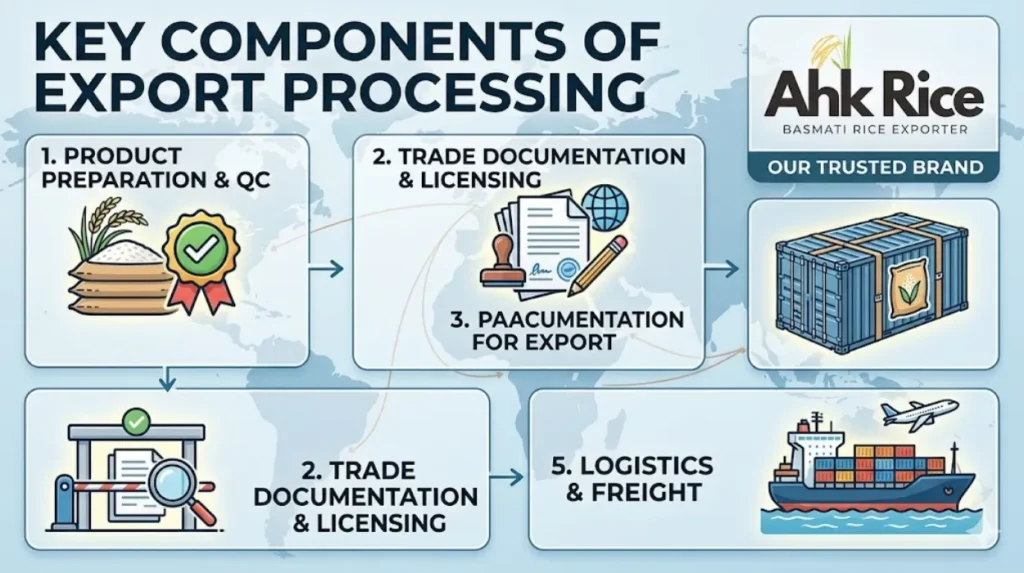
The key components are cleaning systems, milling machines, graders, color sorters, laboratories, packaging lines, and storage facilities.
Export processing requires specialized equipment designed to maintain consistency across thousands of metric tons.
Cleaning Systems
Cleaning systems remove impurities before milling. Efficient cleaning improves final appearance and reduces contamination risks.
Milling Equipment
Milling equipment removes husk and bran layers. Precision milling preserves grain length and reduces breakage percentages.
Length Graders
Length graders separate head rice from broken rice. Uniform grain size improves market acceptance and pricing.
Color Sorters
Color sorters use optical technology to detect visual defects. These systems remove immature grains, stained kernels, and foreign particles.
Quality Laboratories
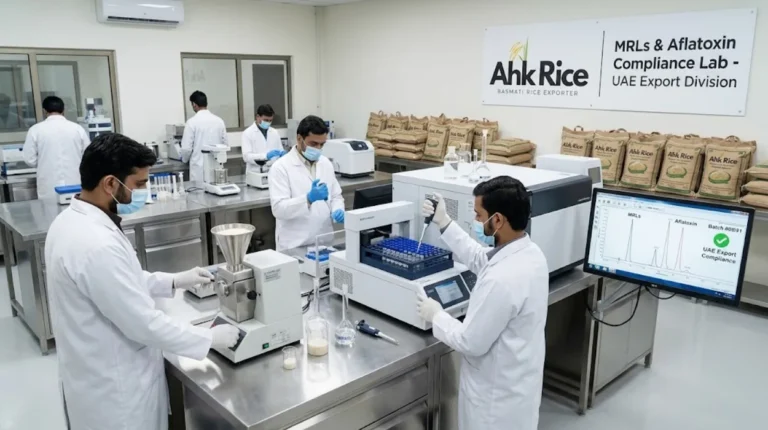
Quality laboratories verify moisture content, purity levels, grain dimensions, and cooking performance. Export shipments depend on documented testing procedures.
Packaging Lines
Packaging lines weigh, fill, seal, label, and palletize finished products. Consistent packaging protects rice during international transportation.
The equipment creates measurable quality outcomes, which explains why buyers choose processed export-grade rice.
What Benefits Does Proper Processing Provide?
Proper processing improves grain appearance, cooking performance, shelf life, food safety, and export compliance.
Processing directly influences customer satisfaction and international trade acceptance.
Improved Appearance
Uniform grain size creates a premium visual presentation. Retail buyers and food distributors evaluate appearance before purchase decisions.
Better Cooking Results
Controlled milling and grading produce consistent cooking behavior. Uniform grains absorb water evenly and elongate consistently.
Longer Storage Stability
Moisture control protects rice during warehousing and transportation. Stable moisture levels reduce spoilage risks.
Food Safety Compliance
Testing programs verify compliance with importing country regulations. Food safety verification supports customs clearance and commercial acceptance.
Export Market Access
Certified processing facilities meet importer requirements across multiple regions. Compliance documentation supports international trade transactions.
The benefits explain why processing standards matter, which raises the next question about where this rice is actually used.
Where Is Export-Grade 1509 Basmati Rice Used?
Export-grade 1509 Basmati rice serves retail markets, catering businesses, restaurants, wholesalers, food manufacturers, and government procurement programs.
Different markets require different specifications and packaging formats.
Retail Packaging
Retail brands package 1509 Basmati rice in 1 kg, 2 kg, 5 kg, and 10 kg formats. Consumers prefer long-grain aromatic rice for household cooking.
Catering Operations
Catering companies purchase rice in bulk packaging. Large kitchens prioritize consistency, cooking yield, and cost efficiency.
Restaurants
Restaurants use 1509 Basmati rice for biryani, pulao, rice platters, and regional rice dishes. Long grain elongation improves plate presentation.
Wholesale Distribution
Wholesale distributors supply supermarkets, food service companies, and local traders. Large-volume procurement programs focus on specification consistency.
Government Tenders
Government procurement agencies import rice for food security and institutional distribution programs in several countries.
Readers comparing bulk-use specifications can explore how different grades perform in commercial kitchens through our article about selecting the most suitable 1509 grade for large-scale food service operations [Insert Link to MOFU Article].
Understanding use cases helps explain which grades buyers purchase for different applications.
What Grades of 1509 Basmati Rice Are Available for Export?
The main export grades include Steam, Sella, Golden Sella, Brown, White, Head Rice, and Broken Rice grades.
Export markets purchase different grades depending on storage conditions, cooking requirements, and budget targets.
1509 Steam Basmati Rice
Steam rice undergoes controlled steaming before final processing. The grain maintains a natural white appearance and soft texture.
1509 Sella Basmati Rice
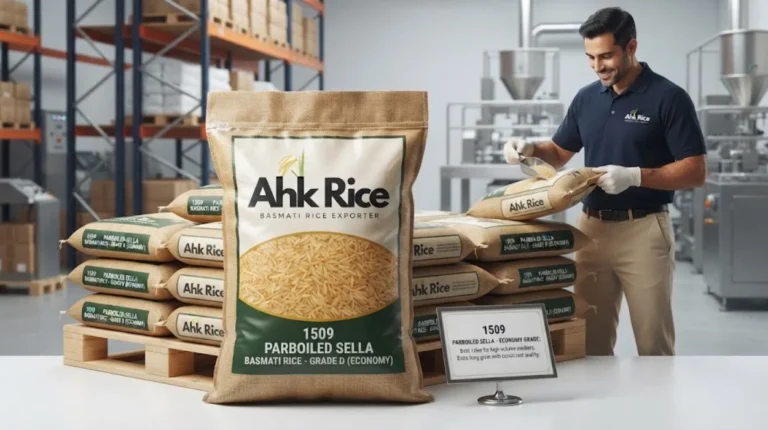
Sella rice undergoes parboiling treatment. The process strengthens grain structure and improves handling performance.
1509 Golden Sella Basmati Rice
Golden Sella rice receives intensive parboiling treatment. The grain develops a golden color and extended storage stability.
Golden Sella lasts longer than Steam rice. In a 40°C warehouse environment, Golden Sella maintains quality for approximately 18 months, while Steam rice performs best within approximately 12 months under equivalent storage conditions.
1509 Brown Basmati Rice
Brown rice retains the bran layer. Health-conscious consumers select this grade because it contains additional fiber.
1509 White Basmati Rice
White rice undergoes complete milling and polishing. Many retail markets prefer this appearance.
Head Rice and Broken Rice Grades
Head rice contains maximum whole kernels.
Broken rice contains fragmented kernels.
Different industries purchase each specification based on application requirements and budget considerations.
Grade selection depends on quality requirements, which makes certification equally important.
What Certifications Apply to 1509 Basmati Rice Exports?
Common certifications include ISO standards, HACCP, GMP, phytosanitary certification, fumigation certification, and laboratory test reports.
International trade requires documented verification procedures.
Food Safety Certifications
HACCP systems identify and control food safety risks. Importers frequently require HACCP compliance documentation.
Quality Management Certifications
ISO certification verifies standardized operational procedures and quality management systems.
Phytosanitary Certification
Government authorities issue phytosanitary certificates after inspection. The certificate confirms compliance with plant health regulations.
Fumigation Certification
Fumigation certificates verify approved pest-control treatment before export shipment.
Laboratory Reports
Laboratory reports document moisture content, purity, broken percentage, grain length, and other technical specifications.
Certification confirms product compliance and supports international market access, which addresses several misconceptions surrounding export rice processing.
What Common Misconceptions Exist About 1509 Basmati Rice Processing?
The most common misconceptions involve aroma loss, excessive polishing, uniform grading assumptions, and certification requirements.
Many buyers misunderstand how export processing affects rice quality.
Misconception 1: Processing Removes Aroma
Processing preserves aroma when moisture and temperature remain controlled. Proper handling protects aromatic compounds.
Misconception 2: All Export Rice Has the Same Grade
Export shipments contain multiple specifications. Steam, Sella, Golden Sella, Head Rice, and Broken Rice grades serve different market needs.
Misconception 3: Longer Grains Always Mean Higher Quality
Quality evaluation includes purity, moisture, cooking performance, and defect levels. Grain length represents only one specification.
Misconception 4: Packaging Determines Quality
Packaging protects quality. Processing standards determine quality before packaging begins.
Misconception 5: Certification Is Optional
Many importing countries require documented compliance. Certification supports customs clearance and buyer acceptance.
1509 Basmati rice processing combines agricultural production, industrial milling, quality verification, and export logistics into one controlled system. Every stage contributes to the consistency required by international food markets.
Frequently Asked Questions
How long is 1509 Basmati rice before cooking?
1509 Basmati rice typically measures 8.2–8.5 mm before cooking, depending on grade and crop conditions.
Which countries import 1509 Basmati rice?
Major importing regions include the Middle East, Africa, Europe, North America, and Asia (source: REAP export data, December 2025).
What is the difference between Steam and Golden Sella 1509 rice?
Steam rice retains a white appearance and softer texture. Golden Sella undergoes intensive parboiling and offers stronger grain structure and longer storage stability.
Why is color sorting important in rice processing?
Color sorting removes defective grains, foreign particles, and discolored kernels. The process improves appearance and export quality consistency.
What moisture level is preferred for export rice?
Most export programs target controlled moisture levels around industry-approved standards to maintain storage stability and grain quality.