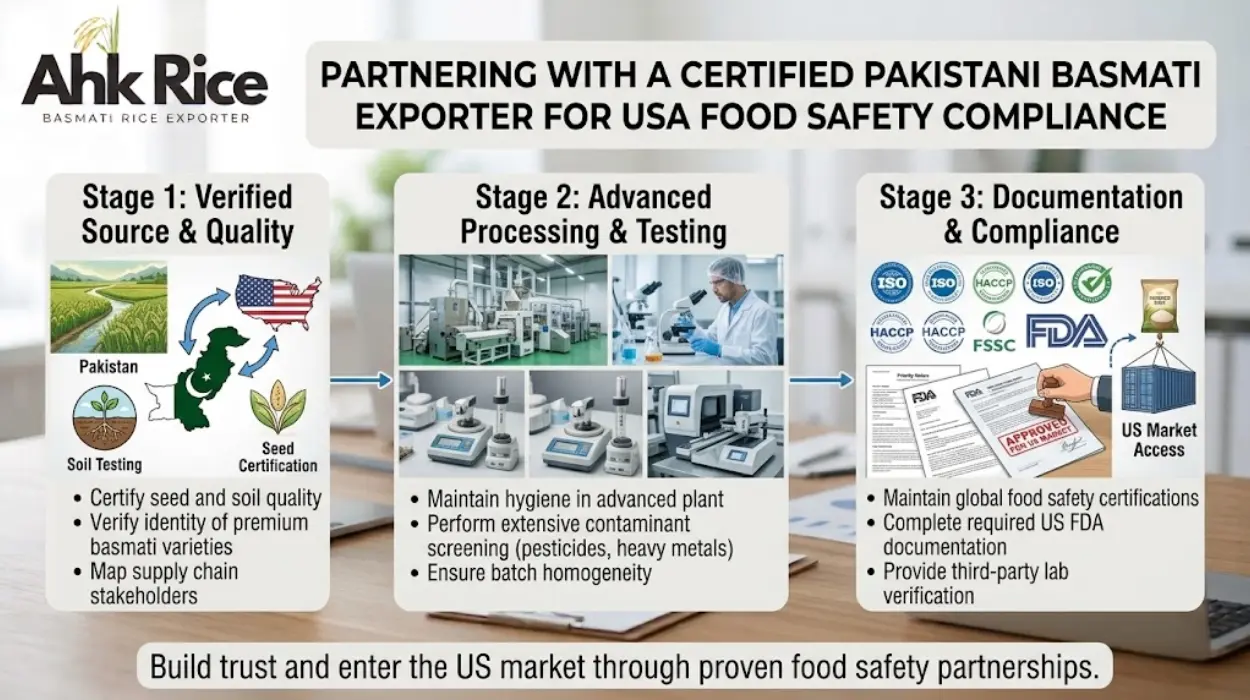
Partner with a Certified Pakistani Basmati Exporter for USA Food Safety Compliance
Importing Pakistani Basmati rice into the United States requires more than competitive pricing and premium grain quality. Buyers must evaluate supplier controls, applicable FDA requirements, product specifications, traceability, shipment documentation, and the evidence available to verify food safety.
Before selecting a supplier, review which food safety certifications a Basmati rice exporter should have. A documented compliance process helps USA importers assess supplier suitability, identify regulatory gaps, and reduce avoidable shipment delays.
For importers seeking a commercially practical sourcing partner, AHK Rice provides Pakistani Basmati rice export services, including product selection, processing coordination, packaging specifications, and export documentation support. Buyers should verify the specific certifications, facility scope, and compliance records relevant to their proposed order before signing a supply agreement.
What is the best solution for sourcing compliant Pakistani Basmati rice for the USA?
The best solution is to select an exporter that can demonstrate documented food safety controls, provide traceable product specifications, coordinate export paperwork, and support the US importer’s compliance responsibilities. Certification claims must be verified against the actual facility, product, and transaction.
USA buyers should assess three connected areas before placing an order. The first is the exporter’s food safety management system. The second is the rice’s quality and traceability documentation. The third is the importer’s ability to meet applicable US regulatory requirements.
ISO 22000 establishes requirements for a food safety management system. HACCP focuses on identifying and controlling food safety hazards. BRCGS and SQF are additional food safety standards that buyers may encounter when evaluating suppliers for particular retail or distribution programs.
These standards are not interchangeable, and none automatically guarantees US import clearance. Buyers must confirm the actual certification, issuing body, validity, scope, and facility covered by each certificate.
The US Food and Drug Administration regulates imported food under applicable federal requirements. Depending on the transaction, responsibilities can include food facility registration, prior notice, applicable Foreign Supplier Verification Program obligations, and compliance with relevant food safety and labeling rules.
A supplier can support these processes by preparing accurate product and shipment information. However, the US importer remains responsible for its own applicable regulatory obligations.
AHK Rice helps buyers establish a clear sourcing specification before production. This includes rice variety, grain length, broken percentage, moisture level, processing method, packaging, destination, and required documentation.
Why choose AHK Rice as your Pakistani Basmati exporter?
Choose AHK Rice when your purchasing requirements align with its available rice varieties, processing capabilities, export services, and documented shipment controls. Verify certifications and facility records directly before treating any standard or certificate as confirmed for your order.
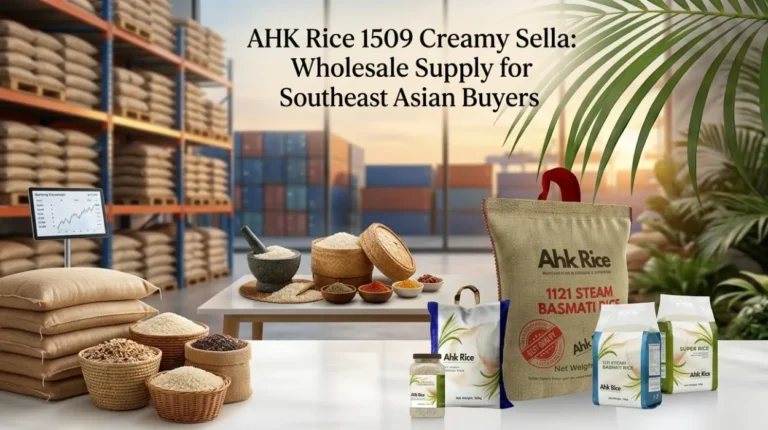
AHK Rice is a Pakistani Basmati rice exporter based in Punjab, supplying buyers with varieties such as 1121, Super Kernel, and 1509 Basmati rice. Its export service covers product sourcing, processing coordination, packaging arrangements, and export documentation.
Explore the AHK Rice export and supply service to assess the available sourcing options for your business.
The most suitable variety depends on the intended market position. 1121 Basmati suits buyers targeting premium long-grain presentation and aromatic rice. Super Kernel Basmati serves buyers seeking traditional Pakistani Basmati characteristics. 1509 Basmati offers an alternative for buyers evaluating grain performance, purchasing economics, and bulk supply requirements.
These varieties should not be purchased on name alone. Buyers should approve the actual commercial specification and, where necessary, test the sample before confirming a bulk order.
A professional sourcing process should also define acceptable moisture, broken percentage, foreign matter, packaging material, net weight, labeling, and inspection arrangements. Written specifications reduce disagreements between the buyer and supplier because both parties work against the same acceptance criteria.
USA importers comparing certification systems can also review ISO 22000, HACCP, BRCGS and SQF for USA rice buyers. This comparison helps procurement teams understand which standards their customers require and which evidence they should request from a prospective supplier.
AHK Rice should be evaluated against the buyer’s documented requirements rather than general claims about certification. Request copies of relevant certificates, confirm their validity with the issuing organization, and check whether their scope covers the facility performing the required processing.
What food safety documents should USA buyers request before ordering?
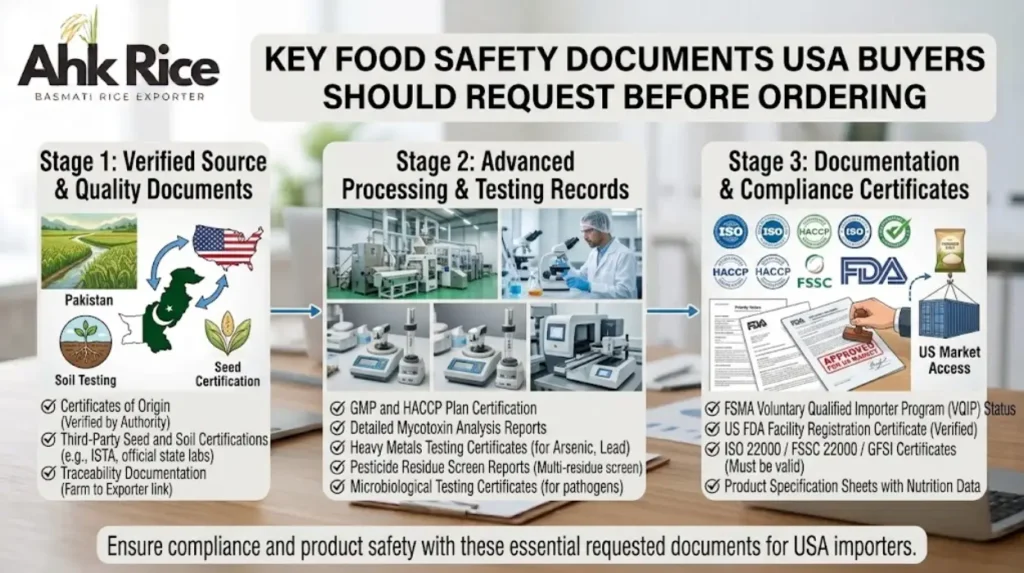
Request the applicable supplier certificates, product specification, traceability records, available test reports, and shipment documents before approving the order. The exact package depends on the product, facility, transaction, and current US import requirements.
A practical supplier review should include the following evidence:
| Document or record | What the buyer should verify |
|---|---|
| Food safety certificate | Issuer, validity, facility, scope, and standard |
| Product specification | Variety, grain length, moisture, broken percentage, and tolerances |
| Laboratory test reports | Parameters tested, methods, results, and sample identification |
| Traceability records | Product lot, processing details, and source identification |
| Packing list and commercial invoice | Quantities, packaging, product description, and declared values |
| Certificate of Origin | Origin details and issuing authority, where applicable |
| Phytosanitary documentation | Whether required for the specific product and import conditions |
| Transport documents | Shipment details and consistency with commercial records |
Additional evidence may be required for pesticide residues, contaminants, or other hazards identified through the buyer’s risk assessment. A laboratory report is meaningful only when the tested sample, analytical method, reporting limits, and results meet the applicable specification.
FDA prior notice and food facility registration requirements must be assessed separately. An exporter should not promise that its paperwork alone guarantees entry into the United States.
For relevant transactions, the importer should also establish who is responsible for maintaining FSVP records and conducting the required foreign supplier verification. The specific requirements depend on the importer’s circumstances and applicable exemptions.
What results can buyers expect from a documented sourcing process?
A documented sourcing process improves specification control, purchasing transparency, and shipment preparation. Buyers can identify missing records earlier, compare suppliers on consistent criteria, and reduce avoidable disputes over product quality or packaging.
Consider a US distributor ordering 1121 Steam Basmati rice for retail packaging. Before production, the distributor approves the variety, grain specifications, moisture limits, broken percentage, bag weight, label artwork, and inspection criteria.
The exporter then confirms the agreed specifications and production arrangements. The buyer reviews the available quality and food safety records before approving the shipment documentation.
This process creates defined checkpoints instead of relying on verbal assurances. If the sample does not meet the agreed cooking or grain-quality requirements, the buyer can request clarification before committing to the full order.
The same principle applies to restaurant and foodservice buyers. A buyer purchasing 1509 Basmati rice may prioritize cooking performance, batch consistency, packaging durability, and delivered cost. A premium retailer may place greater emphasis on grain appearance, aroma, branding, and traceability.
AHK Rice buyers should agree on measurable acceptance criteria before production begins. Certification documents support supplier assessment, while batch-specific specifications and test results address the particular shipment.
No exporter can guarantee that every shipment will clear customs without inspection or delay. Actual results depend on the shipment, documentation, applicable regulations, carrier schedules, and decisions by relevant authorities.
How much does Pakistani Basmati rice export to the USA cost?
The final cost depends on rice variety, grade, order quantity, processing, packaging, inspection, freight, insurance, and the agreed Incoterm. Buyers should request a shipment-specific quotation instead of relying on an indicative market price.
A useful quotation separates the product price from other costs. This makes it easier to compare suppliers and calculate the expected landed cost per kilogram.
| Cost factor | Impact on the quotation |
|---|---|
| Rice variety | 1121, Super Kernel, and 1509 have different market positioning |
| Grade and specifications | Grain length, broken percentage, and quality tolerances affect selection |
| Processing | Raw, Steam, Golden Sella, or other agreed processing requirements |
| Packaging | Bulk bags, retail packs, printing, and private-label artwork |
| Order quantity | Volume influences production planning and freight economics |
| Inspection and testing | Depends on buyer requirements and the agreed inspection scope |
| Freight and insurance | Varies by destination, carrier, season, and shipment size |
| Incoterm | Determines which costs and responsibilities belong to each party |
A quote on FOB terms generally excludes the buyer’s main ocean freight and destination costs. A CIF quotation includes the agreed cost, insurance, and freight to the named destination port, subject to the precise contract terms. Neither automatically includes every destination charge, import duty, tax, or customs brokerage expense.
For a realistic landed-cost calculation, US buyers should also account for applicable customs charges, port handling, inland transport, customs brokerage, and any required inspections or testing.
AHK Rice should receive the destination port, required variety, target grade, packaging format, estimated quantity, and preferred Incoterm to prepare a commercially relevant quotation. Prices and shipping costs should be confirmed when the order is negotiated.
How long does shipping Pakistani Basmati rice to the USA take?
Ocean freight from Pakistan to the United States commonly requires several weeks, with actual transit depending on the destination port, carrier routing, transshipment, and schedule. Production, documentation, and customs clearance add time beyond the vessel journey.
For initial planning, buyers can use the following broad estimates. These are indicative planning ranges, not confirmed carrier schedules or delivery guarantees.
| Destination market | Indicative ocean transit planning range |
|---|---|
| US East Coast ports | Approximately 25–40 days |
| US Gulf Coast ports | Approximately 25–40 days |
| US West Coast ports | Approximately 30–45 days |
Actual transit can fall outside these ranges. Routing changes, vessel availability, port congestion, transshipment, and seasonal disruptions affect delivery.
Allow additional time for sample approval, production, packaging, inspections, export documentation, and destination clearance. A first order may take several additional weeks before the cargo is ready to ship, depending on stock availability and the order’s requirements.
Before confirming a delivery commitment, ask AHK Rice for the planned shipment date, expected port routing, current carrier schedule, and estimated document-readiness date. The buyer should also confirm who will manage customs entry and coordinate any examination or testing at destination.
How does the rice sample process work, and what does it cost?
The sample process should verify product suitability before a bulk commitment. Buyers define the required variety and specification, review sample charges and courier arrangements, evaluate the rice, and approve the final commercial specification before production.
A practical sample-to-order workflow has five steps.
Step 1: Define the sample. Specify whether you need 1121, Super Kernel, or 1509 Basmati rice. Identify the processing style, target grain characteristics, intended use, and any critical quality requirements.
Step 2: Confirm sample availability and charges. Ask AHK Rice to confirm the available sample quantity, product charge, packaging, dispatch schedule, and payment arrangements. Do not assume the sample itself is free unless the supplier confirms that in writing.
Step 3: Calculate delivery and compliance costs. Courier charges depend on the sample’s weight, dimensions, destination ZIP code, courier service, and delivery speed. Any applicable phytosanitary documentation, permits, customs processing, or other regulatory charges must be confirmed for the particular sample shipment.
Step 4: Test the sample. Evaluate grain appearance, aroma, cooking performance, elongation, texture, and consistency against your purchasing requirements. Where food safety verification is needed, agree on the relevant laboratory tests and who pays for them.
Step 5: Approve the bulk order. Confirm the final specification, quantity, packaging, tolerances, inspection arrangements, shipment terms, and payment conditions in writing.
There is no reliable universal courier or compliance fee for a USA sample without its weight, delivery address, service level, and applicable import conditions. Request an itemized estimate before dispatch. Small commercial samples may also be subject to US import requirements, so confirm admissibility and documentation before shipment.
A sample approval should identify the agreed product and quality criteria. This provides a clear reference for evaluating the commercial shipment and reduces the risk of ordering rice that does not match the buyer’s needs.
How can USA importers get started with AHK Rice?
Start by submitting a defined purchasing specification and destination. Review the supplier’s relevant compliance evidence, confirm sample and testing arrangements, approve the commercial terms, and establish shipment responsibilities before authorizing production.
USA buyers can prepare for an efficient quotation by supplying six details:
- Required variety: 1121, Super Kernel, or 1509 Basmati.
- Processing preference: raw, Steam, Golden Sella, or another agreed grade.
- Order quantity and preferred packaging.
- Destination port and final delivery location.
- Required certifications, laboratory tests, and documentation.
- Preferred Incoterm, target shipment window, and sample requirements.
AHK Rice can then assess the requested specification against available supply and processing arrangements. Buyers should obtain written confirmation of the product grade, final price, production schedule, inspection terms, and documents to be supplied.
Before placing the first order, verify the applicable food safety certificates and agree on responsibility for US import compliance. Confirm the commercial invoice, packing list, origin information, transport documents, and other required records before shipment.
For a supply relationship built around clear specifications and documented responsibilities, submit your requirements through the AHK Rice request-a-quote page.
Frequently Asked Questions
Does a Pakistani Basmati exporter need ISO 22000 certification to export to the USA?
ISO 22000 is a food safety management standard, but it is not a universal requirement for every rice shipment entering the USA. Buyers should verify customer requirements, applicable regulations, and the supplier’s actual certification scope.
Is HACCP certification enough for US rice import compliance?
No. HACCP-related controls do not replace all applicable FDA requirements. Importers must assess food facility registration, prior notice, FSVP obligations, and other requirements relevant to their specific transaction.
How long does Pakistani Basmati rice take to reach the USA?
Ocean transit commonly takes several weeks, depending on the destination port and routing. Production, documentation, port handling, and customs clearance add time, so buyers should obtain a shipment-specific schedule.
Can USA buyers request rice samples from AHK Rice?
Buyers can contact AHK Rice to confirm sample availability and arrangements. The supplier should confirm the sample quantity, product charge, courier cost, dispatch timeline, and applicable import documentation before dispatch.
What determines the final price of Pakistani Basmati rice in the USA?
The final cost depends on variety, grade, processing, packaging, order quantity, freight, insurance, and the Incoterm. Buyers should also account for applicable customs charges, port fees, testing, and inland delivery.