What Is Grain Elongation in Basmati Rice?
Grain elongation in Basmati rice is the increase in grain length during cooking as rice absorbs water and heat. The process is especially noticeable in 1121 Basmati, a Pakistani long-grain variety known for exceptional cooked length, slender grains, and separated texture.
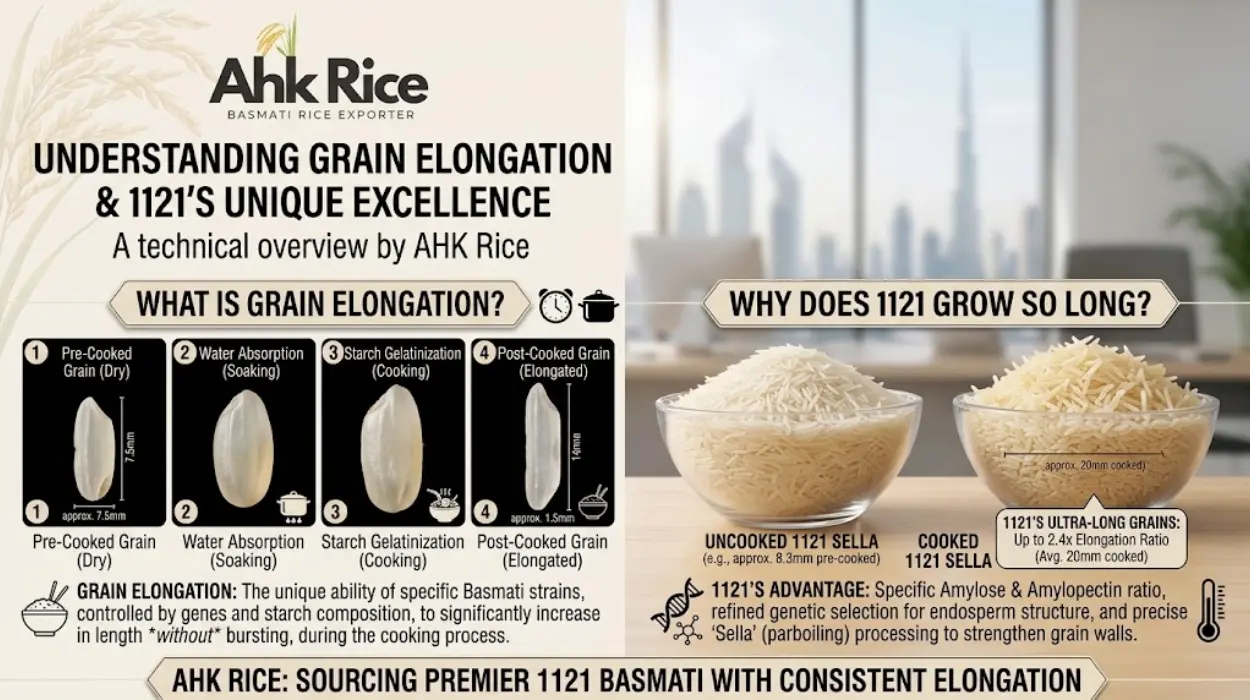
Raw rice contains starch, proteins, moisture, and other natural grain components. During cooking, water enters the grain and heat changes its internal structure. The starch granules absorb water, swell, and gelatinise, allowing the grain to expand.
Grain elongation describes the increase in length between the uncooked and cooked states. It differs from general swelling, which includes increases in width and volume. Basmati rice is valued for lengthwise expansion because long, slender cooked grains create an attractive appearance in dishes such as biryani, pulao, and other rice-based meals.
1121 Basmati is particularly recognised for this characteristic. Its raw grains are exceptionally long and slender, and properly cooked grains extend further without losing their individual shape. The final result depends on the rice’s variety, maturity, processing, storage, water ratio, soaking time, and cooking method.
Why Does 1121 Basmati Rice Grow So Long?
1121 Basmati produces long cooked grains because its genetic characteristics support exceptional raw grain length and substantial lengthwise expansion. Grain structure, starch behaviour, moisture absorption, and controlled cooking work together to preserve its slender appearance and produce elongated, separate grains.
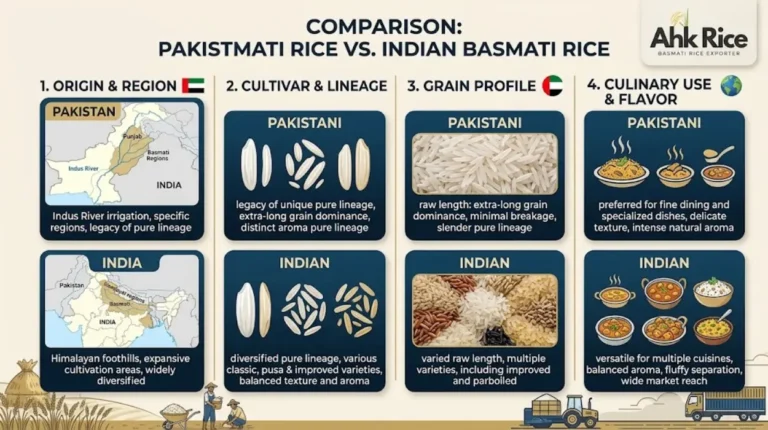
1121 Basmati is a long-grain aromatic rice variety cultivated in Pakistan’s Punjab region. Its breeding characteristics distinguish it from shorter-grain varieties and many other commercial rice types. The raw grain already has considerable length before it enters the cooking process.
Its cooking performance depends on more than its starting dimensions. Water penetrates the grain, heat softens its internal structure, and starch gelatinisation allows expansion. When these processes occur evenly, the grain grows lengthwise while retaining its structure.
The final cooked length varies according to the product specification and cooking conditions. Aged rice, for example, generally absorbs water differently from freshly harvested rice. Excessive water, uneven heating, or prolonged cooking also affects grain integrity.
1121’s appeal comes from the combination of long raw grains, aromatic character, and pronounced cooked elongation. These properties make it suitable for premium biryani, restaurant meals, catering, and retail products where the appearance of individual grains matters.
How Is Grain Elongation Measured?
Grain elongation is measured by comparing the average length of cooked rice grains with their average length before cooking. The resulting elongation ratio indicates lengthwise expansion, while separate measurements assess grain width, swelling, and structural integrity.
The basic formula is:
\[ \text{Elongation Ratio}=\frac{\text{Average Cooked Grain Length}}{\text{Average Raw Grain Length}} \]
For example, if the average raw grain measures 8.2 mm and the cooked grain measures 16.4 mm, the elongation ratio is 2.0. This means the grain doubles in length.
A consistent test requires a representative sample, controlled cooking conditions, and measurements taken at comparable points. Testing 10 or more grains provides a practical starting point for a small evaluation, although commercial laboratories and buyers follow their own sampling procedures.
Three measurements help explain cooking performance:
- Raw grain length: The average length of uncooked grains, measured in millimetres.
- Cooked grain length: The average length after cooking under defined conditions.
- Elongation ratio: Cooked length divided by raw length.
An elongation ratio does not describe every aspect of rice quality. Two samples with identical ratios can differ in aroma, firmness, stickiness, and the percentage of broken grains. Importers evaluate these properties separately when assessing commercial suitability.
Which Components Control Grain Elongation?
Grain elongation depends on genetic characteristics, starch composition, grain structure, moisture absorption, and processing history. These factors influence how rice absorbs water, softens under heat, expands lengthwise, and maintains its shape during cooking and serving.
1. Variety and grain structure
Genetics establish the grain’s dimensions and influence its cooking behaviour. 1121 Basmati is recognised for exceptional length, while Super Kernel offers traditional Basmati aroma and slender grains. The 1509 variety is another long-grain option used in commercial and foodservice markets.
2. Starch composition
Rice starch consists mainly of amylose and amylopectin. Amylose content influences cooked firmness and surface stickiness, while amylopectin contributes to swelling and texture. The relationship between these starch components affects how a grain behaves after absorbing water.
3. Moisture and water absorption
Rice requires sufficient water to cook evenly. Water enters the grain and supports starch gelatinisation. Insufficient water leaves hard centres, while excessive water promotes softness and surface starch release.
4. Milling and grain integrity
Milling removes the husk and bran layers from white rice. Excessive mechanical stress creates cracks and broken grains. Damaged grains often cook less uniformly than intact grains, reducing the visual consistency of a finished dish.
5. Ageing and storage
Properly stored aged Basmati generally exhibits different water absorption and cooking behaviour from freshly harvested rice. Storage conditions also influence moisture stability. Poor storage exposes rice to moisture changes, pests, odours, and quality deterioration.
How Does Grain Elongation Work During Cooking?
Grain elongation develops through water absorption, heat transfer, starch gelatinisation, and structural expansion. Controlled cooking allows these processes to occur throughout the grain, producing greater length while preserving firmness, separation, and the characteristic appearance of Basmati rice.
The process follows five stages.
1. Preparation: Rice is cleaned and measured. Washing removes loose surface starch, dust, and foreign material. Soaking, when required, allows water to enter the grain before heating.
2. Water absorption: Water moves into the grain through its outer layers and internal structure. The absorption rate depends on grain condition, temperature, soaking time, and moisture content.
3. Heating: Heat moves from the cooking water into the grain. As its temperature rises, the starch absorbs water and begins to gelatinise.
4. Expansion: The softened starch structure allows the grain to expand. In varieties such as 1121, lengthwise expansion creates the characteristic long cooked appearance.
5. Resting: After cooking, a short resting period allows moisture and heat to redistribute. Gentle separation with a fork or rice paddle helps preserve whole grains.
Each stage influences the final result. Over-soaking, excessive stirring, vigorous boiling, or prolonged cooking increases the risk of grain breakage. A consistent method makes elongation tests more useful because it reduces differences caused by preparation rather than variety.
What Are the Benefits of High Grain Elongation?
High grain elongation improves the visual presentation of Basmati dishes by producing longer cooked grains. When accompanied by good aroma, suitable firmness, and low stickiness, it supports premium foodservice presentation, retail appeal, catering consistency, and buyer satisfaction.
Long grains are particularly useful in biryani, where the rice should remain visible as separate pieces among meat, vegetables, spices, and garnishes. Elongated grains also create an attractive appearance in pulao and banquet dishes.
For restaurants and caterers, cooking consistency matters alongside length. A batch that produces long grains but also breaks easily creates more handling problems and an uneven appearance. Buyers therefore evaluate the percentage of intact grains after cooking.
For retailers, grain elongation helps distinguish premium Basmati products from rice varieties with less pronounced expansion. Product labels and marketing claims still need to match the actual variety and verified specifications.
High elongation alone does not establish superior quality. Aroma, taste, purity, food safety, texture, and consistency remain important measures of consumer acceptance.
Which Basmati Rice Grades Are Known for Grain Elongation?
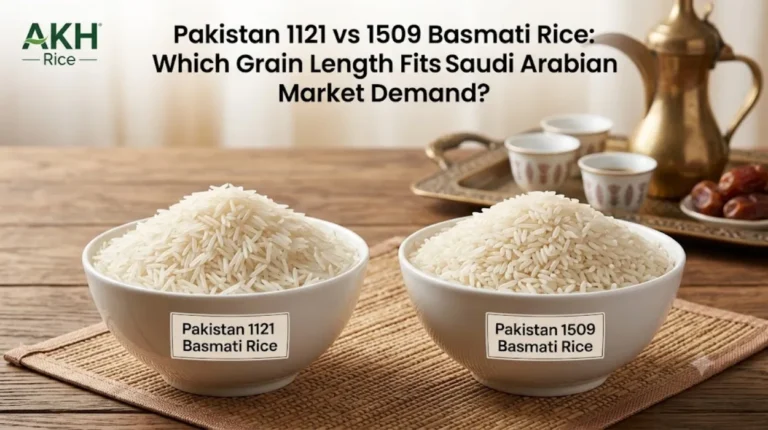
1121 Basmati is widely recognised for exceptional cooked grain length, while Super Kernel combines traditional aroma with slender grains. The 1509 variety offers long-grain performance and commercial efficiency for retail, wholesale, and foodservice applications.
Different Basmati varieties serve different buyer requirements. Their cooking results depend on the particular grade, processing method, storage conditions, and preparation technique.
| Variety | Main characteristics | Common applications |
|---|---|---|
| 1121 Basmati | Exceptional raw length and pronounced cooked elongation | Premium biryani, catering, export retail |
| Super Kernel Basmati | Traditional aroma, slender grains, characteristic Basmati texture | Ethnic retail, restaurants, wholesale |
| 1509 Basmati | Long grains, shorter crop maturity, commercial versatility | Bulk distribution, foodservice, value-focused retail |
Each variety is available in different processing grades. White rice retains its natural white appearance after milling. Steam rice undergoes steaming during processing, while parboiled rice receives hydrothermal treatment before milling.
1121 is also sold as Steam, Golden Sella, Creamy Sella, and Brown rice, depending on the processor’s product range. Super Kernel and 1509 are similarly offered in selected processing and packaging formats.
These product types differ in appearance, texture, processing requirements, and cooking behaviour. Buyers should assess the exact grade rather than assume that every product within a variety delivers identical elongation.
Which Markets Import Long-Grain Pakistani Basmati Rice?
Pakistani Basmati rice reaches international markets through retail distributors, wholesalers, foodservice suppliers, and importers. Major destinations include the Gulf states, the United Kingdom, North America, and selected African and Asian markets, with specifications determined by each buyer’s requirements.
In the United Arab Emirates and Saudi Arabia, long-grain Basmati serves households, restaurants, catering companies, and wholesale distributors. Premium 1121 grades suit buyers seeking elongated grains for biryani and large catering operations.
In the United Kingdom and North America, importers supply ethnic supermarkets, specialist grocery stores, private-label brands, and foodservice businesses. These buyers evaluate grain dimensions, aroma, cooking consistency, labelling, and applicable food-safety requirements.
African markets include destinations where price, packaging size, grain appearance, and suitability for local dishes influence purchasing decisions. Demand differs between countries, so importers establish specifications according to their customers and distribution channels.
Asian markets also contain specialised opportunities for aromatic rice. Import requirements, tariffs, permitted pesticide residues, documentation, and labelling rules vary by destination.
For an exporter, identifying the target market is the first step in selecting a suitable variety. The next steps involve defining the grade, verifying specifications, preparing samples, and confirming the applicable import requirements.
Which Certifications and Quality Checks Apply to Basmati Rice Exports?
Basmati export quality combines product specifications, food-safety controls, traceability, and destination-specific documentation. Applicable certifications depend on the importing country, buyer contract, processing facility, and shipment requirements rather than grain elongation alone.
Importers assess several aspects of product compliance:
- Food safety: Hazard analysis and critical control point systems, commonly called HACCP, help identify and control food-safety hazards. ISO 22000 provides a framework for food-safety management systems.
- Residue compliance: Pesticide residue testing checks whether results meet applicable destination-market limits.
- Product purity: Inspection checks foreign matter, damaged grains, varietal consistency, and other agreed quality parameters.
- Moisture and broken percentage: Laboratory or inspection reports verify whether the rice meets the contracted specification.
- Traceability: Batch records connect the finished product with its source, processing history, and shipment documents.
Depending on the destination and transaction, shipments also require commercial invoices, packing lists, certificates of origin, phytosanitary documentation, and other customs or regulatory documents. The exact requirements must be confirmed before shipment.
A certificate does not automatically guarantee compliance with every importing market. Buyers should verify the issuing authority, document validity, testing scope, and applicable legal requirements.
What Common Problems Affect Grain Elongation?
Poor cooking results often come from inconsistent water ratios, excessive heat, unsuitable soaking, damaged grains, or incorrect expectations about variety performance. Controlled preparation and representative testing help distinguish genuine elongation characteristics from cooking errors.
One common misconception is that the longest raw grain always produces the longest cooked grain. Raw dimensions provide useful information, but the elongation ratio measures how much the grain length changes during cooking.
Another problem is confusing elongation with volume expansion. Rice can increase in width and volume without achieving the same lengthwise growth. Buyers should measure these properties separately.
Excessive cooking also damages grain integrity. When the surface becomes too soft, grains break or stick together, making the sample appear less uniform. Insufficient cooking produces hard centres and understates the variety’s potential.
Inconsistent testing creates misleading comparisons. Different soaking periods, water ratios, cooking times, and resting periods produce different results even when the same rice batch is used.
Commercial evaluations therefore need a standardised cooking procedure, clearly defined measurements, and repeatable conditions.
How Can Importers Evaluate Grain Elongation Before Ordering?

Importers should test representative samples using a consistent cooking procedure, measure raw and cooked grain lengths, and assess aroma, fluffiness, non-stickiness, and grain integrity. Comparing these results with the purchase specification supports an evidence-based grade selection.
A practical evaluation follows six steps:
- Request a representative sample with a clearly identified variety and processing grade.
- Record the average raw grain length and inspect the sample for broken grains.
- Apply a documented washing, soaking, and cooking procedure.
- Measure cooked grain length and calculate the elongation ratio.
- Assess aroma, firmness, fluffiness, surface stickiness, and the percentage of intact grains.
- Compare the findings with the agreed product specification and retain the approved sample as a reference.
For UAE buyers, the evaluation should reflect the intended use. Restaurant kitchens prioritise repeatable cooking results and presentation, while retailers also consider pack consistency and consumer expectations.
The next stage is to compare the cooking results across commercial grades. A detailed guide to [the cooking tests UAE importers use to assess elongation ratio, aroma, fluffiness, and non-stickiness] can help buyers structure this evaluation.
The final decision should balance cooked appearance, sensory quality, food-safety compliance, price, and consistency between shipments.
Frequently Asked Questions About Grain Elongation in Basmati Rice
Why does 1121 Basmati elongate more than many other rice varieties?
1121 Basmati has genetic characteristics associated with exceptionally long grains and pronounced lengthwise expansion during cooking. Its final elongation depends on grain quality, processing, storage, and cooking conditions.
What is the grain elongation ratio?
The elongation ratio is the average cooked grain length divided by the average raw grain length. A ratio of 2.0 means the grain doubles in length during cooking.
Does a higher elongation ratio always mean better rice?
No. Elongation is one quality indicator. Aroma, taste, firmness, non-stickiness, grain integrity, purity, and cooking consistency also determine suitability for retail and foodservice.
Which Pakistani Basmati variety is best for biryani?
1121 Basmati is a popular choice for premium biryani because of its long cooked grains. Super Kernel and 1509 also suit biryani, depending on the desired aroma, texture, budget, and preparation method.
Does soaking improve Basmati rice elongation?
Soaking allows water to enter the grain before cooking and can improve cooking uniformity. The ideal duration depends on the variety, processing grade, rice age, and cooking method.
What should UAE rice importers test before approving a shipment?
Importers should assess raw and cooked grain length, elongation ratio, aroma, fluffiness, non-stickiness, moisture, broken percentage, and applicable food-safety documentation. The tests should follow an agreed specification and consistent cooking procedure.