Which Countries Import the Most Pakistani Basmati Rice?
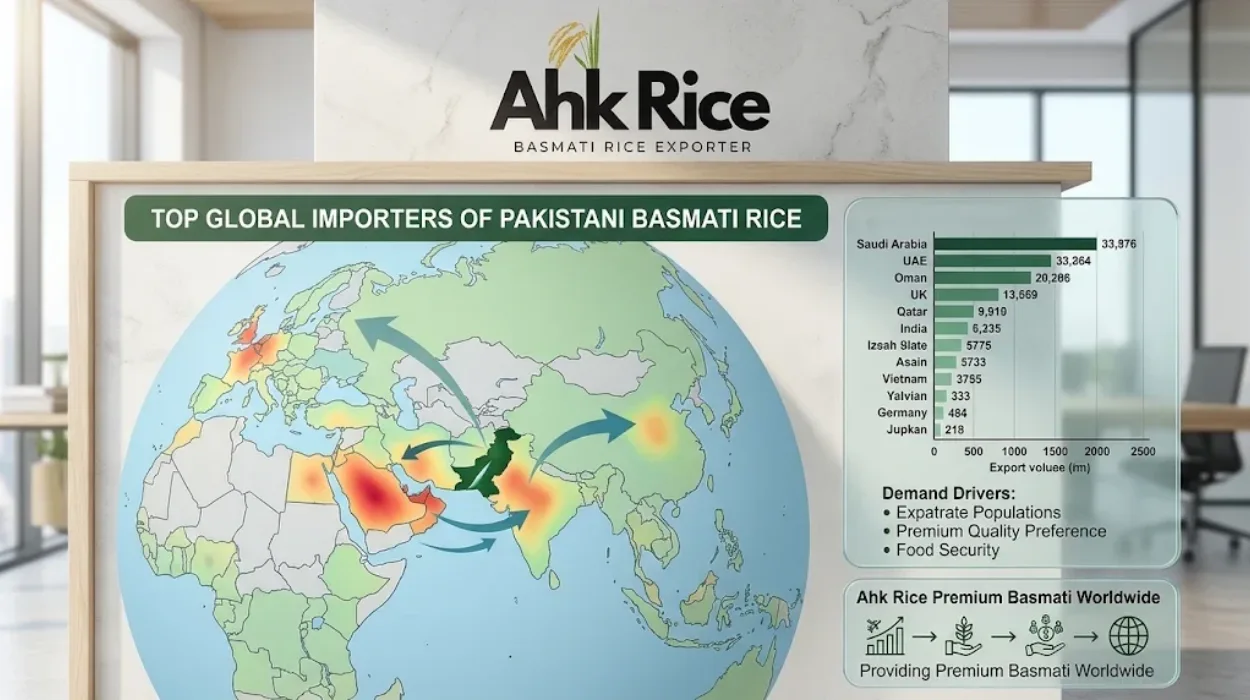
Pakistan is one of the world’s major Basmati rice exporters, with Punjab as the main production region. The largest Pakistani Basmati markets include the United Arab Emirates, Saudi Arabia, United Kingdom, Oman, Qatar, Kuwait, Bahrain, Malaysia, and other countries across the Middle East, Europe, Asia, and North America.
Pakistani Basmati rice is a long-grain aromatic rice known for its fragrance, slender appearance, and cooked elongation. Pakistan supplies several commercial types, including 1121, Super Kernel, and 1509. Each type serves different requirements in retail, foodservice, catering, and private-label distribution.
What is Pakistani Basmati rice and where is it grown?
Pakistani Basmati rice is an aromatic long-grain rice grown mainly in Punjab, especially in areas such as Gujranwala, Hafizabad, Sheikhupura, Narowal, and Sialkot. Its export identity combines geographic origin, grain quality, aroma, processing, and controlled specifications.
Basmati refers to a distinctive aromatic rice category associated with the northwestern Indian subcontinent. Pakistani Basmati production is concentrated in Punjab because its soil, climate, irrigation, and agricultural conditions support aromatic long-grain rice cultivation.
Pakistan produces several commercially important Basmati varieties. 1121 Basmati is recognized for exceptional grain length and strong cooking elongation. Super Kernel Basmati is valued for its aroma, slender grain, and traditional Pakistani Basmati character. 1509 Basmati provides long grains with strong yield and commercial efficiency.
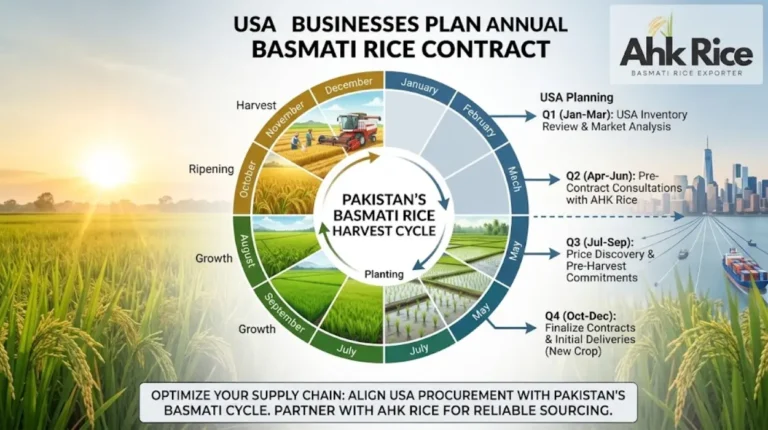
The production chain starts with paddy cultivation. Farmers harvest mature rice plants and deliver paddy to processing facilities. The paddy then passes through cleaning, drying, milling, grading, sorting, and packing before export.
Pakistan also maintains origin documentation for export shipments. A Certificate of Origin identifies Pakistan as the country of origin. GI-related requirements support traceability for qualifying Basmati production from designated geographical areas.
Which countries import the most Pakistani Basmati rice?
Pakistani Basmati rice reaches major markets across the Gulf, Europe, Asia, North America, and other regions. Important destinations include the UAE, Saudi Arabia, Oman, Qatar, Kuwait, Bahrain, the United Kingdom, Malaysia, and the United States.
United Arab Emirates
The UAE is one of the most important destinations for Pakistani rice. Dubai functions as both a consumption market and a regional trading and re-export hub.
Pakistani Basmati serves supermarkets, wholesalers, restaurants, catering companies, ethnic grocery stores, and foodservice distributors. Common commercial pack sizes include 5 kg, 10 kg, 25 kg, and 50 kg.
Saudi Arabia
Saudi Arabia has strong demand for long-grain rice across household consumption, restaurants, catering, and institutional foodservice. Pakistani Basmati competes in premium and ethnic rice segments.
1121 Basmati is suitable for buyers seeking long grain and strong cooking performance. Super Kernel serves buyers prioritizing traditional aroma and Pakistani Basmati identity.
United Kingdom
The United Kingdom has an established South Asian grocery and foodservice market. Pakistani Basmati is sold through supermarkets, independent retailers, wholesalers, restaurants, caterers, and private-label brands.
Packaging requirements become important in this market because retail buyers need compliant product information, accurate weights, country-of-origin details, and traceable supply documentation.
Oman, Qatar, Kuwait, and Bahrain
Gulf markets outside the UAE and Saudi Arabia also purchase Pakistani rice. Oman, Qatar, Kuwait, and Bahrain contain established South Asian consumer segments and large foodservice channels.
These markets use rice in household meals, restaurants, catering operations, hotels, and institutional kitchens. Long-grain Basmati remains particularly relevant where aroma, grain appearance, and cooking performance influence purchasing decisions.
Malaysia and Southeast Asia
Malaysia represents an important Asian market for Pakistani rice and connects with a wider Southeast Asian opportunity. Pakistani Basmati is used in retail and foodservice channels where consumers and businesses seek aromatic long-grain rice.
The wider Southeast Asian market includes Indonesia, Malaysia, Singapore, and other countries with growing demand for differentiated rice products.
This market direction connects directly with the next commercial stage: [Insert Link to MOFU Article] can be placed where the article discusses why Southeast Asia is becoming important for Pakistani Basmati exporters.
United States
The United States imports Pakistani Basmati for South Asian grocery stores, specialty food retailers, restaurants, caterers, distributors, and private-label programs.
U.S. buyers place strong importance on documentation, food safety, labeling, traceability, and import compliance. Product specifications also need to match the buyer’s retail or foodservice requirements.
How does Pakistani Basmati rice move from farm to export market?
Pakistani Basmati rice follows a controlled chain from paddy cultivation through harvesting, drying, milling, grading, optical sorting, quality testing, packing, documentation, container loading, and international shipment. Each stage controls a specific quality variable.
Paddy cultivation and harvesting
Rice begins as paddy in agricultural fields. Farmers cultivate Basmati varieties according to the crop cycle and regional conditions.
Harvest timing affects grain quality. Proper harvesting limits excessive moisture, immature grains, and mechanical damage.
Drying and storage
Freshly harvested paddy contains higher moisture than export-ready milled rice. Controlled drying reduces moisture to a suitable level for storage and processing.
Storage conditions also influence grain stability. Excess moisture creates conditions for deterioration, while poor storage management affects quality and milling performance.
Milling
Rice mills remove the outer husk from paddy. Further milling removes bran layers and produces edible white rice.
The milling process determines the final appearance of the grain. Excessive milling can affect grain recovery and produce additional broken rice.
Grading and sorting
Grading separates grains according to length, broken percentage, appearance, and other commercial specifications.
Modern processing facilities use mechanical and optical sorting equipment. Sortex systems identify and remove discolored, damaged, immature, or foreign grains.
A double Sortex process provides an additional sorting stage for buyers requiring tighter visual consistency.
Quality testing
Export rice undergoes quality checks before shipment. Tests can cover moisture, broken grains, grain dimensions, foreign matter, milling quality, and other buyer specifications.
DNA-based purity testing is also used for identity verification in programs where varietal purity is a critical purchasing requirement.
Packing and container loading
After final approval, rice is packed according to the buyer’s requirements. Packaging can include retail bags, wholesale sacks, woven polypropylene bags, and custom private-label packaging.
The finished bags are palletized or loaded according to shipment requirements. Export containers are then sealed and prepared for international transportation.
What are the main grades of Pakistani Basmati rice?
The main commercial Pakistani Basmati types include 1121, Super Kernel, and 1509, with further distinctions based on processing and grain condition. Steam, Sella, Golden Sella, Creamy Sella, white, brown, and broken grades serve different markets.
1121 Basmati
1121 is a premium long-grain variety recognized for its exceptional raw grain length and cooking elongation.
It is widely used for premium retail, restaurants, catering, wedding meals, and foodservice applications.
Super Kernel Basmati
Super Kernel is a traditional Pakistani Basmati variety associated with Punjab. It combines aroma, slender grain structure, and cooking performance.
It is widely relevant to ethnic retail and South Asian foodservice markets.
1509 Basmati
1509 provides long grains with strong commercial efficiency. Its shorter crop cycle compared with traditional Basmati types supports larger-scale commercial production.
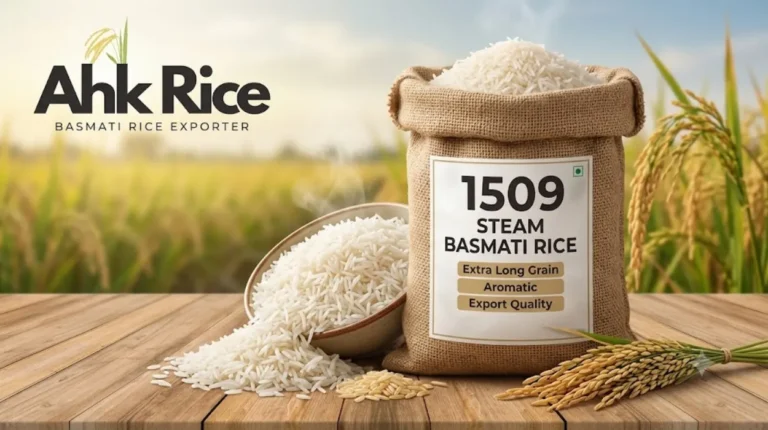
1509 is available in white, Steam, Golden Sella, and other commercial processing formats.
Steam Basmati
Steam processing produces a firm, white rice product with strong cooking performance. It is common in retail and foodservice channels.
Sella Basmati
Sella processing involves parboiling before milling. It produces firm grains and supports applications requiring greater grain integrity during cooking.
Golden Sella
Golden Sella has a golden appearance created through its parboiling and processing method. It is widely used for catering, banquets, restaurants, and institutional foodservice.
Creamy Sella
Creamy Sella provides a lighter appearance than Golden Sella while retaining the firm cooking characteristics associated with parboiled rice.
Brown and broken rice
Brown Basmati retains the bran layer and serves health-oriented and specialty food applications. Broken rice contains smaller grain fragments created during milling and is generally positioned in value-focused applications.
What are the benefits of Pakistani Basmati rice for importers?
Pakistani Basmati gives importers access to long aromatic grains, multiple commercial varieties, flexible processing formats, retail and foodservice grades, and established export channels serving the Gulf, Europe, Asia, North America, and other international markets.
Importers can select grades according to their customer base.
Premium retailers can prioritize 1121. Ethnic grocery distributors can select Super Kernel. High-volume foodservice buyers can evaluate 1509 based on specifications and cost requirements.
Processing also creates product differentiation. Steam, Golden Sella, Creamy Sella, white, brown, and broken formats serve different cooking and commercial purposes.
Packaging creates another layer of flexibility. Importers can purchase standard export packaging or develop private-label formats with defined weights, artwork, labeling, and product specifications.
The export model also supports container-scale purchasing. Buyers can define variety, grade, grain length, broken percentage, moisture, packaging, quantity, destination, and Incoterm before receiving a commercial quotation.
What are the common problems and misconceptions about Pakistani Basmati?
The biggest misconceptions involve assuming that all Pakistani Basmati has the same grain length, processing method, aroma, price, or cooking performance. Export rice differs by variety, grade, processing, crop year, specification, packaging, and destination.
“All Basmati rice is the same”
It is not. 1121, Super Kernel, and 1509 have different commercial characteristics.
A buyer selecting rice only by the word Basmati can receive a product that does not match the intended cooking or retail application.
“Longer grain automatically means higher quality”
Grain length is only one quality parameter. Broken percentage, moisture, grain uniformity, purity, aroma, milling quality, and cooking performance also affect commercial value.
A 1121 specification therefore needs more than a simple length measurement.
“White rice and Sella rice are interchangeable”
They are different processing formats. White Basmati and Sella Basmati have different physical characteristics and cooking behavior.
A restaurant or caterer should select the processing type according to its menu and cooking method.
“The export price is fixed”
International rice pricing depends on multiple variables. Variety, grade, quality specifications, packaging, order quantity, destination, freight, and Incoterm affect the final commercial price.
A buyer should compare complete specifications rather than comparing a single price per metric tonne.
“Origin documentation is optional”
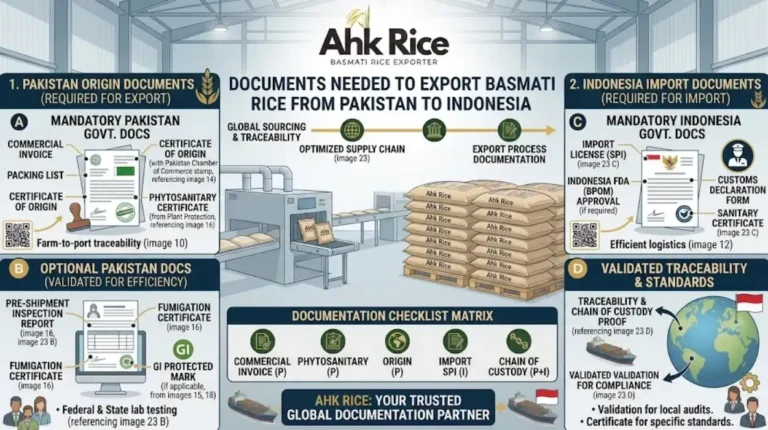
International buyers often require traceable documentation. A commercial shipment can involve a Certificate of Origin, phytosanitary documentation, commercial invoice, packing list, bill of lading, and other documents required by the destination market.
How should importers choose the right Pakistani Basmati grade?

Importers should start with the end market, then define grain type, processing method, quality specification, packaging, quantity, and destination requirements. The correct grade is the one that matches the buyer’s customers and import regulations.
A retail distributor targeting premium South Asian consumers can evaluate 1121 or Super Kernel. A caterer serving large events can evaluate Sella or Golden Sella. A price-sensitive foodservice buyer can compare 1509 against other long-grain specifications.
The purchase specification should identify measurable requirements. These include grain length, broken percentage, moisture, foreign matter, purity, processing type, packing weight, and allowable tolerances.
The buyer should also confirm destination-country requirements before finalizing the shipment. Import regulations differ between the UAE, Saudi Arabia, United Kingdom, United States, Malaysia, Indonesia, and other markets.
This approach turns Basmati procurement into a specification-based decision rather than a simple variety comparison.
What does the global market show about Pakistani Basmati exports?
Pakistani Basmati exports connect Punjab production with established demand in the Gulf, Europe, Asia, North America, and other regions. The strongest markets combine large rice consumption, South Asian demand, foodservice activity, and established import channels.
The UAE and Saudi Arabia remain central Gulf markets. The United Kingdom and United States provide established retail and foodservice channels. Malaysia and Southeast Asia provide additional opportunities for differentiated long-grain aromatic rice.
The market structure also explains why Pakistani exporters offer several varieties instead of one universal product. Different buyers require different grain lengths, processing methods, packaging formats, and price positions.
The export chain therefore begins with agricultural production in Punjab but ends with market-specific specifications. Importers select products based on consumer preferences, foodservice requirements, regulatory conditions, packaging needs, and commercial economics.
For this reason, understanding which countries import Pakistani Basmati rice requires looking beyond shipment volumes. The important question is also what each market buys, why it buys that grade, and which specification fits its customers.
Frequently Asked Questions
Which country imports the most Pakistani Basmati rice?
The United Arab Emirates is one of the largest and most important destinations for Pakistani rice, including Basmati, with Dubai also serving as a regional re-export hub.
Which countries buy Pakistani 1121 Basmati rice?
1121 Basmati is exported to markets including the UAE, Saudi Arabia, United Kingdom, United States, Gulf countries, and other international destinations.
What are the main Pakistani Basmati varieties?
The main commercial varieties are 1121, Super Kernel, and 1509. Each has different grain, processing, cooking, and commercial characteristics.
Where is Pakistani Basmati rice grown?
Pakistani Basmati is primarily grown in Punjab, including areas around Gujranwala, Hafizabad, Sheikhupura, Narowal, and Sialkot.
What is the difference between Steam and Sella Basmati?
Steam Basmati is processed into a firm white rice product, while Sella is parboiled before milling, producing firmer grains and different cooking characteristics.