Pakistan to Malaysia Rice Shipping Time via Port Klang in 2026
Rice shipping from Karachi to Malaysia in 2026 is a structured sea freight process that transports processed Basmati rice from Pakistani export terminals to Malaysian import hubs like Port Klang, taking 14–22 days depending on vessel schedule, routing, customs clearance, and container handling efficiency.
Rice shipping refers to the movement of processed, graded, and packaged rice through international maritime logistics networks. The route from Pakistan to Malaysia is one of the most active corridors in South and Southeast Asia due to strong demand for long-grain aromatic rice.
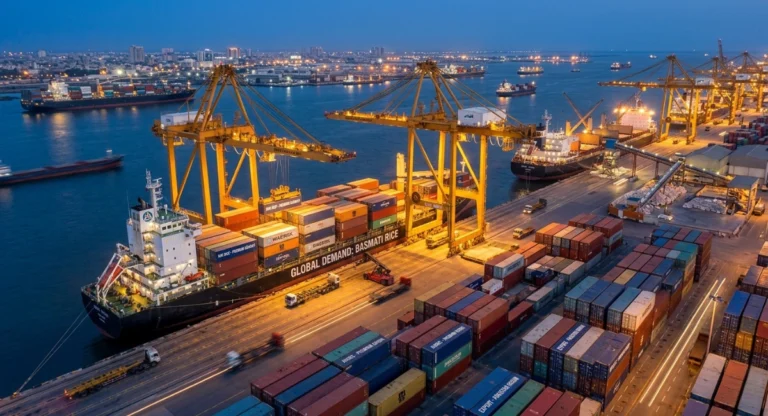
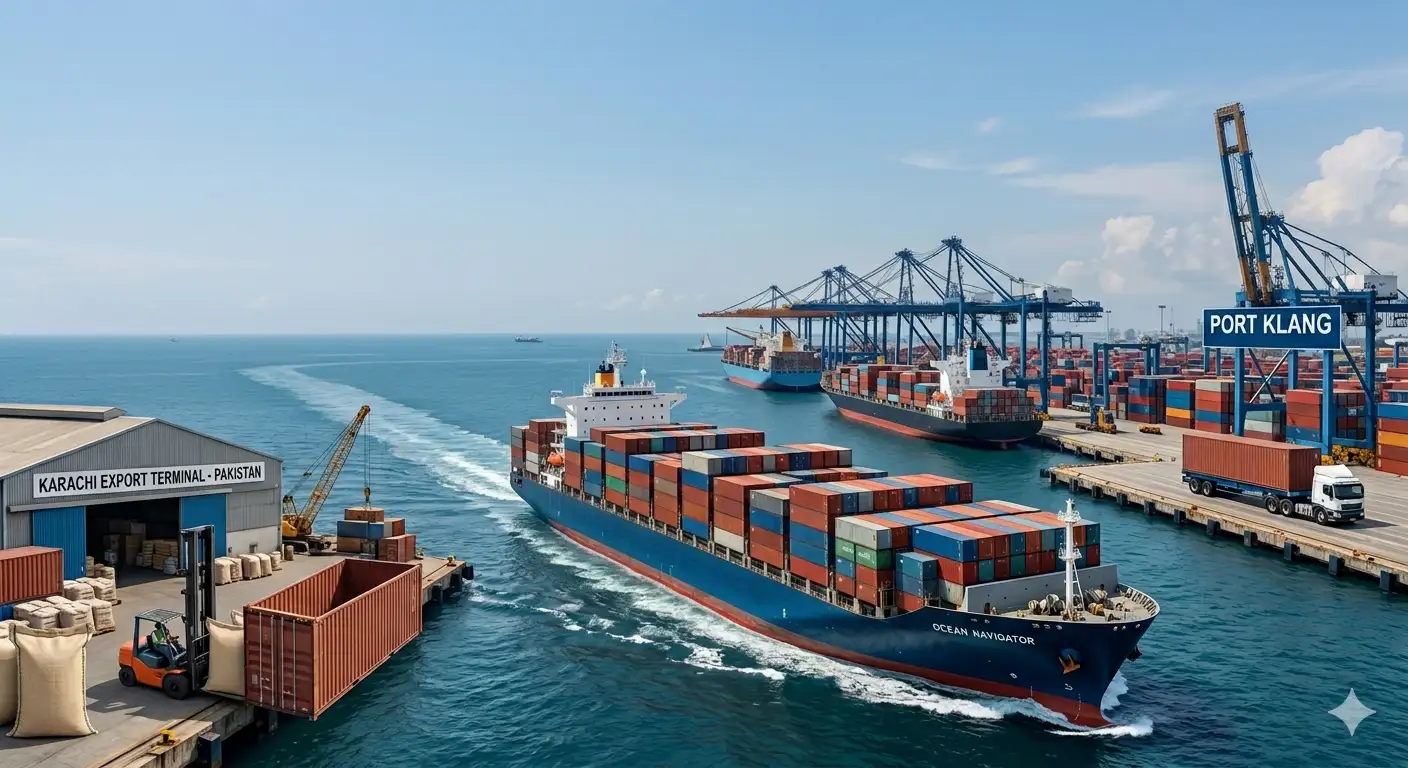
The shipment begins at export terminals in Karachi. These terminals handle container stuffing, customs documentation, and vessel loading. The cargo then moves across the Arabian Sea and the Strait of Malacca before arriving at Port Klang, Malaysia’s primary maritime gateway.
The duration is defined in measurable phases. Sea transit takes 10–16 days. Port handling and customs clearance add 3–6 days. Inland delivery to Malaysian warehouses takes 1–3 days. This results in a total shipping timeline between 14 and 22 days.
Rice shipping is not a single event. It is a sequence of logistics operations that connect farms in Punjab, processing units, export terminals, shipping lines, and import distribution networks.
How does sea freight from Pakistan to Malaysia work step by step?
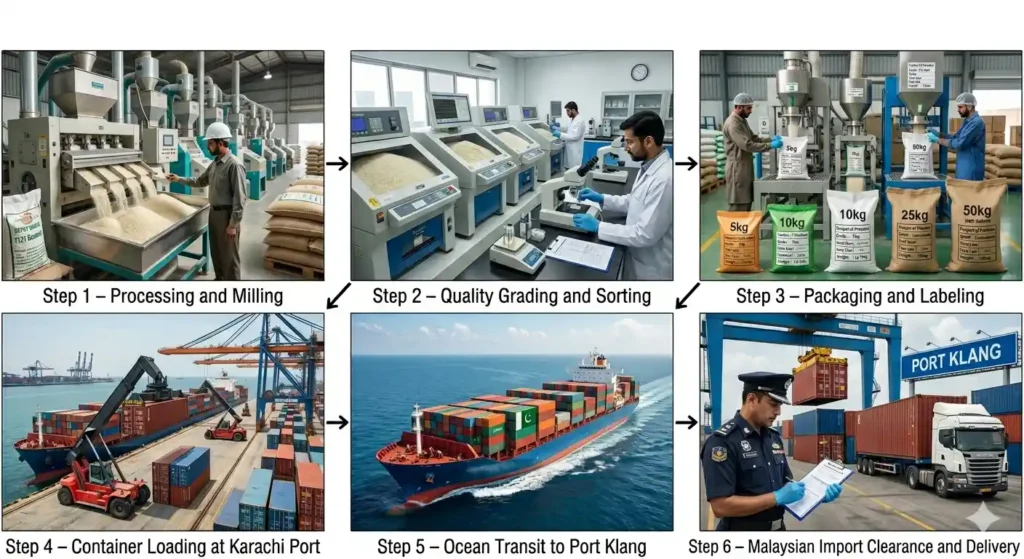
Sea freight from Pakistan to Malaysia works through six defined steps: rice processing, grading, packaging, container loading, ocean transport, and import clearance, each adding measurable time to the total transit duration while ensuring product quality, compliance, and traceability across international borders.
H3: Step 1 – Processing and Milling
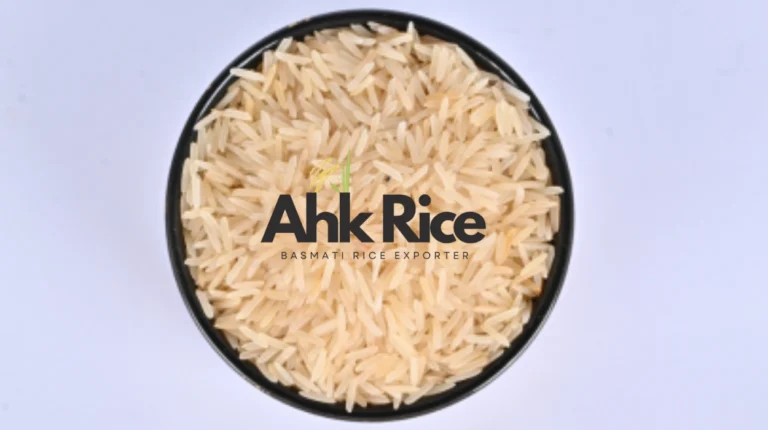
Rice is harvested in Punjab and transported to mills. Milling removes husk, polishes grains, and sorts them into export grades such as 1121 Basmati, Super Kernel Basmati, and 1509 Basmati.
H3: Step 2 – Quality Grading and Sorting
Grains are classified based on length, broken percentage, moisture level, and aroma. Export-grade rice maintains moisture between 12% and 14%. Broken ratio stays below 5% for premium categories.
H3: Step 3 – Packaging and Labeling
Rice is packed in standardized formats such as 5 kg, 10 kg, 25 kg, and 50 kg bags. Materials include PP woven bags, BOPP laminated bags, and jute sacks. Labels include origin, grade, crop year, and certification marks.
H3: Step 4 – Container Loading at Karachi Port
Containers are loaded at terminals in Karachi. A standard 20-foot container carries 24–26 metric tons of rice. A 40-foot container carries 26–28 metric tons depending on packaging density.
H3: Step 5 – Ocean Transit to Port Klang
Ships follow a defined maritime route across the Arabian Sea, through the Indian Ocean, and into the Strait of Malacca. Transit time ranges between 10 and 16 days depending on shipping line schedules and port congestion.
H3: Step 6 – Malaysian Import Clearance and Delivery
At Port Klang, containers undergo customs inspection, duty assessment, and clearance. After release, cargo is transported to warehouses or distributors within Malaysia.
Each step is measurable and contributes directly to the total shipping time.
What are the key components affecting Karachi to Klang shipping time?
Karachi to Klang shipping time depends on vessel schedule frequency, port congestion levels, container availability, customs processing speed, and weather conditions, with each component contributing specific delays or efficiencies that determine whether shipment duration stays closer to 14 days or extends beyond 20 days.
Shipping time is not fixed. It is influenced by multiple logistics variables.
Vessel frequency determines departure intervals. Weekly sailings reduce waiting time, while biweekly schedules add 3–7 days.
Port congestion impacts loading and unloading speed. High container traffic at Karachi or Port Klang increases waiting time by 1–4 days.
Customs clearance efficiency directly affects release time. Digitized systems reduce delays, while manual inspections increase processing duration.
Container availability influences readiness. Shortages of food-grade containers delay shipments by 2–5 days.
Weather patterns affect sailing schedules. Monsoon seasons in the Arabian Sea slow vessel movement and increase transit time by 1–3 days.
Each component operates independently but combines to define the final delivery timeline.
What are the benefits of sea freight for rice delivery to Malaysia?
Sea freight provides cost-efficient bulk transportation, stable transit timelines, high cargo capacity, and standardized handling processes, making it the most reliable method for shipping rice from Pakistan to Malaysia while maintaining grain quality, moisture control, and packaging integrity across long distances.
Sea freight supports large-scale trade. A single vessel carries thousands of containers, reducing per-unit transport cost.
It ensures consistency. Scheduled shipping routes create predictable delivery cycles, which are essential for importers managing inventory.
Containerization protects cargo. Sealed containers prevent contamination, moisture exposure, and physical damage during transit.
It enables scalability. Exporters can ship multiple grades and packaging formats in one consignment, such as 5 kg retail packs and 50 kg bulk bags.
Sea freight also supports compliance. Documentation systems align with international trade standards, ensuring traceability and regulatory approval.
These benefits make sea freight the dominant method for rice exports between Pakistan and Malaysia.
What are the main use cases of rice shipping from Pakistan to Malaysia?
Rice shipping from Pakistan to Malaysia serves wholesale importers, retail distributors, food service industries, and government procurement programs, each requiring specific grades, packaging formats, and delivery timelines that align with market demand cycles and consumption patterns across Malaysian regions.
Wholesale importers purchase bulk quantities. They distribute rice to regional markets and smaller retailers.
Retail distributors import branded packaged rice. These include 5 kg and 10 kg consumer packs sold in supermarkets.
Food service industries such as restaurants and catering companies require consistent supply of long-grain rice for dishes like biryani and nasi briyani.
Government procurement programs import rice to maintain food security reserves. These shipments require strict compliance with quality and certification standards.
Each use case defines packaging, volume, and delivery frequency.
What are the common problems and misconceptions in rice shipping duration?
Common problems include misunderstanding transit time as only sea travel duration, ignoring port delays, underestimating customs clearance time, and assuming all shipments follow identical schedules, while misconceptions arise from not accounting for logistics variables such as vessel routing, container handling, and regulatory inspections.
A frequent misconception is that shipping takes only 10–12 days. This reflects sea transit alone and excludes port handling and clearance.
Another issue is ignoring documentation accuracy. Incorrect paperwork delays customs clearance by 2–5 days.
Importers often assume fixed schedules. Shipping timelines vary based on vessel availability and routing.
Improper packaging leads to damage. Moisture exposure affects grain quality, especially in long-distance shipping.
Lack of coordination between exporter, freight forwarder, and importer increases delays.
Understanding these factors eliminates unrealistic expectations and improves logistics planning.
How do rice grades and processing affect shipping efficiency?
Rice grades and processing levels directly impact shipping efficiency by determining packaging density, container capacity, moisture stability, and inspection requirements, with premium grades like 1121 Basmati requiring stricter quality control and optimized packaging to maintain grain length and aroma during transit.
Different rice grades have distinct characteristics.
1121 Basmati has extra-long grains exceeding 8.3 mm. It requires careful handling to prevent breakage.
Super Kernel Basmati has strong aroma and uniform grain size. It is commonly shipped in both bulk and retail packaging.
1509 Basmati matures faster and has slightly shorter grains. It allows higher yield and faster processing cycles.
Processing methods influence moisture levels. Controlled drying ensures stability during transit.
Packaging density varies. Premium rice uses lighter packing to reduce pressure damage.
These factors affect container loading efficiency and overall shipping performance.
What certifications apply to rice shipped to Malaysia?
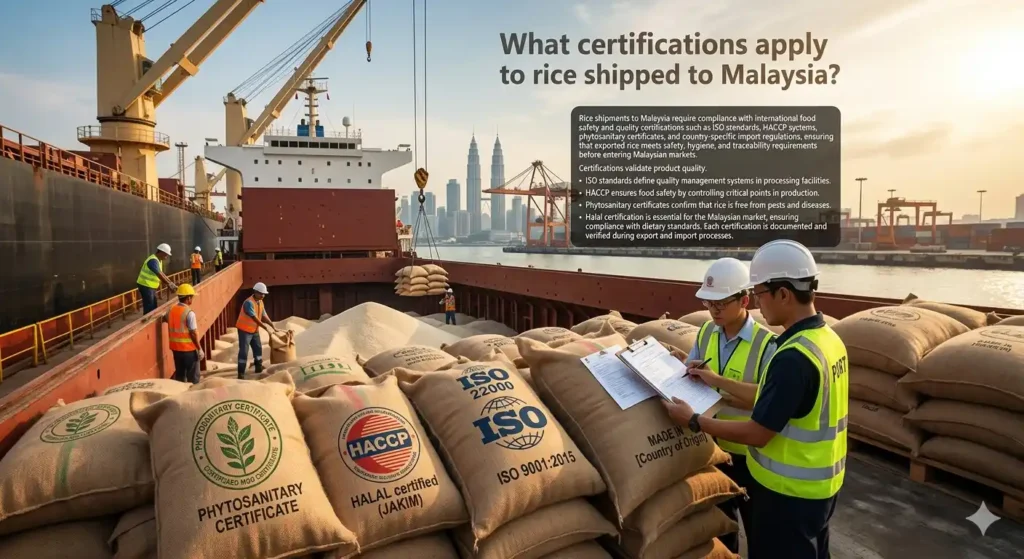
Rice shipments to Malaysia require compliance with international food safety and quality certifications such as ISO standards, HACCP systems, phytosanitary certificates, and country-specific import regulations, ensuring that exported rice meets safety, hygiene, and traceability requirements before entering Malaysian markets.
Certifications validate product quality.
ISO standards define quality management systems in processing facilities.
HACCP ensures food safety by controlling critical points in production.
Phytosanitary certificates confirm that rice is free from pests and diseases.
Halal certification is essential for the Malaysian market, ensuring compliance with dietary standards.
Each certification is documented and verified during export and import processes.
How does Port Klang influence rice transit time and delivery?
Port Klang acts as Malaysia’s primary import hub, influencing rice transit time through its container handling capacity, customs efficiency, and inland distribution network, enabling faster cargo clearance and delivery within 1–3 days after vessel arrival when operations run at optimal efficiency levels.
Port Klang is strategically located along the Strait of Malacca. It connects major global shipping routes.
The port handles high container volumes. Advanced infrastructure supports efficient unloading and processing.
Customs systems are digitized. This reduces clearance time compared to manual processes.
Inland logistics networks connect Port Klang to major cities like Kuala Lumpur, Penang, and Johor.
Efficient port operations reduce overall delivery time and improve supply chain reliability.