Pakistan vs India Basmati Rice in Saudi Arabia: Which Origin Dominates?
Pakistan dominates the Saudi premium Basmati segment for long-grain 1121 and Super Kernel varieties, while India controls larger retail shelf volume through established branded distribution. Here is why: Pakistani Basmati delivers longer grain elongation, lower CIF pricing, and stronger catering demand in Saudi Arabia, while Indian exporters maintain wider supermarket penetration through aggressive retail branding and larger export scale.
Saudi Arabia remains one of the world’s largest Basmati import markets. Saudi buyers import rice for retail chains, HORECA supply, catering contracts, and religious tourism consumption. Pakistani and Indian exporters compete directly across Jeddah, Dammam, and Riyadh. Saudi importers compare grain length, aroma, broken percentage, cooking performance, shelf stability, and CIF landed cost before selecting an origin.
Saudi buyers also compare supplier reliability, fumigation compliance, and packaging flexibility because customs clearance delays directly affect warehouse turnover. Importers searching for detailed grain specifications often begin with educational resources explaining how Basmati grades differ before evaluating commercial supply offers. A practical reference is this guide on selecting premium Basmati specifications for Gulf markets alongside the detailed sourcing framework in the BOFU article about Saudi-focused 1121 CIF supply solutions.
What makes Pakistani and Indian Basmati different in the Saudi market?
Pakistani Basmati dominates Saudi catering demand with longer cooked grain, while Indian Basmati leads retail branding through larger export volumes and stronger supermarket positioning. Saudi importers compare grain elongation, aroma retention, price per metric ton, and shelf performance before choosing an origin.
Saudi Arabia imports multiple Basmati categories from both countries. The most traded varieties include 1121 Steam, 1121 Golden Sella, Super Kernel Basmati, and 1509 Steam. Pakistan and India cultivate similar seed families, but processing methods and export structures differ significantly.
Pakistan primarily supplies 1121 Steam and 1121 Golden Sella for institutional buyers. Saudi catering companies prefer these grades because cooked grain elongation exceeds 20 mm after boiling. Pakistani mills also maintain lower average broken percentages in premium export lots. Saudi buyers value this consistency for buffet operations and mandi restaurants.
India controls larger global Basmati export volume because Indian exporters operate extensive branded retail networks across GCC supermarkets (source: APEDA export statistics 2025). Indian brands dominate shelf visibility in Carrefour, Panda, and Lulu retail chains. Retail packaging investment increases Indian visibility despite higher landed pricing.
How does cultivation affect grain quality?
Punjab regions in Pakistan and India both cultivate aromatic Basmati in alluvial soil. However, Pakistani exporters frequently process rice closer to harvest regions. Reduced inland transportation lowers grain stress and breakage during milling.
Pakistani exporters also focus heavily on aged rice programs. Aged Basmati improves aroma concentration and grain firmness during cooking. Saudi buyers purchasing for premium mandi restaurants prioritize aged stock because holding texture remains stable during bulk service.
Indian exporters emphasize large-scale volume processing. This structure supports consistent retail packaging supply. However, some Saudi catering buyers report higher variability between shipment lots because sourcing networks span multiple milling clusters.
Specification Comparison Between Pakistani and Indian Basmati
| Attribute | Pakistan Basmati | India Basmati |
|---|---|---|
| Average raw grain length | 8.2–8.5 mm | 8.0–8.4 mm |
| Cooked grain elongation | 18–24 mm | 16–22 mm |
| Dominant Saudi segment | Catering and wholesale | Retail supermarkets |
| Common grades | 1121 Steam, Golden Sella, Super Kernel | 1121 Steam, Pusa, Traditional Basmati |
| Average broken percentage | 1–2% premium lots | 2–5% standard lots |
| Average CIF Saudi pricing | Lower by $40–$90/MT | Higher branded pricing |
| Aroma profile | Strong aged aroma | Wider variation by grade |
(source: REAP Pakistan export data 2025, APEDA India trade reports 2025)
Saudi buyers evaluating these specifications must next compare which grades perform best for different commercial applications.
Which Basmati grades dominate Saudi Arabia imports?
1121 Steam and 1121 Golden Sella dominate Saudi imports because both grades provide long cooked grain, strong aroma retention, and reliable holding performance for restaurants, catering companies, and retail distribution across Riyadh, Jeddah, and Dammam.
Saudi Arabia imports rice across two major channels. Retail distributors prioritize shelf appearance and branded packaging. Catering importers prioritize yield, storage life, and cooking consistency.
Why does 1121 Steam perform strongly in Saudi retail?
1121 Steam Basmati delivers bright white appearance and soft texture after cooking. Saudi retail consumers prefer this visual profile for family consumption. Steam processing preserves natural grain color because mills avoid heavy parboiling.
Pakistani 1121 Steam also achieves high elongation ratios during cooking. Saudi wholesalers prefer this characteristic because consumers associate longer grain with premium quality. Indian exporters compete strongly in this category through branded retail packs ranging from 5 kg to 40 kg.
Why does Golden Sella dominate catering demand?
1121 Golden Sella undergoes parboiling before milling. This process improves grain strength and extends shelf stability. Saudi catering companies favor Golden Sella because grains remain separate during large-volume cooking.
Golden Sella also tolerates warehouse heat better than Steam rice. In Saudi storage facilities reaching 40°C, Golden Sella maintains texture stability for up to 18 months. Steam rice typically performs best within 12 months under similar conditions.
Saudi mandi restaurants select Golden Sella because the grain absorbs meat stock without breaking. Large catering kitchens value this performance during Ramadan and Hajj demand spikes.
Saudi regional grade preferences
| Saudi Region | Preferred Grade | Main Buyer Type | Reason |
|---|---|---|---|
| Jeddah | 1121 Golden Sella | Catering importers | Heat stability and buffet performance |
| Riyadh | 1121 Steam | Retail distributors | White grain appearance |
| Dammam | Super Kernel | Wholesale traders | Competitive pricing |
| Madinah | Golden Sella | Institutional kitchens | Longer holding stability |
| Eastern Province | 1509 Steam | Budget retail | Faster cooking time |
(source: GCC rice trade interviews and REAP market data 2025)
With Saudi grade preferences established, the next comparison involves pricing and landed commercial value.
How do Pakistan and India compare on price per metric ton in Saudi Arabia?
Pakistani Basmati maintains lower CIF Saudi pricing because Pakistani exporters operate with lower processing and freight costs, while Indian suppliers maintain higher branded premiums through established retail distribution networks across GCC supermarkets.
Saudi importers compare total landed cost instead of FOB pricing alone. CIF Jeddah and CIF Dammam calculations include freight, insurance, fumigation, packaging, and handling charges.
Average CIF Saudi Arabia pricing comparison
| Grade | Pakistan CIF Saudi | India CIF Saudi |
|---|---|---|
| 1121 Steam | $1,050–1,180/MT | $1,140–1,280/MT |
| 1121 Golden Sella | $980–1,120/MT | $1,050–1,220/MT |
| Super Kernel | $920–1,050/MT | Limited volume |
| 1509 Steam | $850–980/MT | $900–1,050/MT |
(source: REAP export pricing January 2026, APEDA market updates 2026)
Pakistani exporters maintain pricing advantages because freight routes from Karachi to Jeddah remain cost-efficient. Pakistani mills also specialize in bulk container programs for GCC catering importers.
Indian suppliers offset higher pricing through stronger consumer brand recognition. Saudi retailers often accept higher pricing for branded Indian retail packs because supermarket buyers prioritize repeat shelf sales.
What costs influence Saudi rice procurement?
Saudi buyers calculate total warehouse-ready cost. Procurement teams evaluate:
- Freight charges
- Container availability
- Fumigation compliance
- Moisture percentage
- Broken grain ratio
- Packaging durability
- Customs clearance speed
Packaging quality directly affects landed value. Torn PP bags increase warehouse losses during unloading. Saudi wholesalers therefore prioritize reinforced export stitching and humidity-resistant liners.
Pricing comparison alone does not determine the best origin. Shelf life and storage performance also affect long-term profitability.
Which origin offers better shelf life and storage performance?
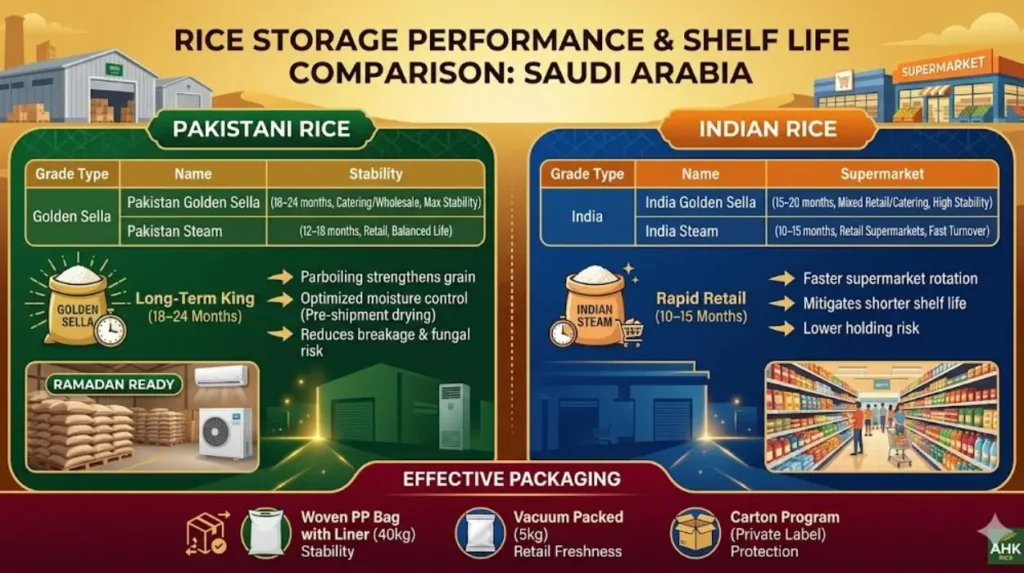
Pakistani Golden Sella provides the strongest long-term storage stability in Saudi conditions because parboiling strengthens grain structure and reduces breakage during extended warehouse storage in hot Gulf climates.
Saudi Arabia’s climate creates storage pressure. High ambient temperatures increase moisture fluctuation risk inside warehouses. Rice quality declines rapidly when exporters fail to stabilize moisture content before loading.
Shelf life comparison
| Grade Type | Average Shelf Life | Best Use Case |
|---|---|---|
| Pakistan Golden Sella | 18–24 months | Catering and wholesale |
| Pakistan Steam | 12–18 months | Retail distribution |
| India Golden Sella | 15–20 months | Mixed retail and catering |
| India Steam | 10–15 months | Retail supermarkets |
(source: GCC food storage guidelines and exporter handling standards 2025)
Pakistani exporters frequently dry rice to optimized export moisture levels before shipment. Controlled drying reduces fungal risk during sea transit. Saudi importers storing inventory for Ramadan demand cycles prioritize these lower moisture specifications.
Indian retail brands frequently move faster through supermarket channels. Faster shelf rotation reduces storage exposure. Retail-focused operations therefore experience lower warehouse holding risk despite shorter shelf windows.
How does packaging affect storage quality?
Saudi wholesalers prefer woven PP bags with moisture-resistant liners. Exporters also use vacuum-packed retail units for supermarket distribution. Packaging selection changes shelf performance significantly.
Common Saudi packaging formats include:
- 5 kg retail packs
- 10 kg supermarket bags
- 20 kg wholesale packs
- 40 kg catering PP bags
- Private-label carton programs
AHK Rice supports custom packaging and export documentation for GCC buyers. The company mills, grades, sorts, inspects, and dispatches Pakistani Basmati directly from Punjab processing facilities for Saudi-focused shipments.
Storage performance explains operational value, but buyers still need a framework for selecting the correct origin for their business model.
Which Basmati origin works best for different Saudi buyers?
Pakistani Basmati works best for catering importers and wholesale distributors, while Indian Basmati works best for retail supermarket programs requiring established consumer branding and premium packaged visibility across GCC retail shelves.
Different Saudi buyers prioritize different outcomes. Procurement strategy determines the best origin.
Decision framework for Saudi rice buyers
| Buyer Type | Best Origin | Recommended Grade | Main Priority | Reason |
|---|---|---|---|---|
| Catering company | Pakistan | 1121 Golden Sella | Cooking stability | Better buffet performance |
| Retail supermarket | India | 1121 Steam | Brand visibility | Strong shelf recognition |
| Budget wholesaler | Pakistan | Super Kernel | Lower landed cost | Competitive pricing |
| Premium restaurant | Pakistan | Aged 1121 Steam | Aroma and elongation | Better presentation |
| Mixed retail importer | India | Retail-packed Steam | Consumer familiarity | Established packaging systems |
Saudi catering buyers typically prioritize operational performance over retail branding. Pakistani exporters dominate this segment because cooked grain elongation and cost efficiency improve foodservice margins.
Saudi supermarket chains prioritize consumer familiarity and packaging consistency. Indian exporters remain strong in this category because branded retail distribution has operated in GCC markets for decades.
Pros and cons of Pakistani Basmati
Advantages
- Lower CIF Saudi pricing
- Stronger grain elongation
- Better catering performance
- Competitive bulk supply
- Longer Golden Sella shelf life
Limitations
- Lower retail brand visibility
- Smaller supermarket marketing budgets
- Less premium retail shelf penetration
Pros and cons of Indian Basmati
Advantages
- Strong retail brand recognition
- Extensive supermarket distribution
- Large-scale packaging systems
- High consumer familiarity
Limitations
- Higher landed pricing
- More variable catering economics
- Higher branded cost premiums
Saudi buyers evaluating these trade-offs ultimately select suppliers based on operational goals, not national preference alone.
What factors should Saudi importers evaluate before selecting a supplier?
Saudi importers should evaluate grain specifications, shipment consistency, fumigation compliance, packaging quality, export documentation, and CIF delivery capability before selecting a Basmati supplier for long-term procurement contracts.
Supplier reliability directly affects warehouse planning and retail continuity. Delayed shipments create stock shortages during Ramadan and Hajj seasons.
Saudi importers should verify:
- Grain length specifications
- Broken percentage certificates
- Moisture test reports
- SGS inspection records
- Fumigation compliance
- Packaging durability
- Port dispatch timelines
Exporters should also provide clear processing transparency. Reliable mills define every production stage instead of using generic quality claims.
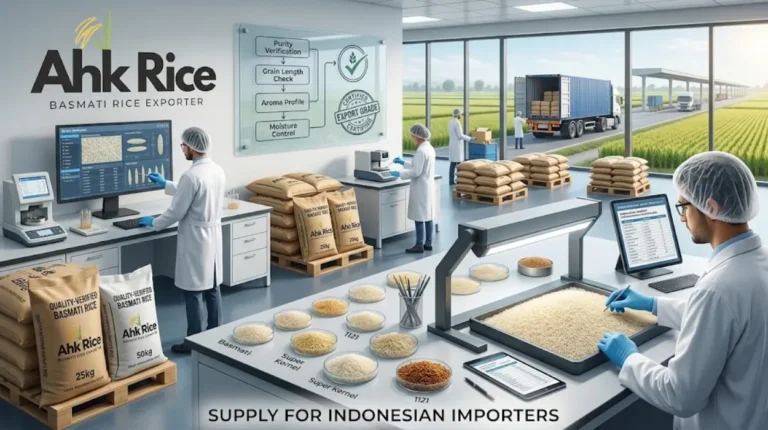
Standard Basmati processing includes:
- Clean the harvested paddy
- Dry the grain to target moisture
- Dehusk the rice carefully
- Polish the milled grain
- Sort by grain length
- Grade by broken percentage
- Inspect for export compliance
- Pack into export formats
- Load and dispatch containers
AHK Rice operates as a Pakistani Basmati exporter supplying 1121, Super Kernel, and 1509 varieties to more than 15 countries. The company supports end-to-end processing, custom packaging, and export handling for Saudi importers requiring CIF Jeddah and Dammam supply structures.
Pakistan and India will continue competing aggressively in Saudi Arabia. However, procurement strategy determines the winning origin for each buyer category. Pakistani Basmati leads catering and wholesale economics. Indian Basmati leads branded supermarket visibility. Saudi buyers achieve better procurement results when specifications, storage conditions, and distribution channels determine supplier selection instead of brand familiarity alone.
FAQs
Which country exports more Basmati rice to Saudi Arabia?
Pakistan leads Saudi Arabia in catering and wholesale Basmati supply, especially for 1121 Golden Sella and Super Kernel varieties. India exports larger retail-branded volumes through supermarket chains. Saudi importers choose origins based on grain performance, pricing, and distribution strategy.
Why do Saudi catering companies prefer Pakistani Basmati?
Saudi catering companies prefer Pakistani Basmati because it delivers longer grain elongation and stronger holding stability during bulk cooking. Pakistani 1121 Golden Sella also performs better in high-temperature storage conditions common across GCC warehouses and catering operations.
Which Basmati grade is most popular in Saudi Arabia?
1121 Steam and 1121 Golden Sella are the most popular Basmati grades in Saudi Arabia. Steam rice dominates retail demand because of its bright white appearance, while Golden Sella dominates catering demand because of its durability and cooking consistency.
How does shelf life differ between Pakistani and Indian Basmati?
Pakistani Golden Sella typically lasts 18–24 months under proper storage conditions. Indian Steam rice usually performs best within 10–15 months. Shelf life depends on moisture control, packaging quality, warehouse temperature, and fumigation compliance during export.
What should Saudi importers check before choosing a rice supplier?
Saudi importers should verify grain length, broken percentage, moisture reports, SGS inspections, packaging durability, fumigation certificates, and CIF delivery timelines. Reliable exporters also provide transparent processing specifications and consistent shipment schedules for long-term procurement contracts.