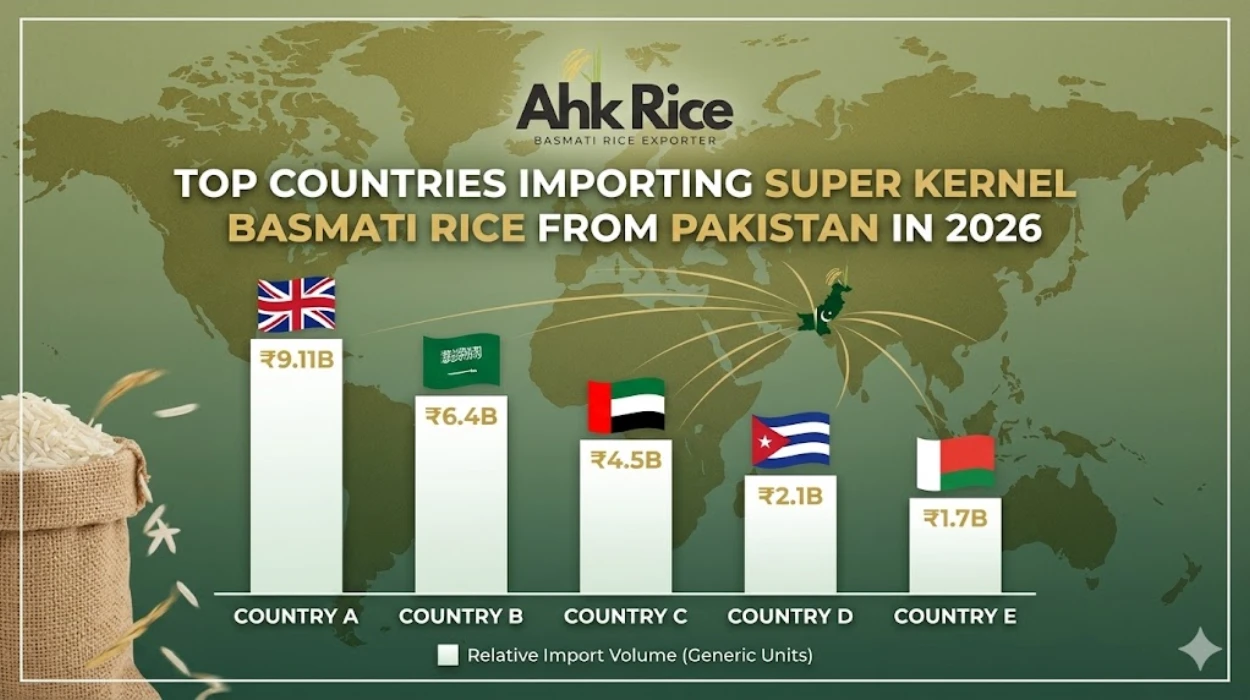
Top Countries Importing Super Kernel Basmati Rice from Pakistan in 2026
Pakistan exports Super Kernel Basmati rice to over 40 countries, with the UAE, Saudi Arabia, Iraq, the United Kingdom, and Oman leading imports in 2026. Here is why: consistent grain length of 7.2–7.6 mm, strong aroma retention, and stable supply chains drive repeat demand (source: REAP export data, December 2025).
Super Kernel Basmati rice remains a core export variety within Pakistan’s aromatic rice category. Pakistan cultivates this variety in Punjab using canal irrigation systems. Exporters mill, grade, and ship it in bulk and retail formats to global markets with defined quality standards.
What is Super Kernel Basmati rice and why do countries import it?
Super Kernel Basmati rice is a long-grain aromatic variety grown in Punjab, Pakistan, known for 7.2–7.6 mm grain length, strong fragrance, and non-sticky cooking texture, which meets demand in Gulf, European, and African markets.
Super Kernel Basmati rice belongs to the aromatic rice family cultivated in the fertile plains of Punjab. Farmers grow this variety using controlled irrigation from the Indus Basin. The grain develops a distinct aroma during aging, which increases export value.
Importing countries choose Super Kernel because it balances price and quality. 1121 Basmati offers longer grains, but Super Kernel provides a lower-cost alternative with stable cooking performance. Gulf countries prioritize aroma and elongation, while African markets prioritize affordability and volume.
Super Kernel exports also align with halal food supply chains. Countries with large Muslim populations, such as Saudi Arabia and Iraq, maintain consistent demand for Pakistani aromatic rice due to dietary compatibility and established trade routes.
With the definition of Super Kernel established, the next question is how its production and export process supports global demand.
How does the Super Kernel Basmati export process work?
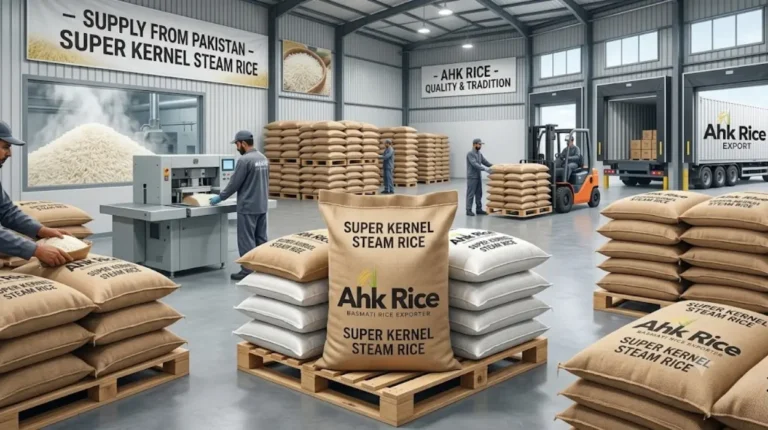
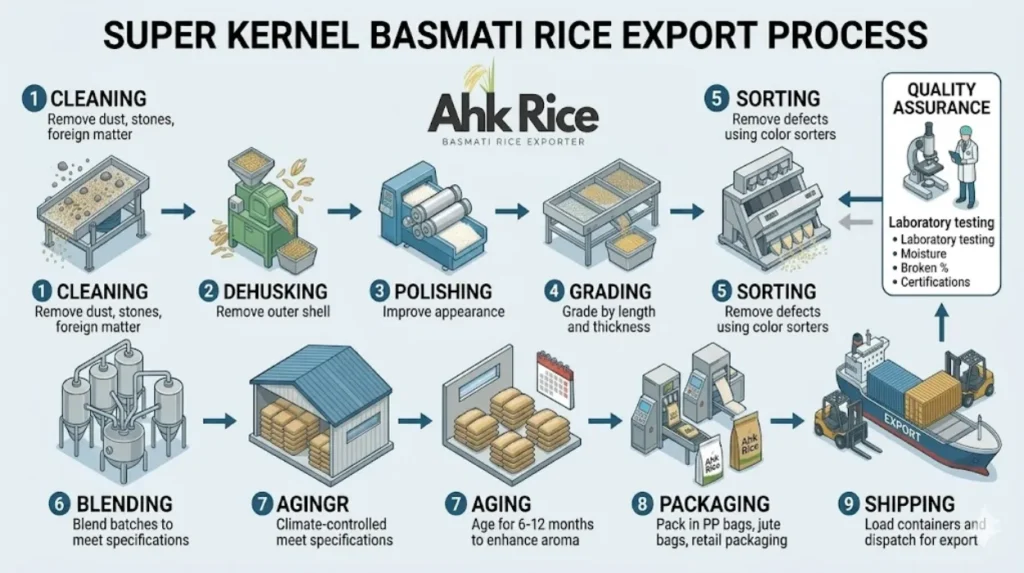
The export process includes 9 controlled steps: cleaning, dehusking, polishing, grading, sorting, blending, aging, packaging, and shipping, ensuring consistent quality for international buyers.
Rice exporters follow a structured milling and export workflow to maintain consistency across shipments.
Processing workflow
- Clean the paddy to remove dust, stones, and foreign matter
- Dehusk the grain to remove the outer shell
- Polish the rice to improve appearance
- Grade by length and thickness
- Sort using color sorters to remove defects
- Blend batches to meet specification requirements
- Age the rice for 6–12 months to enhance aroma
- Pack in PP bags, jute bags, or retail packaging
- Load containers and dispatch for export
Each step directly impacts export acceptance. European buyers reject shipments when broken percentage exceeds contract limits. Gulf buyers require consistent aroma across batches.
Exporters also perform laboratory testing before shipment. Quality teams inspect moisture levels, broken percentage, and foreign matter. Certification bodies verify compliance with importing country regulations.
With the export workflow defined, the next question focuses on the structural components that determine export quality.
What are the key components that define Super Kernel export quality?
Export quality depends on grain length, moisture content, broken percentage, aroma intensity, and purity level, which define acceptance in different international markets.
Super Kernel rice quality varies based on measurable specifications. Buyers use these specifications to compare suppliers and finalize contracts.
Core quality components
- Grain length: 7.2–7.6 mm before cooking
- Moisture content: 12–14% for safe storage
- Broken percentage: 5%, 10%, 15%, 25% grades
- Purity level: 92–95% average
- Aroma intensity: medium to strong
Grain length determines visual appeal. Longer grains attract premium buyers in the UK and EU. Broken percentage affects pricing. African markets accept higher broken ratios, while European buyers require strict limits.
Moisture content impacts shelf life. High moisture leads to fungal growth during shipping. Exporters maintain controlled drying conditions to prevent spoilage.
Aroma intensity defines consumer preference. Middle Eastern markets prioritize fragrance for traditional dishes such as Kabsa and Mandi.
With quality components clarified, the next step is understanding why importing countries prioritize this rice variety.
What benefits drive global demand for Super Kernel Basmati?
Super Kernel Basmati delivers cost efficiency, stable cooking performance, long shelf life, and scalable supply, making it suitable for both retail and bulk consumption markets.
Super Kernel offers a balance between premium and affordability. Buyers select it when they require aromatic rice without the higher cost of 1121 Basmati.
Cost efficiency supports large-scale imports. Iraq and African countries import bulk volumes for public distribution programs. Lower pricing allows governments to manage food supply budgets effectively.
Cooking performance remains consistent. The rice elongates after cooking without sticking. This property suits commercial kitchens and catering businesses.
Shelf life extends up to 12–18 months under proper storage. Exporters dry and package rice to maintain quality during long transit periods. Gulf importers store rice in high-temperature environments, which requires stable grain structure.
Supply stability ensures repeat orders. Pakistan produces millions of tons annually, which supports continuous export flows (source: Pakistan Bureau of Statistics, FY2024-25).
With benefits explained, the next question explores where this demand originates globally.
Which countries import Super Kernel Basmati rice from Pakistan in 2026?
Top importing countries include UAE, Saudi Arabia, Iraq, Oman, United Kingdom, Qatar, Yemen, and Kenya, each with specific quality and pricing preferences (source: REAP export data, December 2025).
Gulf Cooperation Council (GCC) countries
The UAE leads imports due to its role as a re-export hub. Importers distribute rice to Africa and other Middle Eastern markets. Saudi Arabia follows with high demand for premium and mid-range basmati.
Oman and Qatar import smaller volumes but maintain consistent quality requirements. These markets prefer 5% and 10% broken grades.
Middle East and conflict-driven demand
Iraq imports large volumes for government distribution programs. Buyers prioritize affordability and consistent supply. Yemen also imports significant quantities due to food security needs.
Europe
The United Kingdom remains the largest European importer of Pakistani basmati rice. Consumers demand aromatic rice for South Asian cuisine. European buyers enforce strict pesticide residue limits and quality certifications.
A detailed explanation of European buying behavior appears in this related analysis on how EU demand patterns shape sourcing decisions: European buyers increasingly choose Pakistani basmati over Indian supply.
Africa
Kenya and other East African countries import Super Kernel for retail markets. Buyers accept higher broken percentages, such as 15% and 25%, to reduce cost.
Each region demonstrates distinct purchasing logic. Gulf markets prioritize aroma, Europe prioritizes compliance, and Africa prioritizes price.
With import markets identified, the next question examines how this rice fits into real-world applications.
What are the main use cases of Super Kernel Basmati in importing countries?
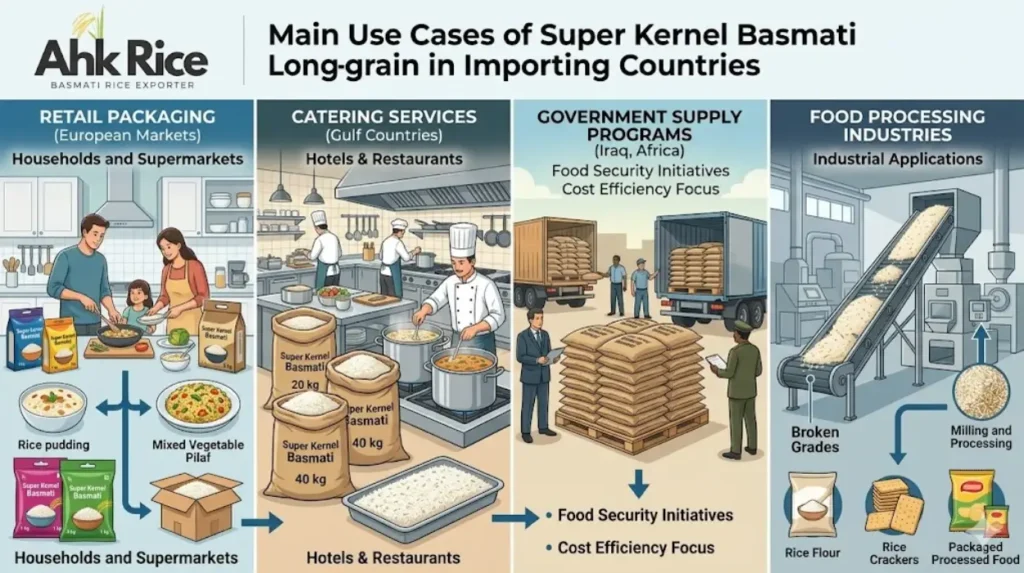
Super Kernel Basmati is used in retail packaging, catering services, government supply programs, and food processing industries, depending on market requirements.
Retail packaging dominates European markets. Supermarkets sell 1 kg to 5 kg packs to households. Consumers cook rice for daily meals and traditional dishes.
Catering services drive demand in the Gulf. Hotels and restaurants use bulk packaging such as 20 kg and 40 kg bags. These businesses require consistent cooking results for large-scale meal preparation.
Government supply programs operate in Iraq and African countries. Authorities distribute rice to support food security initiatives. Cost efficiency determines purchasing decisions in these programs.
Food processing industries use broken grades. Manufacturers produce rice flour and packaged food products. Lower-grade rice supports industrial use without affecting final product quality.
Use cases directly influence grade selection and packaging formats. With applications covered, the next section addresses common misconceptions about this export category.
What common problems or misconceptions exist about Super Kernel exports?
Common misconceptions include confusion with 1121 basmati, assumptions about lower quality, and misunderstanding of grading systems, which affect buyer decisions.
Buyers often confuse Super Kernel with 1121 Basmati. 1121 offers longer grains, typically above 8.0 mm, while Super Kernel remains shorter but still aromatic. This difference affects pricing and positioning.
Another misconception relates to quality. Super Kernel does not represent inferior rice. It serves a different market segment focused on value rather than premium specifications.
Grading systems also create confusion. A 25% broken grade does not indicate poor quality. It reflects a specific market requirement. African importers intentionally select higher broken percentages to reduce costs.
Storage misconceptions lead to losses. Buyers who store rice in humid conditions experience quality degradation. Exporters provide moisture-controlled packaging to prevent this issue.
Understanding these misconceptions improves procurement decisions and reduces supply chain risks. With challenges clarified, the full picture of global Super Kernel trade becomes clear.
Frequently Asked Questions
What is the average grain length of Super Kernel Basmati rice?
Super Kernel Basmati rice has an average grain length of 7.2–7.6 mm before cooking. After cooking, the grains elongate and remain separate, which supports its use in traditional dishes such as biryani and pilaf.
Which countries import the highest volume of Super Kernel Basmati from Pakistan?
The UAE, Saudi Arabia, and Iraq import the highest volumes of Super Kernel Basmati rice. These countries maintain consistent demand due to large populations, strong food service sectors, and established trade routes with Pakistan.
How long can Super Kernel Basmati rice be stored?
Super Kernel Basmati rice can be stored for 12–18 months under controlled conditions. Storage requires moisture levels below 14% and dry environments to prevent spoilage during long-term warehousing or transit.
What are the common export grades of Super Kernel Basmati rice?
Common export grades include 5%, 10%, 15%, and 25% broken rice. Each grade serves different markets, where lower broken percentages target premium buyers and higher broken percentages target cost-sensitive markets.
Why do buyers choose Super Kernel over 1121 Basmati rice?
Buyers choose Super Kernel because it offers a balance between cost and aroma. It provides reliable cooking performance at a lower price point than 1121 Basmati, making it suitable for bulk imports and large-scale consumption.