Golden Sella Basmati Rice: Nutrition Profile and Health Benefits Explained
Golden Sella Basmati rice is a parboiled long‑grain Basmati variety that combines the aromatic profile of Basmati with a strengthened nutrient‑retention pattern from the parboiling process. This rice provides a moderate‑energy‑density staple food that is rich in complex carbohydrates, B‑vitamins, and several minerals, making it suitable for everyday carbohydrate‑control and balanced‑meal‑structuring.
What is Golden Sella Basmati rice and which Basmati form is it?
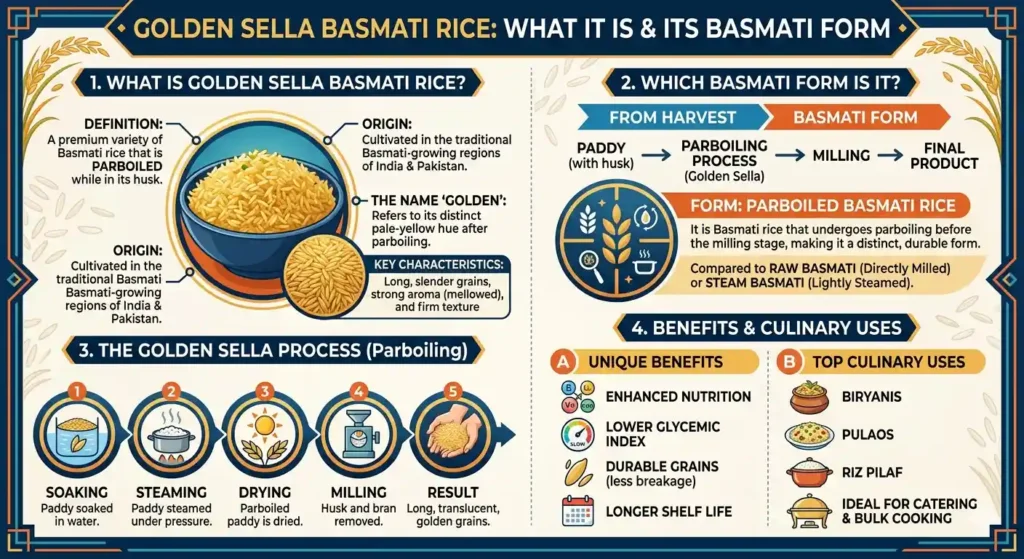
Golden Sella Basmati rice is a partially‑boiled whole‑grain Basmati that retains bran‑layer nutrients and develops a distinct yellow‑golden‑hue during the parboiling stage.
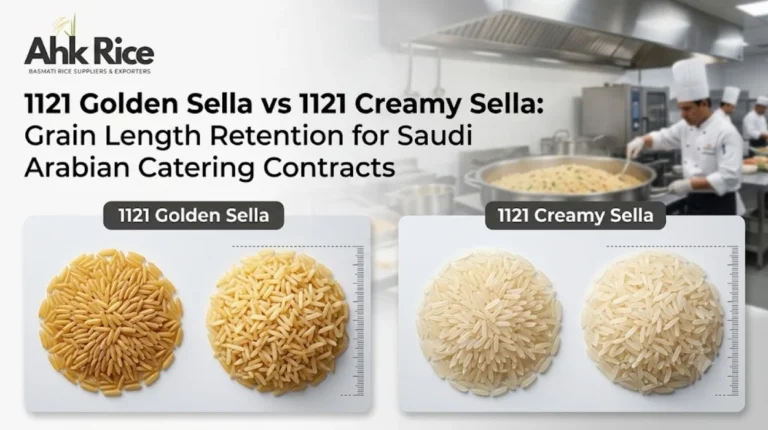
Golden Sella refers to 1121, 1509, or other Basmati types processed through a sella (parboiled) method, where paddy is soaked, steamed, dried, and then milled to retain part of the exterior‑bran‑layer. This differs from white Basmati, where the bran is fully removed, and from Creamy Sella, where more of the outer‑coat is polished away, producing a softer‑cream‑shade.
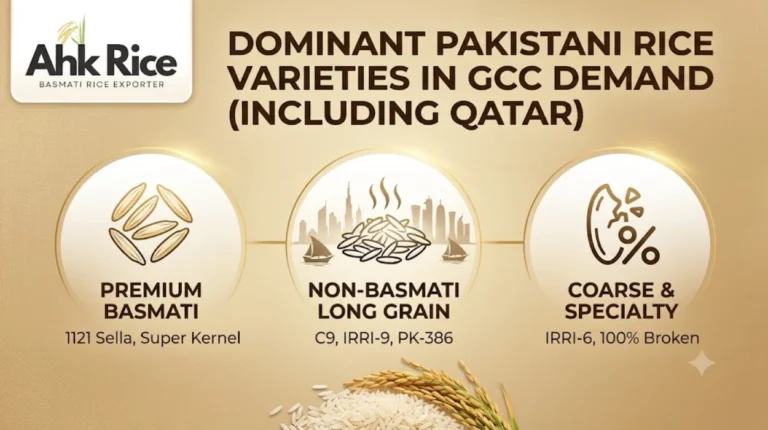
AHK Rice exports 1121, 1509, and Super Kernel Basmati in Golden Sella, Creamy Sella, and white forms, each graded by grain‑length, broken‑percentage, chalk, and moisture. Golden Sella sits in the parboiled‑Basmati‑segment, where steam‑and‑moisture treatment partially gelatinises the starch and migrates bran‑nutrients into the endosperm.
How does the parboiling process affect Golden Sella’s nutrition?
The parboiling process enhances Golden Sella’s nutrition by driving vitamins and minerals from the bran into the grain, increasing B‑complex‑vitamin retention and improving water‑resistance of the starch.
Raw Basmati paddy first undergoes cleaning to remove stones, husk fragments, and discoloured grains. After cleaning, the paddy soaks in water at about 40–50°C for 4–8 hours, depending on ambient‑temperature and moisture. During this phase, water‑soluble B‑vitamins (especially thiamine, niacin, and B6) and minerals such as magnesium and potassium start to move from the bran‑layer toward the starchy interior.
Next, the soaked paddy enters the steaming chamber, where steam at 100–110°C penetrates the husk and partially‑gelatinises the starch for 15–25 minutes. This heat‑and‑moisture‑treatment helps fix bran‑derived nutrients into the grain and improves its structural‑stability during storage and cooking.
The final drying stage reduces moisture from roughly 36–40% down to 12–13% for milling and storage. After hulling and controlled‑polishing, 18–20% of the grain remains as Golden Sella, showing visible golden‑strands, compared with fully‑white Basmati, where the bran‑layer is almost entirely removed.
What are the key nutritional components in Golden Sella Basmati?
Key nutritional components in Golden Sella Basmati include complex carbohydrates, plant‑based protein, B‑vitamins, and several minerals such as magnesium, phosphorus, and selenium, plus a moderate fibre‑content from retained‑bran.
Per 100 g of cooked Golden Sella Basmati, approximate values are:
- 130–140 kcal of energy;
- 28–30 g of carbohydrates, predominantly slow‑digesting starch;
- 2.5–3.5 g of protein;
- 0.8–1.2 g of fat;
- 1.0–1.5 g of dietary fibre;
- 20–30 mg of calcium;
- 0.8–1.2 mg of iron;
- 0.3–0.5 mg of zinc;
- 30–40 µg of selenium;
- 100–140 mg of magnesium;
- 120–160 mg of phosphorus.
Golden Sella also contains B‑vitamins such as thiamine (B1), riboflavin (B2), niacin (B3), and B6, which parboiling helps retain because these nutrients migrate from the bran into the grain rather than being lost in the milling‑water.
The fibre‑content in Golden Sella is higher than in white Basmati, mainly due to the partial‑retention of bran, which contributes to more stable blood‑sugar‑response compared with fully‑refined‑white rice.
How do Golden Sella’s vitamins and minerals support health?
Golden Sella’s vitamins and minerals support health by contributing to energy‑metabolism, nerve‑function, antioxidant‑defences, bone‑mineral‑health, and blood‑formation processes.
B‑vitamins such as thiamine, niacin, and B6 help convert carbohydrates into usable energy and maintain healthy nerve‑conduction, while magnesium and phosphorus contribute to muscle‑contraction, bone‑mineral‑density, and cell‑skeleton‑integrity. Iron from Golden Sella supports haemoglobin‑production, and zinc plays a role in immune‑regulation and enzyme‑activity.
Selenium provides antioxidant‑activity, protecting cell‑membranes from oxidative‑stress, and calcium and phosphorus help maintain bone‑and‑teeth‑structure. The combination of these nutrients, delivered within a moderate‑glycaemic‑load‑starch‑matrix, allows Golden Sella to function as a staple‑food that supplies both calories and micronutrients.
For example, including Golden Sella Basmati in balanced‑meals with vegetables, pulses, or lean‑protein can improve total‑dietary‑fibre‑intake, micronutrient‑diversity, and satiety‑effect compared with meals based on fully‑refined‑white‑rice alone.
What are the main health benefits of eating Golden Sella Basmati rice?
The main health benefits of eating Golden Sella Basmati rice are improved carbohydrate‑quality, higher micronutrient‑density, moderate‑fibre‑intake, and better‑post‑meal‑satiety compared with standard white‑rice, provided portion‑sizes are controlled.
Golden Sella provides complex‑carbohydrates that digest more slowly than highly‑refined‑white rice, which can lead to smoother blood‑sugar‑curves when consumed in sensible portions. The partial‑bran‑retention increases fibre‑content and micronutrient‑availability, supporting digestive‑comfort and long‑term‑micronutrient‑balance.
Including Golden Sella Basmati in rotation with other grains and legumes helps diversify dietary‑protein‑sources and micronutrient‑profiles. For example, pairing Golden Sella with lentils, chickpeas, or tofu increases total‑dietary‑protein and fibre, which can reduce hunger‑between‑meals and support metabolic‑health.
Because Golden Sella is still a starch‑based‑food, optimal benefit comes from moderate‑portioning, combined with vegetables, legumes, and healthy‑fats, rather than treating it as a standalone‑weight‑control‑product.
How is Golden Sella Basmati used in different cuisine types and settings?
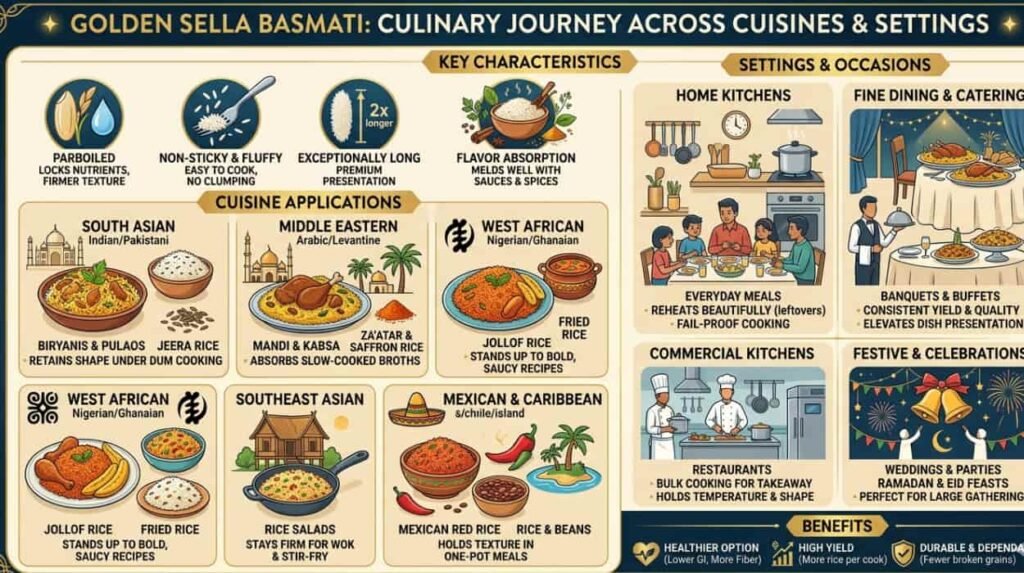
Golden Sella Basmati is used in many cuisine types and settings as a festive, daily‑staple, or institutional‑carbohydrate‑source, thanks to its mild‑aromatic‑flavour, firm‑texture, and colour‑appeal.
In Middle‑Eastern and South‑Asian‑households, Golden Sella appears in pilafs, biryanis, and celebratory‑rice‑dishes where the golden‑hue signals quality and festive‑occasion. In institutional‑settings such as school‑canteens, hospitals, and catered‑events, Golden Sella provides a structurally‑stable, high‑yield grain that holds its shape across multiple portions.
Caterers in the Iraq‑Gulf‑region, where 1121 and 1509 Golden Sella are popular, often use it for large‑tray‑serves, banquet‑meals, and hotel‑buffets, blending Golden Sella with white‑Basmati or Creamy Sella to balance cost, colour, and texture.
For buyers who want to compare 1121 Golden Sella versus 1509 Golden Sella specifically for Iraq‑and‑Gulf‑catering‑contracts, the golden sella 1121 vs 1509 Iraq Gulf catering buyers guide presents a grade‑by‑grade and market‑pricing‑analysis that supports bulk‑purchase‑decisions.
What are common misconceptions about Golden Sella’s health and nutrition?
Common misconceptions about Golden Sella’s health and nutrition include the belief that parboiled‑rice is “low‑carb,” or that the golden‑colour indicates artificial‑dye, when in reality Golden Sella is still a carbohydrate‑dense food with natural‑colour‑from‑bran‑pigments.
Some consumers assume that Golden Sella is low‑energy, but it contains roughly 130–140 kcal per 100 g cooked, similar to other parboiled rice‑types, and higher than many whole‑grain‑barley or whole‑wheat‑options per gram of starch. Others think the golden‑hue must come from added colourants, but certified Golden Sella must pass additive‑and‑dye‑tests, and the colour originates from carotenoid‑like‑bran‑pigments fixed during parboiling.
Another misconception is that Golden Sella alone can control diabetes or weight; in fact, blood‑sugar‑and‑weight‑management depends on portion‑size, total‑diet‑composition, and activity‑level, not a single‑rice‑type.
Understanding these points helps position Golden Sella as a nutritionally‑enhanced‑staple‑food, not a functional‑health‑pill.