UAE Rice Import Market: Why Pakistan Basmati Dominates Dubai Wholesale
Pakistan basmati dominates the UAE rice import market because it delivers 8.0–8.4 mm grain length, consistent aroma, and stable supply chains that meet Dubai wholesale demand. Here is why: Pakistan exports over 4 million tons annually, and the UAE imports a major share for re-export and local consumption (source: REAP export data, December 2025).
What is the UAE rice import market and how does Pakistan basmati fit into it?
The UAE rice import market is a structured trade system where over 90% of rice is imported, and Pakistan basmati holds a leading share due to premium quality and geographic proximity.
The UAE rice import market refers to the sourcing, importing, storage, and redistribution of rice into domestic and regional markets. The UAE produces negligible rice domestically because desert climate limits cultivation. Import dependency reaches above 90%, making it a global rice trade hub.
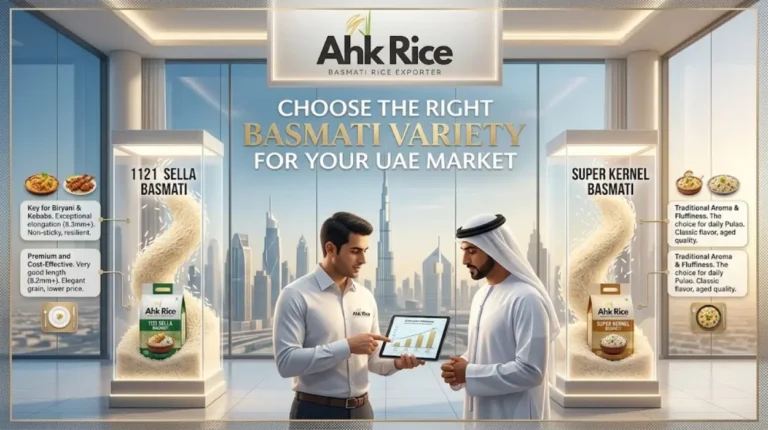
Pakistan basmati fits into this system as a primary supplier of aromatic long-grain rice. Pakistani exporters cultivate basmati in Punjab using canal irrigation from the Indus Basin. This region produces 1121, Super Kernel, and 1509 varieties, which match UAE consumer preferences for long grains and fragrance.
Dubai acts as the central node. Dubai wholesale markets distribute rice to supermarkets, catering companies, and re-export destinations such as Oman, Saudi Arabia, and East Africa. Pakistan’s short shipping distance of 3–5 days via sea freight ensures faster stock turnover compared to India or Thailand.
With the market defined, the next question is how the UAE basmati trade actually functions step by step.
How does the UAE basmati trade work from cultivation to Dubai wholesale?
The UAE basmati trade works through 9 defined steps: cultivate, harvest, clean, dehusk, polish, grade, sort, pack, ship, ensuring consistent quality from farm to Dubai wholesale markets.
Cultivate the paddy
Farmers cultivate basmati rice in Punjab during the Kharif season. Sowing starts in June, and harvesting completes by October. Irrigation uses canal water, which maintains grain elongation potential.
Harvest the crop
Farmers harvest mature paddy when moisture reaches 20–22%. Timely harvesting prevents grain breakage during milling.
Clean the paddy
Processors clean the paddy to remove stones, dust, and husk fragments. Mechanical cleaners ensure uniform input for milling.
Dehusk the grain
Rice mills dehusk the paddy to separate brown rice from husk layers. Rubber roll shellers maintain grain integrity.
Polish the rice
Mills polish the rice to remove bran layers. Polishing levels vary depending on buyer requirements, such as silky finish for retail or semi-polished for catering.
Grade by size
Processors grade rice based on grain length and thickness. For example, 1121 basmati achieves 8.2 mm average length, while Super Kernel reaches 7.5 mm.
Sort by quality
Optical sorters remove discolored and broken grains. Sorting ensures export-grade consistency.
Pack the rice
Exporters pack rice in 5 kg, 10 kg, 25 kg, and 40 kg bags. Packaging types include PP woven bags, BOPP laminated bags, and jute bags.
Ship to UAE
Logistics teams load containers, clear customs, and ship rice to Jebel Ali Port. Transit time averages 3–5 days, enabling rapid distribution.
This structured process explains reliability. The next step is understanding the key components that define this trade system.
What are the key components of Dubai rice wholesale and UAE basmati trade?
Dubai rice wholesale operates through 5 key components: supply chain infrastructure, quality grading systems, import regulations, storage facilities, and distribution networks.
Supply chain infrastructure
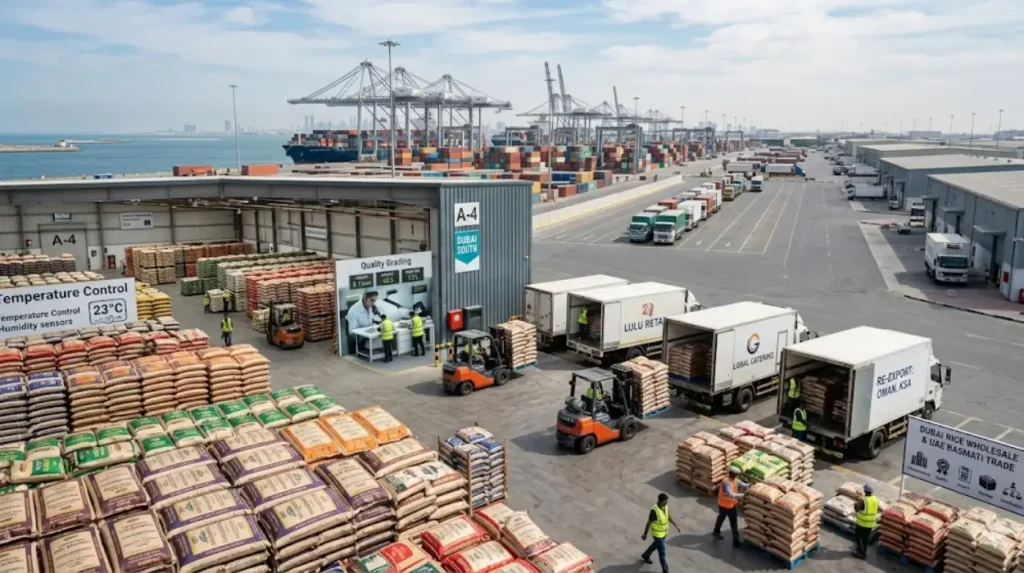
Dubai uses advanced port facilities at Jebel Ali. High container throughput supports bulk rice imports exceeding 1 million tons annually (source: UAE trade statistics, 2025).
Quality grading systems
Importers classify rice using measurable parameters:
- Grain length: 6.5–8.4 mm
- Broken percentage: 1–5%
- Moisture content: 12–14%
These metrics ensure consistency across shipments.
Import regulations
Authorities inspect and certify imported rice. Documentation includes phytosanitary certificates, fumigation reports, and origin certificates. These documents confirm compliance with UAE food safety standards.
Storage facilities
Warehouses in Dubai maintain temperature control between 20–25°C. Proper storage prevents insect infestation and preserves aroma.
Distribution networks
Wholesalers distribute rice to:
- Retail supermarkets (examples: Carrefour, Lulu)
- Catering companies (examples: hotel chains, airline kitchens)
- Re-export markets (examples: Oman, Qatar, Kenya)
These components explain market structure. The next question is why Pakistan basmati specifically dominates this system.
Why does Pakistani rice meet UAE demand better than other origins?
Pakistani rice meets UAE demand because it offers longer grains, stronger aroma, competitive pricing, and stable logistics, outperforming Indian and Thai alternatives in wholesale markets.
Pakistani basmati delivers grain elongation ratios of 2.5–3 times after cooking. This characteristic suits biryani and mandi dishes popular in the UAE. Indian basmati also offers length, but price volatility increases due to export restrictions in certain years.
Thai jasmine rice serves different use cases. Thai rice has shorter grains of 6.5–7 mm and softer texture. UAE consumers prefer firmer, longer grains for traditional dishes, which Pakistani basmati provides.
Pricing stability strengthens Pakistan’s position. Freight costs from Karachi to Dubai remain lower than Southeast Asian routes. Shorter distance reduces shipping delays and ensures fresh stock rotation.
Demand data confirms this dominance. UAE imports significant volumes of Pakistani rice annually, contributing to Pakistan’s export revenue of over $2.5 billion (source: Pakistan Bureau of Statistics, FY2024-25).
With demand explained, the next focus is the benefits driving buyer decisions.
What benefits do UAE buyers gain from Pakistani basmati rice?
UAE buyers gain consistent grain length, extended shelf life, strong cooking performance, and flexible packaging options, making Pakistani basmati ideal for wholesale and catering.
Pakistani basmati maintains grain integrity during cooking. Rice elongates without breaking, which improves presentation in dishes like biryani and kabsa. Catering buyers benefit from consistent portion control because grain expansion remains predictable.
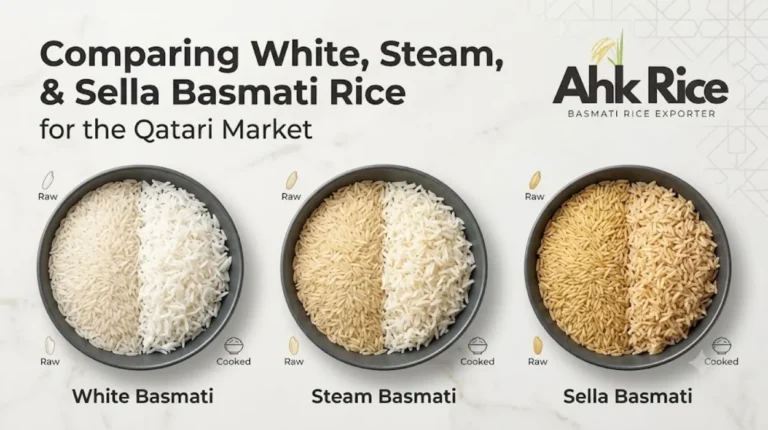
Shelf life provides another advantage. Properly processed basmati maintains quality for 12–18 months under warehouse conditions. Golden Sella variants last longer due to parboiling, while Steam variants require faster turnover.
Packaging flexibility supports different segments. Retail buyers prefer 5 kg and 10 kg bags, while catering buyers use 25 kg and 40 kg bulk packs. Exporters customize packaging to match brand and market requirements.
These benefits explain adoption across sectors. The next step is exploring specific use cases within Dubai wholesale markets.
What are the main use cases of Pakistani rice in Dubai wholesale?
Pakistani rice serves 3 primary use cases: retail consumption, food service catering, and re-export trading, each requiring specific grades and packaging formats.
Retail consumption
Supermarkets sell branded basmati rice to households. Consumers prefer premium grades such as 1121 Steam for daily cooking.
Food service catering
Hotels, restaurants, and airline kitchens procure bulk rice. Catering buyers select Golden Sella for durability during long cooking cycles.
A deeper comparison of processing types helps buyers choose correctly. A detailed explanation of parboiling differences can be explored through this guide on choosing between golden sella and steam rice for UAE catering operations.
Re-export trading
Dubai traders re-export rice to regional markets. African and Middle Eastern buyers often prefer lower broken percentages and competitive pricing.
Use cases highlight market diversity. The next section addresses common problems and misconceptions in the UAE rice import market.
What common problems and misconceptions exist in UAE basmati trade?
Common problems include confusion between grades, incorrect storage practices, and misunderstanding of processing types, which directly impact rice quality and buyer satisfaction.
Grade confusion affects procurement decisions. Buyers often assume all 1121 rice has identical quality. In reality, grading varies by broken percentage, polish level, and grain uniformity. For example, 1121 with 2% broken differs significantly from 5% broken in appearance and price.
Storage mistakes reduce quality. High humidity above 65% causes moisture absorption. This leads to fungal growth and aroma loss. Proper warehouse conditions prevent these issues.
Processing misunderstandings create mismatched expectations. Golden Sella rice undergoes parboiling, which hardens the grain. Steam rice remains softer and cooks faster. Buyers selecting the wrong type face operational inefficiencies in catering environments.
Mislabeling also appears in some markets. Non-basmati rice sometimes enters supply chains labeled as basmati. Certification and inspection processes help eliminate such risks.
These challenges highlight the importance of knowledge. The final section connects all insights into a broader understanding of market dynamics.
How does the UAE rice import market continue to evolve?
The UAE rice import market evolves through increasing demand, stricter quality standards, and diversification of supply sources, while Pakistan maintains dominance through consistency and scale.
Population growth drives demand. The UAE population exceeds 10 million, with expatriates forming a major share. Diverse food preferences increase rice consumption across cuisines.
Quality standards continue to tighten. Import authorities enforce stricter testing for pesticide residues and contaminants. Exporters must meet these standards to maintain market access.
Supply diversification occurs as buyers explore multiple origins. However, Pakistan retains a leading position due to its established trade relationships and consistent product quality.
Digital trade platforms also reshape procurement. Buyers now compare specifications, certifications, and prices online before placing bulk orders. Transparency improves decision-making.
With the evolution explained, the market outlook becomes clearer. Pakistan basmati remains central due to its alignment with UAE demand patterns.
Frequently Asked Questions
What makes Pakistani basmati rice different from other rice types?
Pakistani basmati rice differs because it offers long grains measuring 7.5–8.4 mm, strong natural aroma, and high elongation after cooking. These traits come from cultivation in Punjab’s fertile plains using canal irrigation.
Why does Dubai import most of its rice instead of producing it locally?
Dubai imports rice because its desert climate lacks sufficient water and suitable soil for cultivation. The UAE depends on imports for over 90% of its food supply, including rice.
Which Pakistani rice varieties are most popular in the UAE market?
The UAE market mainly uses 1121, Super Kernel, and 1509 basmati varieties. These varieties meet demand for long grains, consistent cooking results, and suitability for dishes like biryani and mandi.
How long does basmati rice last in UAE storage conditions?
Basmati rice lasts 12–18 months when stored at 20–25°C with controlled humidity below 65%. Golden Sella rice lasts longer than Steam due to its parboiled structure.
What certifications are required for exporting rice to the UAE?
Rice exports require phytosanitary certificates, fumigation reports, certificates of origin, and quality inspection reports. These documents ensure compliance with UAE food safety regulations.