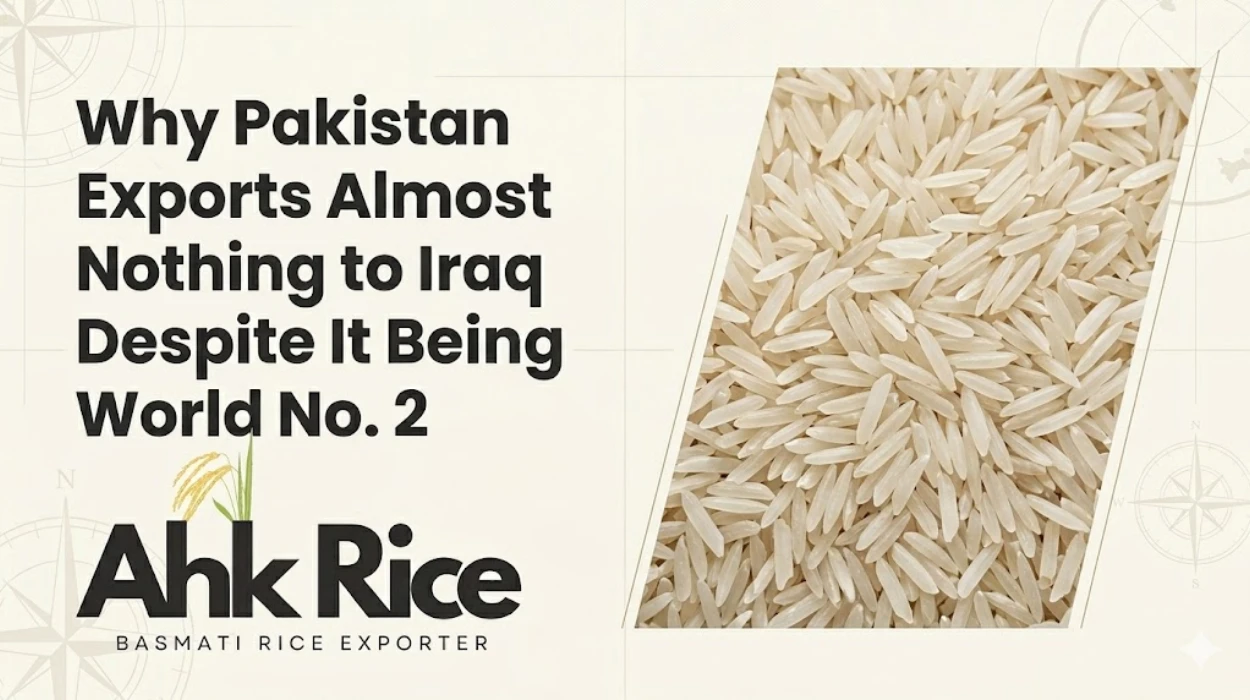
Why Pakistan Exports Almost Nothing to Iraq Despite It Being World No. 2
Pakistan exports only a small volume of Basmati rice to Iraq despite Iraq being one of the world’s largest Basmati-consuming markets. The gap exists because Iraq imports primarily through government tenders, prefers specific supplier relationships, buys significant volumes from India and alternative origins, and prioritizes procurement systems that Pakistan has not consistently captured. Here is why the trade gap exists and what market factors shape it.
What Is the Pakistan–Iraq Rice Trade Gap?
Pakistan supplies only a limited share of Iraq’s Basmati demand despite Iraq ranking among the largest import markets for aromatic rice in the Middle East.
The Pakistan–Iraq rice trade gap refers to the difference between Iraq’s total rice import demand and the relatively small volume sourced from Pakistan. Iraq imports hundreds of thousands of metric tons of rice annually for household consumption, public distribution programs, restaurants, catering businesses, and food processors.
Iraq consumes both Basmati and non-Basmati rice. Basmati occupies a premium position because consumers associate long grains, aroma, and elongation after cooking with quality meals.
Pakistan produces internationally recognized Basmati varieties including 1121 Basmati, Super Kernel Basmati, and 1509 Basmati. Despite this production base, Pakistan does not dominate Iraqi imports.
The trade imbalance creates a noticeable market opportunity because Iraq already understands and consumes Basmati rice at scale. The challenge is not product awareness. The challenge is market access and procurement structure.
With the trade gap defined, the next question is why Iraq imports so much rice in the first place.
Why Does Iraq Import Such Large Volumes of Basmati Rice?
Iraq depends on imported rice because domestic production cannot satisfy national demand for premium aromatic rice varieties.
Iraq has a population exceeding 45 million people and rice forms part of everyday food consumption. Local agricultural production does not provide enough premium aromatic rice to meet market requirements.
Iraqi consumers purchase rice through several channels:
- Household retail markets
- Government food distribution programs
- Catering companies
- Hotels
- Restaurants
- Food wholesalers
Basmati rice occupies a premium category within these channels. Long-grain aromatic rice is used for traditional meals, hospitality services, wedding events, and institutional catering.
Iraqi importers source rice from multiple origins to maintain supply stability. Import diversification reduces dependency on a single exporting country and protects procurement programs from supply disruptions.
Import demand explains why Iraq remains strategically important. The next question is how rice reaches Iraq through international trade channels.
How Does Iraq Source Rice From Global Suppliers?
Government tenders, private importers, wholesalers, and institutional buyers control most rice procurement in Iraq.
Iraq purchases imported rice through structured procurement systems. Government agencies often issue large tenders for public food distribution programs. Private importers manage commercial retail and wholesale demand.
The sourcing process follows a predictable structure:
- Define procurement specifications
- Issue import requirements
- Evaluate supplier qualifications
- Inspect product samples
- Verify certifications
- Award contracts
- Load cargo
- Ship containers
- Clear customs
- Deliver inventory
Government tenders often determine large-volume rice purchases. Winning these contracts requires competitive pricing, compliance documentation, consistent quality, and established procurement relationships.
Private-sector buyers focus on product performance. Grain length, aroma retention, cooking yield, broken percentage, moisture content, and packaging specifications influence purchasing decisions.
Procurement structure explains how Iraq buys rice. The next question is why Pakistan struggles to secure larger market share.
Why Does Pakistan Export So Little Rice to Iraq?
Tender access, supplier relationships, pricing competition, logistics preferences, and procurement history restrict Pakistan’s market penetration.
Pakistan possesses strong production capacity but market access depends on more than cultivation and milling.
Government Tender Concentration
Government procurement programs account for substantial rice volumes. Tender systems often favor suppliers with established performance records and long procurement histories.
Tender participation requires:
- Performance guarantees
- Financial capacity
- Compliance certificates
- Shipment reliability
- Historical delivery records
New suppliers face higher entry barriers because procurement authorities prioritize supply continuity.
Competition From Alternative Origins
India remains one of the largest suppliers of Basmati rice globally. Large export volumes create economies of scale that influence pricing structures.
Indian exporters frequently participate in markets where buyers prioritize volume availability, procurement familiarity, and established trading relationships.
Thai and Vietnamese rice exporters also compete in non-Basmati segments. These suppliers occupy portions of Iraq’s overall rice demand.
Limited Market Development
Market development requires sustained importer engagement. Long-term buyer relationships often determine repeat business more than production capacity alone.
Importers prefer suppliers who consistently provide:
- Stable specifications
- Reliable shipment schedules
- Standardized quality
- Responsive communication
- Predictable pricing structures
Market access barriers explain the trade gap. The next question is whether Pakistani rice specifications match Iraqi demand.

Which Pakistani Rice Varieties Fit Iraqi Market Requirements?
1121 Basmati, Super Kernel Basmati, and 1509 Basmati align closely with Iraqi consumer preferences for long-grain aromatic rice.
Pakistan cultivates several Basmati varieties suitable for Iraq.
1121 Basmati Rice
1121 Basmati is known for extra-long grain length and strong elongation after cooking.
Key characteristics include:
- Raw grain length exceeding 8 mm
- High cooked grain expansion
- Distinct aroma
- Premium appearance
Restaurants and hospitality businesses value 1121 because presentation quality remains consistent across large meal volumes.
Super Kernel Basmati Rice
Super Kernel Basmati combines traditional aroma with strong consumer recognition.
Key characteristics include:
- Traditional Basmati fragrance
- Long grain structure
- Good cooking performance
- Strong retail acceptance
Super Kernel remains popular across Middle Eastern markets because consumers associate it with authentic Basmati characteristics.
1509 Basmati Rice
1509 Basmati offers a balance between quality and affordability.
Key characteristics include:
- Long grain structure
- Fast cooking performance
- Competitive pricing
- Consistent appearance
Institutional buyers frequently evaluate 1509 because it supports large-scale meal preparation.
Buyers comparing cost efficiency and cooking performance often evaluate the differences between 1121 and 1509 grades. A detailed comparison is available in our guide on which Basmati specification Iraqi catering companies typically select for large-volume meal service.
How Is Pakistani Basmati Rice Processed for Export Markets?
Export-grade Basmati follows a structured processing chain that protects grain quality, food safety, and specification consistency.
Rice processing transforms harvested paddy into export-ready product.
The process follows nine primary steps:
- Harvest the paddy
- Clean foreign matter
- Dry moisture uniformly
- De-husk the grain
- Mill the rice
- Polish the kernels
- Grade by size
- Sort through color sorters
- Pack for export
Quality control accompanies every stage.
Processors inspect:
- Moisture content
- Broken percentage
- Grain length
- Purity level
- Foreign matter presence
Export buyers rely on these specifications because rice performance depends on processing consistency.
Processing explains product quality. The next question is which certifications Iraqi buyers typically expect.
Which Certifications Support Rice Exports to Iraq?
Food safety, quality assurance, and shipment compliance certifications support international rice trade with Iraqi buyers.
Importers evaluate certifications before awarding contracts.
Common requirements include:
- Phytosanitary Certificate
- Certificate of Origin
- Fumigation Certificate
- Health Certificate
- Quality Inspection Report
Many international buyers also request management system certifications.
Examples include:
- ISO 22000
- HACCP
- BRCGS
- Halal Certification
Certification requirements vary by importer category. Government buyers often request broader documentation than private wholesalers.
Compliance standards explain trade readiness. The next question is whether misconceptions exist about Iraq’s rice market.
What Misconceptions Exist About Iraq’s Basmati Market?
The largest misconception is that product quality alone determines export success in Iraq.
Many exporters assume superior grain specifications automatically generate sales. International trade operates differently.
Procurement systems evaluate multiple variables simultaneously.
Examples include:
- Supplier history
- Delivery reliability
- Documentation accuracy
- Tender participation
- Financial guarantees
Another misconception involves consumer preference.
Iraqi buyers do not purchase one single rice specification. Different segments prefer different grades.
Examples include:
- Premium retail buyers
- Government procurement agencies
- Restaurant operators
- Catering companies
- Food wholesalers
Each segment evaluates value differently.
Market complexity explains why export success requires more than quality. The next question is where future opportunities exist.
What Is the Future Potential of Iraq for Pakistani Basmati Rice?
Iraq remains one of the strongest untapped growth markets for Pakistani Basmati exports because demand already exists and consumer familiarity is established.
Market expansion does not require creating new demand. Iraqi consumers already purchase and consume imported rice at large scale.
Growth opportunities exist through:
- Increased importer partnerships
- Better tender participation
- Consistent market presence
- Stronger logistics networks
- Targeted product positioning
Premium Basmati demand continues to align with the strengths of Pakistani rice production. Long grains, aroma, and cooking performance already match regional consumption preferences.
Institutional food service growth also creates opportunities. Catering companies, restaurants, hotels, and event operators require consistent rice specifications for large-scale meal preparation.
Iraq’s demand structure remains attractive because it combines government procurement volume with private-sector consumption. This combination creates multiple pathways for exporters seeking market access.
The Pakistan–Iraq rice gap therefore reflects procurement dynamics rather than a mismatch between Iraqi demand and Pakistani production capability.
Frequently Asked Questions
Why does Iraq import large quantities of Basmati rice?
Iraq imports large quantities of Basmati rice because domestic rice production does not meet demand for premium aromatic long-grain varieties. Households, restaurants, catering companies, and government food programs depend on imported rice supplies throughout the year.
Is Iraq one of the biggest markets for Basmati rice?
Yes. Iraq ranks among the largest Basmati-consuming countries in the Middle East. Strong consumer preference for long-grain aromatic rice supports significant import volumes from major rice-exporting countries.
Which Pakistani rice varieties are suitable for Iraqi buyers?
1121 Basmati, Super Kernel Basmati, and 1509 Basmati are the main Pakistani varieties suitable for Iraq. These varieties offer long grain length, aroma, cooking performance, and specifications required by retail, wholesale, and foodservice buyers.
Why does Pakistan have a small share of Iraq’s rice imports?
Pakistan’s share remains limited because Iraqi rice procurement depends on government tenders, established supplier relationships, competitive pricing structures, and long-term importer partnerships. Product quality alone does not determine market access.
What certifications are commonly required for rice exports to Iraq?
Common requirements include a Phytosanitary Certificate, Certificate of Origin, Fumigation Certificate, Health Certificate, and Quality Inspection Report. Many importers also request food safety certifications such as ISO 22000, HACCP, and Halal certification.