How to Choose a Reliable Basmati Rice Supplier in Pakistan
Choosing a supplier with verified processing, export compliance, consistent quality, and transparent documentation delivers better long-term value than selecting the lowest price. Here is why: certified exporters maintain consistent grain specifications, reduce shipment risks, and ensure every container meets buyer expectations.
Importing Basmati rice requires more than finding a competitive quotation. Buyers evaluate production capacity, quality systems, processing technology, export experience, certifications, and logistics before placing repeat orders. Learning these evaluation criteria helps importers reduce procurement risks and improve supply consistency. For a complete understanding of Pakistan’s rice production and export ecosystem, read our guide on Pakistani Basmati rice cultivation and export process.
A supplier becomes valuable through consistent performance rather than marketing claims. AHK Rice, a trusted Pakistani Basmati rice exporter based in Punjab, supplies 1121, Super Kernel, and 1509 Basmati varieties to more than 15 countries. The company provides end-to-end processing, custom packaging, and complete export documentation, making it an example of how modern exporters operate.
What makes a Basmati rice supplier reliable?
A reliable supplier consistently delivers certified quality, transparent pricing, standardized processing, export documentation, and on-time shipments. Buyers benefit from predictable product performance, fewer quality disputes, and stronger long-term supply relationships when every shipment follows measurable quality standards rather than inconsistent market practices.
A Basmati rice supplier is a company that procures paddy, mills rice, grades grains, packages products, and exports finished rice according to international buyer specifications. Reliable suppliers manage every stage instead of depending entirely on third-party processors.
Several measurable factors define supplier reliability.
- Export experience
- Modern milling facilities
- Food safety certifications
- Consistent grain grading
- Moisture control
- Laboratory testing
- International logistics capability
Each factor reduces business risk. For example, moisture testing prevents fungal growth during sea transportation. Colour sorting removes defective kernels before packaging. Laboratory analysis verifies purity before shipment.
Reliable suppliers also publish clear specifications instead of generic descriptions. Buyers should receive measurable values such as grain length, broken percentage, moisture level, foreign matter, crop year, packaging options, and container loading capacity.
Why supplier consistency matters
Consistency reduces purchasing costs over multiple shipments.
A restaurant distributor importing five containers every month requires identical cooking performance across every batch. Different grain lengths or moisture percentages create customer complaints and unnecessary returns.
Professional exporters therefore standardize every production stage.
With supplier reliability established, the next question becomes how available sourcing approaches compare.
How do different supplier types compare?
Integrated exporters provide greater quality control than trading companies because they supervise processing, inspection, packaging, and shipping. Traders mainly coordinate purchases, while manufacturers control production, making integrated exporters the preferred option for buyers seeking consistent specifications and long-term partnerships.
Different supplier models serve different purchasing requirements.
Comparison of Supplier Types
Supplier Specification Comparison
| Attribute | Integrated Exporter | Trading Company | Local Broker |
|---|---|---|---|
| Production Control | Excellent | Limited | None |
| Quality Inspection | In-house | Third-party | Varies |
| Processing Facility | Own Mill | External Mills | External |
| Price Stability | High | Moderate | Low |
| Traceability | Complete | Partial | Limited |
| Documentation | Complete Export Set | Usually Complete | Often Limited |
| Long-term Supply | Strong | Moderate | Weak |
Integrated exporters supervise cultivation partnerships, milling, grading, packaging, inspection, and shipment. This reduces quality variation.
Trading companies purchase rice from multiple mills. Product quality may vary between shipments because different manufacturers process the rice.
Local brokers mainly connect buyers with suppliers. They often provide competitive prices but offer limited quality assurance.
Price Comparison Per Metric Ton
| Rice Type | Integrated Exporter | Trader | Broker |
|---|---|---|---|
| 1121 Steam | Lower long-term cost | Moderate | Variable |
| 1121 Sella | Stable | Variable | Variable |
| Super Kernel | Stable | Moderate | Higher after commissions |
| 1509 Steam | Stable | Moderate | Variable |
The lowest quotation rarely produces the lowest procurement cost. Shipment delays, inconsistent quality, and rejected containers increase overall purchasing expenses.
Having compared supplier models, buyers should now evaluate which specifications suit different international markets.
Which Basmati rice grades suit different export markets?
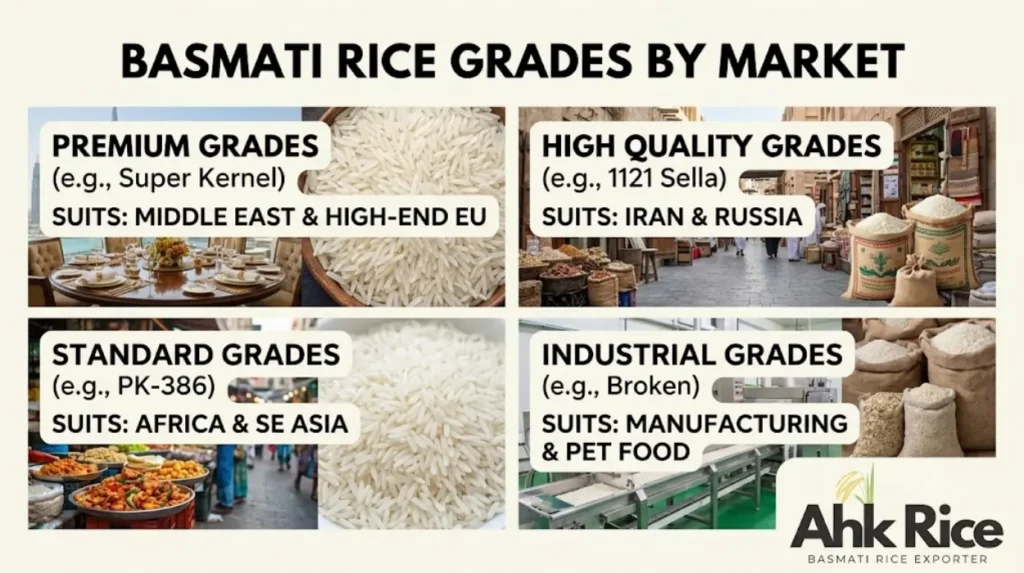
Different regions prioritize different grain characteristics, cooking qualities, and processing methods. Matching the correct grade with each destination market improves customer satisfaction, reduces inventory issues, and strengthens repeat business because buyers receive rice aligned with regional consumer preferences.
Middle East Market
The Gulf region generally prefers premium long-grain rice.
Popular grades include:
- 1121 Steam Basmati
- 1121 Golden Sella
- Super Kernel Basmati
Hotels, catering companies, and supermarkets prioritize extra-long grains, aroma, and elongation after cooking.
European Market
European importers emphasize food safety compliance.
Preferred grades include:
- 1121 Steam
- Organic Basmati
- Super Kernel Steam
European buyers also require stronger documentation, traceability, and laboratory testing before shipment.
Shelf Life Comparison
| Grade | Shelf Life |
|---|---|
| 1121 Steam | 12–18 Months |
| 1121 Golden Sella | 18–24 Months |
| Super Kernel | 12–18 Months |
| 1509 Steam | 12–18 Months |
Golden Sella performs better during long storage because parboiling strengthens grain structure.
Understanding regional preferences helps buyers compare supplier capabilities beyond pricing alone. The next step is evaluating the available sourcing solutions.
Frequently Asked Questions
How do I verify whether a Basmati rice supplier in Pakistan is reliable?
Verify the supplier’s export history, food safety certifications, milling facilities, laboratory testing procedures, and documentation process. Request recent inspection reports, product specifications, and samples before placing a bulk order. Reliable suppliers also provide transparent communication and consistent shipment schedules.
Which certifications should a Pakistani Basmati rice exporter have?
A professional exporter should maintain certifications such as ISO 22000, HACCP, and, where required, Halal certification. Depending on the destination market, additional certifications like BRC, FDA registration, or Organic certification may also be necessary. These certifications demonstrate compliance with international food safety standards.
What is the best Basmati rice grade for international importers?
The ideal grade depends on your target market. 1121 Steam Basmati is preferred for premium retail brands because of its aroma and cooking quality. 1121 Golden Sella is suitable for catering and foodservice businesses due to its longer shelf life and firmer grains. Super Kernel Basmati remains popular in traditional markets because of its authentic fragrance and texture.
Should I choose a manufacturer or a trading company?
An integrated manufacturer and exporter usually offers better quality control, product traceability, and pricing consistency because the company manages milling, grading, packaging, and exports under one system. Trading companies can provide wider sourcing options but may depend on third-party processors, leading to greater variation between shipments.
What documents should a reliable rice exporter provide?
A professional exporter should supply a Commercial Invoice, Packing List, Bill of Lading, Certificate of Origin, Phytosanitary Certificate, Fumigation Certificate, Quality Inspection Report, and any destination-specific compliance documents. Complete documentation helps customs clearance proceed smoothly and minimizes delays.
Why is sample evaluation important before placing a bulk order?
A product sample confirms grain length, moisture content, purity, cooking performance, aroma, and packaging quality before production begins. Testing samples also helps buyers compare multiple suppliers objectively and reduces the risk of receiving products that do not meet agreed specifications.
How can buyers compare prices without sacrificing quality?
Compare suppliers using the total procurement cost instead of the lowest quotation. Evaluate grain specifications, broken percentage, moisture level, certifications, packaging quality, shipping reliability, and after-sales support alongside the price per metric ton. A slightly higher purchase price often delivers better long-term value through fewer quality issues and stronger customer satisfaction.
What questions should I ask before selecting a Basmati rice supplier?
Ask about annual export capacity, available rice varieties, milling technology, quality inspection methods, certifications, packaging options, production lead time, container loading capacity, payment terms, and shipment schedules. Detailed answers indicate operational transparency and export readiness.