Qatar’s Growing Premium Food Import Market and Rice Demand Outlook
Qatar’s premium food import market will continue expanding because consumers, hotels, restaurants, and retailers increasingly prefer premium-quality imported food products. Here is why: higher disposable incomes, tourism growth, luxury hospitality investments, and strong food security policies continue increasing demand for premium Pakistani Basmati rice alongside other imported specialty foods.
Qatar imports most of its food requirements because local agricultural production remains limited by climate and water availability. Government investment in supply chain resilience has strengthened long-term import opportunities while encouraging diversification among international suppliers. Businesses evaluating this market should first understand consumption trends before choosing sourcing strategies. Readers seeking a broader understanding of Pakistan’s export opportunity can begin with our guide on Pakistan’s rice export opportunities in Gulf markets.
Premium rice remains one of the fastest-growing categories because households, luxury hotels, catering companies, and international restaurants value consistent grain length, aroma, cooking performance, and reliable supply. AHK Rice’s Pakistani Basmati rice export service supports these requirements through end-to-end processing, custom packaging, quality inspection, export documentation, and international shipping from Punjab to more than fifteen countries.
What makes Qatar one of the fastest-growing premium food import markets?
Qatar’s premium food sector grows because high-income consumers, luxury hospitality, international tourism, and government food security investments consistently increase demand for imported premium food products across retail and commercial channels.
Qatar possesses one of the world’s highest GDP per capita levels. High purchasing power allows consumers to prioritize food quality instead of selecting products solely on price. Premium packaged foods therefore continue expanding across supermarkets and specialty retailers.
Tourism also drives demand. International sporting events, business conferences, luxury hotels, and fine dining restaurants require dependable supplies of imported premium ingredients throughout the year.
Food security has become another important growth factor. Qatar has diversified its international supplier base since regional supply disruptions demonstrated the importance of multiple sourcing partners. Importers now evaluate suppliers according to reliability, certifications, consistency, and logistics performance rather than price alone.
Rice benefits directly from these developments because it serves households, hotels, restaurants, airlines, catering companies, and institutional kitchens simultaneously.
Understanding market growth naturally leads to comparing the different rice specifications available to buyers.
What premium rice solutions are available for Qatari importers?
Three major premium rice categories dominate Qatar: Pakistani Basmati, Indian Basmati, and premium long-grain non-Basmati rice. Each serves different consumer expectations, price points, and commercial applications.
Pakistani Basmati rice represents the traditional premium segment. Buyers choose it for its natural aroma, long grain, soft texture, and superior elongation after cooking.
Indian Basmati offers similar characteristics while providing broader availability because of larger export volumes.
Premium long-grain non-Basmati rice appeals to institutional kitchens requiring affordability, consistency, and high-volume cooking.
Specification Comparison Table
| Attribute | Pakistani Basmati | Indian Basmati | Premium Long Grain |
|---|---|---|---|
| Grain Length | 8.2–8.5 mm | 8.1–8.4 mm | 6.8–7.3 mm |
| Aroma | Natural | Natural | Mild |
| Elongation | 2.0–2.3× | 1.9–2.2× | Limited |
| Texture | Soft | Soft | Firm |
| Preferred Market | Retail & Luxury Hotels | Retail | Catering |
| Typical Packaging | 1–40 kg | 1–40 kg | 25–50 kg |
| Shelf Life | 18–24 months | 18–24 months | 12–18 months |
Pakistani premium varieties remain especially attractive for supermarkets and premium retailers because consumers associate authentic Basmati aroma with higher quality and better dining experiences.
Comparing specifications helps buyers evaluate which solution matches operational requirements.
How do different sourcing approaches compare?
Direct sourcing from exporters, trading companies, and international distributors each offer different advantages regarding pricing, quality control, logistics, and supply reliability.
Direct procurement from exporters provides greater transparency throughout cultivation, milling, grading, inspection, packaging, and shipping. Buyers communicate directly with the production source.
Trading companies simplify purchasing by combining multiple suppliers into one shipment. This approach reduces procurement complexity but often increases costs.
International distributors maintain local inventory and faster delivery schedules. However, pricing generally includes warehousing and regional distribution expenses.
Price Comparison per Metric Ton
| Supply Method | Typical Price Range (USD/MT) |
|---|---|
| Direct Pakistani Exporter | $950–1,350 |
| International Trader | $1,050–1,450 |
| Local Distributor | $1,150–1,600 |
Price differences alone should never determine supplier selection. Inspection procedures, certifications, shipment consistency, and after-sales communication significantly affect long-term procurement success.
The next consideration involves matching product grades with different buyer segments.
Which rice grades work best for different buyers in Qatar?
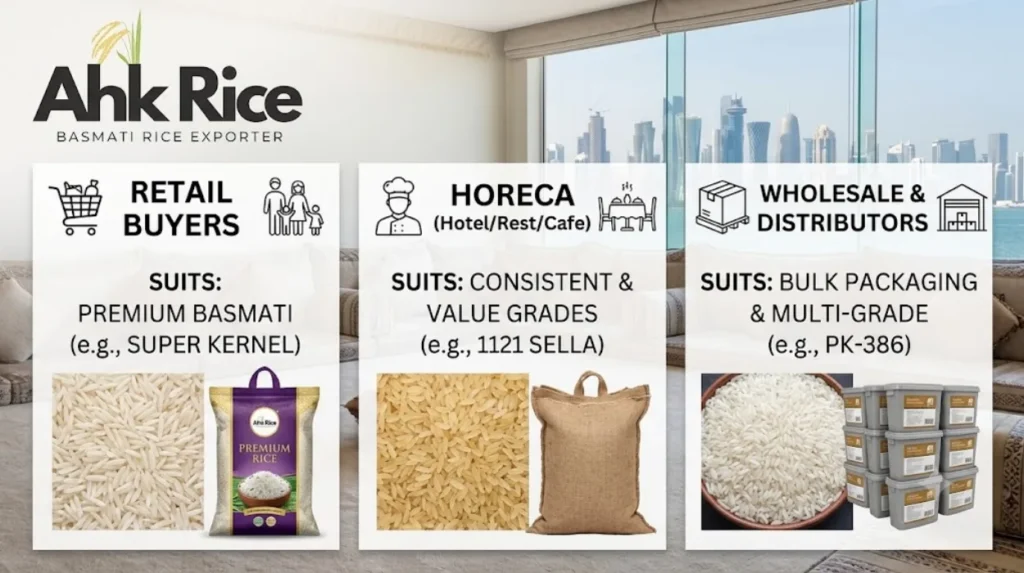
Retail supermarkets prefer premium whole-grain varieties, while hotels, restaurants, and catering companies prioritize cooking consistency, volume efficiency, and dependable year-round supply.
Retail Market
Retail consumers actively seek:
- 1121 Extra Long Grain Basmati
- Super Kernel Basmati
- Premium branded packaging
- Attractive retail presentation
- Consistent aroma
Retail customers willingly pay premium prices for recognizable quality.
Hospitality and Foodservice Market
Hotels, restaurants, airline caterers, and banquet operators emphasize operational efficiency.
Preferred grades include:
- 1121 Steam Basmati
- 1121 Golden Sella
- 1509 Basmati
- Bulk packaging
- Stable cooking performance
Large commercial kitchens value grain integrity because consistent presentation improves customer satisfaction while reducing preparation waste.
Different buyer groups therefore require different procurement strategies rather than one universal product specification.
What are the advantages and disadvantages of each sourcing strategy?
Every sourcing strategy balances cost, flexibility, quality control, and logistics differently. The optimal choice depends on purchasing volume, product specifications, and long-term procurement goals.
| Strategy | Advantages | Limitations |
|---|---|---|
| Direct Exporter | Better pricing, greater transparency | Larger minimum orders |
| Trading Company | Multiple sourcing options | Additional margin |
| Local Distributor | Faster delivery | Higher pricing |
| Private Label Supply | Brand development | Higher planning requirements |
| Spot Buying | Flexibility | Price volatility |
A supermarket importing branded retail products benefits from direct sourcing because packaging, labeling, and quality specifications remain customizable.
A restaurant purchasing smaller monthly quantities may prefer local distribution because inventory becomes immediately available.
These comparisons prepare buyers for evaluating the final purchasing criteria.
Which decision factors should buyers evaluate before selecting a supplier?
Supplier verification, product consistency, certifications, logistics capability, and communication quality determine procurement success more effectively than price alone.
Decision Framework
| Evaluation Factor | Importance | Recommended Assessment |
|---|---|---|
| Product Quality | Very High | Laboratory testing |
| Processing Standards | Very High | Factory inspection |
| Export Experience | High | Shipment history |
| Certifications | High | ISO, HACCP, phytosanitary |
| Logistics Capability | High | Shipping schedules |
Experienced importers also review moisture levels, broken percentage, grain length, milling consistency, fumigation procedures, packaging quality, and export documentation before placing commercial orders.
Reliable suppliers maintain consistent specifications across every shipment instead of varying quality between production batches.
Qatar’s premium food market rewards suppliers capable of delivering consistent value over many years rather than competing only through lower prices.
Qatar’s premium food import market continues expanding through rising consumer expectations, hospitality growth, and stronger food security initiatives. Premium Pakistani Basmati rice occupies an increasingly important position because it satisfies quality, aroma, presentation, and cooking performance requirements across retail and commercial sectors.
Businesses comparing sourcing options should evaluate complete supply capabilities rather than focusing exclusively on purchase price. Product consistency, certifications, logistics expertise, inspection systems, and export experience collectively reduce procurement risk while improving long-term profitability.
As buyers move from evaluating the market to selecting export partners, the next step is understanding how professional importers verify suppliers before signing contracts.
Frequently Asked Questions
Why does Qatar import most of its rice?
Qatar imports most of its rice because its arid climate limits large-scale agricultural production. Imported rice ensures a stable food supply for households, restaurants, hotels, and catering businesses. Pakistani Basmati, Indian Basmati, and other premium long-grain varieties dominate the market due to their quality, aroma, and consistent availability.
Which type of rice is most popular in Qatar?
Premium Pakistani Basmati rice, especially 1121 Extra Long Grain and Super Kernel Basmati, is highly popular in Qatar. Consumers value its natural aroma, extra-long grains, soft texture, and excellent cooking performance. Hotels and fine-dining restaurants also prefer these varieties for premium meal presentations.
What factors drive the growth of Qatar’s premium food import market?
Several factors contribute to market growth, including increasing disposable income, luxury tourism, expanding hospitality projects, food security initiatives, and changing consumer preferences toward premium imported foods. These trends continue increasing demand for high-quality rice and specialty food products.
How do Qatari importers choose a reliable Pakistani rice supplier?
Professional importers evaluate suppliers based on product consistency, export experience, food safety certifications, laboratory testing, packaging quality, shipping reliability, and documentation accuracy. They also request product samples before confirming long-term purchase agreements.