Receive Complete Rice Export Documentation from AHK Rice
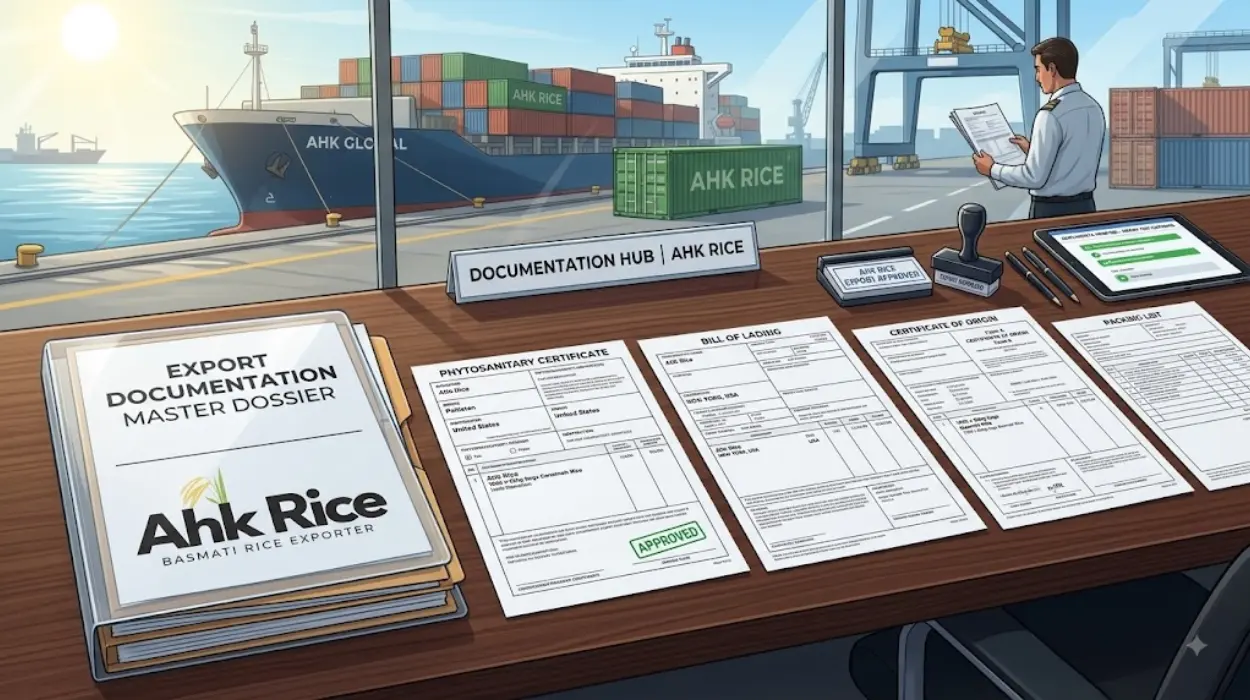
AHK Rice provides a complete rice export documentation workflow covering commercial, customs, phytosanitary, origin, packing, quality, and shipping records. Here is why: complete documents keep the cargo aligned with customs requirements from processing through dispatch and destination clearance.
Northern Ireland buyers can also review why import documentation matters for rice buyers before comparing suppliers. AHK Rice connects the physical rice shipment with the documentation required to identify, inspect, clear, and receive the cargo.
What is the best solution for complete rice export documentation?
The best solution is one exporter-managed document workflow covering invoice, packing list, origin, phytosanitary, fumigation, quality, customs, and bill of lading records before vessel departure. This reduces document mismatches and gives importers one coordinated source for shipment information.
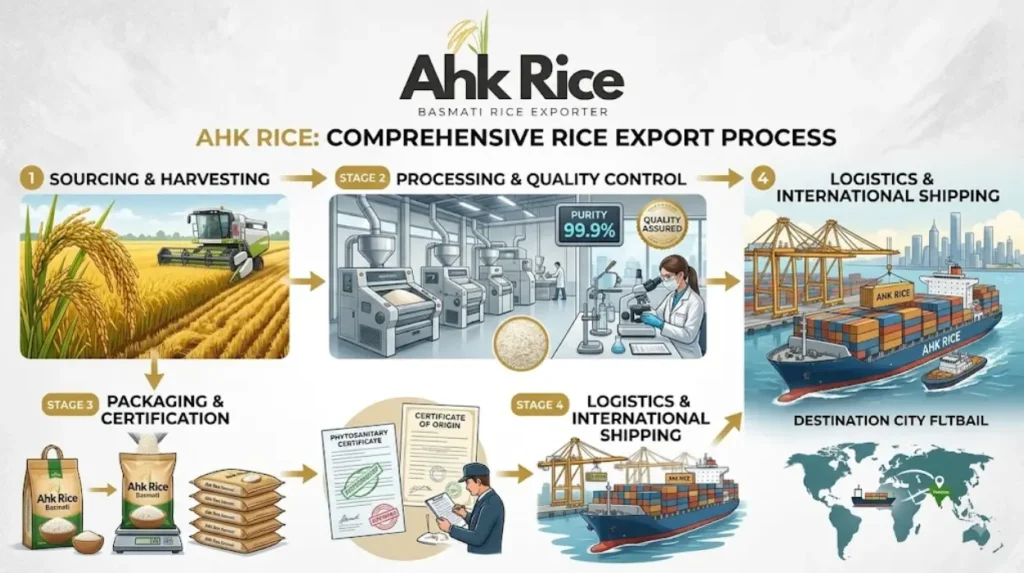
Rice export documentation follows the physical shipment. The exporter first confirms the rice specification, quantity, packaging, and destination requirements. The mill then processes, grades, sorts, tests, and packs the rice.
The documentation set normally includes:
- Commercial Invoice — records product, quantity, price, buyer, and seller.
- Packing List — records bags, weights, packaging, and container details.
- Certificate of Origin — verifies Pakistani origin for destination customs.
- Phytosanitary Certificate — confirms plant-health compliance for the rice shipment.
- Bill of Lading — records carriage and shipment details.
- Fumigation Certificate — confirms applicable pest-treatment requirements.
- Quality Certificate — records tested shipment specifications.
- Goods Declaration — supports Pakistani export customs processing.
Pakistan’s Trade Information Portal lists commercial invoice, packing list, Form-E, phytosanitary documentation for food-related exports, and other applicable records within export customs procedures.
The Department of Plant Protection lists a PKR 2,500 phytosanitary certificate fee and a 1–3 working-day processing window under its web-based procedure.
How export documents support smooth rice shipment clearance provides the comparison-stage explanation. That article can help buyers understand why each document matters before choosing an exporter.
The documentation solution therefore starts before container loading. It does not begin after the vessel sails.
Why choose AHK Rice for rice export documentation?
AHK Rice combines rice processing, specification control, export documentation, packaging, inspection coordination, container loading, and shipment dispatch into one buyer-facing workflow. The benefit is stronger document-to-cargo consistency and fewer handoffs between unrelated suppliers.
AHK Rice supplies Pakistani Basmati rice including 1121, Super Kernel, and 1509. The product specification becomes the reference point for commercial documents, packing records, quality checks, and shipment instructions.
1121 Basmati gives buyers a premium long-grain specification for retail, wholesale, catering, and foodservice applications. Super Kernel Basmati provides another premium Pakistani Basmati option for buyers requiring consistent grain characteristics.
1509 Basmati gives importers another long-grain sourcing option where the required specification and commercial position match the market.
AHK Rice uses processing stages that include cleaning, de-husking, polishing, grading, sorting, moisture testing, foreign-material inspection, packaging, and container loading. These stages create measurable information that can support the export documentation.
The workflow also supports custom packaging requirements. Packaging records can identify bag size, net weight, product description, and shipment quantities.
Third-party inspection can provide additional verification before loading. Importers can request inspection arrangements when their contract or destination requirements demand independent verification.
Documentation accuracy also depends on matching the commercial invoice with the packing list. Weight, quantity, product description, container details, and shipping information should remain consistent across the shipment file.
AHK Rice therefore positions documentation as part of export execution rather than as an administrative afterthought.
What shipping days can buyers expect by market?
Shipping time depends on destination port, vessel routing, transshipment, origin handling, customs, and final delivery. UAE lanes can take about 4–10 sailing days, Saudi routes about 18–26 days, and UK routes about 28–40 days.
| Market | Typical route | Indicative shipping timeline |
|---|---|---|
| UAE | Karachi → Jebel Ali | 4–10 sailing days |
| Saudi Arabia | Karachi → Jeddah | 18–22 days |
| Saudi Arabia | Karachi → Dammam | 20–26 days |
| UK | Karachi → Felixstowe | 28–40 days |
| Northern Ireland | Karachi → Belfast | 46+ days by fastest container route |
UAE market information currently places Karachi-to-Jebel-Ali sailing time at approximately 4–10 days. Saudi shipment information places Karachi-to-Jeddah at approximately 18–22 days and Karachi-to-Dammam at 20–26 days, depending on clearance and routing.
UK routes require more planning. Current Karachi-to-Felixstowe ocean estimates are approximately 28–33 days for standard FCL services. AHK Rice’s UK route guide gives a broader 28–40-day total delivery range after inland movement, port handling, customs, and final delivery.
Northern Ireland requires route-specific planning. A current Karachi-to-Belfast container routing can take approximately 46 days and 11 hours, while an LCL route shown through Rotterdam is estimated at 71 days.
These figures are planning benchmarks, not guaranteed delivery dates. Vessel availability, transshipment, customs inspection, port congestion, and route disruption can extend the timeline.
AHK Rice can therefore prepare documentation around the selected destination and shipping arrangement rather than using one generic export document package.
What results can be expected from a complete documentation workflow?
Buyers can expect better document consistency, faster document retrieval, clearer customs preparation, stronger shipment traceability, and fewer avoidable discrepancies between rice cargo and export records. These outcomes directly support smoother procurement and distribution planning.
A complete documentation workflow gives the importer one organized shipment record. The commercial invoice identifies the transaction. The packing list identifies physical cargo. The certificate of origin establishes origin. The phytosanitary certificate supports plant-health compliance.
The bill of lading connects the cargo with the carrier. Quality and inspection documents provide evidence of tested shipment characteristics.
For Northern Ireland buyers, document preparation should be completed before the cargo reaches the destination. Importers should also confirm current UK requirements with their customs agent and relevant authorities.
For Gulf buyers, destination requirements can include additional compliance or certification requirements. The exact requirement depends on the destination country, product, packaging, and applicable regulations.
AHK Rice can align the export file with the agreed product and shipment specification. This gives the buyer a clearer record to share with freight forwarders, customs agents, banks, and receiving teams.
The result is not simply more documents. The result is a shipment file where the documents describe the same physical cargo.
What does a complete rice export process cost?
Export cost depends on rice grade, quantity, packaging, destination, freight, inspection, certification, customs handling, and delivery terms. A current UK example shows why buyers should compare the complete shipment cost rather than rice price alone.
Consider a 27 MT 1121 Basmati shipment moving from Karachi to Felixstowe.
A current indicative FOB range for 1121 Basmati is approximately $1,165–$1,205 per MT. That places 27 MT of rice at approximately $31,455–$32,535 before freight and destination charges.
A current Karachi-to-Felixstowe 40-foot FCL freight indication is approximately $5,210–$5,636.
The illustrative FOB-plus-ocean-freight calculation is therefore approximately:
| Cost component | Illustrative amount |
|---|---|
| 27 MT rice | $31,455–$32,535 |
| Ocean freight | $5,210–$5,636 |
| Phytosanitary fee | PKR 2,500 |
| Destination charges | Buyer-specific |
| Import duties/taxes | Buyer-specific |
| Final delivery | Buyer-specific |
The illustrative shipment subtotal before destination charges is approximately $36,665–$38,171 plus PKR 2,500.
This example is not a quotation. Freight rates change with cargo-ready date, carrier, route, equipment, surcharges, and booking conditions. Certification and destination costs also depend on the shipment.
AHK Rice can price the actual order against the selected rice grade, quantity, packaging, destination port, and shipping terms.
How can buyers get started with AHK Rice?
Start by sending the rice grade, quantity, packaging requirement, destination port, delivery term, and required documentation. AHK Rice can then align product specification, export paperwork, shipment planning, and commercial pricing.
Start the process with these five details:
- Specify the rice grade — Select 1121, Super Kernel, 1509, or another required specification.
- Confirm the quantity — State metric tons, container quantity, or planned purchase volume.
- Confirm the packaging — Provide bag size, material, printing, and private-label requirements.
- Confirm the destination — State country, destination port, and final delivery location.
- Confirm the documents — Identify certificates, inspection records, and customs documents required.
AHK Rice can then structure the shipment around the buyer’s commercial and compliance requirements. The exporter can coordinate processing, quality verification, packaging, documentation, loading, and dispatch.
The decision should focus on total shipment control rather than the lowest rice price. A lower product price does not create value when documentation errors cause customs delays, storage charges, or missed distribution schedules.
AHK Rice gives buyers a practical route from product selection to export documentation and shipment execution. The next step is to submit the order requirements for a destination-specific commercial quotation.
Request a rice export quotation
Frequently Asked Questions
What documents does a Pakistani rice exporter provide?
A complete file normally includes the commercial invoice.
The packing list identifies quantities and weights.
The certificate of origin verifies Pakistani origin.
Phytosanitary, fumigation, quality, and shipping documents may also apply.
Destination requirements determine the final documentation set.
How long does rice shipping from Pakistan take?
UAE sailing can take about 4–10 days.
Saudi routes can take about 18–26 days.
Felixstowe routes can take about 28–40 days.
Northern Ireland routes can require 46 days or more.
Actual timing depends on routing and destination handling.
How much does rice export documentation cost?
Documentation costs depend on destination requirements.
Pakistan’s phytosanitary procedure lists a PKR 2,500 fee.
Additional certificates can create separate charges.
Inspection requirements can also affect total cost.
Buyers should request a shipment-specific cost breakdown.
Can AHK Rice arrange export documentation for UK buyers?
AHK Rice can structure the export documentation around the shipment.
The file can include commercial and customs records.
Product and packing details should match the documents.
UK buyers should confirm destination requirements with their customs agent.
Route and certification requirements should be confirmed before booking.
What information should a buyer provide for a quote?
Provide the required rice variety and quantity.
State the packaging size and destination port.
Provide the preferred shipping term and delivery location.
List any inspection or certification requirements.
These details allow AHK Rice to prepare a more accurate commercial proposal.