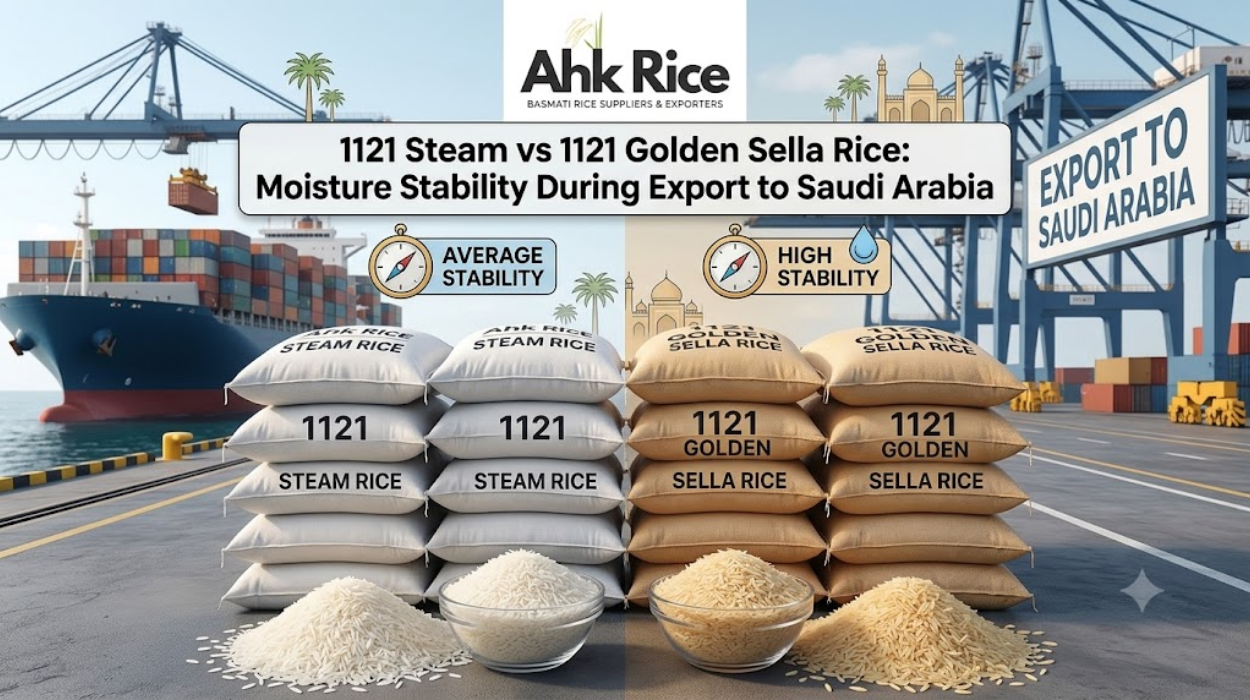
1121 Steam vs 1121 Golden Sella Rice: Moisture Stability During Export to Saudi Arabia
Saudi Arabian importers seeking maximum moisture stability during long-distance shipping generally achieve more consistent storage performance with 1121 Golden Sella Rice, while 1121 Steam Rice remains the preferred choice where lighter colour, faster cooking, and premium table presentation are prioritised.
Saudi Arabia remains one of the largest import destinations for Pakistani Basmati rice. Importers evaluate more than grain length and aroma. Moisture stability during storage, transportation, and distribution directly affects shelf life, cooking consistency, breakage, and commercial value. Understanding how processing influences moisture retention helps buyers reduce quality risks throughout the supply chain. To better understand export-grade quality specifications before comparing these processing methods, read our guide on Pakistani Basmati rice export quality standards.
AHK Rice supplies 1121 Basmati Rice in multiple processing grades for international buyers. The company manages cleaning, milling, grading, colour sorting, packaging, fumigation, container loading, and export documentation from Punjab, Pakistan, enabling consistent quality for buyers across more than 15 countries.
How do 1121 Steam Rice and 1121 Golden Sella Rice differ during export?
1121 Steam Rice and 1121 Golden Sella Rice originate from the same premium Basmati variety, but their processing methods create different moisture behaviour, storage characteristics, grain strength, cooking texture, and export performance. These differences become increasingly important during long-distance shipments to Saudi Arabia’s warm climate and extended warehousing periods.
1121 Basmati refers to a long-grain aromatic rice variety cultivated primarily in Punjab, Pakistan. The distinction between Steam and Golden Sella lies entirely in post-harvest processing rather than genetics.
1121 Steam Rice
Steam Rice undergoes controlled steaming after milling. The process improves grain strength while preserving its naturally white appearance. The rice remains soft in colour and produces a lighter cooked texture.
1121 Golden Sella Rice
Golden Sella Rice undergoes parboiling before milling. Paddy is soaked, steamed under pressure, and dried before husking. This process gelatinises starch inside the grain, increasing structural strength and reducing moisture migration during storage.
Because the grain structure changes during parboiling, Golden Sella generally tolerates higher temperatures and longer storage periods more effectively than Steam Rice.
Which specification differences matter most for Saudi Arabian importers?
Saudi Arabian buyers compare technical specifications rather than appearance alone because moisture stability influences shelf life, transport safety, customer satisfaction, and commercial profitability throughout wholesale distribution and retail supply chains. Export specifications therefore become purchasing criteria instead of simple product descriptions.
| Specification | 1121 Steam Rice | 1121 Golden Sella Rice |
|---|---|---|
| Processing | Controlled steaming | Full parboiling process |
| Grain colour | White | Golden |
| Moisture stability | High | Very High |
| Grain hardness | Medium-High | Very High |
| Breakage resistance | High | Excellent |
| Storage performance | Excellent | Outstanding |
| Export suitability for long transit | Excellent | Best for extended storage |
These specifications explain why many commercial importers request Golden Sella for bulk distribution while premium hospitality businesses often continue selecting Steam Rice.
How does moisture stability affect rice exports to Saudi Arabia?
Moisture stability determines whether rice maintains grain integrity, aroma, cooking quality, and commercial value throughout transportation, customs clearance, warehousing, wholesale distribution, and final retail storage. Stable moisture reduces quality deterioration and extends marketable shelf life considerably.
Rice exported from Pakistan typically travels by sea before entering Saudi distribution networks.
During this journey, containers encounter changing temperatures between ports, inland transport, storage yards, and warehouses.
Moisture fluctuations may contribute to:
- Reduced cooking consistency
- Grain cracking
- Increased breakage during handling
- Aroma reduction
- Shorter storage life
- Higher commercial losses
Professional exporters maintain export moisture levels within internationally accepted ranges, generally around 12–13%, depending on buyer specifications and destination requirements.
Golden Sella’s parboiling process binds moisture more uniformly within the grain, reducing internal stress caused by temperature fluctuations.
Steam Rice also performs well but remains slightly more sensitive under prolonged storage conditions.
What solutions are available for buyers seeking better moisture stability?
Importers improve moisture stability through processing selection, controlled drying, moisture testing, packaging quality, container preparation, and warehouse management rather than relying on a single factor. Combining these solutions produces the most reliable export performance for Saudi Arabian supply chains.
Several approaches improve export outcomes.
Solution 1: Select the appropriate processing method
Processing has the greatest influence on moisture behaviour.
Golden Sella performs exceptionally well during extended storage.
Steam Rice provides excellent stability for premium retail markets requiring brighter appearance.
Solution 2: Maintain export-grade moisture
Proper drying before packing reduces condensation risk.
Modern processing plants continuously monitor moisture using calibrated equipment.
Solution 3: Use quality packaging
Multi-layer PP bags with inner liners reduce external moisture exposure.
Vacuum packaging may be used for smaller retail packs.
Solution 4: Container preparation
Dry containers minimise condensation.
Ventilation planning further reduces moisture accumulation.
Solution 5: Warehouse management
Temperature-controlled or well-ventilated storage preserves grain quality after arrival.
Each solution contributes to maintaining export standards.
How do Steam and Golden Sella compare across major Saudi market segments?
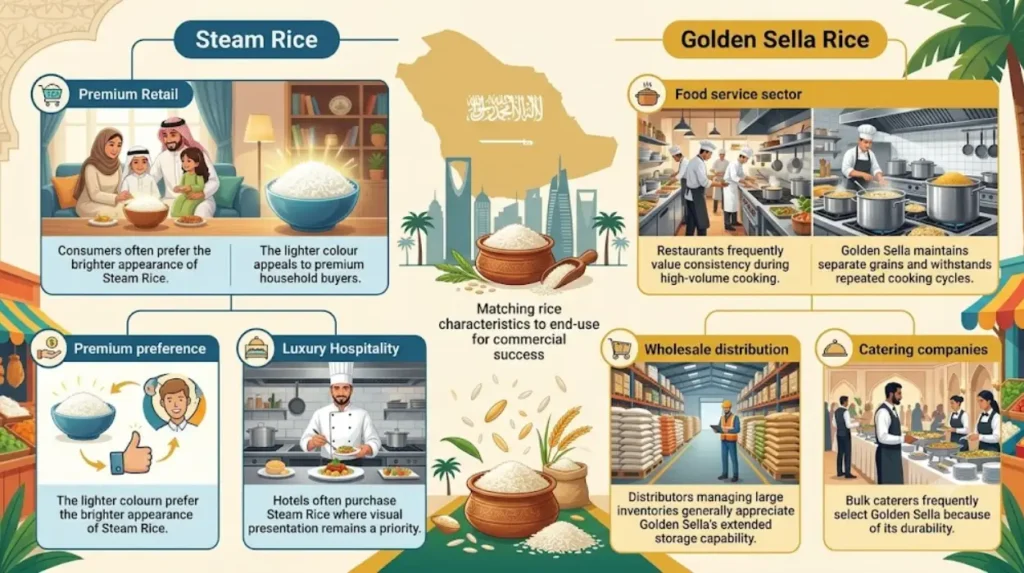
Different sectors within Saudi Arabia purchase rice according to cooking requirements, storage duration, consumer preferences, and pricing strategies rather than selecting one universal processing type. Matching product characteristics with end-use delivers stronger commercial performance and customer satisfaction.
Food service sector
Restaurants frequently value consistency during high-volume cooking.
Golden Sella maintains separate grains and withstands repeated cooking cycles.
Premium retail
Consumers often prefer the brighter appearance of Steam Rice.
The lighter colour appeals to premium household buyers.
Wholesale distribution
Distributors managing large inventories generally appreciate Golden Sella’s extended storage capability.
Catering companies
Bulk caterers frequently select Golden Sella because of its durability.
Luxury hospitality
Hotels often purchase Steam Rice where visual presentation remains a priority.
Which export grade does each international market generally prefer?
Regional buying preferences differ because climate, consumer expectations, cuisine, storage duration, and purchasing patterns influence import specifications. Exporters therefore customise grades according to destination market requirements instead of supplying identical products worldwide.
Market comparison
| Market Region | Preferred Grade | Main Reason |
|---|---|---|
| Saudi Arabia | 1121 Golden Sella | Longer storage, foodservice demand |
| GCC Premium Retail | 1121 Steam Rice | Whiter appearance, premium presentation |
Saudi Arabia imports substantial volumes of Golden Sella for wholesale distribution and institutional catering.
Premium supermarkets and hospitality chains continue purchasing Steam Rice where appearance strongly influences consumer preference.
How do prices compare between Steam Rice and Golden Sella in 2026?
Processing costs, export demand, crop quality, freight conditions, and international purchasing trends influence pricing. Golden Sella generally commands slightly higher prices because additional processing increases production costs while delivering improved storage performance and grain durability.
Approximate export pricing (2026):
| Product | Average Export Price (USD/MT) |
|---|---|
| 1121 Steam Rice | $980–1,090 |
| 1121 Golden Sella Rice | $1,030–1,160 |
Actual contract prices vary depending on:
- Crop season
- Broken percentage
- Packaging
- Destination port
- Contract volume
- Currency exchange rates
Which product offers the longer shelf life?
Shelf life depends upon moisture control, packaging, hygiene, and warehouse conditions, but processing still influences long-term stability. Golden Sella typically maintains commercial quality for longer storage periods under suitable export and warehouse management practices.
| Product | Typical Commercial Shelf Life* |
|---|---|
| 1121 Steam Rice | 18–24 months |
| 1121 Golden Sella Rice | 24–30 months |
*When stored under recommended dry warehouse conditions with export-grade packaging.
Longer shelf life provides greater flexibility for distributors handling larger inventories.
What are the advantages and disadvantages of each option?
Each processing method offers clear commercial strengths depending upon buyer objectives. Selecting the right option requires balancing storage stability, appearance, pricing, cooking characteristics, and intended market rather than assuming one grade suits every application equally well.
1121 Steam Rice
Advantages
- Bright white appearance
- Excellent aroma
- Faster cooking
- Premium retail appeal
- Preferred for luxury dining
Limitations
- Slightly lower storage stability than Golden Sella
- More sensitive during prolonged warehousing
Example
A premium supermarket supplying high-end consumers may prioritise Steam Rice because appearance strongly influences purchasing decisions.
1121 Golden Sella Rice
Advantages
- Excellent moisture stability
- Longer shelf life
- Stronger grains
- Lower breakage
- Better bulk storage performance
Limitations
- Golden colour differs from white rice
- Slightly longer cooking time
Example
A Saudi wholesale distributor storing inventory for several months typically benefits from Golden Sella’s enhanced storage characteristics.
Which option works best for different buying situations?
Choosing between Steam and Golden Sella depends upon inventory turnover, customer expectations, warehouse duration, product positioning, and cooking application. Decision-making becomes simpler when buyers evaluate operational requirements instead of focusing only on purchase price.
| Buying Situation | Recommended Choice | Reason |
|---|---|---|
| Premium supermarkets | Steam Rice | Visual appearance |
| Hotels | Steam Rice | Elegant presentation |
| Restaurants | Golden Sella | Grain durability |
| Bulk distributors | Golden Sella | Storage stability |
| Government supply tenders | Golden Sella | Long shelf life |
What factors should buyers evaluate before placing an export order?
Professional buyers assess processing quality, moisture content, grading consistency, packaging, certifications, export capability, and supply reliability together because these factors collectively determine shipment performance, customer satisfaction, and long-term procurement success.
Consider the following decision framework before finalising purchases.
| Decision Factor | Why It Matters | Steam Rice | Golden Sella |
|---|---|---|---|
| Storage duration | Determines quality retention | Good | Excellent |
| Retail appearance | Consumer preference | Excellent | Good |
| Bulk warehousing | Inventory protection | Good | Excellent |
| Grain strength | Handling losses | Very Good | Excellent |
| Overall moisture stability | Export performance | High | Very High |
Evaluating these factors helps importers align product selection with commercial objectives rather than relying solely on pricing.
Both 1121 Steam Rice and 1121 Golden Sella Rice deliver premium Pakistani Basmati quality, but they serve different commercial requirements. Steam Rice offers exceptional appearance and premium dining appeal, while Golden Sella provides superior moisture stability, stronger grain structure, and longer storage performance for Saudi Arabia’s wholesale and foodservice markets.
Exporters that maintain controlled moisture levels, advanced processing, quality packaging, and consistent grading enable buyers to preserve grain quality throughout international transportation and storage.
For buyers comparing long-term procurement options and storage-focused export specifications, the next step is understanding:
How to source Pakistani Basmati rice processed specifically for extended storage in Saudi Arabia.
Frequently Asked Questions
Which rice offers better moisture stability for export to Saudi Arabia?
1121 Golden Sella Rice offers better moisture stability because the parboiling process strengthens the grain and reduces moisture fluctuations during long-distance shipping and storage.
Is 1121 Steam Rice suitable for Saudi Arabian importers?
Yes. 1121 Steam Rice is widely exported to Saudi Arabia, especially for premium retail, hotels, and restaurants that prefer its bright white appearance and aromatic cooking quality.
What is the main difference between 1121 Steam and 1121 Golden Sella Rice?
The main difference is the processing method. Steam Rice is gently steamed after milling, while Golden Sella is parboiled before milling, resulting in greater grain strength and longer storage stability.
Which rice has a longer shelf life?
1121 Golden Sella Rice generally has a longer shelf life than 1121 Steam Rice when stored under recommended moisture and warehouse conditions.
Does Golden Sella Rice cost more than Steam Rice?
Yes. Golden Sella Rice is usually priced slightly higher because its additional parboiling process increases production costs while improving storage performance and grain durability.
Which grade is better for restaurants and bulk foodservice?
1121 Golden Sella Rice is often preferred for restaurants, catering companies, and institutional kitchens because it maintains separate grains and performs well during large-scale cooking.
What moisture level is recommended for export-grade Basmati rice?
Most export-grade Pakistani Basmati rice is shipped with a moisture content of approximately 12–13%, depending on buyer specifications and destination market requirements.
How can buyers choose the right Basmati rice for Saudi Arabia?
Buyers should compare processing type, moisture stability, shelf life, grain strength, packaging, intended market, and storage duration before selecting the most suitable export-grade rice.