What Quantity of 1121 Brown Basmati Rice Fits Your Market?
1121 Brown Basmati Rice fits different markets in quantities ranging from 1 kg retail packs to 25 MT container shipments. Here is why: retail buyers require small consumer packs, food service distributors purchase pallet quantities, and importers source full container loads based on market demand patterns.
1121 Brown Basmati Rice serves multiple market segments. Each segment purchases different volumes. Understanding quantity requirements starts with understanding the product itself, its production process, grades, certifications, and international demand.
What Is 1121 Brown Basmati Rice?
1121 Brown Basmati Rice is a long-grain aromatic rice variety with only the outer husk removed, preserving bran layers, fiber, vitamins, and minerals.
1121 Brown Basmati Rice belongs to the Basmati family cultivated in the Punjab region of Pakistan and India. The variety is known for its exceptional grain length. Raw grain length typically ranges between 8.20 mm and 8.40 mm.
1121 Brown Basmati Rice differs from white Basmati rice because millers remove only the husk. The bran layer remains intact. This process preserves nutritional value while maintaining the characteristic aroma associated with Basmati rice.
1121 Brown Basmati Rice develops a nutty flavor during cooking. The grains elongate significantly after cooking. Cooked grain length often reaches nearly double the uncooked size.
Pakistan remains one of the world’s leading Basmati exporters. Basmati exports contribute significantly to agricultural trade revenues (source: Pakistan Bureau of Statistics, FY2024-25).
With the product definition established, the next question is how 1121 Brown Basmati Rice reaches export quality.
How Does 1121 Brown Basmati Rice Production Work?
1121 Brown Basmati Rice follows a structured process involving cultivation, harvesting, dehusking, grading, sorting, testing, packaging, shipping, and export certification.
How Is 1121 Brown Basmati Rice Cultivated?
Punjab’s fertile plains provide suitable conditions for Basmati cultivation. Farmers cultivate the crop during the Kharif season. Fields receive controlled irrigation throughout the growing cycle.
1121 Basmati plants mature over approximately 135 to 145 days. Farmers harvest the crop when grain moisture reaches suitable levels for post-harvest handling.
What Processing Steps Create Brown Basmati Rice?
Export-quality Brown Basmati Rice follows these processing steps:
- Clean the harvested paddy.
- Dry the paddy to target moisture levels.
- Store the paddy under controlled conditions.
- Remove the outer husk.
- Grade the grains by size.
- Sort defects through optical systems.
- Test moisture and purity levels.
- Package according to buyer specifications.
- Load containers for export.
Brown Basmati Rice skips the polishing stage used for white rice. The bran layer remains intact. This distinction creates the nutritional profile preferred by health-conscious consumers.
With production explained, the next question concerns the available grades and specifications.
What Grades of 1121 Brown Basmati Rice Are Available?
Exporters commonly supply whole grain, premium, standard, broken, and customized grades with purity levels ranging from 85% to 100%.
Premium Whole Grain Grade
Premium grades contain the highest proportion of whole kernels. Grain length remains consistent. Breakage levels remain minimal.
This grade serves premium retail markets in Europe, North America, and Australia.
Standard Whole Grain Grade
Standard grades maintain strong grain uniformity while allowing slightly higher breakage percentages.
This grade serves supermarkets, wholesalers, and regional distributors.
Broken Brown Basmati Rice
Broken grades contain fragmented kernels created during processing. These grades support industrial food manufacturing.
Examples include cereal production, rice flour manufacturing, and processed food applications.
| Grade | Purity Level | Typical Use |
|---|---|---|
| Premium Whole Grain | 100% | Retail |
| Standard Whole Grain | 95%–99% | Distribution |
| Commercial Grade | 90%–95% | Food Service |
| Broken Rice | 5%–100% Broken | Manufacturing |
With grades explained, the next question concerns market quantity requirements.
What Quantity of 1121 Brown Basmati Rice Fits Different Markets?
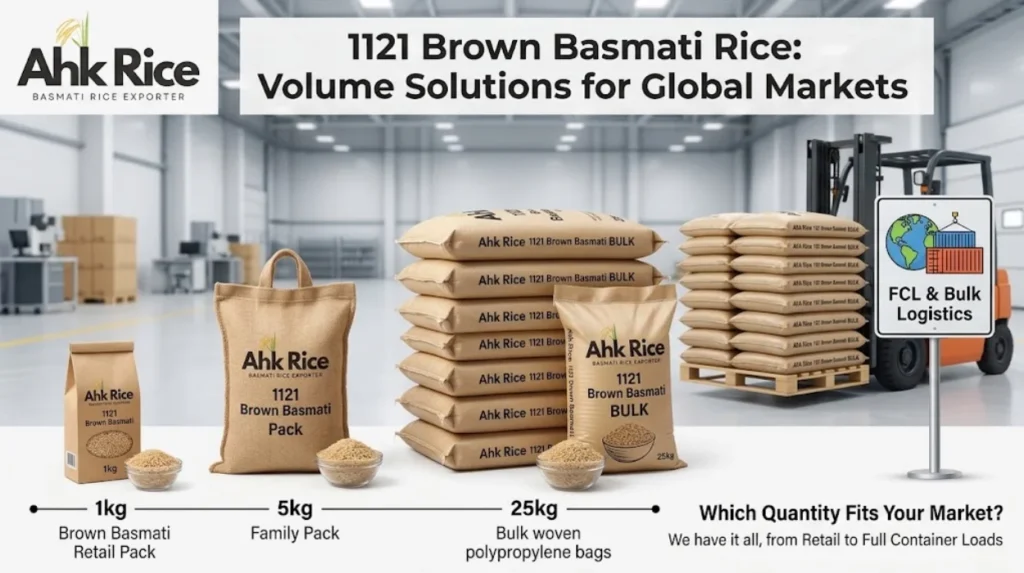
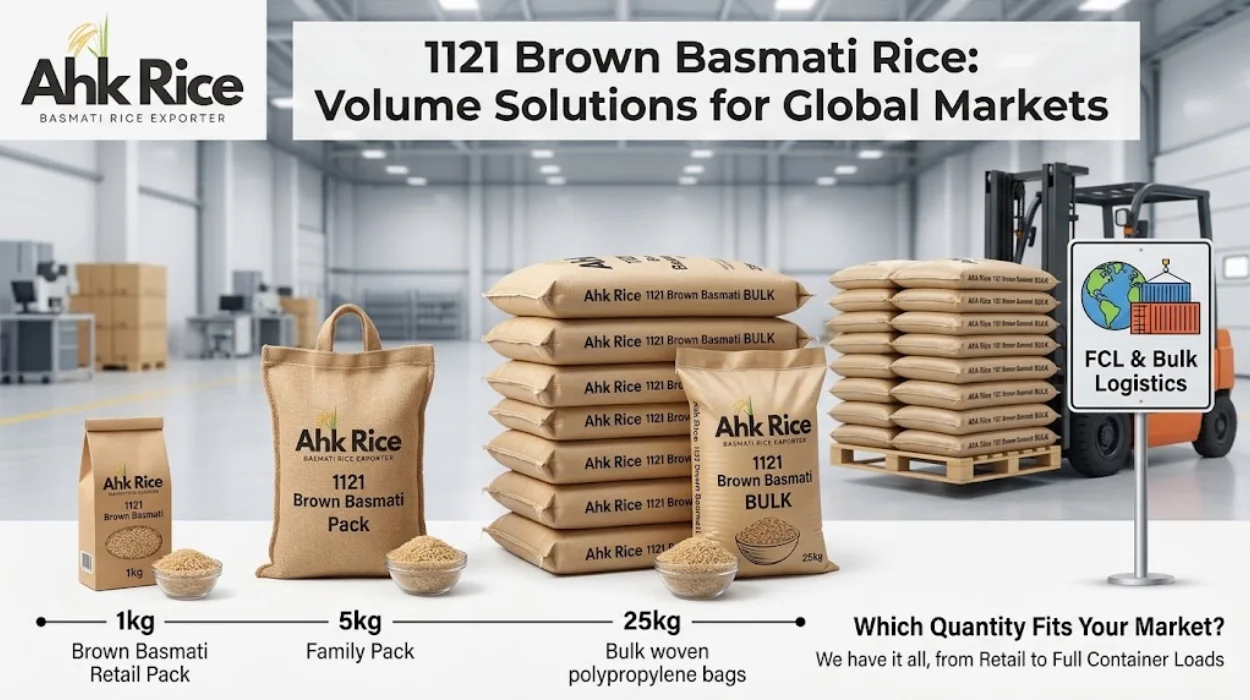
Retail markets purchase 1–20 kg packs, distributors purchase 1–5 MT lots, and importers purchase 20–25 MT container shipments.
Retail Markets
Retail channels prioritize consumer packaging.
Examples include:
- 1 kg packs
- 2 kg packs
- 5 kg packs
- 10 kg packs
Health-focused consumers commonly purchase smaller quantities.
Food Service Markets
Restaurants and catering companies require larger packaging formats.
Examples include:
- 20 kg bags
- 25 kg bags
- 40 kg bags
Food service operators prioritize operational efficiency. Larger bags reduce packaging costs per kilogram.
Import Markets
Importers source container quantities.
Common shipment sizes include:
- 20-foot container: 20–22 MT
- 40-foot container: 25–27 MT
Middle Eastern importers frequently source full container loads. European specialty distributors often combine multiple rice varieties within single shipments.
With quantity requirements established, the next question examines the product’s benefits.
What Benefits Does 1121 Brown Basmati Rice Provide?
Higher fiber, lower processing, natural nutrients, long grain appearance, and aromatic characteristics make 1121 Brown Basmati Rice valuable across multiple markets.
Brown Basmati Rice retains bran layers. Bran contains dietary fiber and micronutrients. Consumers seeking less processed foods often select brown rice products.
1121 Brown Basmati Rice delivers visual appeal. Long grains create premium presentation. Premium presentation supports higher-value retail positioning.
1121 Brown Basmati Rice maintains cooking performance. Grains remain separate after cooking. Food service operators value this characteristic.
Brown Basmati Rice also aligns with growing whole-grain consumption trends in developed markets (source: FAO Food Outlook Report).
With benefits explained, the next question concerns major importing regions.
Which Markets Import 1121 Brown Basmati Rice?
The Middle East, Europe, North America, Australia, and Africa import 1121 Brown Basmati Rice in varying quantities and packaging formats.
Middle East
Countries such as Saudi Arabia, UAE, Qatar, Kuwait, and Oman import substantial rice volumes.
Food service sectors dominate demand. Large packaging formats remain common.
Europe
Countries such as Germany, France, Netherlands, Belgium, and the United Kingdom import premium packaged Brown Basmati Rice.
Retail consumers drive demand. Organic and certified products receive strong market attention.
North America
The United States and Canada import Brown Basmati Rice through specialty food distributors and retail chains.
Health-focused consumers contribute significantly to demand growth.
Australia
Australian consumers increasingly purchase whole-grain rice products. Brown Basmati Rice fits this preference.
Rice remains an important staple food category across these regions (source: International Grains Council, 2025).
With market demand explained, the next question concerns certifications.
What Certifications Apply to 1121 Brown Basmati Rice Exports?
ISO 22000, HACCP, BRCGS, Halal, Phytosanitary, and laboratory testing certifications commonly support international exports.
Food Safety Certifications
Food safety systems verify processing standards.
Examples include:
- ISO 22000
- HACCP
- BRCGS
Religious Compliance Certifications
Certain markets require religious compliance documentation.
Examples include:
- Halal Certification
Export Documentation
International shipments commonly require:
- Phytosanitary Certificate
- Certificate of Origin
- Commercial Invoice
- Packing List
- Bill of Lading
- Laboratory Analysis Report
Certification requirements vary by destination country. Import regulations determine required documentation.
With certification requirements explained, the next question addresses common misconceptions.
What Common Misconceptions Exist About 1121 Brown Basmati Rice?
Brown Basmati Rice is not lower quality, does not cook poorly, and does not lack export demand.
Some buyers assume brown rice represents unfinished processing. Brown Basmati Rice follows intentional processing standards. The retained bran layer creates its defining characteristic.
Some consumers assume brown rice cooks identically to white rice. Brown rice requires longer cooking times. The bran layer increases water absorption requirements.
Some traders assume export demand focuses exclusively on white rice. Brown Basmati Rice demand continues growing in health-conscious retail markets across Europe and North America (source: International Trade Centre, 2025).
Understanding these misconceptions helps buyers evaluate the product accurately. The final consideration is how quantity selection aligns with market objectives.
How Should Buyers Match Quantity to Market Demand?
Small retailers benefit from 1–10 kg packs, distributors benefit from pallet quantities, and importers benefit from full container loads.
Market demand determines optimal order quantity. Retail channels require flexible packaging. Food service sectors require operational efficiency. Importers require container-level economics.
1121 Brown Basmati Rice supports all three purchasing models. Product specifications remain consistent while packaging and shipment sizes change according to market requirements.
Understanding the product, processing methods, grades, certifications, and importing regions creates a clear framework for selecting the correct quantity for any target market.
Frequently Asked Questions
What is the grain length of 1121 Brown Basmati Rice?
1121 Brown Basmati Rice typically measures 8.20–8.40 mm before cooking.
Is 1121 Brown Basmati Rice healthier than white Basmati Rice?
Brown Basmati Rice retains the bran layer, providing more fiber and micronutrients than white Basmati Rice.
Which countries import 1121 Brown Basmati Rice?
Major importers include Saudi Arabia, UAE, United Kingdom, Germany, Canada, United States, and Australia.
What packaging sizes are commonly exported?
Common export packaging includes 1 kg, 5 kg, 10 kg, 20 kg, 25 kg, and 40 kg bags.
What certifications are commonly required?
ISO 22000, HACCP, Halal, BRCGS, Phytosanitary Certificates, and Certificates of Origin are frequently required.
How much rice fits in a shipping container?
A 20-foot container generally holds 20–22 MT, while a 40-foot container generally holds 25–27 MT.