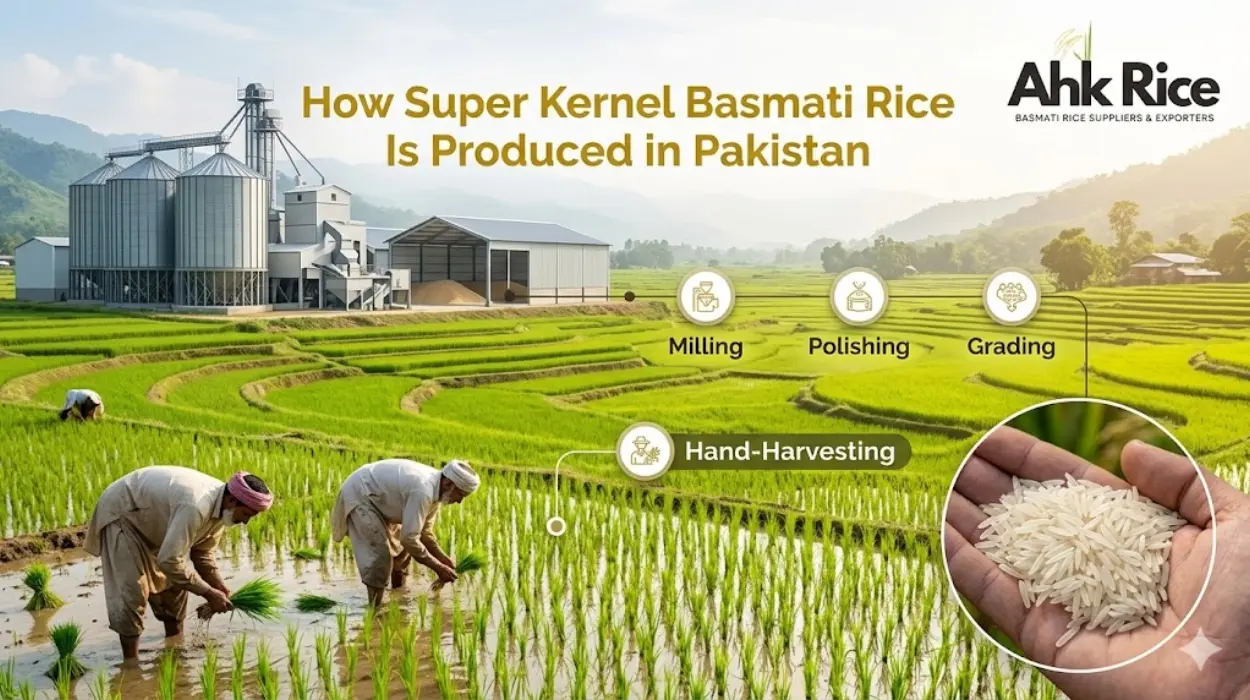
How Super Kernel Basmati Rice Is Produced in Pakistan
Super Kernel Basmati rice is produced through a controlled process that starts with cultivation in Pakistan’s Basmati-growing regions and ends with milling, grading, quality testing, and export packaging. Here is why: Pakistan’s climate, fertile alluvial soil, traditional Basmati genetics, and modern rice processing systems create the long-grain aromatic rice recognized in international markets.
Super Kernel Basmati rice remains one of Pakistan’s most recognized agricultural exports. The variety is known for its natural aroma, long grain structure, and cooking elongation. International buyers source it for retail, food service, hospitality, and wholesale distribution channels across multiple continents.
Pakistan cultivates Super Kernel Basmati primarily in Punjab. The region provides the soil composition, irrigation network, and seasonal climate required for consistent grain development. The production process combines farming expertise with modern milling technologies to preserve grain quality from field to shipment.
Understanding how Super Kernel Basmati rice is produced requires examining cultivation, harvesting, processing, grading, certifications, and export preparation as one connected system.
What Is Super Kernel Basmati Rice?
Super Kernel Basmati rice is a traditional aromatic long-grain rice variety grown mainly in Punjab, Pakistan, with grain lengths typically reaching 7.0–7.4 mm before cooking and significantly elongating after cooking.
Super Kernel Basmati rice belongs to the Basmati family of aromatic rice varieties. The term “Basmati” refers to rice known for its fragrance, grain elongation, and distinct texture after cooking.
Super Kernel Basmati differs from hybrid long-grain rice because it preserves traditional aroma characteristics. The grains remain slender and separate after cooking. This characteristic makes the variety suitable for premium rice applications.
Punjab serves as the primary cultivation region because the area combines fertile alluvial soil with irrigation from the Indus Basin system. Farmers cultivate the crop during the Kharif season and harvest it in autumn.
Major importing regions include the Middle East, Europe, North America, Africa, and Asia-Pacific markets (source: REAP export data, December 2025).
With the definition of Super Kernel Basmati established, the next question is how the production process begins in the field.
How Is Super Kernel Basmati Rice Grown in Pakistan?
Super Kernel Basmati rice grows through a seasonal cultivation cycle that includes seed selection, nursery preparation, transplantation, irrigation, crop management, and harvesting over approximately 120–140 days.
Rice cultivation begins with certified seed selection. Farmers select uniform seed lots to achieve consistent plant growth and grain quality.
How Does the Cultivation Cycle Start?
Farmers prepare nursery beds before transplantation. Seedlings develop for several weeks before movement to prepared fields.
Farmers transplant young rice plants into flooded fields. Controlled spacing improves sunlight exposure and nutrient utilization.
Which Growing Conditions Support Super Kernel Basmati?
Punjab provides temperatures ranging between 25°C and 35°C during critical growth stages. These conditions support grain formation and aroma development.
Irrigation systems supply water throughout the cultivation cycle. Farmers monitor water levels to maintain crop health and grain quality.
Nutrient management supports plant development. Farmers apply balanced fertilization programs based on soil conditions and crop requirements.
How Is the Crop Protected?
Farmers inspect fields regularly. Field monitoring identifies pest pressure, disease risks, and nutrient deficiencies before yield losses occur.
Integrated crop management practices improve productivity. Quality control begins in the field because grain quality directly influences milling performance.
With cultivation complete, the next stage involves harvesting and preparing paddy for processing.
How Is Super Kernel Basmati Rice Harvested and Prepared?
Super Kernel Basmati rice is harvested at maturity, dried to safe moisture levels, cleaned, and transported to rice mills for further processing.
Harvest timing affects grain quality. Farmers harvest when grain moisture and maturity levels meet processing requirements.
What Happens During Harvesting?
Farmers harvest mature paddy using combines or mechanical harvesters. Proper harvesting reduces grain breakage and field losses.
Freshly harvested paddy contains excess moisture. Drying stabilizes the grain and prevents storage deterioration.
Why Is Moisture Control Important?
Rice mills target moisture levels suitable for storage and milling. Excess moisture increases spoilage risk. Insufficient moisture increases breakage during milling.
Drying yards and mechanical drying systems help achieve uniform moisture content.
How Is Paddy Prepared for Milling?
Clean the paddy.
Remove stones and foreign materials.
Separate immature grains.
Store the paddy under controlled conditions.
Transport the paddy to milling facilities.
These preparation steps create the foundation for efficient rice processing and quality preservation.
With harvested paddy ready for milling, the next question is how raw rice becomes export-grade Super Kernel Basmati.
How Does the Super Kernel Basmati Rice Processing System Work?
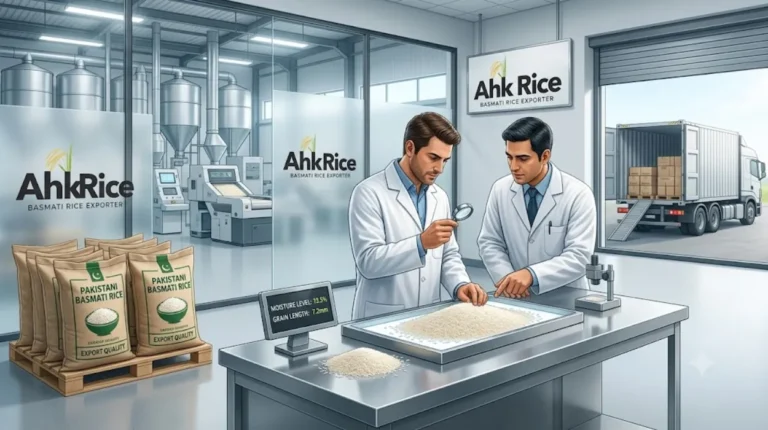
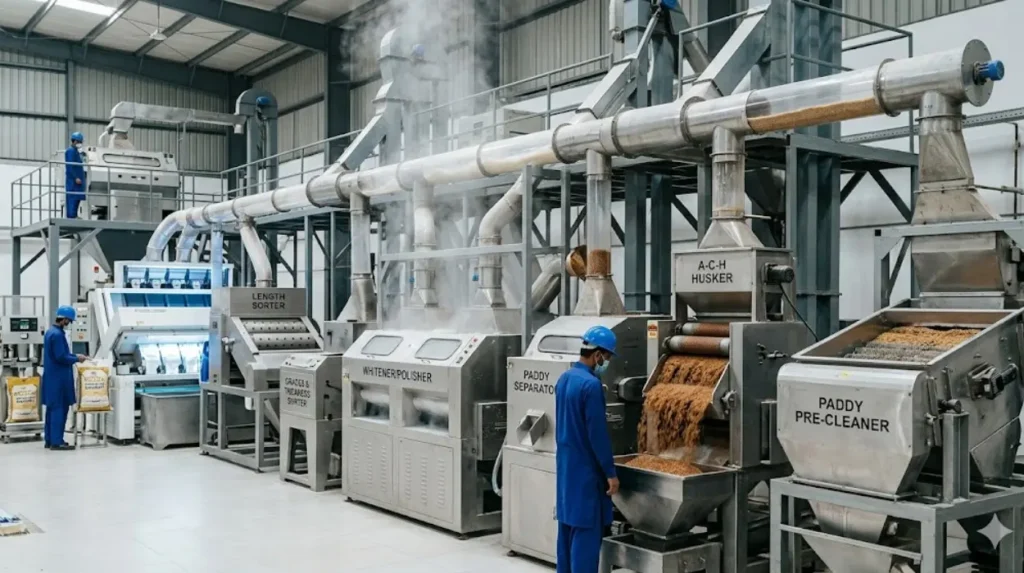
Super Kernel Basmati rice passes through multiple processing stages that remove husk layers, improve appearance, classify grain sizes, and prepare export-quality finished rice.
Modern rice mills use mechanical systems and optical technologies to preserve grain integrity.
What Are the Main Processing Steps?
Mill operators follow a structured workflow:
- Clean the paddy.
- Dehusk the grain.
- Separate brown rice.
- Polish the rice.
- Grade the rice.
- Sort the rice by length.
- Remove defects through color sorting.
- Inspect quality parameters.
- Pack the finished rice.
Each step serves a specific quality objective.
How Does Dehusking Work?
Dehusking removes the outer husk layer. The process converts paddy into brown rice while preserving the edible grain.
Modern equipment minimizes grain breakage. Reduced breakage improves final recovery rates.
Why Is Polishing Performed?
Polishing removes bran layers. The process creates the white appearance expected in most export markets.
Controlled polishing maintains grain structure while improving visual presentation.
What Role Does Color Sorting Play?
Color sorting systems use cameras and sensors. The equipment identifies defective grains and foreign materials.
Color sorting improves consistency. International buyers often require strict defect tolerances.
Why Is Grading Important?
Grading separates grains according to size and quality specifications.
Grading allows exporters to supply different market requirements. Retail buyers, wholesalers, and food-service distributors often purchase different specifications.
With processing understood, the next question concerns the grades available in the market.
What Grades of Super Kernel Basmati Rice Are Available?
Super Kernel Basmati rice is available in several grades based on grain integrity, broken percentage, sorting quality, and customer specifications.
Different markets require different grades. Grade selection affects pricing, packaging, and application.
Head Rice Grade
Head rice contains a high percentage of whole grains.
This grade serves premium retail and hospitality markets.
Sortex Grade
Sortex grade undergoes advanced optical sorting.
This grade provides improved visual uniformity and appearance.
Broken Rice Grades
Broken rice contains fragmented grains produced during milling.
Common examples include 5%, 10%, 15%, and 25% broken specifications.
Broken grades support industrial processing, food manufacturing, and value-oriented markets.
Buyer-Specific Grades
Exporters prepare custom specifications based on contractual requirements.
Examples include private-label retail programs, institutional catering grades, and regional distribution specifications.
Grade classifications explain market segmentation. The next question examines why buyers value this rice variety.
What Are the Main Benefits of Super Kernel Basmati Rice?
Long grain structure, natural aroma, cooking elongation, grain separation, and international recognition make Super Kernel Basmati rice a preferred variety in many markets.
Consumers often evaluate rice according to cooking performance and eating quality.
Why Is Grain Length Important?
Super Kernel Basmati develops elongated cooked grains.
Long grains improve plate presentation and visual appeal.
Why Is Aroma Valuable?
Natural fragrance differentiates Basmati from ordinary long-grain rice.
Aromatic characteristics contribute to consumer preference in premium rice categories.
Why Is Grain Separation Important?
Cooked grains remain separate rather than sticky.
Restaurants and catering businesses often require this characteristic for biryani and pilaf preparations.
Why Does International Recognition Matter?
Super Kernel Basmati has established demand across multiple export regions.
Established demand supports consistent trade flows and market familiarity.
These benefits explain product demand. The next question focuses on where the rice is used globally.
Where Is Super Kernel Basmati Rice Commonly Used?
Super Kernel Basmati rice serves retail consumers, restaurants, hotels, caterers, food distributors, and international importers across numerous regions.
Usage patterns vary by market and consumer preference.
Middle East Markets
Middle Eastern buyers use Super Kernel Basmati for traditional rice dishes.
Examples include biryani, mandi, kabsa, and pilaf applications.
European Markets
European buyers emphasize quality consistency, food safety compliance, and traceability.
Readers interested in purchasing preferences can learn how European importers evaluate quality standards in our article discussing the factors behind European demand for premium Pakistani Basmati rice.
North American Markets
North American distributors supply ethnic grocery channels, food-service operators, and specialty retailers.
Demand continues to expand within multicultural consumer segments (source: USDA rice market reports, 2025).
African Markets
African importers source multiple rice grades based on retail and wholesale demand structures.
Market requirements vary according to purchasing power and consumer preferences.
These applications demonstrate global demand. The next section addresses certifications and compliance requirements.
Which Certifications Apply to Super Kernel Basmati Rice Exports?
Food safety, quality assurance, phytosanitary compliance, and laboratory testing certifications support international trade requirements for Super Kernel Basmati rice.
Certification requirements vary according to destination country regulations.
Which Food Safety Standards Are Common?
Common certifications include:
- ISO 22000 Certification
- HACCP Certification
- Food Safety Management Systems
- GMP Compliance Programs
These standards document food safety controls throughout production.
Which Export Documents Are Required?
Export shipments commonly require:
- Commercial Invoice
- Packing List
- Certificate of Origin
- Phytosanitary Certificate
- Fumigation Certificate
- Bill of Lading
- Quality Inspection Reports
Documentation requirements differ according to destination market regulations.
Why Are Laboratory Tests Important?
Laboratories test moisture content, purity, broken percentage, and contamination indicators.
Testing verifies compliance before shipment.
Certification and testing support trade confidence. The final question addresses common misconceptions surrounding production.
What Are the Most Common Misconceptions About Super Kernel Basmati Rice Production?
The most common misconceptions involve origin, processing methods, aroma development, and grade classifications.
Misunderstanding these factors often creates confusion among new buyers.
Is All Long-Grain Rice Basmati?
No. Long grain describes shape.
Basmati describes a specific rice category with recognized aroma, cooking behavior, and genetic characteristics.
Does Polishing Create Aroma?
No. Aroma develops through genetics, cultivation conditions, and post-harvest handling.
Processing preserves aroma rather than creating it.
Does Every Grade Have the Same Specification?
No. Grade classifications differ according to grain integrity, sorting level, and broken percentage.
A 5% broken grade differs significantly from a 25% broken grade.
Does Production End After Milling?
No. Quality inspection, certification, packaging, storage, loading, and shipping remain essential stages before export delivery.
Understanding these misconceptions completes the full production picture.
Conclusion
Super Kernel Basmati rice production combines cultivation, harvesting, drying, milling, grading, testing, certification, packaging, and export preparation into one integrated supply chain.
Punjab provides the agricultural foundation for cultivation. Modern rice mills preserve grain quality through controlled processing systems. International standards guide testing and certification. Global markets value the variety for its aroma, grain length, cooking performance, and established reputation.
The complete production process explains why Super Kernel Basmati rice remains one of Pakistan’s most recognized agricultural exports.
Frequently Asked Questions
How long is Super Kernel Basmati rice before cooking?
Super Kernel Basmati rice typically measures 7.0–7.4 mm before cooking. The grains elongate significantly during cooking and maintain a slender appearance. This characteristic distinguishes it from many ordinary long-grain rice varieties.
Which region of Pakistan produces most Super Kernel Basmati rice?
Punjab produces most Super Kernel Basmati rice in Pakistan. Major cultivation areas include districts within the traditional Basmati belt, where fertile alluvial soil and irrigation systems support consistent grain quality and aroma development.
How many processing stages are involved in Super Kernel Basmati rice production?
Super Kernel Basmati rice generally passes through 9 main processing stages: cleaning, dehusking, brown rice separation, polishing, grading, length sorting, color sorting, quality inspection, and packaging. Each stage improves quality and export readiness.
What is the difference between Super Kernel Basmati and ordinary long-grain rice?
Super Kernel Basmati rice offers a natural aroma, greater cooking elongation, and better grain separation than ordinary long-grain rice. Ordinary long-grain rice focuses primarily on grain shape, while Basmati is defined by aroma, texture, and cooking performance.
Which countries import Super Kernel Basmati rice from Pakistan?
Super Kernel Basmati rice is imported by buyers in the Middle East, Europe, North America, Africa, and Asia-Pacific regions. Common destination markets include the UAE, Saudi Arabia, the United Kingdom, Canada, Germany, and several African countries.