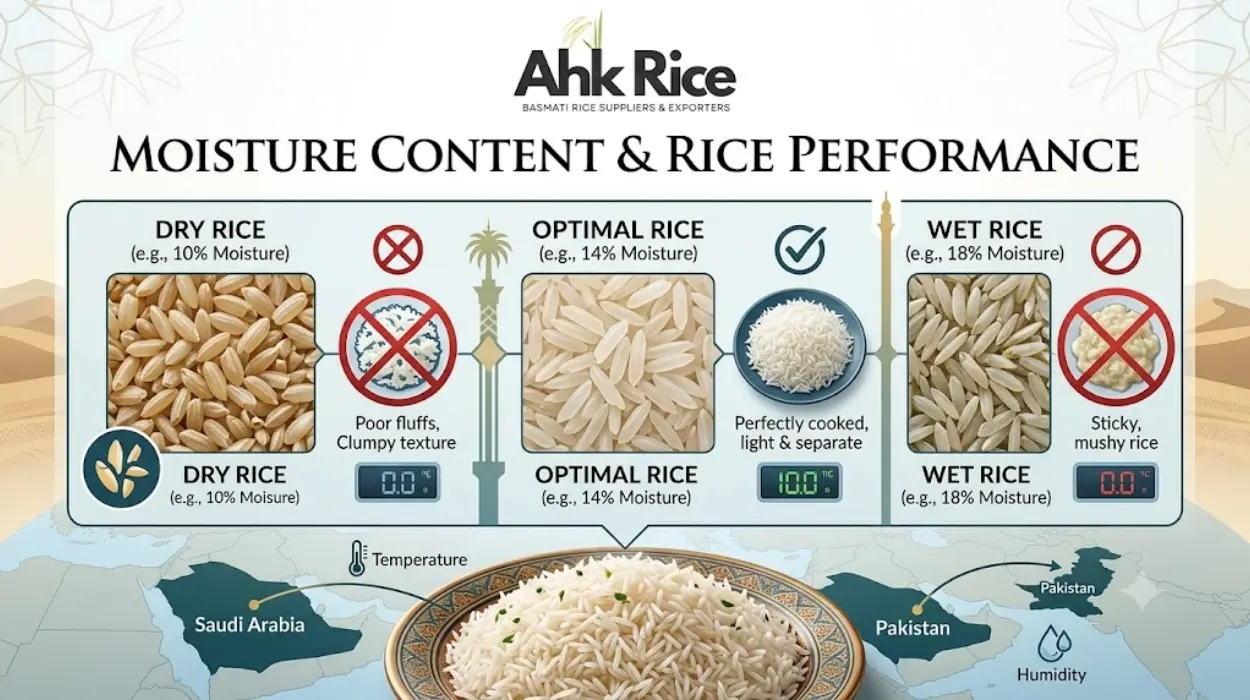
How Moisture Content Influences Cooking Performance of Pakistan Basmati Rice in Saudi Arabia
Cooking performance of Pakistan Basmati rice in Saudi Arabia depends more on moisture content than any other post-harvest quality parameter because moisture directly influences grain expansion, texture, water absorption, cooking time, aroma release, storage stability, and consistency across commercial kitchens.
Saudi Arabia imports large volumes of Pakistani Basmati rice every year for restaurants, catering companies, hotels, institutional kitchens, wholesalers, and retail brands. Buyers increasingly evaluate moisture specifications alongside grain length, purity, broken percentage, chalkiness, and aging because moisture determines whether rice performs consistently after weeks of shipping and warehouse storage.
Many Saudi food businesses already understand why moisture inspection matters before shipment, as explained in our guide on
Why Do Saudi Arabian Food Service Buyers Check Moisture Levels Before Importing Pakistan Rice? Once buyers understand the importance of moisture testing, the next decision is selecting the moisture specification that delivers the desired cooking results for their market segment.
Pakistan produces premium Basmati rice in Punjab, where fertile alluvial soils, Himalayan irrigation systems, favorable climate, and modern milling facilities support export-quality production. Companies such as AHK Rice combine controlled drying, precision milling, grading, laboratory testing, and customized packaging to maintain moisture specifications required by Saudi Arabian food service buyers.
What is moisture content, and why does it affect cooking performance?
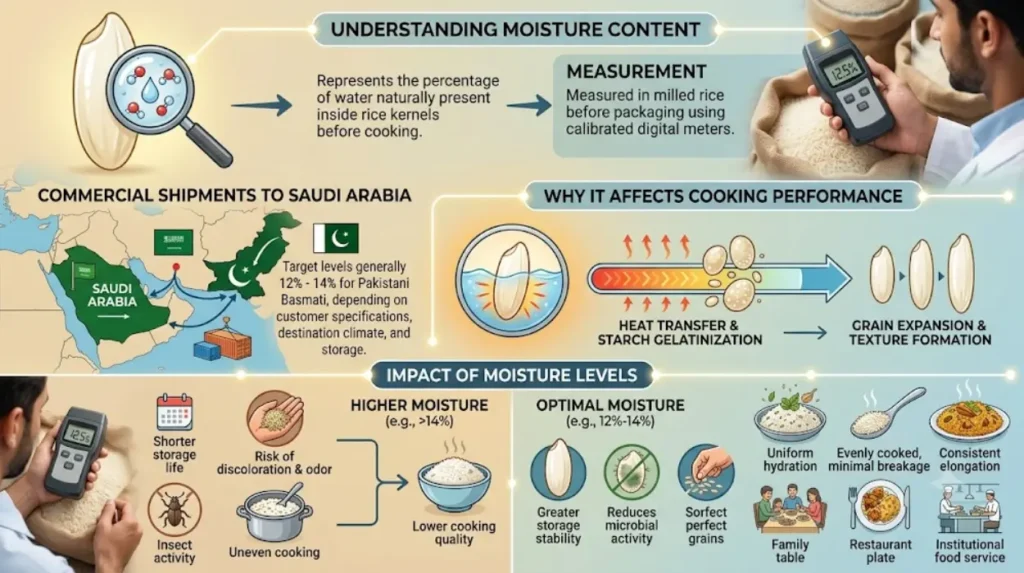
Moisture content represents the percentage of water naturally present inside rice kernels before cooking. This measurement influences heat transfer, starch gelatinization, grain expansion, texture formation, cooking duration, storage stability, aroma development, and final serving quality in households, restaurants, hotels, and institutional kitchens throughout Saudi Arabia.
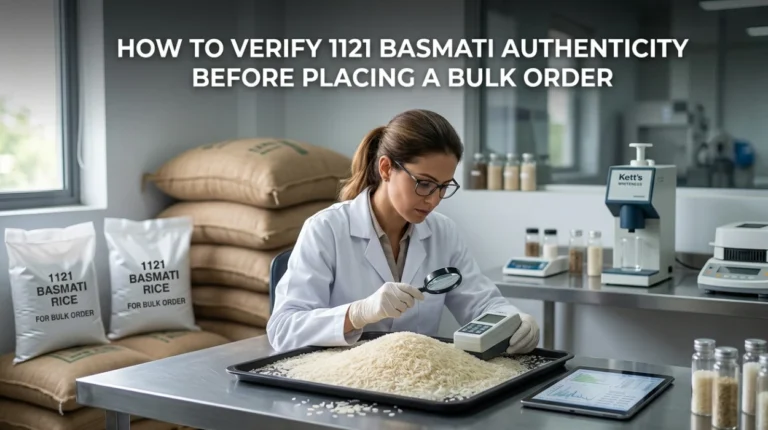
Moisture content is measured as the percentage of water inside milled rice before packaging. Export laboratories use calibrated digital moisture meters to verify every production batch before container loading.
For Pakistani Basmati rice exported to Saudi Arabia, commercial shipments generally target moisture levels between 12% and 14%, depending on customer specifications, processing method, packaging type, destination climate, and expected storage period.
Lower moisture provides greater storage stability and reduces microbial activity during transportation. Higher moisture shortens storage life and increases the risk of discoloration, odor development, insect activity, and uneven cooking.
Cooking performance changes because moisture affects how rapidly rice absorbs additional water during boiling. Uniform moisture creates uniform hydration, producing evenly cooked grains with consistent elongation and minimal breakage.
How do different moisture levels compare for cooking quality?
Different moisture specifications create measurable differences in cooking consistency, grain separation, expansion ratio, shelf life, transportation stability, aroma release, and processing efficiency. Comparing moisture ranges helps Saudi buyers select specifications matching commercial kitchens, wholesalers, retail brands, and food manufacturing requirements.
Pakistan Basmati Rice Moisture Specification Comparison
| Specification | 12% Moisture | 13% Moisture | 14% Moisture |
|---|---|---|---|
| Storage Stability | Excellent | Very Good | Moderate |
| Grain Breakage Risk | Low | Very Low | Moderate |
| Cooking Uniformity | Excellent | Excellent | Good |
| Water Absorption | Controlled | Balanced | Higher |
| Grain Elongation | High | Excellent | Good |
| Shelf Life | Longest | Long | Shorter |
| Export Suitability | Premium Export | Standard Premium | Limited Long-Term Storage |
Rice maintained near 12.5–13% moisture generally provides the best balance between cooking quality and storage stability for international exports.
Commercial kitchens benefit because batches cook consistently despite high production volumes. Retail consumers experience predictable cooking times and improved grain separation.
Moisture above recommended specifications increases variability. Some grains absorb water faster while others remain undercooked, creating inconsistent texture after serving.
What moisture management solutions are available for exporters?
Modern exporters manage moisture using controlled drying systems, laboratory testing, automated storage, precision milling, sealed packaging, and shipment monitoring. Each solution addresses different stages of the export chain while maintaining cooking quality after transportation from Pakistan to Saudi Arabia.
Moisture control begins immediately after harvesting. Freshly harvested paddy contains excessive water that must be reduced gradually without damaging kernel structure.
Mechanical drying systems lower moisture evenly before storage. Controlled drying minimizes stress cracks that later increase broken grain percentages during milling.
Modern warehouses maintain ventilation and humidity control to prevent moisture fluctuations before processing.
During milling, rice passes through grading, polishing, color sorting, and laboratory inspection. Every production lot undergoes moisture verification before packaging.
Vacuum packaging, woven polypropylene bags with liners, and food-grade laminated bags further reduce environmental moisture exposure during ocean transportation.
Exporters also monitor container loading conditions because excessive condensation inside shipping containers may increase localized moisture during transit.
Which moisture specification works best for different Saudi buyers?
Different market sectors require different moisture targets because storage duration, inventory turnover, cooking methods, transportation distance, and customer expectations vary significantly between restaurants, wholesalers, retailers, manufacturers, and institutional catering companies operating across Saudi Arabia.
Regional Market Comparison
| Market Region | Preferred Moisture | Common Rice Grades | Primary Buyers |
|---|---|---|---|
| Western Saudi Arabia (Jeddah, Makkah, Madinah) | 12–13% | 1121 Steam, Super Kernel Steam | Hotels, catering, HORECA |
| Central & Eastern Saudi Arabia (Riyadh, Dammam, Al Khobar) | 13–14% | 1121 White, 1509 Steam, Super Kernel White | Retail distributors, wholesalers, supermarkets |
Western Saudi Arabia receives large seasonal demand during Hajj and Umrah. Hotels and catering businesses prioritize consistent cooking performance and long storage stability.
Central Saudi Arabia serves major wholesale distribution centers where inventory turnover, packaging flexibility, and retail presentation influence purchasing decisions.
Eastern Saudi Arabia supplies industrial food production and retail distribution networks that often require balanced moisture specifications suitable for warehousing before resale.
How does moisture influence export pricing and overall value?
Moisture specifications affect total export value because they influence processing costs, storage duration, transportation risk, laboratory testing, and product consistency. Buyers compare total commercial performance instead of evaluating only the purchase price per metric ton.
Although international rice prices fluctuate according to harvest conditions, freight costs, exchange rates, and global demand during 2026, lower-moisture premium export lots generally command slightly higher processing value because they require additional drying, testing, and quality assurance.
Typical Commercial Comparison (2026)
| Specification | Relative Price per MT | Commercial Value |
|---|---|---|
| 12% Moisture Premium | Highest | Maximum storage and cooking consistency |
| 13% Moisture Standard Premium | Medium | Best balance of quality and value |
| 14% Moisture Commercial | Lowest | Suitable for faster inventory turnover |
Many Saudi importers calculate overall operating cost instead of focusing exclusively on FOB price. Lower storage losses, fewer customer complaints, consistent cooking, and reduced breakage often create greater commercial value than small differences in purchase price.
How does moisture content affect shelf life?
Shelf life depends directly on moisture because water supports biological activity, quality deterioration, odor formation, insect development, and physical changes during storage. Controlled moisture preserves grain quality throughout international transportation and warehouse storage.
Lower moisture significantly extends storage stability when rice is packed correctly and stored under recommended warehouse conditions.
Approximate commercial shelf life comparisons are shown below.
| Moisture Level | Expected Shelf Life* |
|---|---|
| 12% | Up to 24 months |
| 13% | 18–24 months |
| 14% | 12–18 months |
*Subject to proper packaging, warehouse ventilation, temperature management, and handling practices.
Saudi importers often purchase inventory months before peak demand periods. Stable moisture allows distributors to maintain quality throughout long storage cycles.
What are the advantages and disadvantages of different moisture strategies?
Every moisture strategy offers operational advantages and limitations. Selecting the correct specification depends on shipping duration, warehouse conditions, cooking expectations, inventory turnover, packaging system, and commercial objectives rather than pursuing a single universal standard.
Lower Moisture (Around 12%)
Advantages
- Longer storage life
- Better shipping stability
- Reduced microbial activity
- Improved export reliability
- Consistent cooking performance
Limitations
- Higher drying costs
- Greater processing precision required
Example
A Saudi hotel chain importing inventory for six months benefits from lower-moisture rice because quality remains stable throughout extended storage.
Standard Premium Moisture (Around 13%)
Advantages
- Excellent cooking balance
- Strong grain elongation
- Reliable aroma release
- Competitive commercial value
Limitations
- Requires proper warehouse management
Example
Restaurant distributors serving multiple cities frequently choose this specification because it balances cooking quality with commercial efficiency.
Higher Moisture (Around 14%)
Advantages
- Lower processing costs
- Suitable for rapid inventory turnover
Limitations
- Reduced storage life
- Greater transportation sensitivity
- Increased cooking variability
Example
Short-term domestic distribution channels may use this specification when products are sold quickly after import.
How should buyers decide the right moisture specification?
Selecting the correct specification requires evaluating storage duration, cooking application, customer expectations, distribution model, inventory turnover, climate conditions, packaging, certification requirements, and supplier quality management instead of considering only purchase price or appearance.
Decision Framework
| Business Situation | Recommended Moisture | Reason |
|---|---|---|
| Luxury hotels | 12–13% | Consistent premium cooking |
| Restaurant chains | Around 13% | Balanced performance |
| Retail distribution | 13–14% | Good commercial flexibility |
| Long warehouse storage | Around 12% | Maximum shelf life |
| Fast inventory turnover | Up to 14% | Cost-efficient operations |
Other important purchasing considerations include:
- Laboratory moisture certification
- ISO and HACCP quality systems
- Uniform milling quality
- Grain length consistency
- Broken percentage
- Packaging integrity
- Container loading standards
- Export documentation
Evaluating all specifications together provides a more accurate assessment of long-term commercial value.
Moisture content is one of the most influential quality specifications affecting the cooking performance of Pakistan Basmati rice exported to Saudi Arabia. It determines how uniformly rice absorbs water, how well grains elongate, how long products remain stable in storage, and how consistently commercial kitchens achieve premium serving quality. Moisture also influences transportation reliability, warehouse performance, and overall commercial efficiency.
For most Saudi importers, moisture levels around 12–13% provide the strongest balance between cooking performance, storage stability, export reliability, and long-term value. Selecting the appropriate specification ultimately depends on the intended application, storage period, and customer expectations rather than price alone.
Businesses evaluating suppliers should also review quality assurance processes, laboratory testing, export certifications, and moisture documentation before finalizing procurement decisions. For buyers moving toward supplier selection, a detailed guide on:
Certified bulk Pakistan Basmati rice supply for Saudi food service companies explains the documentation, certification, packaging, and export processes used for commercial shipments.
Frequently Asked Questions
What is the ideal moisture content for Pakistan Basmati rice exported to Saudi Arabia?
The ideal moisture content is typically 12–13%. This range provides excellent cooking performance, better grain elongation, longer shelf life, and improved storage stability during export and distribution.
How does moisture content affect the cooking quality of Basmati rice?
Moisture content influences water absorption, cooking time, grain separation, texture, aroma release, and elongation. Proper moisture levels ensure consistent cooking results with fluffy, separate grains.
Why do Saudi Arabian buyers check moisture levels before importing rice?
Saudi buyers verify moisture content to reduce storage losses, prevent spoilage, maintain product quality during shipping, and ensure consistent cooking performance for hotels, restaurants, and retail customers.
Which moisture level offers the longest shelf life for Basmati rice?
Rice with approximately 12% moisture generally provides the longest shelf life because lower moisture reduces the risk of mold growth, insect infestation, and quality deterioration during storage.
Does moisture content influence the export price of Pakistan Basmati rice?
Yes. Premium rice with controlled moisture levels often has a slightly higher export price because it requires precise drying, laboratory testing, and quality control, resulting in better long-term value.
Which Pakistani Basmati rice grades are most popular in Saudi Arabia?
The most commonly imported grades include 1121 Steam Basmati Rice, 1121 White Basmati Rice, Super Kernel Basmati Rice, and 1509 Basmati Rice, depending on the buyer’s market segment and cooking requirements.
How is moisture content measured before rice export?
Exporters use calibrated digital moisture meters and laboratory testing to verify that every production batch meets the moisture specifications agreed upon with international buyers.
What happens if Basmati rice contains excessive moisture?
Excessive moisture can reduce shelf life, increase the risk of mold and insect activity, cause uneven cooking, and negatively affect grain quality during transportation and warehouse storage.
Which moisture specification is best for commercial kitchens in Saudi Arabia?
Commercial kitchens generally prefer 12–13% moisture because it delivers consistent cooking performance, reliable grain elongation, and stable quality across large-volume meal preparation.
Why should importers choose exporters with moisture certification?
Exporters providing moisture certification offer verified quality assurance, improved shipment consistency, compliance with international food safety standards, and greater confidence in long-term product performance.