Choose a Pakistan Basmati Rice Supplier with Strict Admixture Control for Saudi Arabia
Saudi Arabian rice importers purchase Pakistan Basmati rice based on consistency, purity, compliance, and long-term supply reliability. Before selecting a supplier, it is important to understand how grain admixture affects cooking performance, consumer acceptance, import inspections, and wholesale profitability. If you have not yet explored the fundamentals, learn more in our guide on:
How admixture influences Pakistan Basmati rice quality in Saudi Arabia before comparing commercial suppliers. For a detailed comparison of acceptable import specifications, see our article explaining:
The admixture levels Saudi Arabian buyers typically approve in commercial shipments.
What is the best solution for controlling admixture in Pakistan Basmati rice exports to Saudi Arabia?
The best solution is choosing a supplier that follows variety-specific procurement, multiple cleaning stages, optical color sorting, laboratory verification, documented quality control, and final inspection before container loading. These combined procedures reduce admixture risk, improve shipment consistency, satisfy Saudi import standards, and protect long-term commercial relationships between exporters and importers.
Admixture refers to the presence of grains from another rice variety or quality grade within a shipment. Even small percentages can influence cooking consistency, grain appearance, aroma, and customer satisfaction.
Saudi Arabian wholesalers, supermarkets, catering companies, and food-service distributors increasingly request documented quality specifications before confirming purchase orders. During 2026, many buyers continue requesting detailed pre-shipment inspection reports alongside laboratory documentation showing grain purity, moisture, broken percentage, and foreign matter limits.
AHK Rice follows a structured production system designed to minimize admixture throughout the supply chain.
The process begins with sourcing paddy from approved farming regions where each variety is procured separately. Storage lots remain segregated to prevent accidental mixing before milling.
During processing, paddy passes through cleaning equipment that removes stones, dust, immature grains, and unwanted materials before milling begins.
Modern milling equipment removes husk uniformly while preserving grain length.
The rice then enters multiple grading systems where broken kernels are separated from whole grains.
Optical color sorters identify grains with color variation, defects, or unwanted varieties that differ from the selected specification.
Every production batch undergoes laboratory analysis before packaging.
Only batches matching contractual specifications proceed to export packaging.
AHK Rice documents every production stage to support commercial transparency with Saudi Arabian importers.
Why choose the Saudi Arabia export service for Pakistan Basmati rice?
Selecting a supplier with a dedicated Saudi Arabia export program ensures documentation accuracy, consistent quality specifications, faster logistics coordination, compliance with importer requirements, reliable communication, and repeatable shipment performance. A specialized export process reduces commercial risks while improving long-term procurement confidence for wholesale buyers.
Saudi Arabia remains one of the largest destinations for premium Pakistan Basmati rice.
Importers typically purchase for wholesale distribution, supermarkets, private labels, restaurants, hospitality groups, and institutional catering.
Choosing a supplier with an established Saudi Arabia service means every shipment is prepared according to destination-specific documentation and commercial expectations rather than generic export procedures.
AHK Rice understands Saudi buyer requirements because export planning begins before milling starts.
Customer specifications are confirmed first.
Production schedules are then organized according to the required rice variety, grade, packing size, and container quantity.
Documentation generally includes:
- Commercial Invoice
- Packing List
- Certificate of Origin
- Phytosanitary Certificate
- Fumigation Certificate where applicable
- Quality Inspection Reports
- Laboratory Analysis
- Bill of Lading
- Additional documents requested by the importer
Proper documentation reduces customs delays and improves shipment processing.
Saudi Arabian buyers also value suppliers capable of maintaining identical specifications across multiple containers rather than only one successful shipment.
AHK Rice focuses on repeatability because long-term contracts depend on consistent quality.
What results can buyers expect from a supplier with strict admixture control?
Importers can expect greater product consistency, fewer customer complaints, improved cooking performance, stronger retail reputation, smoother customs inspections, better inventory management, and higher confidence when placing repeat container orders from Pakistan throughout long-term commercial partnerships.
Lower admixture improves overall grain uniformity.
Uniform grains absorb water more consistently during cooking.
Restaurants benefit because cooked rice maintains better appearance during serving.
Retail consumers notice improved texture and grain separation.
Wholesale distributors receive fewer quality complaints.
Private-label brands protect their reputation.
Commercial kitchens experience predictable cooking yields.
These operational advantages often translate into stronger customer retention.
Saudi Arabian distributors supplying hotels and restaurants particularly benefit from uniform grain quality because professional chefs expect consistency throughout every batch.
AHK Rice supports these commercial expectations by maintaining documented inspection procedures before shipment approval.
Every approved export lot undergoes quality verification against agreed specifications before packaging.
This approach minimizes unexpected quality variation after arrival.
How does AHK Rice prove quality before shipment?
Reliable suppliers provide measurable evidence instead of marketing claims. Laboratory reports, inspection records, production traceability, packaging verification, and container loading supervision allow buyers to confirm shipment quality before final export, reducing purchasing uncertainty and strengthening confidence throughout the procurement process.
Saudi Arabian buyers increasingly request measurable evidence before releasing final payment.
AHK Rice provides quality verification through documented inspection procedures.
Typical laboratory reports may include:
| Specification | Typical Verification |
|---|---|
| Variety Confirmation | Production Record |
| Admixture Level | Laboratory Inspection |
| Moisture Content | Moisture Analysis |
| Broken Percentage | Grading Report |
| Foreign Matter | Cleaning Report |
| Grain Length | Physical Measurement |
| Packaging Weight | Packing Verification |
Container loading also follows documented procedures.
Packaging integrity is inspected before loading begins.
Containers are checked for cleanliness and dryness.
Loading supervision helps maintain shipment condition until sealing.
Container seal numbers are documented before dispatch.
This systematic process supports commercial transparency.
What affects pricing for Pakistan Basmati rice exports to Saudi Arabia?
Pricing depends on rice variety, purity level, admixture specification, crop quality, processing requirements, packaging format, order quantity, freight conditions, currency movements, inspection requirements, and seasonal market demand. Buyers comparing quotations should evaluate total delivered value rather than only the lowest unit price.
Rice pricing changes throughout the marketing season.
Several factors influence export quotations during 2026.
Variety
Premium varieties command higher prices than standard grades.
Admixture Requirement
Lower admixture specifications require additional sorting and inspection.
This increases processing costs.
Packaging
Retail packaging costs more than bulk export bags.
Private-label printing also affects pricing.
Order Volume
Full container orders generally achieve lower unit costs than smaller shipments.
Destination Port
Ocean freight varies according to destination within Saudi Arabia.
Certification Requirements
Additional inspections or laboratory documentation may increase overall export costs.
Seasonal Supply
Fresh harvest availability and international demand influence market pricing throughout the year.
Professional importers compare quotations based on complete commercial value rather than initial price alone.
AHK Rice provides quotations according to buyer specifications rather than using one standard price for every customer.
How long does shipping take from Pakistan to Saudi Arabia?
Most Pakistan Basmati rice shipments reach major Saudi Arabian ports within approximately 10–18 days after vessel departure, while production, quality inspection, documentation, and container preparation generally require an additional 7–10 working days before shipment depending on order size and specifications.
A realistic export timeline helps buyers plan inventory efficiently.
A typical schedule is:
| Stage | Estimated Time |
|---|---|
| Order Confirmation | 1 Day |
| Production Planning | 1–2 Days |
| Milling & Processing | 3–5 Days |
| Quality Inspection | 1 Day |
| Packaging | 1–2 Days |
| Container Loading | 1 Day |
| Export Documentation | 1–2 Days |
| Sea Freight to Saudi Arabia | 10–18 Days |
Transit time varies depending on:
- Shipping line
- Port congestion
- Destination port
- Customs procedures
- Weather conditions
Planning inventory around these timelines reduces stock shortages.
AHK Rice coordinates production schedules with vessel availability to improve delivery reliability.
What is the sample process before placing a bulk order?
Professional suppliers offer structured sample procedures allowing buyers to evaluate grain quality, cooking characteristics, aroma, packaging, and laboratory specifications before committing to container purchases. Sampling reduces procurement risk and supports informed commercial decisions for both first-time and repeat importers.
Most commercial buyers request samples before confirming container orders.
The typical process includes:
- Buyer submits required specifications.
- Supplier selects matching production batch.
- Sample is prepared.
- Laboratory specifications are verified.
- Sample is securely packaged.
- Courier shipment is arranged.
- Buyer evaluates cooking performance.
- Commercial discussions continue after approval.
Typical sample costs during 2026 include:
| Item | Typical Range |
|---|---|
| Product Sample | Often complimentary for qualified buyers |
| Courier Charges | Usually USD 40–90 depending on destination |
| Laboratory Testing (if requested) | Additional cost depending on requirements |
AHK Rice assists buyers throughout this evaluation process to ensure the approved sample accurately represents commercial production.
How do you get started with AHK Rice?
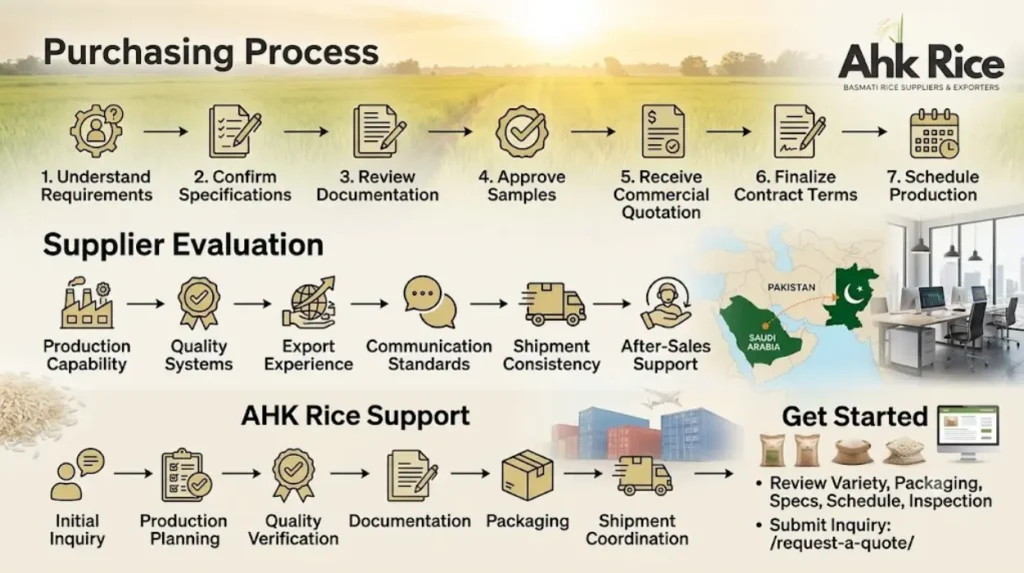
The purchasing process begins with understanding product requirements, confirming specifications, reviewing documentation, approving samples, receiving a commercial quotation, finalizing contract terms, and scheduling production. A structured procurement process reduces misunderstandings while creating reliable long-term supply partnerships for Saudi Arabian importers.
Choosing the right supplier is a commercial decision that extends beyond comparing prices.
Importers should evaluate production capability, documented quality systems, export experience, communication standards, shipment consistency, and after-sales support.
AHK Rice has developed its export operations around these commercial priorities.
The company supports buyers from initial inquiry through production planning, quality verification, documentation, packaging, and shipment coordination.
Whether supplying supermarkets, wholesalers, food-service distributors, or private-label brands, AHK Rice focuses on maintaining consistent specifications throughout every shipment.
Before confirming your next purchase, review your required variety, packaging, quality specifications, documentation needs, expected delivery schedule, and inspection requirements with the export team. Once these details are finalized, you can proceed confidently by submitting your inquiry through request a quote and begin planning your next Pakistan Basmati rice shipment with AHK Rice.
Frequently Asked Questions
How does admixture affect the quality of Pakistan Basmati rice exported to Saudi Arabia?
Admixture reduces grain uniformity, affects cooking consistency, and may impact aroma and appearance. Lower admixture levels help Saudi importers maintain premium product quality and improve customer satisfaction.
What admixture level is generally preferred by Saudi Arabian rice importers?
Most Saudi buyers prefer the lowest commercially achievable admixture level specified in the sales contract. Exact limits vary depending on the rice variety, buyer requirements, and intended market segment.
Why should I choose a supplier with strict admixture control?
A supplier with strict admixture control delivers more consistent grain quality, reduces the risk of shipment disputes, improves cooking performance, and supports long-term business relationships.
How does AHK Rice control admixture during production?
AHK Rice follows separate procurement, advanced cleaning, grading, optical color sorting, laboratory testing, and final quality inspections before packaging each export shipment.
What quality documents are provided before shipment?
Depending on contract requirements, buyers may receive laboratory analysis reports, phytosanitary certificates, certificates of origin, packing lists, commercial invoices, fumigation certificates, and quality inspection reports.
How long does it take to ship Pakistan Basmati rice to Saudi Arabia?
Production and export preparation usually require 7–10 working days, while sea freight to major Saudi Arabian ports generally takes around 10–18 days, depending on the shipping line and destination port.
What factors influence the export price of Pakistan Basmati rice?
Pricing depends on the rice variety, admixture specification, packaging type, order quantity, freight charges, certifications, seasonal supply, and global market conditions.
Can I request a sample before placing a bulk order?
Yes. Most commercial buyers request product samples before confirming container orders. Buyers usually pay courier charges, while product samples may be provided without charge for qualified inquiries.
What packaging options are available for Saudi Arabian buyers?
Exporters commonly offer 1 kg, 2 kg, 5 kg, 10 kg, 20 kg, 25 kg, and 50 kg packaging, along with customized private-label packaging based on buyer requirements.
Why is AHK Rice a suitable supplier for Saudi Arabian importers?
AHK Rice offers strict quality control, documented inspection procedures, export documentation support, customized packaging, consistent specifications, and reliable supply for wholesale, retail, and food-service buyers in Saudi Arabia.