How Does Admixture Affect the Quality of Pakistan Basmati Rice in Saudi Arabia?
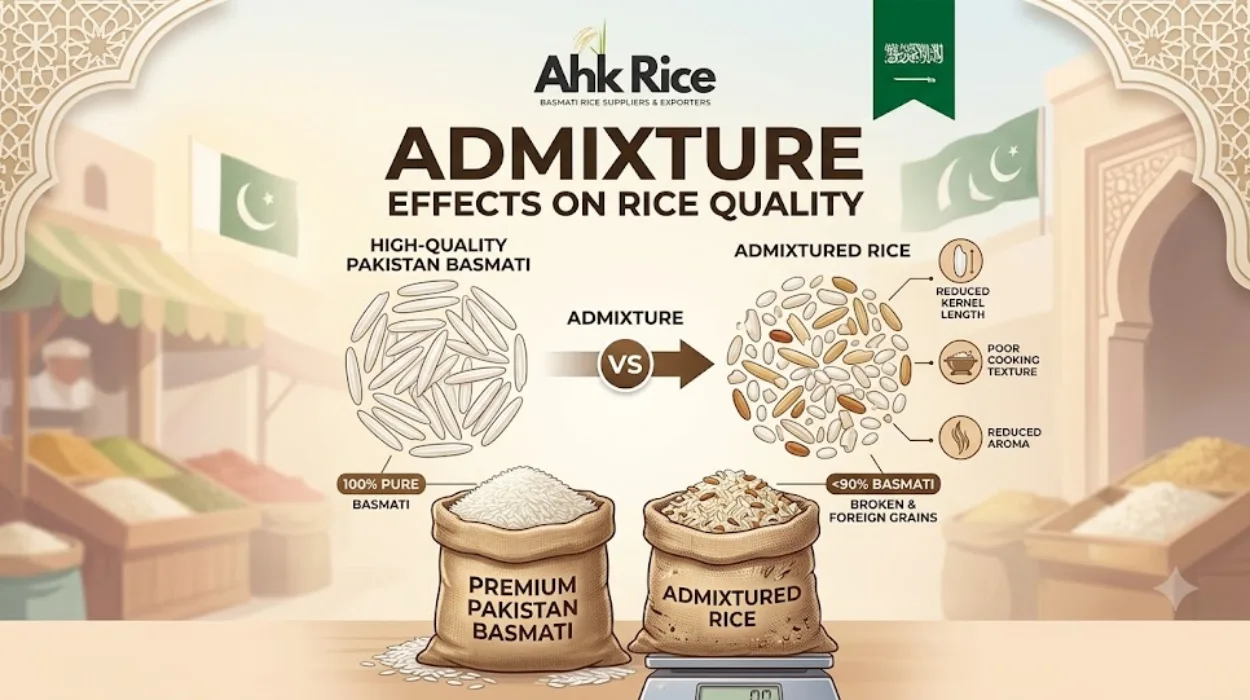
Admixture directly affects the commercial quality, cooking consistency, grading, and import acceptance of Pakistan Basmati rice in Saudi Arabia. Buyers evaluate admixture percentages before approving shipments because grain purity determines market value, processing efficiency, and compliance with contractual specifications. Understanding admixture helps importers, distributors, food manufacturers, and retailers select rice that matches their quality standards.
Pakistan remains one of the leading exporters of premium Basmati rice in 2026. Saudi Arabia continues to rank among the largest destinations for Pakistani Basmati due to strong consumer demand for long-grain aromatic rice. Quality inspection begins long before containers leave the port, and admixture analysis forms an essential part of that inspection process.
What Is Admixture in Pakistan Basmati Rice?
Admixture is the percentage of grains that differ from the declared rice variety inside a shipment. These grains include other rice varieties, broken kernels, damaged grains, immature kernels, chalky grains, or foreign varieties that reduce varietal purity and influence the final commercial grade.
Admixture refers to any grain that does not belong to the specified rice variety or quality standard stated in the sales contract.
For example, a shipment labeled as 1121 Basmati should primarily contain authentic 1121 grains. If Super Kernel, IRRI rice, broken kernels, immature grains, or other varieties appear within the lot, they become part of the admixture percentage.
International rice trade separates admixture from foreign matter.
Foreign matter includes:
- Stones
- Dust
- Straw
- Metal particles
- Soil
- Husk pieces
Admixture only refers to unwanted rice grains that differ from the declared specification.
Saudi Arabian importers evaluate admixture because it directly affects cooking performance, grain appearance, and retail consistency.
How Does Admixture Affect the Quality of Pakistan Basmati Rice?
Admixture changes grain uniformity, cooking behavior, aroma consistency, visual appearance, milling efficiency, and customer satisfaction. Higher admixture percentages reduce varietal purity, making premium Basmati rice perform differently from the expected quality during cooking and commercial processing.
Basmati rice earns its premium value because every grain shares similar physical characteristics.
These characteristics include:
- Long grain length
- Uniform width
- Similar moisture content
- Consistent aroma
- Equal cooking expansion
When multiple rice varieties enter the shipment, these characteristics become inconsistent.
For example, authentic 1121 Basmati expands significantly after cooking. Shorter grains from another variety expand differently. The cooked rice loses its uniform appearance.
Restaurants notice these differences immediately because cooked dishes contain grains of different lengths.
Retail consumers also recognize inconsistent grain appearance inside transparent packaging.
Quality becomes less predictable from one bag to another.
For readers interested in how Saudi buyers determine acceptable varietal purity before purchase, the companion guide on:
Acceptable admixture standards required by Saudi rice importers provides the next stage of quality evaluation.
How Does Admixture Occur During Rice Production?
Admixture develops when different rice varieties mix during cultivation, harvesting, transportation, drying, storage, milling, or packaging. Modern quality management minimizes these mixing points through controlled production systems and continuous inspection at every processing stage.
Rice production involves multiple operations.
Each operation introduces opportunities for grain mixing if proper segregation is absent.
Cultivation
Fields located close together sometimes contain different rice varieties.
Examples include:
- 1121 Basmati
- Super Kernel Basmati
- 1509 Basmati
Separate harvesting schedules reduce accidental mixing.
Harvesting
Harvest combines process thousands of kilograms every hour.
Machines require cleaning before changing from one variety to another.
Residual grains inside the equipment increase admixture.
Transportation
Rice moves between farms, drying yards, warehouses, and mills.
Transport vehicles require complete cleaning before loading another variety.
Storage
Warehouses usually contain multiple rice grades.
Separate storage bins prevent different varieties from mixing.
Milling
The milling line removes husk, bran, and polishing layers.
Processing equipment is cleaned between production batches to preserve varietal purity.
Packaging
Final packaging includes another inspection.
Optical sorting machines remove unwanted grains before filling export bags.
Every production stage contributes to overall grain purity.
What Components Are Included in Admixture Analysis?
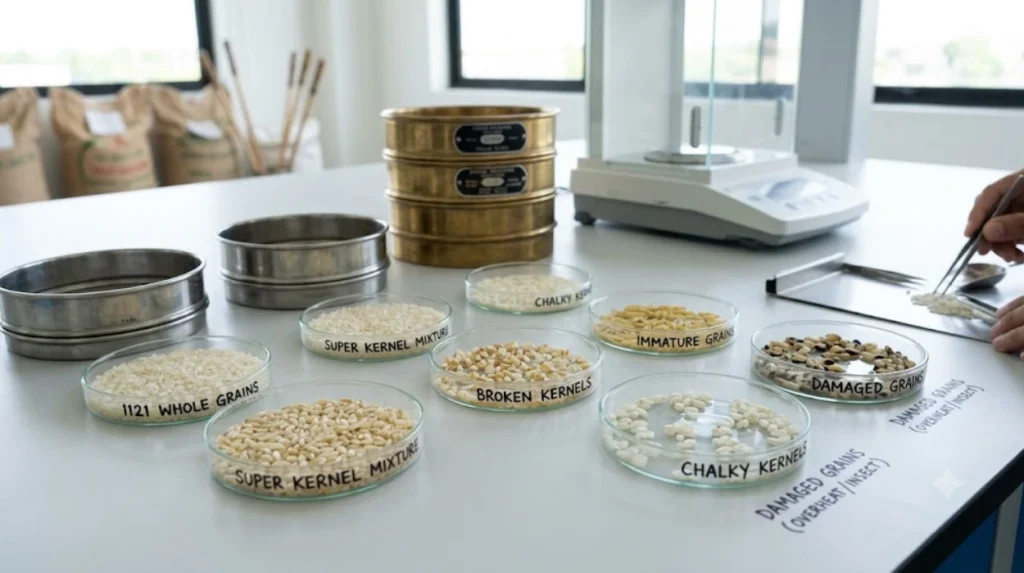
Admixture analysis measures several grain characteristics that influence rice quality. Inspectors evaluate varietal purity, broken grains, immature kernels, damaged grains, chalky kernels, and color defects according to export specifications and buyer requirements.
Rice inspection laboratories follow standardized sampling methods.
Several quality components receive individual measurements.
Different Rice Varieties
This category identifies grains belonging to varieties other than the declared product.
Example:
A 1121 shipment containing Super Kernel grains.
Broken Kernels
Broken rice measures less than three-fourths of a whole grain.
Examples include:
- Half kernels
- Three-quarter kernels
- Small fragments
Immature Grains
Immature grains develop before reaching full maturity.
These kernels appear thinner and lighter than mature grains.
Chalky Grains
Chalkiness appears as opaque white sections inside the kernel.
High chalkiness reduces visual quality.
Damaged Grains
Damaged grains include kernels affected by insects, discoloration, overheating, or improper storage.
Each category influences commercial grading independently.
Why Do Saudi Arabian Buyers Evaluate Admixture Carefully?
Saudi Arabian buyers examine admixture because consistent grain purity supports premium retail presentation, predictable cooking performance, efficient food manufacturing, and compliance with contractual quality specifications across wholesale and foodservice distribution channels.
Saudi Arabia imports large volumes of premium Basmati annually.
The market includes several buyer groups.
Examples include:
- Importers
- Supermarkets
- Food distributors
- Hotels
- Restaurants
- Catering companies
- Food manufacturers
Each sector values consistency.
Retail brands require attractive packaging with uniform grain appearance.
Hotels require identical cooking performance every day.
Restaurants require equal grain length across every serving.
Food manufacturers require predictable processing efficiency.
Lower admixture supports these operational requirements.
What Are the Benefits of Maintaining Low Admixture Levels?
Low admixture preserves varietal identity, improves visual quality, increases customer confidence, supports consistent cooking performance, simplifies grading, and strengthens export quality throughout international rice supply chains.
High varietal purity creates several measurable advantages.
Uniform grains absorb water at similar rates.
Cooked rice appears more attractive.
Packaging looks consistent.
Sorting losses remain lower.
Commercial grading becomes easier.
Inspection reports become clearer.
Storage performance also improves because uniform grain batches maintain more consistent physical characteristics.
These quality improvements benefit exporters, importers, distributors, retailers, and foodservice operators alike.
Where Is Low-Admixture Pakistan Basmati Rice Commonly Used?
Rice with high varietal purity serves applications where appearance, aroma, grain length, and cooking consistency remain essential. Premium markets prefer cleaner rice because consumers recognize visible quality differences immediately after cooking.
Premium Basmati serves numerous industries.
Examples include:
Retail Packaging
Consumers compare grain appearance before purchasing.
Uniform kernels improve shelf presentation.
Hotels
Luxury hotels prepare rice daily.
Consistent grain expansion improves presentation.
Restaurants
Traditional dishes require long, separate grains.
Examples include:
- Kabsa
- Mandi
- Biryani
- Pilaf
Food Distribution
Wholesale distributors supply retailers with standardized quality.
Uniform specifications simplify inventory management.
International Repacking
Importers often repackage rice under private labels.
High purity supports stronger brand consistency.
What Are Common Misconceptions About Admixture?
Several misunderstandings exist regarding admixture. Grain purity differs from cleanliness, broken rice differs from foreign matter, and premium rice quality depends on multiple measurable characteristics rather than a single inspection result.
Many buyers confuse different quality terms.
Admixture Means Dirty Rice
This statement is incorrect.
Clean rice contains no stones or dust.
It still contains admixture if different rice varieties appear inside the shipment.
Broken Rice Equals Admixture
Broken kernels represent one quality parameter.
Varietal admixture measures different rice varieties.
Inspection reports evaluate these separately.
Longer Grain Always Means Lower Admixture
Grain length alone does not determine purity.
Two long-grain varieties still count as admixture if they differ genetically.
Polishing Removes Admixture
Polishing improves surface appearance.
It does not change varietal composition.
Sorting equipment removes unwanted grains before polishing reaches its final stage.
Aroma Determines Purity
Fragrance reflects one quality characteristic.
Laboratory inspection determines actual varietal purity through sampling and grain identification.
How Is Admixture Measured Before Export?
Professional inspection laboratories determine admixture through representative sampling, grain separation, visual classification, laboratory analysis, and documented reporting that follows internationally recognized rice inspection procedures used throughout global export markets.
Inspection begins with representative sampling.
Samples come from multiple bags or locations inside bulk storage.
Inspectors spread the grains across sorting trays.
Each grain category undergoes manual or optical classification.
Laboratories calculate percentages for every quality parameter.
Inspection reports include measurable values instead of descriptive opinions.
Modern rice mills increasingly combine optical sorting systems with laboratory verification to improve consistency before export shipments receive final approval.
Why Does Understanding Admixture Matter in the Saudi Rice Market?
Understanding admixture helps buyers interpret quality specifications, compare export grades accurately, evaluate inspection reports objectively, and select rice that matches commercial requirements across different sectors of the Saudi Arabian food industry.
Rice quality extends beyond grain length and aroma.
Commercial buyers compare complete quality profiles before making purchasing decisions.
Admixture represents one of the most important indicators of varietal consistency.
Understanding this concept allows importers to interpret laboratory reports accurately.
It also helps wholesalers compare suppliers using measurable specifications rather than visual impressions alone.
As quality standards continue evolving in 2026, grain purity remains an essential factor for maintaining consistency throughout the Pakistan-to-Saudi Arabia Basmati rice trade.
Frequently Asked Questions
What is admixture in Pakistan Basmati rice?
Admixture is the percentage of grains that differ from the declared Basmati variety, including other rice varieties, broken kernels, immature grains, and damaged grains.
Why is admixture important for Saudi Arabian rice buyers?
Saudi buyers evaluate admixture because it affects grain purity, cooking consistency, retail appearance, and compliance with agreed quality specifications.
How does admixture affect cooking quality?
Higher admixture levels produce uneven grain expansion, inconsistent texture, and variations in appearance after cooking, reducing overall product consistency.
How does admixture occur during rice production?
Admixture develops when different rice varieties mix during cultivation, harvesting, transportation, storage, milling, or packaging without proper segregation.
Which rice varieties are commonly evaluated for admixture?
Export inspections commonly evaluate 1121 Basmati, Super Kernel Basmati, and 1509 Basmati for varietal purity before shipment.
What components are included in admixture analysis?
Inspectors measure different rice varieties, broken kernels, immature grains, chalky kernels, damaged grains, and other quality parameters during analysis.
How is admixture different from foreign matter?
Admixture refers to unwanted rice grains, while foreign matter includes stones, dust, straw, husk pieces, soil, and other non-rice materials.
How is admixture measured before export?
Professional laboratories use representative sampling, grain sorting, visual inspection, optical sorting systems, and standardized quality reports to determine admixture percentages.
What are the benefits of maintaining low admixture levels?
Low admixture improves varietal purity, grain uniformity, cooking performance, visual appearance, commercial grading, and customer satisfaction.
Which industries prefer low-admixture Basmati rice?
Hotels, restaurants, supermarkets, food manufacturers, distributors, and private-label packaging companies prefer rice with high varietal purity.
Does polishing remove admixture?
No. Polishing improves grain appearance but does not remove different rice varieties. Optical sorting and careful grading reduce admixture.
Does longer grain length mean lower admixture?
No. Grain length alone does not determine varietal purity. Different long-grain rice varieties still count as admixture if they differ from the declared variety.
Why do inspection reports include admixture percentages?
Inspection reports provide measurable quality data that helps importers compare shipments, verify specifications, and ensure consistency before export.
How does low admixture support international rice trade?
Low admixture improves buyer confidence, simplifies quality verification, supports consistent grading, and helps maintain standardized export specifications across global markets.