Pure Variety vs Mixed Variety Rice: What Saudi Arabian Retailers Prefer
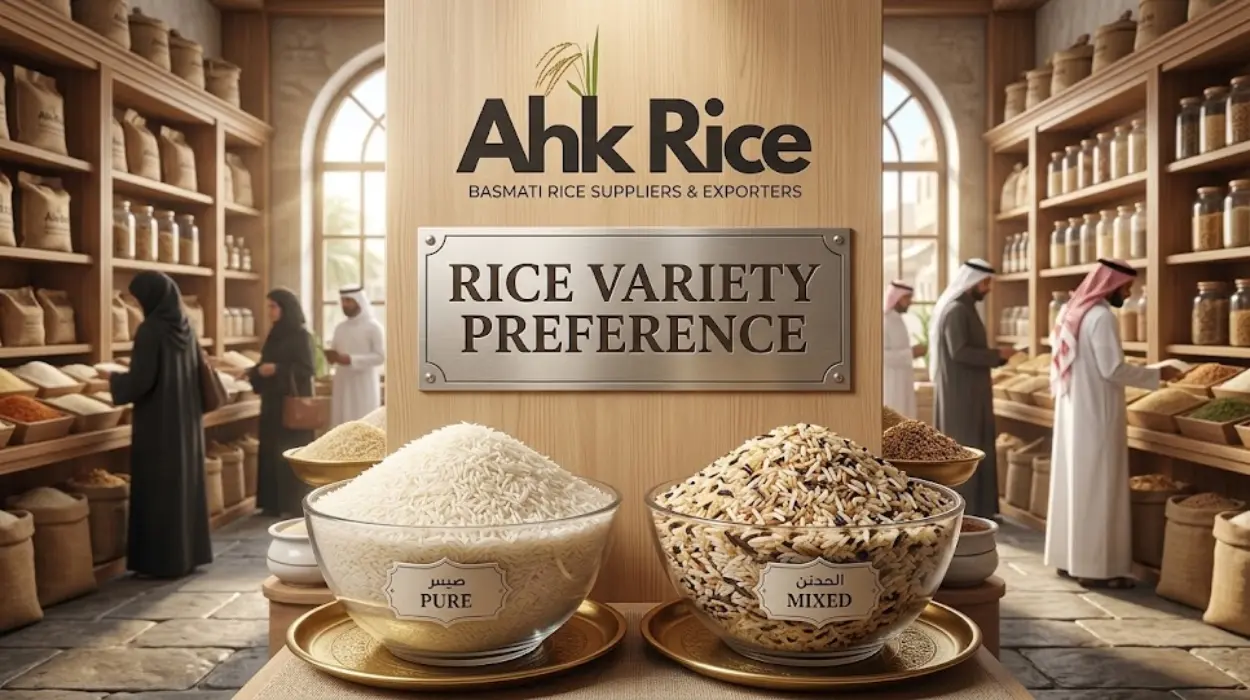
Saudi Arabian retailers consistently achieve stronger consumer trust, lower complaint rates, and better long-term brand positioning by choosing pure variety Basmati rice over mixed variety rice, although mixed varieties remain suitable for selected price-sensitive retail segments when quality specifications are clearly defined.
Saudi Arabia is one of the largest importers of Pakistani Basmati rice, with demand continuing to grow across supermarkets, wholesalers, independent grocery chains, and private label brands throughout 2026. Retail buyers evaluate rice beyond price. They assess grain uniformity, cooking consistency, aroma retention, shelf presentation, consumer satisfaction, and repeat purchase behaviour before selecting suppliers.
Retailers that want to better understand how grain purity shapes customer confidence should first explore how Pakistani Basmati quality influences purchasing behaviour across the Saudi market before evaluating product specifications. Understanding:
How Pakistani Basmati rice quality builds long-term consumer confidence in Saudi Arabia
Among Pakistan’s exporters, AHK Rice offers multiple export-grade Basmati categories with complete processing, quality inspection, customised packaging, and international documentation through its Pakistan Basmati Rice Export Services. Understanding the difference between pure and mixed varieties helps buyers choose specifications that align with their retail positioning rather than simply reducing procurement costs.
What is the difference between pure variety and mixed variety rice?
Pure variety rice consists entirely of one authenticated rice cultivar processed separately from harvesting through packaging, while mixed variety rice combines two or more compatible rice varieties to achieve a target price, cooking profile, or commercial specification for specific retail markets.
Rice purity refers to the percentage of grains belonging to one recognised botanical variety. In Pakistan, export-quality Basmati is sorted using modern optical sorters, grading equipment, length separators, and quality inspection systems to achieve commercial purity standards.
A pure variety shipment contains grains originating from a single variety, such as 1121 Steam Basmati or Super Kernel Basmati. Every grain shares similar physical characteristics including length, width, colour, moisture behaviour, elongation, and cooking performance.
Mixed variety rice intentionally blends compatible varieties. For example, exporters may combine long-grain aromatic rice with medium-length grains to satisfy specific price targets requested by importers. These blends are not defective products. They represent a different commercial strategy designed for value-focused market segments.
Saudi retailers increasingly specify acceptable purity percentages in procurement contracts because customers now recognise visual consistency, especially within premium supermarket shelves.
Pure variety versus mixed variety specification comparison
| Attribute | Pure Variety Rice | Mixed Variety Rice |
|---|---|---|
| Grain uniformity | Excellent | Moderate |
| Cooking consistency | Highly consistent | Variable |
| Aroma consistency | Strong | Moderate |
| Retail shelf appearance | Premium | Standard |
| Consumer complaint rate | Lower | Higher if blend quality varies |
| Private label suitability | Excellent | Suitable for economy brands |
| Average export price (2026) | Higher | Lower |
The specification difference directly influences retail reputation because consumers immediately notice changes in cooked appearance and grain consistency.
What solutions are available for Saudi Arabian retailers?
Saudi retailers can choose premium pure varieties, controlled commercial blends, customised purity specifications, private label programmes, or multi-tier product portfolios depending on customer expectations, retail positioning, and pricing strategy across different regions of the Kingdom.
Retail buyers generally select one of five sourcing solutions.
The first solution involves purchasing 100% pure premium Basmati varieties. This approach targets premium supermarkets, luxury grocery chains, hospitality suppliers, and retailers serving consumers who actively compare grain quality before purchasing.
The second solution uses commercial mixed varieties developed for value-conscious customers. These products reduce procurement costs while maintaining acceptable cooking performance for everyday household consumption.
The third solution allows buyers to define customised purity percentages. Exporters produce shipments according to agreed specifications, creating consistency across future deliveries.
The fourth solution combines multiple product tiers. Retailers stock premium pure Basmati alongside economy blends, allowing consumers to choose according to budget rather than forcing a single price point.
The fifth solution involves private label manufacturing with clearly documented quality standards, purity verification, and traceability systems that strengthen retailer credibility.
Each solution addresses different commercial objectives rather than representing a universal standard.
How do pure and mixed varieties compare in Saudi retail performance?
Pure varieties outperform mixed varieties in customer satisfaction, repeat purchasing, premium positioning, and product consistency, whereas mixed varieties offer stronger price competitiveness and broader accessibility within budget-conscious retail categories across Saudi Arabia.
Saudi consumers have become increasingly familiar with authentic Pakistani Basmati characteristics. Longer grains, consistent elongation, pleasant aroma, and uniform cooking influence purchasing decisions more than simple package design.
Retailers therefore evaluate products using commercial performance indicators instead of procurement cost alone.
Regional market comparison
| Market Region | Preferred Grade | Typical Retail Position | Relative Price per MT (2026) | Preferred Shelf Life |
|---|---|---|---|---|
| Central & Western Saudi Arabia (Riyadh, Jeddah, Makkah, Madinah) | Premium Pure 1121 & Super Kernel | Premium supermarkets | Higher | 24 months under proper storage |
| Eastern & Southern Saudi Arabia | Premium and Value Blends | Mixed retail formats | Moderate | 18–24 months depending on packaging |
Premium retail chains serving affluent urban populations consistently prioritise grain purity because customers expect visible quality differences.
Budget-focused retailers serving broader consumer groups frequently maintain blended product lines that provide acceptable quality while protecting competitive retail pricing.
Price comparison
Pure varieties command higher export prices per metric ton because production requires stricter segregation, additional grading, more intensive quality control, and lower tolerance for off-type grains.
Mixed varieties reduce manufacturing costs through controlled blending strategies, allowing importers greater flexibility in retail pricing while maintaining commercial quality standards.
The price difference should always be evaluated alongside reduced customer complaints, stronger brand reputation, and improved repeat purchases rather than procurement cost alone.
Which approach works best for different retail situations?
The best sourcing strategy depends on customer expectations, retail positioning, target pricing, and brand objectives rather than selecting the cheapest available rice or automatically choosing premium specifications for every product category.
Different retailers require different sourcing strategies.
Large supermarket chains selling premium imported foods benefit from pure variety Basmati because product consistency supports long-term customer loyalty.
Regional wholesalers supplying independent grocery stores often balance premium and blended categories to satisfy diverse customer budgets.
Discount supermarkets generally prioritise competitive pricing while maintaining acceptable cooking performance through professionally controlled blends.
Hospitality distributors supplying hotels and restaurants typically prefer pure varieties because chefs demand predictable cooking behaviour and consistent presentation.
Private label retailers frequently specify customised purity standards to balance manufacturing cost with consumer expectations.
Decision framework
| Retail Situation | Recommended Choice | Primary Reason | Consumer Expectation | Commercial Outcome |
|---|---|---|---|---|
| Premium supermarket | Pure variety | Brand reputation | Highest | Higher customer loyalty |
| Private label premium | Pure variety | Consistency | High | Strong differentiation |
| Economy supermarket | Mixed variety | Price competitiveness | Moderate | Better affordability |
| Wholesale distribution | Mixed portfolio | Customer diversity | Variable | Broader market coverage |
| Hospitality supply | Pure variety | Cooking consistency | Highest | Reliable kitchen performance |
The decision framework demonstrates that product specification should align with commercial objectives rather than price alone.
What are the advantages and disadvantages of each option?
Both sourcing methods provide measurable commercial benefits, but each also introduces operational trade-offs that retailers should evaluate against customer expectations, procurement strategy, and long-term brand positioning before making purchasing decisions.
Advantages of pure variety rice
Pure variety products deliver superior visual consistency. Consumers immediately recognise uniform grain appearance inside transparent packaging.
Cooking performance remains predictable across different batches. Families preparing traditional Saudi rice dishes expect identical results every time.
Premium positioning becomes easier because retailers can confidently communicate product quality using verified specifications.
Consumer complaints decrease when grain length, aroma, and texture remain consistent throughout repeated purchases.
Private label branding benefits from stronger customer confidence because shoppers associate consistency with retailer reliability. Understanding:
Private Label Pakistan Basmati Rice with Guaranteed Purity for Saudi Supermarkets
Disadvantages of pure variety rice
Procurement costs remain higher.
Production requires stricter segregation throughout harvesting, milling, storage, and export.
Seasonal supply planning demands closer coordination with exporters.
Premium pricing may limit accessibility for highly price-sensitive consumers.
Advantages of mixed variety rice
Mixed varieties improve affordability.
Retailers gain pricing flexibility during competitive promotions.
Commercial blends can maintain acceptable cooking quality when professionally developed.
Supply availability often remains more stable because exporters have greater production flexibility.
Mixed products support broader customer coverage across economy retail segments.
Disadvantages of mixed variety rice
Visual consistency may vary.
Cooking performance can differ between batches if blending standards change.
Premium positioning becomes more difficult because consumers increasingly recognise authentic long-grain Basmati characteristics.
Brand differentiation depends heavily on supplier quality control.
Which decision factors should Saudi retailers evaluate before choosing?
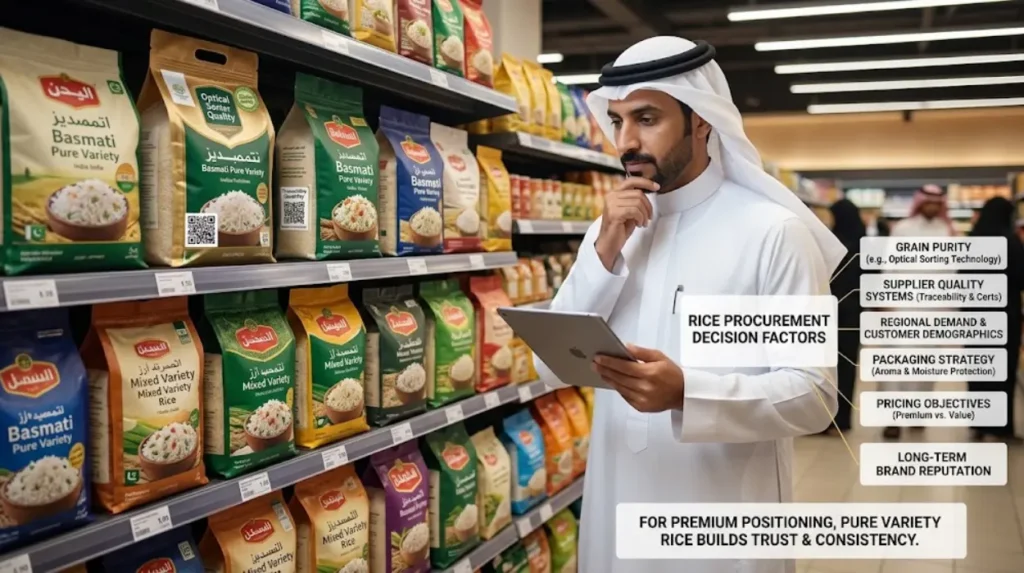
Retailers should evaluate grain purity, supplier quality systems, regional demand, packaging strategy, pricing objectives, cooking consistency, export certification, and long-term brand reputation before selecting any rice specification for commercial distribution.
Successful procurement decisions involve multiple measurable factors.
Quality assurance should verify variety authenticity using documented inspection procedures.
Processing technology influences consistency because advanced optical sorting reduces off-type grains.
Packaging quality preserves aroma and protects moisture levels throughout international transportation and retail storage.
Export documentation confirms compliance with destination market requirements.
Supplier traceability enables retailers to investigate quality issues efficiently if consumer feedback identifies inconsistencies.
Retail positioning determines whether premium purity generates sufficient commercial value relative to procurement cost.
Finally, customer demographics remain the most influential decision factor. Premium consumers reward consistency with repeat purchases, whereas value-focused households often prioritise affordability provided cooking performance meets everyday expectations.
Pure variety rice has become the preferred choice for Saudi Arabian retailers seeking premium positioning, stronger consumer trust, and consistent product performance in 2026. Mixed variety rice continues to serve an important role within value-oriented retail segments where affordability remains the primary purchasing driver.
The strongest procurement strategy is not selecting one option for every situation. Instead, retailers should align rice specifications with target customers, pricing strategy, shelf positioning, and long-term brand objectives. By evaluating grain purity alongside cooking performance, packaging quality, supplier traceability, and commercial consistency, buyers can build product portfolios that satisfy multiple consumer segments while strengthening retail competitiveness.
Frequently Asked Questions
What is the main difference between pure variety and mixed variety rice?
Pure variety rice contains grains from one authenticated rice variety, offering consistent appearance, aroma, and cooking performance. Mixed variety rice combines two or more compatible varieties to achieve a specific price point or commercial specification.
Why do Saudi Arabian retailers prefer pure variety Basmati rice?
Saudi retailers often prefer pure variety Basmati because it delivers uniform grain quality, consistent cooking results, stronger consumer trust, and better brand positioning, especially in premium supermarkets.
Is mixed variety rice suitable for retail supermarkets?
Yes. Mixed variety rice is suitable for economy and value-focused supermarkets where competitive pricing is important. High-quality controlled blends can still provide satisfactory cooking performance for everyday consumers.
Does pure variety rice cost more than mixed variety rice?
Yes. Pure variety rice generally has a higher price per metric ton because it requires strict segregation, advanced grading, and more comprehensive quality control throughout production and export.
Which Pakistani Basmati varieties are most popular in Saudi Arabia?
The most popular Pakistani Basmati varieties include 1121 Basmati, Super Kernel Basmati, and 1509 Basmati, depending on retailer requirements, consumer preferences, and target price segments.
How does rice purity affect consumer satisfaction?
Higher rice purity improves consistency in grain length, aroma, texture, and cooking performance. This leads to fewer customer complaints, greater satisfaction, and stronger repeat purchasing.
What factors should retailers evaluate before selecting a rice supplier?
Retailers should assess grain purity, quality certifications, processing standards, packaging options, export documentation, supplier traceability, production capacity, and consistency across multiple shipments.
Can retailers offer both pure and mixed variety rice?
Yes. Many Saudi retailers successfully offer both premium pure varieties and value-oriented mixed varieties to serve different customer segments and maximise market coverage.
Does packaging influence the shelf life of Basmati rice?
Yes. High-quality moisture-resistant packaging helps preserve aroma, grain quality, and freshness, allowing properly stored Basmati rice to maintain a shelf life of up to 24 months.
Which option is better for private label supermarket brands?
Pure variety rice is generally the preferred option for private label supermarket brands because it provides consistent quality, strengthens consumer confidence, and supports long-term brand reputation.