Private Label Pakistan Basmati Rice with Guaranteed Purity for Saudi Supermarkets
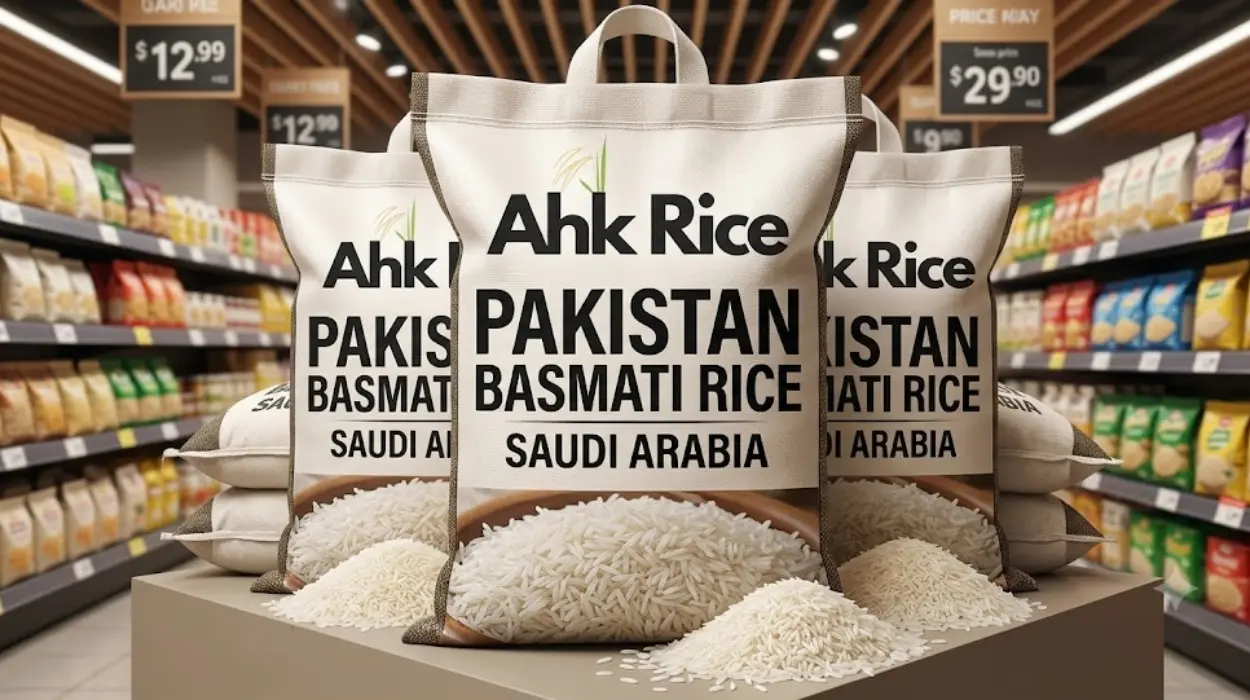
Saudi supermarkets need private-label Pakistan Basmati rice that delivers the same variety, purity, grain appearance, and cooking performance from one shipment to the next. AHK Rice addresses this requirement through controlled sourcing, processing, inspection, packaging, and export documentation designed for commercial retail supply.
For retailers still evaluating how purity affects purchasing decisions,
Understanding rice purity and Saudi consumer trust provides the necessary foundation before selecting a private-label supply model. The commercial decision is straightforward: a private-label program should not depend only on attractive packaging. It should begin with a defined rice specification and end with documented conformity.
What is the best solution for maintaining guaranteed rice purity?
The best solution is a specification-controlled private-label program that defines rice variety, purity, broken percentage, moisture, grain length, foreign matter, packaging, inspection, and batch traceability before production begins. This prevents inconsistent raw material selection from reaching Saudi supermarket shelves.
Private-label rice becomes difficult when the brand owner controls the package but not the underlying product specification. A bag may look identical while the rice inside changes between production lots.
For Saudi supermarkets, the safer model is to establish a fixed product specification before the first commercial order. The specification should identify the Basmati variety, grade, grain characteristics, acceptable broken percentage, moisture target, foreign matter tolerance, packaging format, net weight, country of origin, and required inspection documents.
Purity should also be treated as more than a percentage printed on a specification sheet. It includes varietal identity, physical cleanliness, uniformity, and the absence of unwanted admixture. This is particularly important when the product is marketed as Basmati.
AHK Rice can structure the supply around the retailer’s approved specification instead of treating every shipment as a generic rice order. That approach makes the product easier to evaluate before production and easier to control after arrival.
The retailer should also distinguish between pure variety and mixed variety procurement. Saudi retailers that want a premium private label generally have stronger reasons to specify a single approved variety and define its acceptance parameters. The comparison between these procurement models is explained in:
Pure variety versus mixed variety rice for Saudi retailers.
The commercial outcome is stronger consistency. If the supermarket launches a private-label 1121 Basmati product, for example, the supplier should not substitute another variety simply because its grain length or price appears similar. The approved specification should govern purchasing, processing, inspection, and packing.
Saudi food controls also make documentation important. The Saudi Food and Drug Authority states that imported food products must comply with applicable Saudi regulations and that imported consignments can undergo documentary, identity, physical, and, where required, laboratory checks.
What does guaranteed purity mean for a private-label retailer?
Guaranteed purity should mean that the supplier commits to measurable specifications rather than using a broad marketing claim. The exact guarantee should be written into the commercial specification, purchase order, or contract and supported by inspection or laboratory evidence where applicable.
Why choose AHK Rice for Saudi supermarket private labels?
AHK Rice is suitable for a private-label program when the buyer needs controlled Pakistan Basmati sourcing, defined quality parameters, customized packaging, documented inspections, and coordinated export preparation rather than purchasing an anonymous commodity lot. The process connects product control directly with retail requirements.
AHK Rice is positioned around Pakistan-origin Basmati supply and export coordination. For a Saudi supermarket, that matters because private-label procurement requires more than simply finding rice at the lowest quoted price.
The first requirement is product definition. The buyer should identify the intended variety and grade before requesting a quotation. The second is sample approval. The third is production against the approved specification. The fourth is inspection and documentation. The fifth is shipment execution.
This sequence creates a clear chain between what the buyer approved and what ultimately reaches the supermarket.
Packaging is another important part of the model. A retailer may require 1 kg, 2 kg, 5 kg, or another retail format depending on its positioning. Packaging can also include the supermarket’s private brand, product description, country of origin, net weight, storage instructions, barcode requirements, and Arabic labeling.
Saudi SFDA guidance states that prepackaged food labeling in English alone is not sufficient where the applicable regulation requires Arabic; information in another language should appear alongside equivalent Arabic information.
AHK Rice should therefore receive the final artwork and product information before commercial packaging is printed. This reduces the risk of producing packaging that later needs correction.
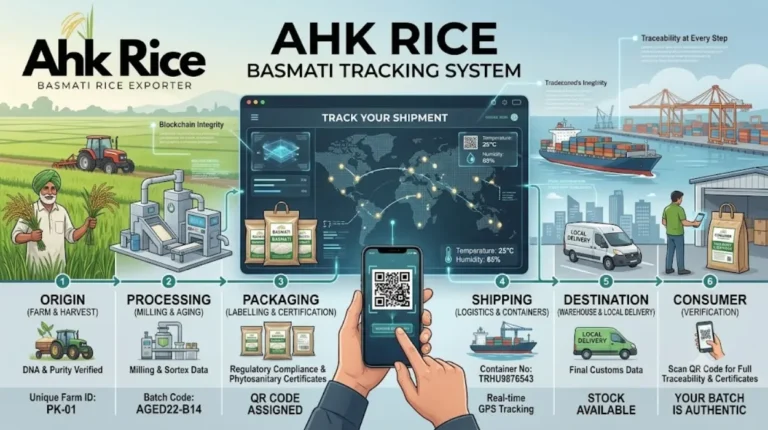
The supplier should also maintain batch-level records. A private-label retailer benefits when the production lot, packing date, specification, inspection results, and shipment documentation can be connected. This makes quality discussions more precise if a buyer raises a question after delivery.
Saudi import controls reinforce the importance of this approach. SFDA requires food importers to register relevant food items and states that imported products must meet Saudi technical regulations and standards.
Is private-label packaging available with Pakistan Basmati rice?
Private-label packaging can be structured around the buyer’s approved retail format, artwork, pack size, and commercial specification. Packaging requirements should be finalized before production so that rice processing and packing follow one confirmed purchase specification.
What results can Saudi supermarkets expect from the supply process?
A properly controlled private-label program should deliver consistent variety, cleaner visual appearance, predictable cooking behavior, traceable batches, compliant packaging, and a repeatable purchasing process. The strongest result is not one successful shipment, but consistent conformity across successive commercial orders.
The most important result is repeatability. A supermarket cannot build a private brand around a product that performs well in one shipment and differently in the next.
For example, suppose a retailer launches a premium 1121 Basmati private label. Customers expect long grains after cooking, acceptable aroma, good separation, and consistent appearance. If the next shipment contains materially different grain characteristics, customer confidence can decline even if the package design has not changed.
AHK Rice can approach this risk by using the approved sample and specification as the reference point for commercial production.
The result should be measurable through several checkpoints:
- Variety matches the approved specification.
- Physical purity meets the agreed requirement.
- Broken grains remain within the agreed tolerance.
- Moisture remains within the agreed commercial range.
- Grain length and appearance remain consistent.
- Packaging matches approved artwork and net weight.
- Export documents correspond with the shipment.
- Batch information remains traceable.
Shipping performance also affects retail planning. For Saudi Arabia, a Pakistan-origin shipment normally requires planning across production, container loading, ocean transit, destination handling, customs clearance, and inland transportation rather than considering only vessel transit.
A practical planning model is approximately 7–10 days for production and export preparation, followed by roughly 15–25 days for ocean movement and associated logistics to Jeddah, with additional time required for destination clearance and inland delivery. These are planning ranges, not guaranteed transit commitments.
The 2026 shipping environment requires additional caution. Current Red Sea security disruptions have increased route and insurance uncertainty, while recent reporting indicates that northern Saudi ports such as Jeddah and Yanbu have experienced lower war-risk premiums than some southern routes.
For that reason, AHK Rice should confirm the actual sailing schedule and freight conditions when the order is booked rather than treating a historical transit time as a fixed promise.
For a retailer receiving through Jeddah and distributing to Riyadh, a reasonable planning window is approximately 25–40 days from production start to inland warehouse arrival, depending on production readiness, vessel schedule, customs processing, and domestic transport.
Dammam-bound cargo may require a different routing and schedule. Riyadh is an inland destination, so its final delivery time depends on the selected Saudi port and inland transport arrangement. Jeddah supermarket deliveries can generally avoid the additional long-haul inland movement required for Riyadh.
How long does Pakistan Basmati rice take to reach Saudi supermarkets?
A realistic commercial planning window is about 25–40 days from production initiation to inland warehouse arrival, but the exact timeline depends on production, vessel availability, port operations, customs clearance, route conditions, and the final Saudi distribution location.
What factors affect the private-label rice price?
Private-label rice pricing depends on variety, grade, purity specification, crop and market conditions, processing requirements, packaging material, printing, order quantity, inspection, freight, destination charges, and payment terms. The lowest rice price is therefore not necessarily the lowest landed retail cost.
The rice itself is only one component of the final private-label cost.
A buyer requesting premium 1121 Basmati with strict purity parameters should expect a different price structure from a buyer purchasing a standard grade with broader tolerances. The same applies to packaging.
A basic commercial cost model can be viewed as:
Rice cost + processing + packaging + inspection + documentation + inland logistics + ocean freight + destination charges = landed procurement cost.
Packaging can become significant when the retailer requires custom printed bags, multiple pack sizes, specialized materials, or smaller production runs. Larger production quantities generally provide better opportunities to spread setup and packaging costs across more units.
The sample stage should also be budgeted separately.
A practical sample budget example for a Saudi supermarket buyer could include:
| Sample stage | Typical planning allowance |
|---|---|
| Rice sample | $0–$50 |
| Sample packaging preparation | $20–$75 |
| Courier and handling | $60–$180 |
| Optional third-party laboratory testing | $50–$150 |
| Illustrative sample budget | $130–$455 |
These figures are budgetary planning ranges, not an AHK Rice quotation. Actual costs vary according to sample weight, courier destination, packaging requirements, laboratory scope, and whether testing is conducted by the buyer or supplier.
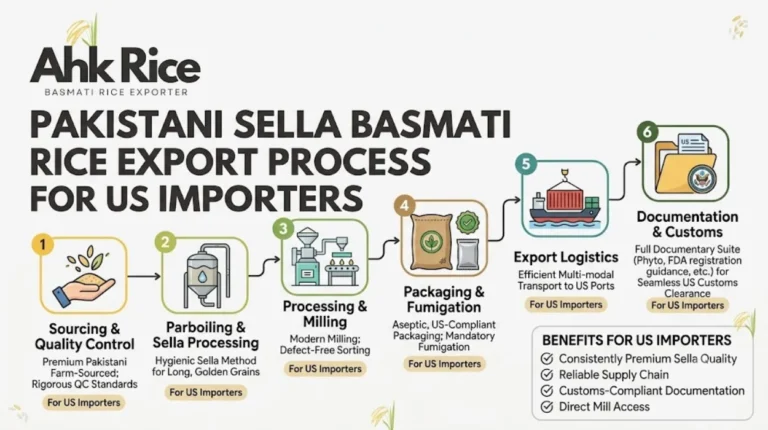
The full sample process should follow a controlled sequence.
Step 1: The retailer submits its required variety, purity, grain, moisture, packaging, and labeling specifications.
Step 2: AHK Rice confirms whether the requested specification can be produced and provides a commercial quotation based on the required grade and quantity.
Step 3: A representative rice sample is prepared from the proposed production specification.
Step 4: The buyer evaluates physical appearance, grain uniformity, aroma, cooking performance, and purity requirements. If required, laboratory testing can be arranged.
Step 5: The buyer approves the sample in writing.
Step 6: Final packaging artwork and product information are confirmed.
Step 7: Commercial production begins against the approved specification.
Step 8: Final inspection and documentation are completed before container loading.
This process reduces the risk of a retailer approving a generic sample and later receiving a commercially different product.
How should Saudi supermarket buyers decide on a supplier?
Saudi supermarket buyers should select the supplier that can prove specification control, sample conformity, packaging accuracy, documentation readiness, and repeatable shipment execution. A reliable private-label decision should be based on measurable controls rather than price, promises, or packaging appearance alone.
The decision should begin with the product specification and work backward from the supermarket shelf.
| Decision factor | What the buyer should verify |
| Rice identity | Approved Basmati variety and grade |
| Purity | Defined acceptance criteria and inspection method |
| Sample conformity | Commercial shipment matches approved sample |
| Packaging | Correct artwork, pack size, weight, and labeling |
| Documentation | Origin, invoice, inspection, and required compliance documents |
| Shipment control | Production and container-loading timeline |
| Repeatability | Ability to reproduce the same specification on future orders |
AHK Rice becomes a stronger option when these controls are documented before the order is confirmed.
The retailer should also avoid treating “100% pure” as sufficient evidence by itself. The meaningful question is what the supplier means by purity and how the claim is verified.
A proper specification can define varietal identity, foreign matter, broken grains, moisture, grain characteristics, and other agreed parameters. The buyer can then compare suppliers against the same commercial criteria.
This also improves negotiations. If two suppliers offer different prices, the retailer can compare like-for-like specifications instead of comparing headline prices.
The final decision should therefore consider landed cost, conformity risk, documentation quality, supply continuity, and customer-facing consistency together.
How can a Saudi supermarket get started with AHK Rice?
Start by submitting the target variety, purity specification, pack size, estimated order quantity, destination, packaging requirements, and required delivery window. The supplier can then structure sampling, quotation, approval, production, inspection, and shipment around those commercial requirements.
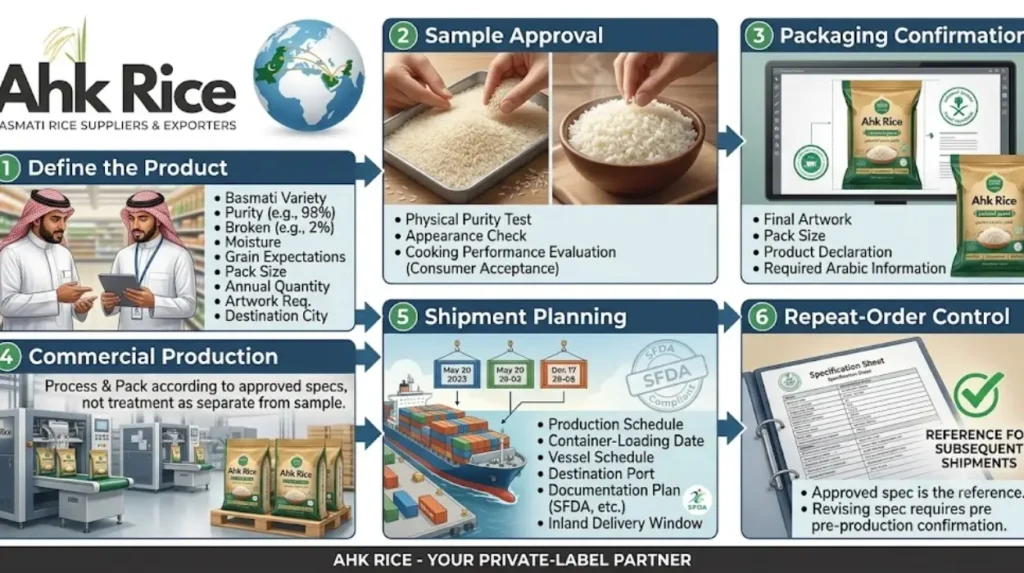
The first step is to define the product.
A Saudi supermarket should provide the desired Basmati variety, purity requirement, broken percentage, moisture specification, grain expectations, packaging size, annual or initial quantity, private-label artwork requirements, and destination city.
AHK Rice can then use those requirements to establish the proposed commercial specification.
The second step is sample approval. The buyer should test the sample before committing to the complete commercial shipment. Cooking performance should be evaluated alongside physical purity and appearance because a private-label rice product is ultimately judged by the consumer after preparation.
The third step is packaging confirmation. The retailer should approve the final artwork, pack size, product declaration, and required Arabic information before production.
The fourth step is commercial production. AHK Rice should process and pack the shipment according to the approved specification rather than treating the sample as a separate product.
The fifth step is shipment planning. The buyer should receive the expected production schedule, container-loading date, vessel schedule, destination port, documentation plan, and estimated inland delivery window.
The sixth step is repeat-order control. The approved specification should remain the reference for subsequent shipments. If the retailer changes variety, grade, packaging, or purity requirements, the revised specification should be confirmed before production.
For Saudi Arabia, this approach also aligns the commercial workflow with the country’s food-import control environment. SFDA conducts documentary, identity, physical, and potentially laboratory checks on imported food consignments, and non-compliant consignments can be prevented from entering the market.
AHK Rice therefore should be evaluated not merely as a rice seller, but as a supply partner capable of connecting Pakistani Basmati sourcing with the retailer’s defined private-label specification.
If a supermarket wants consistent private-label positioning, it should decide on verified product conformity, controlled packaging, transparent sample approval, and realistic shipping planning. That combination provides a stronger foundation for protecting retail quality and consumer trust than purchasing purely on price.
To begin the commercial discussion, submit the required specification, quantity, packaging format, destination, and delivery requirements through the private-label rice quotation request.
Frequently Asked Questions
What does guaranteed purity mean in private-label Pakistan Basmati rice?
Guaranteed purity means the rice meets an agreed specification for varietal identity, physical cleanliness, broken grains, foreign matter, moisture, and other quality parameters established before commercial production.
Why is rice purity important for Saudi supermarkets?
Rice purity supports consistent product quality, cooking performance, consumer trust, and private-label positioning. Consistent purity also helps retailers maintain the same product specification across repeat shipments.
Can Saudi supermarkets order Pakistan Basmati rice under their own private label?
Yes. Private-label programs can be structured around the retailer’s selected Basmati variety, pack size, packaging artwork, labeling requirements, quality specification, and order quantity.
Which Pakistan Basmati varieties can be used for private-label supply?
Common commercial options include 1121, Super Kernel, and 1509 Basmati rice. The appropriate variety depends on the supermarket’s target price, grain-length requirements, cooking characteristics, and customer segment.
How is the purity of Pakistan Basmati rice verified?
Purity can be verified through an agreed product specification, physical inspection, representative sampling, and laboratory testing when required. The acceptance criteria should be defined before commercial production.
What should Saudi retailers check in a Basmati rice sample?
Retailers should evaluate grain appearance, varietal consistency, broken percentage, foreign matter, aroma, moisture, cooking performance, elongation, texture, and overall conformity with the proposed commercial specification.
How long does Pakistan Basmati rice take to reach Saudi Arabia?
A practical planning window can be around 25–40 days from production initiation to inland warehouse arrival, depending on production, vessel schedules, port operations, customs clearance, route conditions, and the final Saudi destination.
What affects the cost of private-label Basmati rice?
Price depends on rice variety and grade, purity requirements, processing, order volume, packaging material, custom printing, inspection, laboratory testing, freight, destination charges, and payment terms.
Does private-label rice require custom packaging?
Custom packaging is not always mandatory, but private-label supermarket programs commonly require retailer-specific artwork, pack sizes, product information, net weight, country of origin, and applicable Arabic labeling.
How does the private-label rice sample process work?
The buyer provides specifications, the supplier prepares a representative sample, the retailer evaluates and approves it, packaging artwork is finalized, commercial production begins, and the finished shipment is inspected before container loading.
Can the approved rice sample be used as a reference for future shipments?
Yes. The approved sample and written product specification can serve as reference points for subsequent orders. This helps maintain consistency in variety, purity, grain characteristics, cooking performance, and packaging.
What documents should Saudi supermarket buyers request?
Depending on the shipment and applicable requirements, buyers may request commercial invoices, packing lists, certificates of origin, inspection or quality documents, shipping documents, product specifications, and other documents required for Saudi food import compliance.
Why should retailers compare pure and mixed variety rice?
Pure variety rice provides clearer control over varietal identity and product consistency. Mixed varieties can have different grain characteristics and cooking behavior, making them less suitable when a supermarket wants a tightly controlled premium private label.
How can Saudi supermarkets start a private-label rice order?
Buyers should provide the required Basmati variety, purity specification, quantity, packaging format, destination, private-label requirements, and expected delivery window. The supplier can then proceed with sampling, quotation, approval, production, inspection, and shipment planning.