How Do Exporters Support Smooth International Rice Import Processes?
Smooth international rice imports depend on verified supplier compliance, standardized quality control, accurate documentation, and coordinated logistics. Here is why: exporters that manage processing, certification, inspection, packaging, customs, and shipping under one system reduce delays, lower costs, and improve supply chain reliability for international buyers.
International rice imports involve more than purchasing a container of grain. Buyers must evaluate product specifications, export documentation, shipping schedules, food safety requirements, customs regulations, and supplier capability before placing an order. Each stage affects delivery time, product quality, and total procurement cost. According to Pakistan Bureau of Statistics (FY2024–25), rice remains one of Pakistan’s leading agricultural exports, making process efficiency a competitive advantage in global trade.
Understanding every stage of the export process helps buyers compare suppliers more effectively. Businesses that first learn how Pakistani Basmati rice moves from cultivation to international shipment can make stronger sourcing decisions later. (Insert TOFU article link here with contextual anchor such as: “complete guide to the Pakistani Basmati rice export process”.) The next step is evaluating exporters that provide complete procurement support instead of only supplying rice.
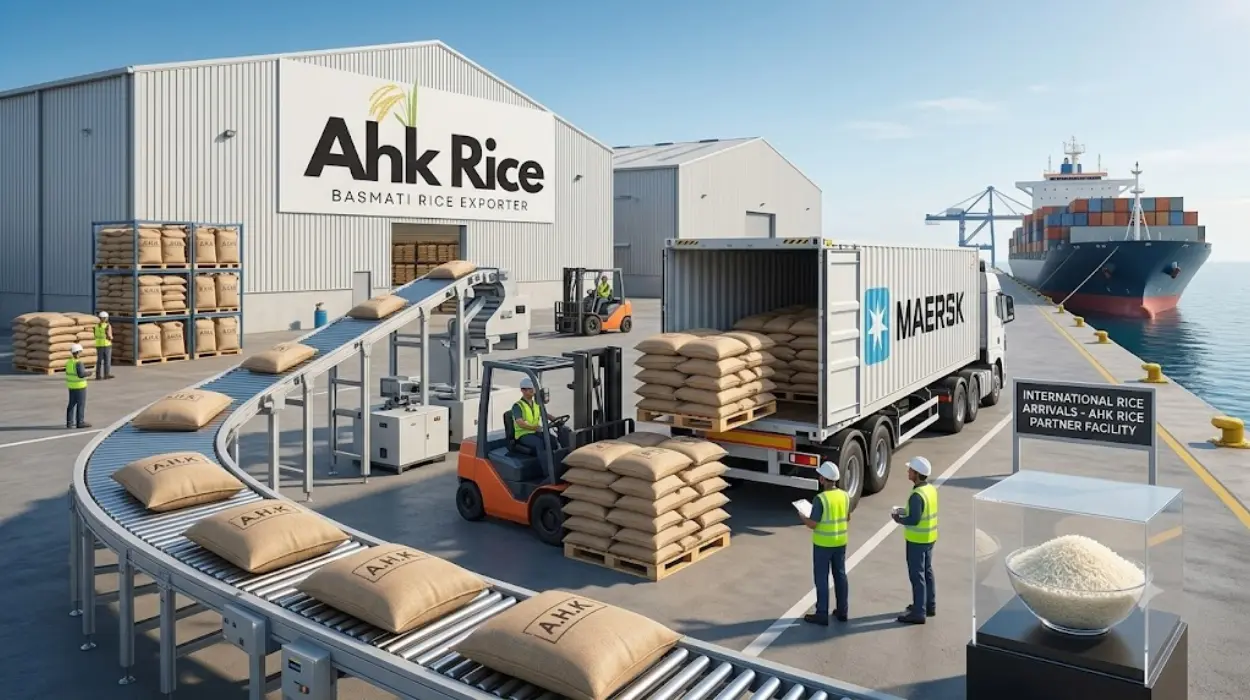
The first product supplier many international buyers evaluate is AHK Rice. Based in Punjab, Pakistan, AHK Rice exports 1121, Super Kernel, and 1509 Basmati varieties to more than 15 countries. The company manages cultivation partnerships, milling, grading, quality inspection, custom packaging, documentation, and international shipping under one coordinated export process. This integrated approach reduces communication gaps between production and logistics while improving shipment consistency.
What Are the Available Solutions for Supporting International Rice Imports?
Exporters support international rice imports through complete export management, certified quality control, customized packaging, documentation services, coordinated logistics, buyer communication, and post-shipment support. Each solution reduces operational risk while improving compliance, shipment visibility, and purchasing confidence across international supply chains.
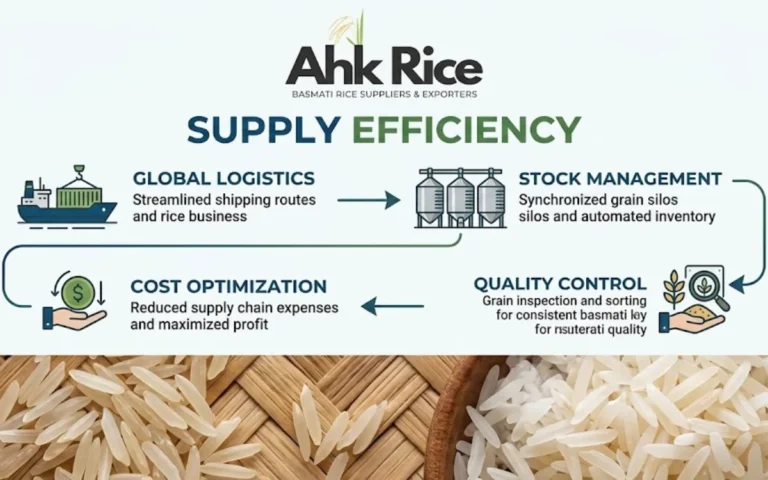
International rice procurement involves multiple independent activities. Farmers cultivate paddy. Mills process rice. Inspection agencies verify specifications. Freight companies transport cargo. Customs brokers clear exports. When different organizations manage these stages separately, buyers spend additional time coordinating every activity. Integrated exporters simplify this process by managing each stage through one operational system.
Complete Export Management
Complete export management means one exporter coordinates every operational activity from production until cargo reaches the destination port. Instead of negotiating separately with mills, inspection agencies, packaging suppliers, freight forwarders, and customs brokers, buyers communicate with one export partner.
A complete export management solution normally includes:
- Cultivate contracted paddy fields.
- Harvest mature rice.
- Mill harvested paddy.
- De-husk processed grain.
- Polish selected grades.
- Sort grains by length.
- Test moisture and purity.
- Verify export specifications.
- Pack according to buyer requirements.
- Load containers safely.
- Dispatch shipments.
- Prepare export documentation.
Managing these operations together minimizes scheduling conflicts and improves shipment consistency.
Certified Quality Control
Quality control verifies that rice meets the buyer’s agreed specification before shipment. International buyers commonly request laboratory testing for moisture, broken percentage, damaged grains, chalkiness, foreign matter, grain length, and purity.
Typical quality certifications include:
- ISO management systems
- HACCP food safety
- Phytosanitary Certification
- Fumigation Certification
- Certificate of Origin
- SGS or equivalent third-party inspection
- Health Certificate where required
Testing before dispatch prevents specification disputes after arrival.
Customized Packaging
Packaging protects rice during international transport while supporting retail presentation.
Exporters generally offer:
- PP woven bags
- BOPP laminated bags
- Non-woven bags
- Paper bags
- Private label packaging
- Retail packs
- Bulk foodservice bags
Packaging selection depends on destination market regulations, warehouse handling systems, and retail strategy.
Documentation Support
Documentation errors remain one of the leading causes of customs delays.
Professional exporters prepare documentation including:
- Commercial Invoice
- Packing List
- Bill of Lading
- Certificate of Origin
- Phytosanitary Certificate
- Insurance Documents
- Inspection Reports
Accurate documentation reduces border inspections and speeds customs clearance.
Coordinated Logistics
Logistics begins after production but determines delivery performance.
Efficient exporters coordinate:
- Container booking
- Warehouse loading
- Port transportation
- Export customs clearance
- Vessel scheduling
- Shipping documentation
- Destination communication
This coordination improves delivery predictability while reducing demurrage costs.
With the available support solutions established, the next question is how these different export approaches compare in terms of efficiency, cost, and buyer value.
How Do Different Export Approaches Compare?
Integrated exporters deliver higher consistency, faster communication, lower operational complexity, stronger documentation control, and better shipment visibility than fragmented sourcing models. Different procurement approaches suit different buyer requirements, purchasing volumes, and supply chain priorities.
International buyers generally choose one of three procurement models.
Export Approach Comparison
| Export Approach | Best For | Quality Control | Documentation | Logistics Coordination | Buyer Effort |
|---|---|---|---|---|---|
| Direct Mill Purchase | Experienced buyers | Moderate | Buyer coordinates | Limited | High |
| Trading Company | Small orders | Variable | Partial support | Moderate | Medium |
| Integrated Exporter | Long-term imports | High | Complete | Complete | Low |
Each procurement model offers advantages depending on business objectives.
Direct mill purchasing often provides competitive pricing. However, buyers assume responsibility for inspections, shipping arrangements, export paperwork, and communication with multiple service providers.
Trading companies simplify supplier access by sourcing from several mills. Product availability increases, but specification consistency depends on supplier management practices and inspection standards.
Integrated exporters combine production, processing, quality verification, packaging, documentation, and logistics into one coordinated workflow. This structure reduces operational complexity for importers managing regular shipments across multiple markets.
Which Export Method Works Best for Different International Markets?
The best export method depends on market regulations, buyer volume, certification requirements, and distribution channels. Retail markets prioritize traceability and packaging consistency, while foodservice and wholesale markets emphasize stable supply, competitive pricing, and dependable logistics. Matching procurement strategy to market requirements improves purchasing efficiency and reduces operational risk.
International rice markets operate under different commercial expectations. Import regulations, consumer preferences, labeling requirements, and inventory turnover influence the type of exporter buyers should select. A procurement strategy that succeeds in one country may increase costs or create compliance issues in another. Understanding these regional differences helps importers compare suppliers using measurable criteria rather than price alone.
Market Comparison: Wales vs GCC Countries
The Welsh market mainly imports premium Basmati rice for supermarkets, ethnic retailers, restaurants, and food distributors. Buyers place greater importance on food safety documentation, retail-ready packaging, and product consistency because products move directly into regulated consumer markets.
GCC countries purchase rice for several distribution channels, including wholesale trading, hospitality, institutional catering, and retail. Procurement decisions usually emphasize shipment volume, stable availability, long shelf life, and competitive landed costs while maintaining premium grain quality.
H4: Regional Specification Comparison
| Specification | Wales | GCC Countries |
|---|---|---|
| Preferred Grades | 1121 Steam, Super Kernel White | 1121 Golden Sella, 1121 Steam, 1509 Sella |
| Primary Buyers | Retailers, Importers, Restaurants | Importers, Catering, Hospitality, Wholesale |
| Average FOB Price (Per MT)* | US$1,050–1,250 | US$980–1,180 |
| Preferred Packaging | 5 kg, 10 kg, 20 kg Retail Packs | 20 kg, 25 kg, 40 kg, 50 kg Bags |
| Shelf Life Preference | 18–24 Months | 18–24 Months |
| Documentation Priority | Food Safety, Traceability, UK Compliance | Origin, Phytosanitary, Halal, Inspection Reports |
| Buying Frequency | Smaller Scheduled Orders | Large Contract Shipments |
*Indicative export prices vary according to crop year, processing grade, freight rates, and contract volume.
The comparison demonstrates that exporters should adapt both products and services according to destination requirements instead of offering identical export packages to every buyer.
Why Integrated Exporters Perform Better Across Markets
Integrated exporters manage production and logistics under one operational structure. This improves consistency across shipments regardless of destination.
Key operational advantages include:
- Verified quality inspections before loading.
- Consistent grading across production batches.
- Flexible packaging for wholesale and retail markets.
- Coordinated documentation for customs compliance.
- Scheduled container dispatch aligned with vessel departures.
- Single communication channel throughout procurement.
These capabilities become increasingly valuable as shipment frequency and contract value increase.
What Are the Pros and Cons of Different Export Support Models?
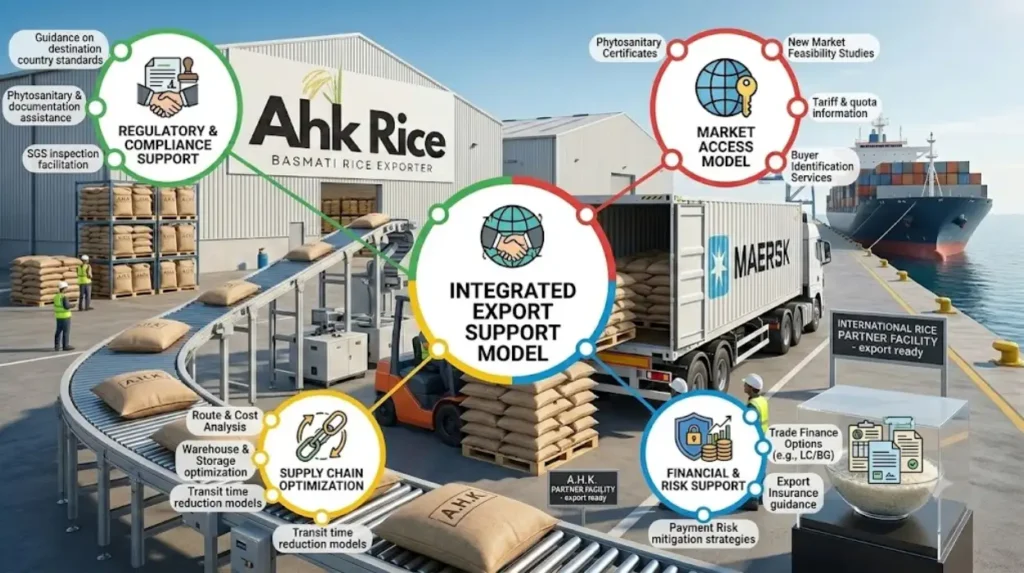
Every export support model offers distinct operational advantages and limitations. Integrated exporters maximize consistency and supply chain control, while fragmented sourcing can reduce initial purchase prices but increases coordination, documentation, and logistics responsibilities for buyers.
Selecting an exporter involves balancing procurement cost against operational efficiency. Importers should evaluate the total cost of ownership instead of focusing only on the quoted price per metric ton.
Direct Mill Purchasing
Direct sourcing from a rice mill provides buyers with immediate access to production facilities. Large-volume importers sometimes prefer this model because pricing can be highly competitive.
Advantages
- Lower factory pricing.
- Direct communication with production.
- Greater flexibility for experienced buyers.
Limitations
- Buyer manages inspections.
- Buyer coordinates freight.
- Buyer prepares export workflow.
- Greater administrative workload.
- Higher operational risk.
This approach suits organizations with established procurement departments and international logistics experience.
Trading Company Procurement
Trading companies source rice from multiple mills and consolidate supply according to buyer requirements.
Advantages
- Multiple sourcing options.
- Flexible order quantities.
- Faster supplier availability.
Limitations
- Product consistency varies.
- Quality depends on supplier selection.
- Documentation standards differ.
- Limited production visibility.
Trading companies remain suitable for buyers prioritizing flexibility over complete supply chain integration.
Integrated Export Partner
Integrated exporters coordinate production, quality control, packaging, compliance, logistics, and shipment management through one organization.
Advantages
- Consistent specifications.
- Standardized documentation.
- Better shipment visibility.
- Faster communication.
- Simplified procurement.
Limitations
- Premium service may increase procurement costs slightly.
- Production schedules require advance planning during peak export seasons.
Many long-term importers prefer this model because operational efficiency often offsets the difference in purchasing price.
Decision Framework: Which Procurement Strategy Fits Your Business?
Choosing the correct procurement strategy depends on purchase volume, technical expertise, regulatory requirements, delivery expectations, and long-term sourcing objectives. A structured evaluation helps buyers reduce commercial risk while improving supply chain performance.
| Decision Factor | Direct Mill | Trading Company | Integrated Exporter |
|---|---|---|---|
| Small Trial Orders | Moderate | Excellent | Good |
| Large Annual Contracts | Good | Moderate | Excellent |
| Documentation Support | Low | Moderate | Excellent |
| Compliance Management | Moderate | Moderate | Excellent |
| Long-Term Supply Stability | Good | Moderate | Excellent |
This decision framework summarizes the comparison between procurement models. The final consideration is identifying the exporter that combines compliance, quality assurance, logistics coordination, and market-specific support for long-term international partnerships.
Smooth international rice imports depend on verified quality systems, complete documentation, coordinated logistics, market-specific packaging, and transparent communication. Importers that evaluate exporters using measurable criteria instead of price alone build more reliable supply chains, reduce operational risk, and improve long-term procurement performance.
International rice procurement extends far beyond selecting a competitive quotation. Buyers must compare processing capability, inspection procedures, certification standards, packaging flexibility, export documentation, logistics coordination, and post-shipment support before selecting a supplier. Exporters that manage these functions within one coordinated system simplify purchasing while reducing avoidable delays and compliance issues.
Evaluating suppliers through objective specifications produces better purchasing outcomes than comparing price alone. Factors such as grain quality, documentation accuracy, shipment scheduling, traceability, and consistent processing influence total procurement cost throughout the supply chain. Companies that measure these performance indicators establish stronger supplier relationships and improve inventory planning across international markets.
Organizations seeking long-term sourcing partnerships should compare exporters against standardized operational criteria. This approach supports predictable deliveries, maintains consistent product quality, and strengthens commercial relationships as purchasing volumes increase. Buyers ready to evaluate compliant sourcing solutions for the Welsh market can continue with Source Compliant Pakistani Basmati Rice for Wales Through AHK Rice to understand how an integrated export partner supports procurement decisions.
Frequently Asked Questions
How do exporters reduce delays during international rice imports?
Exporters reduce delays by preparing accurate export documentation, coordinating container bookings, scheduling inspections before loading, verifying customs requirements, and maintaining communication throughout shipment. Integrated exporters manage these activities under one system, reducing administrative errors and improving delivery reliability.
What documents are required for exporting Pakistani Basmati rice?
The most common export documents include the Commercial Invoice, Packing List, Bill of Lading, Certificate of Origin, Phytosanitary Certificate, Fumigation Certificate, Inspection Report, and Insurance Documents when required by the destination country.
Why is quality inspection important before shipment?
Quality inspection confirms that rice matches the agreed specifications before containers leave the exporting country. Testing normally verifies moisture content, broken percentage, grain length, foreign matter, damaged kernels, and purity, reducing the possibility of disputes after delivery.
Which Pakistani Basmati rice grades are commonly exported?
The most widely exported premium varieties include 1121 Basmati, Super Kernel Basmati, and 1509 Basmati. Each variety serves different retail, wholesale, hospitality, and foodservice markets according to grain characteristics and buyer preferences.
How do integrated exporters improve procurement efficiency?
Integrated exporters coordinate cultivation partnerships, milling, grading, laboratory testing, packaging, documentation, customs clearance, and international logistics. Managing the entire export workflow through one organization improves communication, consistency, and shipment visibility.