What Is Foreign Matter in Pakistan Basmati Rice Imported into the UAE?
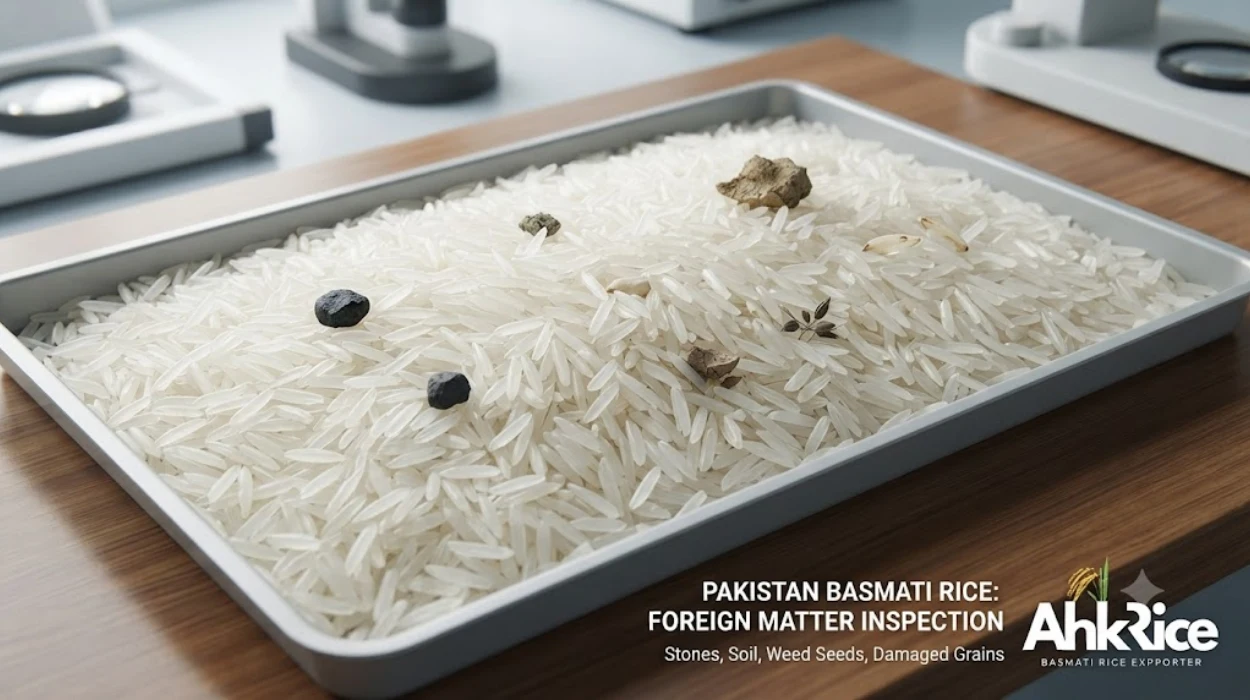
Foreign matter in Pakistan Basmati rice refers to any material that is not a healthy rice kernel. Examples include stones, husks, straw pieces, dust, weed seeds, broken plant material, metal fragments, insects, and other unwanted particles. Foreign matter affects food safety, milling quality, buyer confidence, and import compliance. Here is why: every shipment entering the UAE undergoes quality inspection, and foreign matter remains one of the first measurable quality parameters.
Pakistan produces some of the world’s highest-quality aromatic Basmati rice. The grain grows mainly in Punjab under controlled irrigation systems before it enters modern milling facilities. During harvesting, transportation, storage, and processing, unwanted materials naturally mix with paddy rice. Rice processors remove these materials through multiple cleaning stages before export.
Understanding foreign matter helps importers evaluate rice quality correctly. It also explains why exporters invest heavily in cleaning technology before loading export containers.
This article explains what foreign matter is, how it enters rice, how processors remove it, why UAE buyers monitor it carefully, and how international quality standards classify acceptable limits.
If you also want to understand how UAE buyers evaluate acceptable impurity percentages, continue with our guide on foreign matter limits required by UAE rice importers from Pakistan.
What is foreign matter in Pakistan Basmati rice?
Foreign matter means any material other than sound rice kernels, including stones, dust, straw, husks, weed seeds, insects, metal particles, and plant residue. Rice inspectors measure its percentage because cleaner rice delivers better food safety, milling quality, appearance, and import compliance.
Foreign matter is one of the standard quality parameters used throughout the global rice trade. Every rice-producing country measures it before export because it directly affects food quality and buyer satisfaction.
Foreign matter falls into two broad categories.
Natural Foreign Matter
Natural materials originate during cultivation or harvesting.
Examples include:
- Straw
- Rice husks
- Weed seeds
- Dust
- Sand
- Small stones
- Soil particles
Farm harvesting combines mature rice plants with surrounding field materials. Even modern harvesting equipment cannot completely separate every unwanted particle during collection.
Artificial Foreign Matter
Artificial materials originate during transportation, storage, or processing.
Examples include:
- Plastic pieces
- Metal fragments
- Thread
- Packaging fibers
- Glass fragments
Modern export mills inspect carefully because artificial contamination presents a serious food safety concern.
Foreign matter differs from broken rice. Broken rice remains edible rice. Foreign matter contains materials that buyers expect processors to remove before shipment.
With the definition established, the next question explains how foreign matter enters rice during production.
How does foreign matter enter Pakistan Basmati rice?
Foreign matter enters rice during cultivation, harvesting, transportation, drying, storage, and milling. Modern rice mills reduce contamination through several cleaning stages before grading, packaging, and export.
Foreign matter begins in the agricultural field. Rice grows in open environments where soil particles, stones, grass seeds, insects, and plant residue naturally surround the crop.
Harvesting combines rice plants with these surrounding materials. Mechanical harvesters collect large volumes efficiently, but they also gather lightweight debris and small impurities.
Transportation introduces another contamination stage. Trucks carry freshly harvested paddy from farms to drying facilities. Dust, fibers, and loose plant material enter loads if vehicles are not cleaned before loading.
Drying yards also require continuous inspection. Wind carries leaves and lightweight debris across drying surfaces when facilities lack proper protection.
Storage conditions determine whether additional contamination develops. Poor warehouse hygiene allows insects, rodents, or damaged packaging materials to enter stored grain.
Rice mills therefore perform multiple inspection and cleaning operations before grading export-quality Basmati.
Understanding these contamination sources makes the cleaning process easier to understand.
How is foreign matter removed during rice processing?
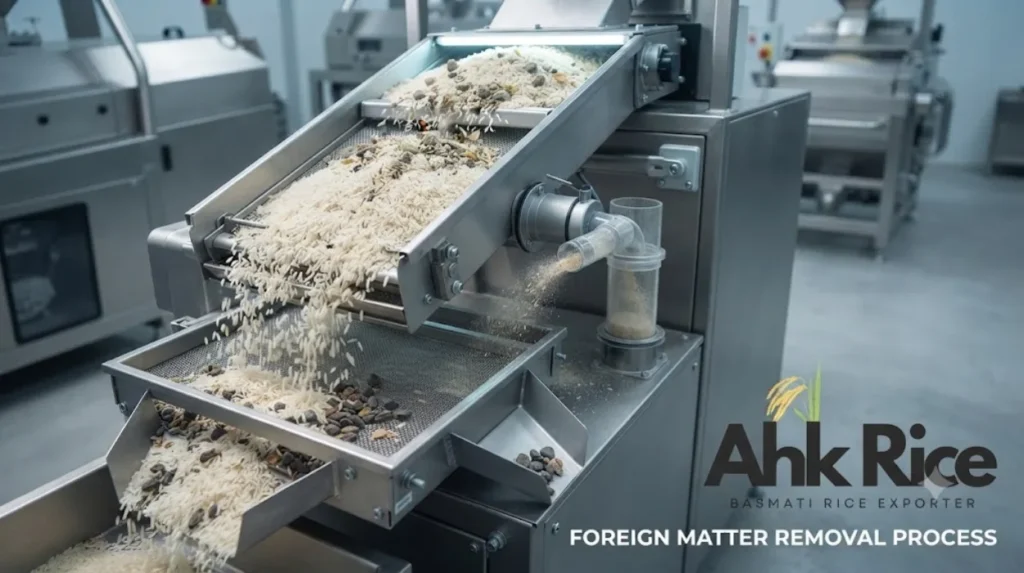
Foreign matter is removed through cleaning, aspiration, de-stoning, magnetic separation, grading, colour sorting, polishing, inspection, and final quality testing. Each stage removes specific impurities before export packaging begins.
Modern rice mills use several machines because no single machine removes every impurity.
Step 1 — Clean the Paddy
Cleaning machines remove large debris.
Examples include:
- Straw
- Leaves
- Twigs
- Large stones
Step 2 — De-husk the Grain
De-husking separates the outer husk from rice kernels before further processing.
Step 3 — Separate Stones
Destoners remove heavy particles based on density differences.
Examples include:
- Gravel
- Small stones
- Dense soil particles
Step 4 — Remove Metal
Magnetic separators collect tiny metal fragments that originate from machinery or transportation equipment.
Step 5 — Sort by Size
Graders separate immature kernels, oversized particles, and remaining debris.
Step 6 — Colour Sort the Rice
Optical colour sorters identify abnormal particles using high-speed cameras.
Examples include:
- Black grains
- Discoloured kernels
- Foreign seeds
- Plastic particles
Step 7 — Polish the Rice
Polishing removes remaining bran particles while improving grain appearance.
Step 8 — Inspect the Finished Rice
Quality inspectors collect representative samples before packaging.
They verify moisture, grain length, broken percentage, chalkiness, and foreign matter levels.
Step 9 — Pack the Rice
Clean rice enters export bags under hygienic conditions before loading containers.
These processing stages explain why export-quality Basmati contains significantly less foreign matter than freshly harvested paddy.
Why is foreign matter important for Pakistan Basmati rice imported into the UAE?
Foreign matter directly affects food safety, import compliance, consumer confidence, milling quality, shelf life, and commercial value. Lower foreign matter percentages produce cleaner rice, reduce processing losses, and help importers maintain consistent product quality.
Foreign matter represents one of the first quality indicators that importers inspect after receiving a rice shipment. A clean product reflects controlled farming, efficient milling, and effective quality management throughout the supply chain.
Food Safety
Food safety remains the primary reason for controlling foreign matter.
Consumers expect rice to contain only edible kernels. Materials such as stones, glass fragments, plastic pieces, or metal particles create unnecessary safety risks. Modern processing removes these contaminants before packaging to produce rice suitable for human consumption.
Product Appearance
Appearance strongly influences purchasing decisions.
Consumers easily recognize clean rice because the grains look bright, uniform, and free from visible impurities. Dust, husks, and straw reduce visual quality even when the rice remains edible.
Premium Pakistan Basmati rice achieves its reputation through long, uniform grains with minimal visible contamination.
Milling Performance
Foreign matter reduces milling efficiency.
Stones and hard particles damage processing equipment. Dust increases cleaning time. Plant residue interrupts grading accuracy. Removing these materials before final milling protects machinery and improves operational efficiency.
Storage Stability
Clean rice stores more consistently than contaminated rice.
Plant residue and excess dust retain moisture more easily than polished rice kernels. Stable moisture levels help preserve grain quality throughout transportation and warehouse storage.
Commercial Value
Rice quality determines market value.
Importers compare specifications before purchasing. Cleaner shipments require less additional processing after arrival. Lower cleaning costs improve operational efficiency for wholesalers, retailers, and food service companies.
These benefits explain why exporters invest in multiple cleaning stages before shipment.
With the importance established, the next section explains the individual materials classified as foreign matter.
What materials are classified as foreign matter?
Foreign matter includes mineral materials, plant materials, biological contaminants, and artificial contaminants. Each category originates from different stages of cultivation, harvesting, transportation, storage, or processing.
Quality inspectors classify foreign matter according to its source rather than its size.
Natural Plant Materials
Plant materials originate directly from harvested rice fields.
Examples include:
- Straw
- Rice husks
- Leaves
- Stem fragments
- Weed seeds
- Grass seeds
These materials enter harvested paddy during mechanical collection.
Mineral Materials
Mineral contamination originates from agricultural land.
Examples include:
- Stones
- Sand
- Gravel
- Soil particles
- Clay
Modern destoning equipment removes these heavier particles before milling.
Biological Contaminants
Biological contaminants develop during storage when warehouse management is poor.
Examples include:
- Dead insects
- Insect fragments
- Rodent contamination
- Bird feathers
Export-quality rice undergoes inspection to prevent these contaminants from entering finished products.
Artificial Contaminants
Artificial contaminants originate during handling and processing.
Examples include:
- Plastic fragments
- Metal particles
- Packaging fibers
- Thread
- Glass pieces
Magnetic separators, optical sorters, and manual inspections reduce these contaminants before export packaging.
Understanding these classifications helps explain why different machines perform different cleaning functions.
The next section examines how inspectors measure foreign matter scientifically.
How is foreign matter measured during quality inspection?
Foreign matter is measured by collecting representative samples, separating impurities, weighing them, and calculating the percentage against the total sample weight. Standard laboratory procedures produce repeatable inspection results.
Inspection begins with representative sampling.
Inspectors collect rice from different locations inside bags or containers to ensure the sample represents the entire shipment.
The sample then enters laboratory inspection.
Sample Preparation
Inspectors spread the rice over clean inspection trays under controlled lighting conditions.
Visible impurities are separated manually or with specialized laboratory equipment.
Classification
Each impurity enters its appropriate category.
Examples include:
- Stones
- Plant material
- Dust
- Metal
- Plastic
- Other foreign particles
Separating categories improves reporting accuracy.
Weighing
Inspectors weigh the separated foreign matter using calibrated laboratory balances.
The remaining rice kernels are also weighed.
Percentage Calculation
The laboratory calculates the foreign matter percentage using the impurity weight compared with the total sample weight.
This standardized method allows buyers and suppliers to compare quality objectively across different shipments.
Measurement provides consistency, which leads naturally to the quality standards used by international rice buyers.
What misconceptions exist about foreign matter in Basmati rice?
Foreign matter does not mean poor-quality rice, broken rice, damaged grains, or unsafe production. It simply measures unwanted materials that remain before final inspection and packaging.
Several misunderstandings appear frequently in rice trading discussions.
Foreign Matter Is Not Broken Rice
Broken rice remains edible rice.
Foreign matter contains materials that are not rice kernels.
These two quality parameters appear separately in export specifications.
Foreign Matter Does Not Define Aroma
Basmati aroma develops from variety, cultivation, harvesting, aging, and storage conditions.
Foreign matter does not determine fragrance.
Small Percentages Still Matter
Even tiny impurity percentages receive attention because buyers expect consistent quality across every shipment.
Consistency supports reliable commercial trade.
Modern Mills Remove Most Foreign Matter
Freshly harvested paddy naturally contains impurities.
Modern rice processing removes the overwhelming majority before export through sequential cleaning and inspection systems.
Understanding these misconceptions helps buyers interpret quality reports more accurately.
The final section summarizes why foreign matter remains an essential quality parameter in international Basmati trade.
Why should importers understand foreign matter in Pakistan Basmati rice?
Foreign matter provides a measurable indicator of cleaning efficiency, processing quality, inspection standards, and shipment consistency. Understanding this parameter helps importers evaluate rice quality using objective specifications instead of visual appearance alone.
Foreign matter forms part of every professional rice quality assessment because it measures cleanliness through standardized laboratory methods.
Pakistan Basmati rice passes through harvesting, drying, milling, grading, sorting, polishing, and inspection before export. Each processing stage reduces unwanted materials while improving product consistency.
Importers use foreign matter reports alongside moisture content, broken percentage, grain length, damaged kernels, chalkiness, and milling quality to assess complete shipment quality.
Understanding foreign matter also prepares buyers to interpret export specifications correctly before comparing suppliers.
Frequently Asked Questions
What is foreign matter in Pakistan Basmati rice?
Foreign matter includes any material other than healthy rice kernels. Examples include stones, straw, husks, dust, weed seeds, plastic fragments, and metal particles.
Is foreign matter the same as broken rice?
No. Broken rice consists of edible rice kernels that have fractured during milling. Foreign matter consists of non-rice materials that processors remove during cleaning.
How is foreign matter removed from Basmati rice?
Rice mills remove foreign matter through cleaning, aspiration, de-stoning, magnetic separation, grading, optical colour sorting, polishing, and final laboratory inspection.
Why do UAE importers inspect foreign matter?
UAE importers inspect foreign matter to verify food safety, cleanliness, processing quality, and compliance with contractual quality specifications.
Does foreign matter affect rice quality?
Yes. Lower foreign matter levels improve appearance, processing efficiency, food safety, storage performance, and buyer confidence.
Can foreign matter be completely eliminated?
Modern rice mills remove nearly all foreign matter through multiple processing stages. Laboratory inspections verify that the remaining level complies with agreed quality specifications before export.