How Does Export Packaging Protect Basmati Rice During Transport?
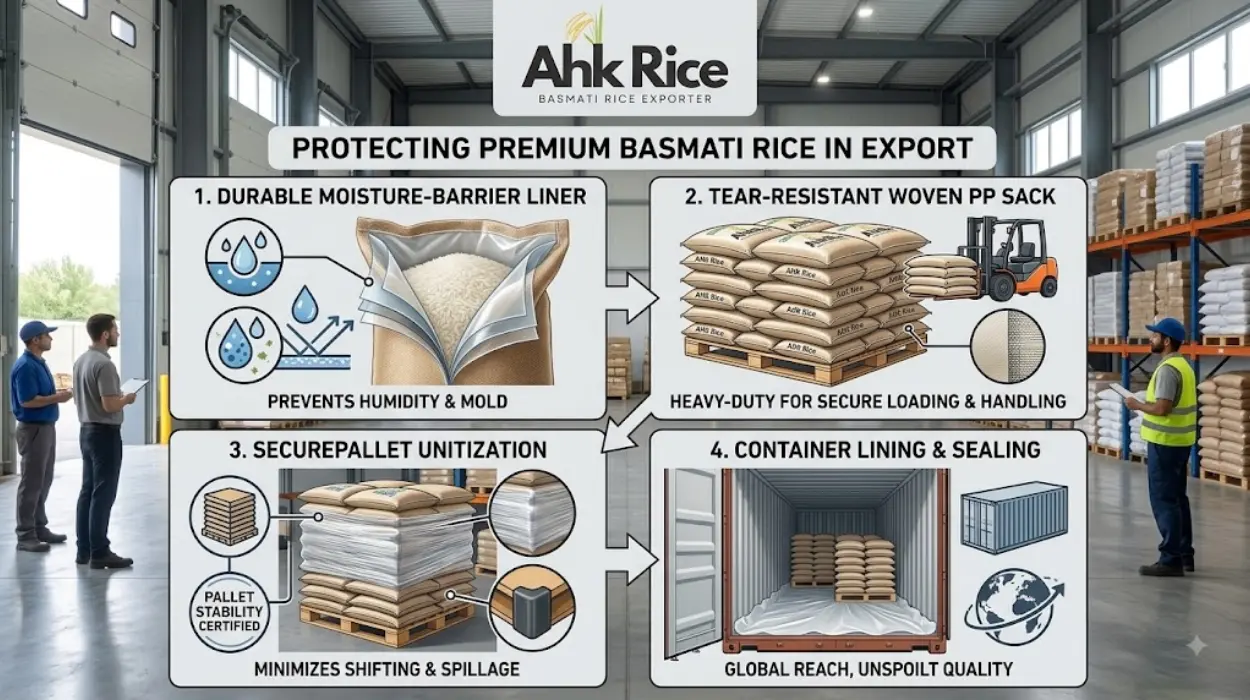
Export packaging protects Basmati rice most effectively when material strength, moisture control, sealing, stacking, and market-specific labeling work together. Here is why: ocean freight exposes rice to handling pressure, humidity, temperature changes, and long storage periods.
The correct packaging also depends on the destination market and sales channel. For a deeper foundation, read 1121 Basmati rice packaging options for export. That guide explains how jute, PP, non-woven, and custom bags serve different export applications.
AHK Rice supplies 1121, Super Kernel, and 1509 Basmati rice from Punjab to more than 15 countries. Its export workflow connects processing, grading, packaging, inspection, documentation, container loading, and dispatch.
What are the available Basmati rice export packaging solutions?
The main solutions are PP woven bags, BOPP laminated bags, jute bags, non-woven bags, inner liners, and retail-ready custom packs. Each format provides a different balance of moisture resistance, mechanical strength, presentation, cost, and handling efficiency.
PP woven bags
PP woven bags provide strong mechanical protection for wholesale and bulk shipments. Polypropylene resists tearing during lifting, stacking, and container handling. Exporters commonly use 20 kg, 25 kg, 40 kg, and 50 kg formats.
PP packaging suits distributors that prioritize durability and cost control. A 40 kg PP bag can support catering distribution while reducing packaging material per tonne.
BOPP laminated bags
BOPP laminated bags combine woven polypropylene strength with a printed laminated surface. BOPP means biaxially oriented polypropylene. The material provides stronger branding and improved surface protection.
BOPP packaging suits retail and private-label products. Printed graphics can identify variety, origin, weight, cooking information, and brand identity.
Jute bags
Jute bags provide a traditional natural-fibre packaging option. They suit buyers seeking traditional presentation and breathable outer packaging. Jute remains relevant for selected wholesale and specialty markets.
Jute alone provides less moisture protection than a properly lined synthetic bag. A food-safe inner liner can improve barrier performance during ocean transport.
Non-woven bags
Non-woven bags support premium retail presentation. Their smooth surface creates a cleaner appearance than conventional woven sacks. They suit branded 1 kg, 5 kg, and 10 kg retail formats.
Non-woven packaging becomes valuable when packaging appearance forms part of the product proposition. Premium Basmati buyers evaluate the bag alongside grain appearance and cooking quality.
Inner liners and barrier systems
Inner liners provide an additional protection layer inside the outer sack. Polyethylene liners can reduce moisture migration between the rice and surrounding environment.
A liner does not replace correct storage conditions. Rice still requires clean, dry, and properly handled containers. Packaging works as one part of the complete logistics system.
Retail-ready custom packaging
Retail-ready packaging converts bulk rice into a shelf-ready consumer product. Formats include 1 kg, 2 kg, 5 kg, and 10 kg packs. Custom printing supports private-label branding.
For England, packaging must also support applicable food-contact and labeling requirements. UK guidance requires suitable food-contact packaging and specific mandatory information on prepacked food labels.
With the packaging options defined, the next question is how their specifications compare during actual export handling.
How do different export packaging approaches compare?
PP provides the strongest balance for bulk export, BOPP improves retail presentation, jute supports traditional positioning, and custom retail packs provide the highest branding control. The correct method depends on shipment size, transit exposure, warehouse conditions, and sales channel.
Specification comparison table
| Attribute | PP Woven | BOPP Laminated | Jute | Non-Woven / Custom |
|---|---|---|---|---|
| Mechanical strength | High | High | Medium | Medium-High |
| Moisture protection | High with liner | High | Medium with liner | High |
| Retail presentation | Medium | High | High | Very High |
| Bulk suitability | Excellent | Good | Good | Limited |
| Private-label suitability | Good | Excellent | Good | Excellent |
| Typical use | Wholesale, catering | Retail, wholesale | Traditional trade | Premium retail |
| Packaging cost | Low-Medium | Medium | Medium-High | Medium-High |
PP woven bags normally provide the best cost-to-strength ratio for containerized wholesale rice. DHL’s Pakistan rice export guidance also identifies polypropylene as suitable for longer shipments because of its strength and moisture resistance.
BOPP becomes more attractive when packaging must perform both logistical and marketing functions. The printed surface gives retailers stronger shelf presentation while retaining woven-bag strength.
Jute performs differently. Its traditional appearance can support premium positioning, but moisture management requires greater attention. A liner becomes important for long ocean routes.
Custom non-woven packaging provides the strongest retail identity. Its higher packaging cost makes it less suitable for low-margin bulk distribution.
Packaging comparison therefore should not focus on bag price alone. Buyers should compare protection, handling losses, branding requirements, storage duration, and retail positioning.
With the specification comparison established, the next step is matching each packaging method to a real commercial case.
Which packaging method works best for different export cases?
PP woven packaging works best for bulk wholesalers, BOPP suits retail brands, jute fits traditional markets, and custom non-woven packs suit premium private-label retail. Packaging should follow the commercial channel rather than forcing one bag type across every shipment.
Bulk wholesale distribution
PP woven bags provide the strongest practical solution for bulk distribution. Wholesalers value stacking strength, handling durability, and controlled packaging cost.
A distributor buying 25 MT for catering customers does not need the same presentation as a supermarket selling 1 kg packs. The wholesale specification should prioritize durability and transport efficiency.
Supermarket retail
BOPP laminated or custom printed bags provide stronger retail performance. Supermarkets need clear product identification, consistent weights, attractive presentation, and compliant labeling.
UK guidance requires mandatory food information to remain visible, legible, and accurate on prepacked foods. Net quantity, food name, origin where required, lot information, and storage conditions form part of the labeling framework.
Premium ethnic retail
Non-woven and premium printed bags work well for ethnic retailers. These channels often sell Basmati through visual differentiation, brand identity, and perceived quality.
A 5 kg retail pack can communicate variety, origin, grain characteristics, cooking instructions, and brand positioning directly to consumers.
Traditional wholesale markets
Jute packaging fits traditional markets where natural materials and familiar presentation matter. Jute also supports differentiation from standard polypropylene sacks.
Long-distance ocean shipments require additional moisture protection. An appropriate food-safe liner can provide that barrier while retaining the traditional outer appearance.
Private-label programs
Custom packaging works best for private-label programs. The importer controls brand identity while the exporter manages rice processing and packing against agreed specifications.
AHK Rice supports custom packaging across its Basmati export workflow. The company’s UK sourcing information identifies retail bags, bulk sacks, private-label formats, and packaging sizes ranging from 1 kg to 50 kg.
With the market applications established, the next question is what each approach gains and sacrifices.
What are the pros and cons of each export packaging method?
PP minimizes bulk packaging cost, BOPP strengthens retail presentation, jute differentiates traditional products, and custom packs maximize branding. Each method also creates trade-offs involving cost, barrier performance, handling, and production complexity.
PP woven packaging
Advantages
- High mechanical strength
- Efficient bulk handling
- Strong stacking performance
- Competitive packaging cost
- Suitable for 20–50 kg formats
Disadvantages
- Lower visual appeal than premium printed packs
- Requires careful liner selection for moisture-sensitive routes
- Provides less retail differentiation
A catering distributor illustrates the advantage. The buyer needs 40 kg bags that survive repeated warehouse movement. PP provides the required durability without adding unnecessary retail packaging cost.
BOPP laminated packaging
Advantages
- Strong printed surface
- High retail visibility
- Good structural strength
- Suitable for private labels
- Supports market-specific designs
Disadvantages
- Higher packaging cost
- More complex printing requirements
- Greater design approval requirements
A supermarket brand illustrates the benefit. The buyer needs packaging that protects the rice while communicating brand identity on the shelf.
Jute packaging
Advantages
- Traditional appearance
- Natural-fibre positioning
- Strong differentiation
- Suitable for selected premium markets
Disadvantages
- Lower moisture barrier without a liner
- Higher handling considerations
- Less efficient for some modern automated packing systems
A specialty retailer may accept these limitations because packaging appearance contributes directly to product positioning.
Custom retail packaging
Advantages
- Maximum brand control
- Flexible pack sizes
- Strong shelf presentation
- Private-label compatibility
- Market-specific labeling
Disadvantages
- Higher unit packaging cost
- Artwork approval requirements
- More complex production planning
Custom packaging therefore provides the strongest commercial value when the rice will reach consumers under a dedicated retail brand.
The pros and cons show why packaging cannot be selected independently from the market strategy.
Which packaging factors should importers evaluate before ordering?
Importers should evaluate moisture protection, bag strength, pack size, labeling, stacking, warehouse conditions, destination rules, and total landed cost before approving packaging. These factors determine whether packaging remains effective from mill loading through retail distribution.
Moisture protection
Moisture control protects grain stability during storage and transportation. The packaging specification should identify whether the outer bag needs an inner liner.
Rice packaging should also remain clean and undamaged before container loading. Contaminated or damaged packaging weakens the protection system.
Mechanical strength
Bag strength determines resistance to tearing and seam failure. Container loading, unloading, pallet movement, and warehouse stacking all create mechanical stress.
A 50 kg wholesale sack requires stronger handling performance than a 1 kg retail pouch. Pack size therefore directly influences packaging design.
Pack size
Pack size should match the sales channel. Common export formats include 1 kg, 2 kg, 5 kg, 10 kg, 20 kg, 25 kg, 40 kg, and 50 kg.
UK retail buyers generally need smaller consumer formats. Foodservice distributors often prefer 20 kg or 25 kg packs. Bulk wholesalers may select 40 kg or 50 kg bags.
Label compliance
England-bound retail packs require compliant food information. UK rules require clear mandatory information, including food name, net quantity, relevant date information, ingredients where applicable, origin where required, lot information, and storage conditions.
Packaging materials used for food must also be suitable for food contact. UK guidance states that businesses should retain evidence demonstrating compliance for relevant packaging materials.
Container loading
Container loading protects the final packaging system. Exporters should inspect containers before loading and confirm that they are clean, dry, and suitable for food cargo.
DHL’s Pakistan rice export guidance specifically recommends container inspection before use and emphasizes accurate weights across shipping documentation.
Total landed cost
Packaging cost should be evaluated against damage risk and market value. A cheaper bag can become expensive through torn sacks, moisture exposure, repacking, or rejected retail presentation.
A premium retail pack may cost more per kilogram but create higher selling value. A bulk PP bag may deliver better economics for catering distribution.
These decision factors convert packaging selection from a material choice into a complete export specification.
Which packaging strategy is best for two major market regions?
England favors retail-ready, compliant packaging, while Gulf markets place greater emphasis on heat-resistant handling, strong bags, and storage stability. The same Basmati grade can require different packaging decisions because distribution environments and customer expectations differ.
England and wider UK retail
UK retail buyers typically prioritize retail presentation, labeling accuracy, traceability, pack size, and consistent product specifications. A 1 kg, 2 kg, 5 kg, or 10 kg custom pack suits supermarket and ethnic retail channels.
AHK Rice’s UK export information lists 1121 Steam, 1121 Golden Sella, Super Kernel, and other Basmati options for UK importers. Packaging choices include retail bags and larger PP formats.
The UK approach also requires attention to food-contact packaging and mandatory label information. This makes compliance part of the packaging specification rather than a separate administrative task.
Gulf markets
Gulf buyers place greater emphasis on storage stability, strong handling, and suitability for high-volume distribution. PP, BOPP, and lined packaging support these requirements.
Retail supermarkets may select 5 kg or 10 kg branded packs. Catering buyers may select 25 kg, 40 kg, or 50 kg formats.
The regional difference is therefore commercial. England emphasizes retail compliance and presentation. Gulf distribution emphasizes handling, storage, and volume efficiency.
What decision framework should importers use for Basmati rice packaging?
A five-factor decision framework should evaluate market channel, transit exposure, pack size, compliance, and cost before selecting the final packaging specification. This method links packaging performance directly to commercial requirements.
| Decision factor | Choose stronger retail packaging | Choose bulk export packaging |
|---|---|---|
| Sales channel | Supermarket or private label | Wholesale or catering |
| Transit exposure | Long ocean route | Standard container route |
| Pack size | 1–10 kg | 20–50 kg |
| Branding | High | Low |
| Cost priority | Brand value | Lowest practical cost |
A supermarket private-label program should prioritize custom printed packaging and compliant retail information. A catering distributor should prioritize strong PP packaging and efficient pallet or container loading.
A buyer supplying premium retail should also define grain specifications before packaging approval. Packaging protects the product, but it cannot correct poor milling, excessive breakage, incorrect moisture, or inconsistent grading.
AHK Rice integrates milling, grading, sorting, packaging, inspection, documentation, and container loading within its export workflow. Its stated capabilities include custom packaging, private labeling, export documentation, and professional container stuffing.
The decision framework therefore connects the bag to the rice specification, destination, customer, and logistics plan.
How does packaging protect Basmati rice from mill to destination?
Protection comes from coordinated processing, moisture control, food-safe packaging, secure sealing, container inspection, careful loading, and compliant labeling. The package becomes effective when every stage preserves the same agreed specification.
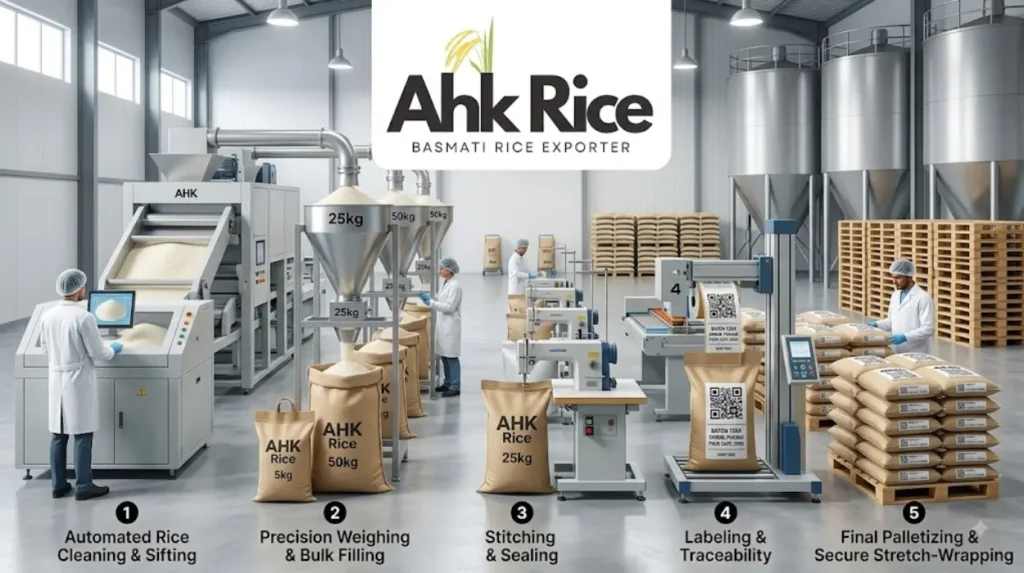
The export sequence starts with processed and graded rice. The exporter verifies the product before packing. The rice then enters the selected food-safe packaging format.
The package is weighed and sealed according to the agreed specification. The outer bag provides structural protection. The liner provides an additional barrier where required.
The packed bags are then stacked for container loading. Proper loading limits movement and reduces physical damage during handling.
The container itself becomes the next protection layer. Exporters inspect the container before stuffing. The cargo is then loaded, documented, and dispatched through the selected shipping route.
AHK Rice describes a workflow covering processing, packaging, quality inspection, documentation, container loading, and shipment coordination. Its product export pages also show packaging options ranging from small retail packs to 40 kg formats.
This integrated approach matters because packaging cannot operate independently. The correct bag protects a correctly processed product. The correct container protects correctly packed bags. The complete chain determines arrival quality.
What should buyers specify before approving export packaging?
Buyers should specify rice variety, processing grade, moisture target, broken percentage, pack size, packaging material, liner requirement, labeling, inspection, Incoterm, destination port, and shipment schedule. A written specification prevents packaging disputes after production begins.
For 1121, Super Kernel, or 1509 Basmati, the buyer should first identify the intended market and sales channel. Retail, catering, wholesale, and private-label programs require different packaging configurations.
The buyer should then approve the physical rice specification. Grain length, broken percentage, moisture, purity, crop year, and processing type should appear in the commercial specification.
The packaging specification should identify material, weight, dimensions, printing, liner, stitching or sealing method, and palletization requirements. These details turn a generic packaging request into an executable export order.
The final specification should also identify destination requirements. England-bound consumer packaging requires particular attention to labeling and food-contact compliance.
Packaging becomes commercially effective when the buyer evaluates it as part of the complete rice supply chain. Material, grade, market, warehouse, container, and retail channel must work together.
Frequently Asked Questions
What is the best packaging for exporting Basmati rice?
PP woven bags provide the strongest balance for bulk export. BOPP laminated and custom printed bags provide stronger retail presentation. Jute suits traditional positioning. Non-woven bags suit premium retail applications.
Does packaging affect Basmati rice shelf life?
Packaging can support shelf stability by reducing exposure to moisture and physical damage. Storage conditions remain essential. Dry warehouses, clean containers, suitable liners, and correct handling preserve rice quality.
What packaging sizes are available for Basmati rice?
Common export sizes include 1 kg, 2 kg, 5 kg, 10 kg, 20 kg, 25 kg, 40 kg, and 50 kg. The appropriate size depends on retail, wholesale, catering, or private-label distribution.
What packaging is suitable for UK Basmati rice imports?
UK retail imports commonly require food-safe consumer packaging with compliant labeling. Retail-ready BOPP, non-woven, or custom printed formats suit supermarkets and private-label brands. UK labeling requirements must be checked for the specific product.
Does AHK Rice offer custom Basmati rice packaging?
Yes. AHK Rice states that it supports custom packaging and private-label formats across its export operation. Available formats include retail bags, bulk sacks, and market-specific packaging.
Which packaging is best for wholesale Basmati rice?
PP woven packaging is generally the practical choice for wholesale Basmati rice. It provides strong handling performance, efficient bulk packing, and competitive packaging economics.
Which packaging is best for private-label Basmati rice?
Custom printed BOPP, non-woven, or other retail-ready formats provide the strongest private-label solution. They combine product protection with brand identity and market-specific labeling.