What Makes 1121 Golden Sella Basmati Its Characteristic Golden Colour?
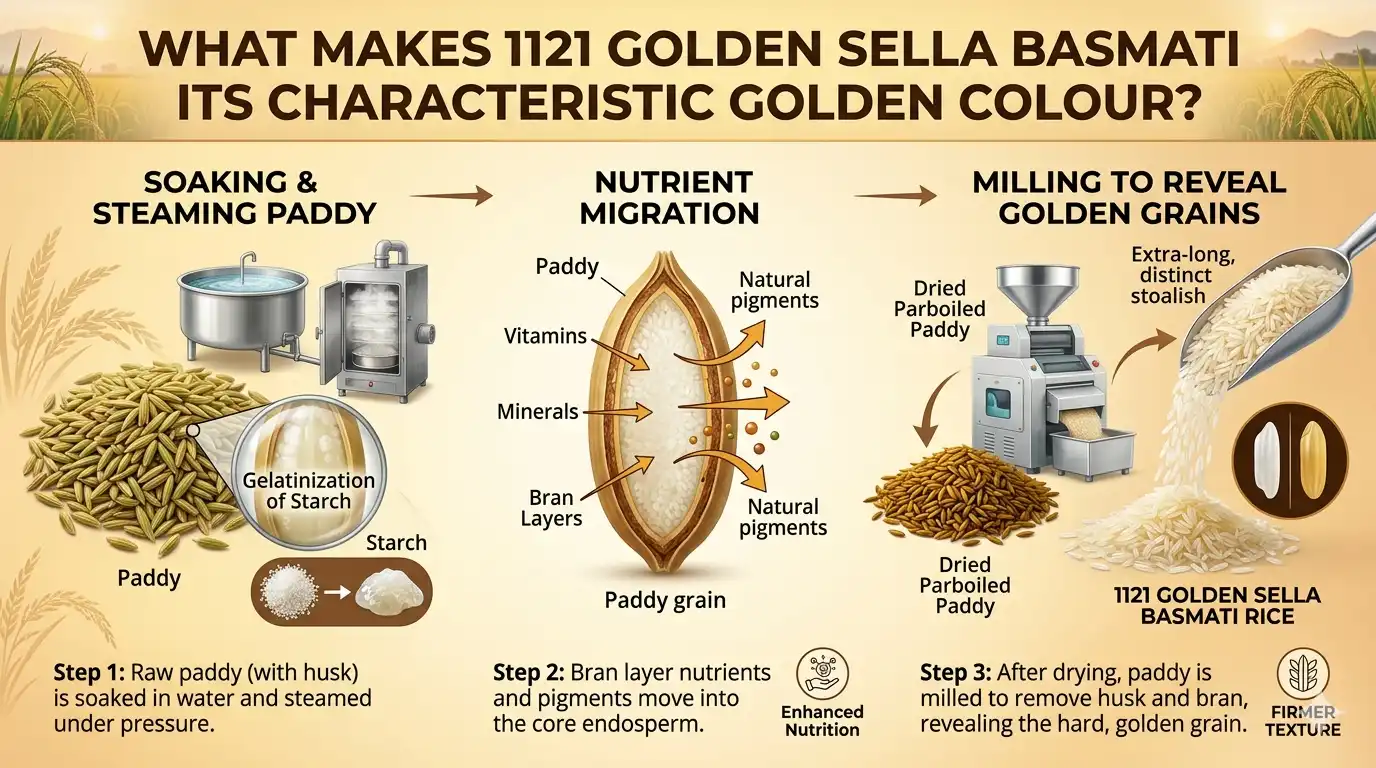
1121 Golden Sella Basmati receives its characteristic golden‑colour mainly from the parboiling stage, where heat and moisture transfer natural pigments from the bran into the starchy kernel. The colour originates from carotenoid‑type compounds in the outer layers, which are partially solubilised and fixed into the grain during the soaking, steaming, and drying steps of the sella process.
What is 1121 Golden Sella Basmati?
1121 Golden Sella Basmati is a long‑grain aromatic rice that undergoes partial boiling and drying before milling, which preserves part of the bran and gives the grain a distinct golden‑hue.
1121 refers to the Basmati variety officially registered in Pakistan, known for extra‑long, slender grains with a typical raw‑length of about 8.2–8.3 mm. When processed as “sella” (parboiled) and left with a small amount of bran attached, the grain appears yellow‑golden rather than pure white.
Golden Sella Basmati is different from ordinary white 1121, where the bran is mostly removed to produce opaque white kernels. It is also different from 1121 Creamy Sella, where the parboiled grain is milled more thoroughly, giving a softer, creamier appearance with less visible colour.
AHK Rice exports 1121 Golden Sella in 1121, Super Kernel, and 1509 varieties, treating each type with separate milling and grading protocols while keeping the distinctive golden‑hue consistent across batches.
How does the sella (parboiling) process work for 1121 Golden Sella?
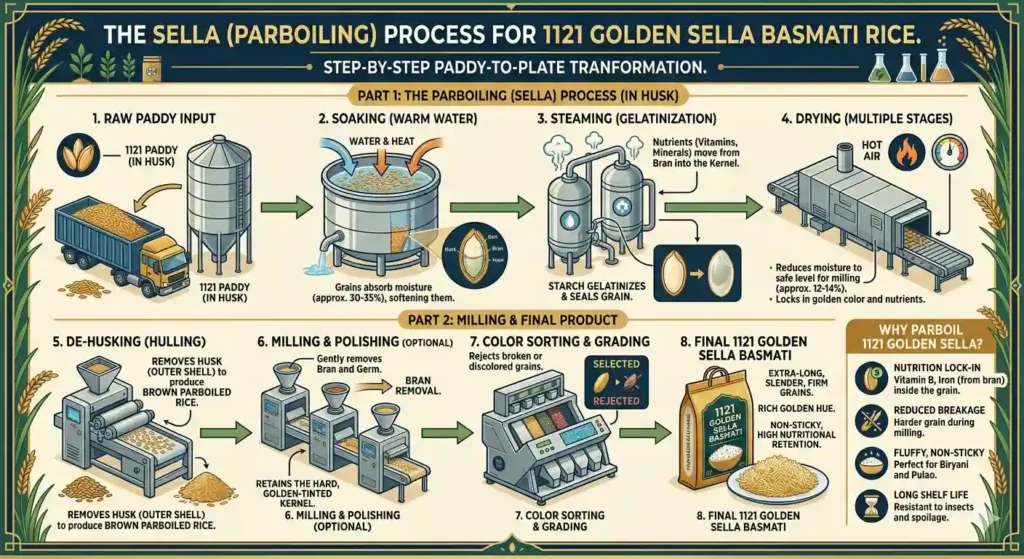
The sella process for 1121 Golden Sella works by partially cooking the soaked paddy in steam, then drying it before milling, which forces nutrients and pigments from the bran into the grain.
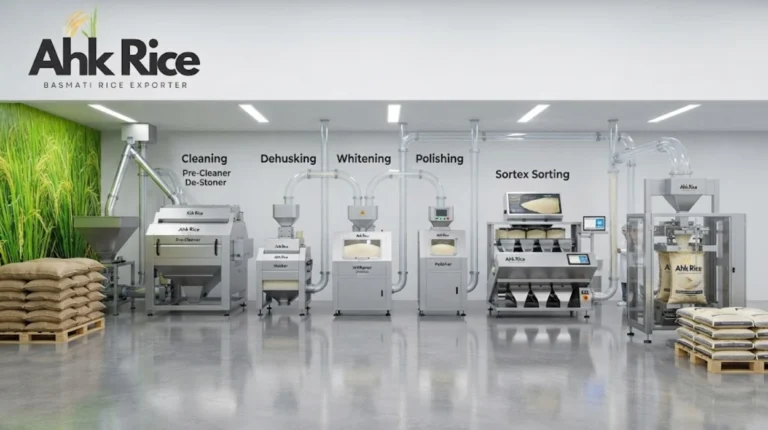
Raw 1121 paddy is first cleaned to remove dust, stones, and discoloured kernels. The cleaned paddy is then soaked in water at a controlled temperature, usually 40–50°C, for 4–8 hours depending on ambient conditions and grain moisture.
After soaking, the paddy enters the steaming chamber, where saturated steam at 100–110°C penetrates the husk and bran for approximately 15–25 minutes. During this phase, the starchy interior partially gelatinises and the moisture‑borne pigments start moving inward.
Once steamed, the paddy is dried using hot‑air tunnels or rotary driers, reducing the moisture from about 36–40% down to 12–13% for safe storage and milling. The resulting parboiled grain, still in paddy form, is then hulled and milled with a controlled degree of polishing to retain part of the golden‑coloured outer layer.
This sella procedure is applied to each pack of 1121 Golden Sella, giving it a uniform cook‑time and texture plus the stable golden‑colour that distinguishes it from regular white 1121.
What are the key components that give 1121 Golden Sella its golden hue?
The key components that give 1121 Golden Sella its golden hue are carotenoid‑related pigments and minor phenolic compounds in the bran layer, which are partially fixed into the grain during parboiling.
The outer bran of 1121 Basmati contains pigments similar to yellow and orange carotenoid structures, which dissolve slightly in the hot‑soaking and steaming water. As the grain absorbs moisture, these pigments migrate from the bran toward the endosperm, where some become chemically bound or trapped in the gelatinising starch.
Processing parameters such as soaking time, steaming duration, and temperature control how much of this colour transfers into the kernel. Longer soaking and higher‑temperature steaming generally intensify the golden‑tone, while shorter, milder treatment gives a lighter‑yellow effect.
AHK Rice engineers these parameters so that each lot of 1121 Golden Sella reaches a consistent L* and a* colour index, avoiding the greyish or dull‑yellow tones that appear when the procedure is uneven.
What are the available grades of 1121 Golden Sella Basmati?
The available grades of 1121 Golden Sella Basmati are defined by grain length, broken‑percentage, chalk, moisture, and colour‑uniformity, creating several distinct commercial categories.
On the top‑end, 1121 Golden Sella A‑grade typically allows 18–20% broken, 1–2% chalk, and 7.0–7.5 mm average raw grain length, with a bright, uniform‑golden‑hue. The B‑grade has around 22–25% broken and 2–3% chalk, with slightly less colour intensity and more variable grain‑length.
Lower‑grades, often used for re‑milling or blending, accept 30–40% broken and higher‑chalk content, resulting in a duller, patchy‑yellow appearance. These grades are suitable for industrial‑use or value‑packs where the premium look is less critical.
AHK Rice defines each grade by export‑market standards, aligning 1121 Golden Sella with GCC, EU, and East‑African‑specifications so that buyers receive consistent colour and length within the contractual band.
Which markets mainly import 1121 Golden Sella Basmati?
The main importing markets for 1121 Golden Sella Basmati are the Middle East, parts of Europe, and select African‑and‑CIS‑countries that value golden‑parboiled Basmati for festive and premium‑packaged products on 1121 golden sella vs creamy sella price difference stock.
In the UAE, Saudi Arabia, Qatar, and Oman, Golden Sella is used for celebratory dishes such as celebratory pulao and special‑occasion‑biryanis, where the golden‑tone signals richness and care. EU‑buyers, especially in the UK and Germany, accept Golden Sella for branded‑retail and HORECA‑segments, though they often require stricter aflatoxin and pesticide‑limits.
East‑African‑importers such as Kenya, Uganda, and Tanzania favour Golden Sella for mid‑price bundles, blending it with white 1121 to balance cost and colour. CIS‑markets like Russia and Kazakhstan buy Golden Sella mainly for festive‑season‑demand, where the golden‑appearance reinforces perceived‑quality.
AHK Rice tailors 1121 Golden Sella packaging and documentation to each of these regions, ensuring that the export‑batch meets both phytosanitary‑requirements and aesthetic‑expectations.
What food‑safety and quality certifications are common for 1121 Golden Sella exports?
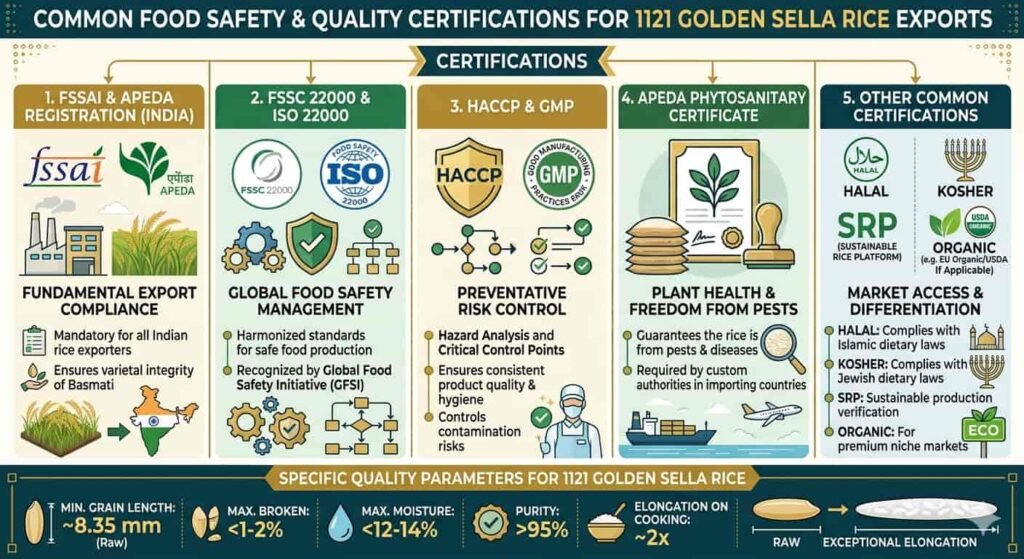
Common food‑safety and quality certifications for 1121 Golden Sella exports include FSSC 22000, HACCP, ISO 22000, and country‑specific regulated‑standards like Saudi‑GSO and EU‑FSSC.
FSSC 22000 and ISO 22000 set requirements for hazard‑analysis, critical‑control‑points, and documentation, which apply to the entire 1121 Golden Sella‑supply‑chain from paddy‑receiving to milling and packing. HACCP‑plans specifically monitor critical‑control‑points such as steaming‑temperature, drying‑time, and metal‑detection settings.
Export‑certificates like Saudi‑GSO, GCC‑focus‑standards, and EU‑hygiene‑and‑traceability‑rules demand specific‑test‑protocols for heavy‑metals, aflatoxins, pesticide‑residues, and moisture‑levels. Each 1121 Golden Sella shipment is tested against these benchmarks so that colour and aroma do not come at the expense of safety.
AHK Rice keeps its 1121 Golden Sella mills under these certification‑schemes, aligning every batch with the target‑market’s regulatory‑framework while preserving the characteristic golden‑colour.
Common misconceptions about 1121 Golden Sella’s colour
A common misconception is that 1121 Golden Sella’s colour comes from artificial dyes or added pigments; in reality the hue arises from natural bran‑pigments fixed during parboiling.
Some buyers assume that the golden‑tone indicates added colouring agents, but certified 1121 Golden Sella must pass residual‑dye‑and‑additive‑screening tests that rule out artificial‑colourants. The colour originates from carotenoid‑type co pounds in the bran and the controlled‑heat‑and‑moisture‑exposure in the sella process.
Another misconception is that deeper‑golden‑1121 Golden Sella is always higher‑quality; in fact excessive‑colour can signal over‑steaming, which may harden the grain or reduce aroma. AHK Rice balances colour‑intensity with grain‑length, aroma, and texture so that the 1121 Golden Sella performs as intended in cooking.