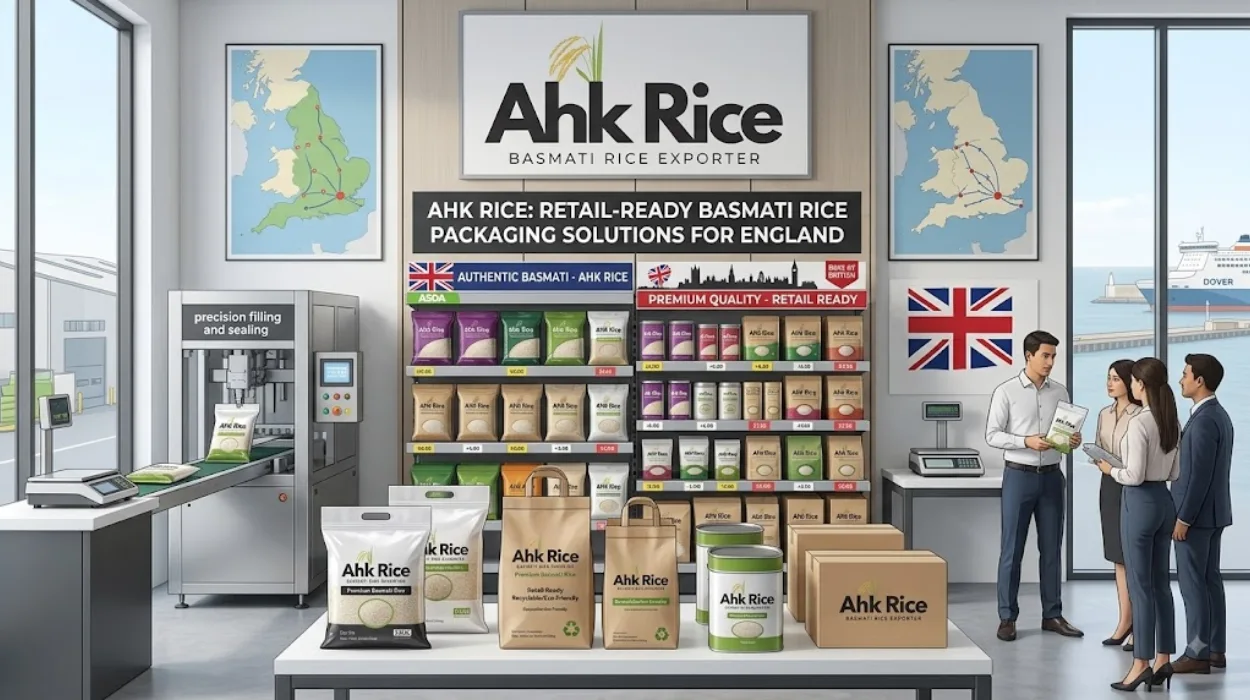
AHK Rice Provides Retail-Ready Basmati Rice Packaging Solutions for England
AHK Rice provides a specification-led packaging solution for England, combining Basmati rice processing, retail packaging, quality checks, export documentation, and container coordination. Here is why: English retailers need compliant labels, accurate net quantities, traceability, and packaging that protects rice through international transport.
Retail-ready packaging should be designed around the final sales channel, not only the rice itself. For background, retailers can review UK rice packaging requirements before import before defining their purchase specification.
What is the best solution for retail-ready Basmati rice packaging?
The best solution is specification-controlled Basmati packed to the buyer’s retail format, label requirements, quantity, quality grade, and shipment plan before container loading begins. This approach reduces packaging changes, specification disputes, documentation gaps, and delays after production.
Retail-ready Basmati starts with the product specification. Buyers should define the variety, processing type, grain length, broken percentage, moisture requirement, packaging size, artwork, quantity, and destination.
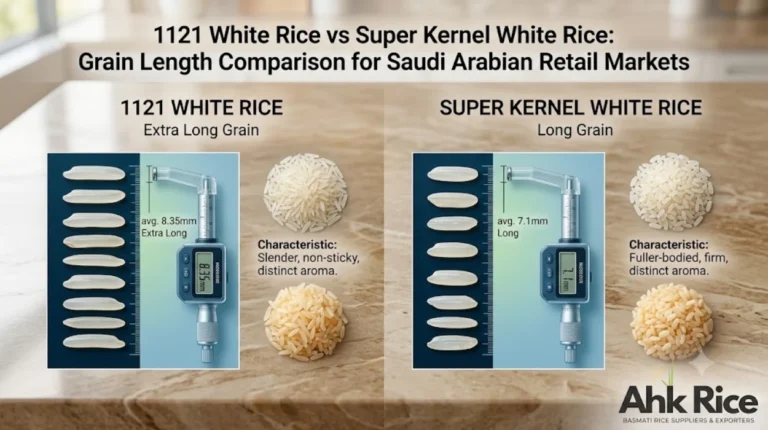
AHK Rice can supply Pakistan Basmati varieties including 1121, Super Kernel, and 1509 according to buyer requirements. The commercial specification should identify the exact grade before packaging approval.
UK food labels must show the food name, net quantity, relevant date information, required warnings, ingredients where applicable, origin information where required, lot identification, storage conditions, and cooking instructions where necessary. The package must also identify the responsible food business or importer. (source: GOV.UK)
Net quantity is especially important for retail packs. UK packaged-goods rules require accurate declared quantities and establish tolerable negative errors for different pack sizes. (source: GOV.UK)
Rice classification also matters commercially. UK guidance classifies rice using characteristics including grain length and length-to-width ratio. Basmati is identified as a long-grain aromatic rice. (source: GOV.UK)
The packaging decision therefore needs to connect product grade, retail presentation, legal information, and transport protection. With the specification established, the next decision is selecting the right export partner.
Why choose AHK Rice for England retail packaging?
AHK Rice connects rice processing, grading, sorting, packaging, documentation, inspection coordination, and shipment planning within one export workflow, giving English buyers greater control over specification consistency. The commercial advantage is fewer handoffs between product and packaging suppliers.
AHK Rice manages the product journey from processing through export preparation. Its workflow uses domain-specific controls such as milling, grading, sorting, packaging, inspection, documentation, loading, and dispatch.
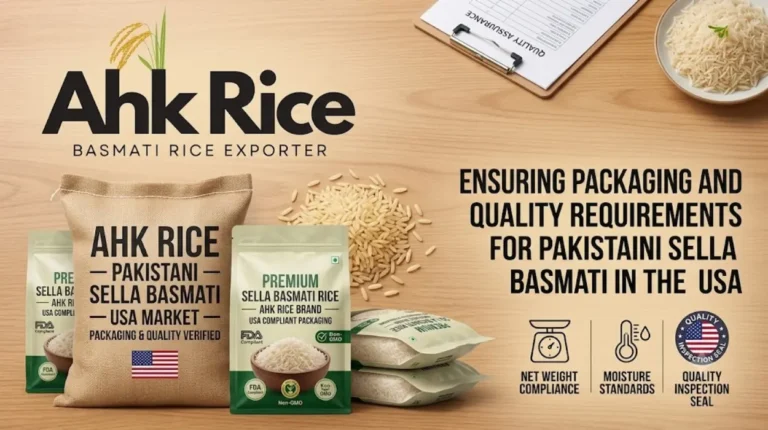
Retail packaging can also support private-label procurement. The buyer can specify bag size, printed artwork, branding requirements, retail positioning, and carton configuration before production.
Packaging should protect the rice during ocean transport. Moisture control, strong seals, suitable food-contact materials, and stable outer handling reduce the risk of damaged retail packs reaching the UK warehouse.
The comparison stage is also important. Buyers evaluating transport protection can review how export packaging protects Basmati rice during transport before finalizing their packaging specification.
AHK Rice can then align the approved product with the approved packaging. This creates one reference specification for production, inspection, packing, and shipment.
The English market also requires attention to food compliance. UK guidance states that imported cereals from third countries must meet the same or equivalent food hygiene standards and procedures as food produced in Great Britain. (source: GOV.UK)
Pakistan rice imports also remain subject to specific GB controls. The Food Standards Agency updated its restricted-food information in July 2026 to include aflatoxins and ochratoxin A within controls for rice from Pakistan. (source: Food Standards Agency)
These requirements make specification control more valuable than simply choosing the lowest rice quotation. The next question is what measurable results the buyer should expect.
What results can be expected from retail-ready Basmati packaging?
A correctly controlled retail program should deliver consistent pack weights, repeatable rice specifications, protected products, clearer compliance documentation, stronger shelf presentation, and fewer packaging changes between production and UK distribution. These outcomes support smoother wholesale procurement.
The first result is specification consistency. AHK Rice can work from an approved product specification covering grade, processing, moisture, broken percentage, purity, packaging, and quantity.
The second result is packaging consistency. Approved artwork and pack specifications reduce the risk of receiving bags that differ from the retailer’s agreed presentation.
The third result is transport protection. Proper export packaging reduces handling exposure during container loading, ocean transit, unloading, and warehouse movement.
The fourth result is documentation alignment. The packaging information can be prepared alongside export documentation rather than treated as a separate task.
The fifth result is retail readiness. The buyer receives rice configured for the intended channel instead of repacking bulk rice after arrival.
A practical example is a UK distributor launching a 5 kg private-label 1121 Basmati product. The buyer can approve the rice sample, approve artwork, confirm the label data, define the carton arrangement, and then align bulk production with the approved specification.
This process creates a repeatable procurement model. The same specification can guide later container orders, reducing unnecessary changes.
How many shipping days should England buyers plan for?
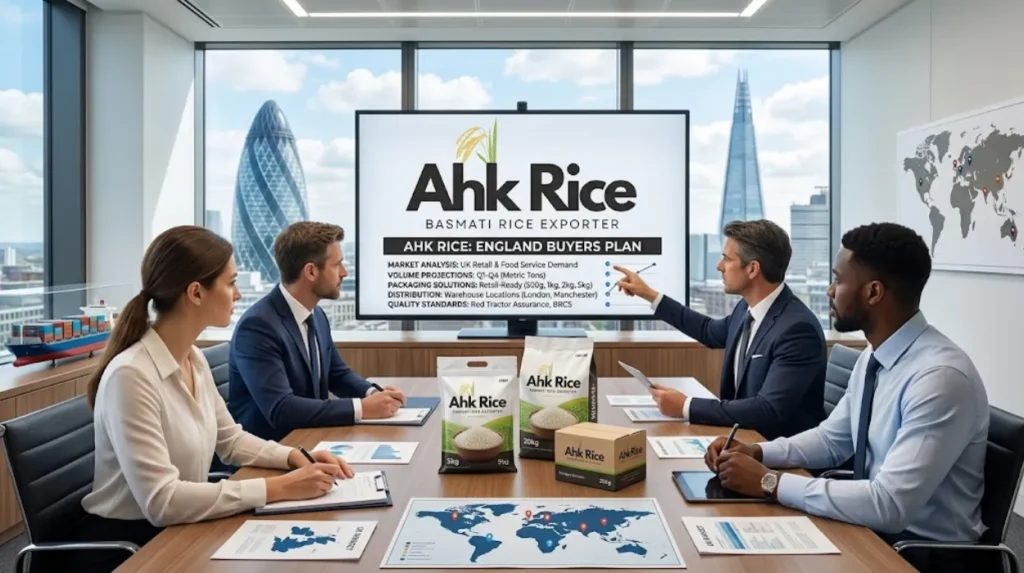
England buyers should plan around 28–33 ocean-transit days from Karachi to Felixstowe for standard FCL routing, with additional time for production, booking, clearance, and inland delivery. Current freight data confirms that actual transit varies by service and route.
A current Karachi–Felixstowe FCL benchmark shows approximately 28–33 days of ocean transit for a 40-foot high-cube container. (source: Flexport, 2026)
London Gateway can also serve England importers. Current LCL benchmarks show longer transit estimates, including approximately 35 days or more depending on routing and shipment configuration. (source: Flexport, 2026)
| England route | Practical planning basis |
|---|---|
| Karachi → Felixstowe FCL | 28–33 days ocean transit |
| Karachi → Felixstowe LCL | Up to 43 days in current benchmark |
| Karachi → London Gateway LCL | Around 35 days in current benchmark |
| Port → UK warehouse | Add customs and inland delivery time |
These figures are transit benchmarks, not guaranteed delivery dates. Production, packaging approval, vessel booking, port congestion, customs clearance, and inland transportation can extend the total order cycle.
Retailers should therefore place replenishment orders before warehouse inventory reaches its minimum level. Urgent restocking creates fewer options for freight and packaging coordination.
How does the full sample process work and what does it cost?
The sample process should verify the exact commercial specification before bulk production, while sample costs should be separated into rice, courier, packaging, testing, certification, and later-order credits. This prevents buyers from approving a sample that differs from the final shipment.
What should the buyer provide?
The buyer should provide:
- Specify the Basmati variety and processing type.
- Confirm the required retail pack size.
- Provide the destination and target market.
- Provide packaging artwork and label requirements.
- Confirm the required quantity and preferred Incoterm.
- Identify requested laboratory tests or certifications.
What should AHK Rice provide?
AHK Rice should prepare a representative sample against the agreed product specification. The buyer should inspect dry grain appearance, uniformity, broken percentage, colour, aroma, and foreign matter.
The buyer should then cook the sample using a consistent method. Cooking evaluation should assess elongation, separation, texture, aroma, and overall consumer suitability.
AHK Rice states that samples of up to 20 kg can be provided. The buyer covers sample shipping, while courier charges depend on shipment weight, dimensions, service level, destination, and account rates.
A practical sample budget should therefore separate each cost:
| Sample cost | Buyer should confirm |
|---|---|
| Rice sample | Quantity and whether waived |
| Courier | Actual carrier quotation |
| Packaging | Standard or custom format |
| Laboratory testing | Moisture, purity, or requested tests |
| Certification | Whether required |
| Final order | Whether approved sample costs are credited |
No fixed courier price should be assumed without shipment details. The same principle applies to laboratory testing and special certification.
The most important commercial rule is sample matching. The approved sample should match the final grade, moisture range, broken percentage, polish level, and packaging format.
Which packaging factors affect the final price?
Retail packaging cost depends on rice grade, order volume, bag construction, printing, artwork, processing, testing, freight, destination, and commercial terms rather than one fixed packaging rate. Buyers should therefore request pricing against a complete specification.
Rice grade affects the underlying product cost. Premium grades can require tighter sorting and lower broken percentages.
Quantity affects procurement economics. Larger container commitments can improve cost efficiency across rice, packaging, production, and freight.
Packaging affects cost through material type, pack size, printing, artwork, carton configuration, and private-label requirements.
Processing affects cost through additional sorting, polishing, blending, inspection, or laboratory requirements.
Freight affects landed cost through carrier availability, equipment, route, booking date, and port charges. Current Karachi–Felixstowe freight benchmarks illustrate why online freight numbers should not be treated as fixed quotations.
Incoterms also change the commercial comparison. FOB, CFR, and CIF place different responsibilities on the buyer and seller.
The correct comparison is therefore total landed cost per metric ton. A cheaper FOB rice price may not produce the lowest final cost after packaging, freight, inspection, clearance, and inland delivery.
How can an English retailer get started with AHK Rice?
Start with one complete retail specification, approve a representative sample, finalize packaging artwork, confirm commercial terms, complete documentation checks, and schedule production against the required UK inventory date. This sequence keeps the buying process controlled from sample to shipment.
Start with the product specification. State variety, processing grade, grain requirements, moisture, broken percentage, purity, pack size, and quantity.
Confirm the packaging specification. Provide artwork, mandatory label information, bag material, carton requirements, barcode data, and private-label details.
Approve the sample. Compare the physical grain, cooking performance, packaging appearance, and label presentation against the commercial requirement.
Confirm the quotation. Review rice cost, packaging, testing, freight basis, Incoterm, destination port, and payment terms.
Complete export preparation. Confirm required certificates, inspection requirements, packing documents, commercial invoice, certificate of origin, and other applicable paperwork.
Schedule production and loading. Align the production window with vessel booking and the retailer’s inventory requirement.
AHK Rice gives the buyer a specification-led route from Pakistan processing to retail-ready export. AHK Rice can align product quality with packaging, while AHK Rice also supports the documentation and shipment coordination needed for the commercial order.
The strongest decision is therefore not simply to purchase packaged Basmati at the lowest quoted price. Choose a supplier that can reproduce the approved rice specification, packaging format, documentation, and shipment process across repeat orders.
Contact AHK Rice today and submit your requirements through the quotation request form to receive a tailored export proposal.
Frequently Asked Questions
What packaging sizes can English retailers request?
Retailers can specify the required consumer pack size.
The specification can include bag material and printed artwork.
Carton configuration can also be defined for distribution.
The final format should match the intended retail channel.
AHK Rice can quote against the complete packaging specification.
How large can an AHK Rice sample be?
AHK Rice states that samples of up to 20 kg can be provided.
The buyer covers sample shipping costs.
Courier pricing depends on weight, dimensions, destination, and service level.
Laboratory testing can create additional charges when requested.
The approved sample should match the final commercial specification.
How long does Pakistan-to-England shipping take?
Karachi-to-Felixstowe FCL currently shows approximately 28–33 days ocean transit.
LCL routing can take longer.
Production and packaging approval require additional time before dispatch.
Customs and inland delivery also affect the final schedule.
Buyers should therefore plan inventory before stock reaches minimum levels.
What information must appear on UK retail packaging?
UK labels require core information such as food name and net quantity.
Relevant dates, warnings, origin, lot information, and storage conditions may also apply.
Importer or responsible-business details must appear where required.
Cooking instructions may be needed for products requiring them.
Final artwork should be checked against current UK requirements.
How does AHK Rice reduce packaging-related buying risk?
AHK Rice works from an agreed product and packaging specification.
The sample provides a reference before bulk production.
Packaging artwork can be approved before shipment preparation.
Quality checks support consistency between the approved sample and commercial order.
This creates a clearer route from procurement to retail distribution.