Why Do UK Retailers Check Rice Packaging Requirements Before Import?
UK retailers check rice packaging requirements before import because packaging controls food safety, legal labelling, traceability, quantity, and product protection. Here is why: UK rules require food packaging to carry specific information and use materials suitable for food contact.
What Are Rice Packaging Requirements for UK Imports?
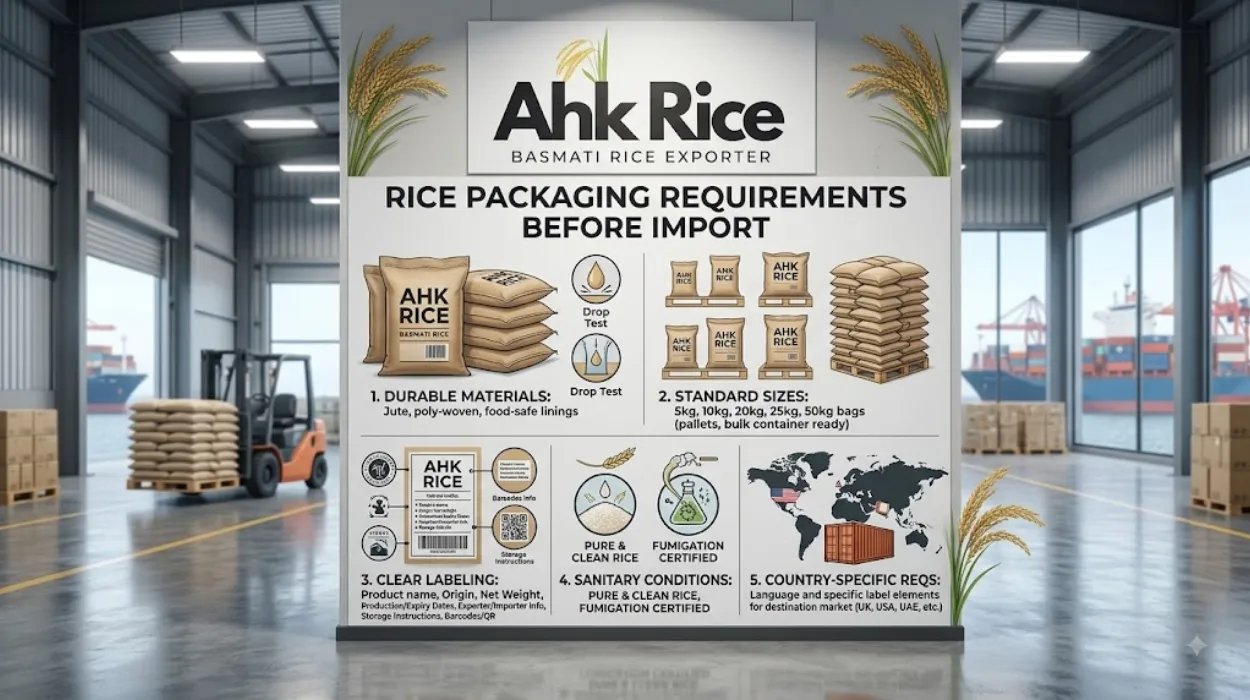
UK rice packaging requirements cover food-contact safety, mandatory labelling, net quantity, dates, origin, importer details, storage instructions, and traceability. Retail packaging must present required information clearly and protect rice throughout storage and distribution.
Rice packaging serves two connected functions. The first function protects the grain. The second function communicates legally required product information.
UK guidance requires prepacked food labels to show the food name, net quantity, date marking, required origin information, storage conditions, and responsible business details.
Packaging also needs food-contact suitability. Food packaging must use materials suitable for contact with food. Plastic, ceramic, and cellophane materials can require documented compliance evidence from the packaging supplier.
For rice, the packaging specification therefore connects the product, processing grade, pack size, label, storage conditions, and importer information.
A 5 kg retail bag provides a simple example. The pack needs a clear product name, net quantity, date marking, required storage information, and responsible business details.
With the packaging definition established, the next question is why UK retailers inspect these details before placing an import order.
Why Do UK Retailers Check Packaging Before Import?
Retailers check packaging before import to prevent non-compliant stock, relabelling costs, rejected shipments, damaged rice, and traceability failures after arrival in the UK. Packaging approval therefore starts before dispatch.
Retail buyers operate within a supply chain. A packaging error created at origin can reach warehouses, distribution centres, and retail shelves.
A missing mandatory label detail creates a compliance problem. An incorrect net quantity creates a weights-and-measures problem. Weak packaging creates a product-protection problem.
UK food information must remain clear, legible, permanent, and visible to consumers. Mandatory information must not become hidden or obscured by other packaging content.
Packaging also affects retailer operations. Warehouse staff need identifiable product units. Importers need batch information. Retailers need consistent pack sizes for inventory systems.
Rice imported from Pakistan also receives additional regulatory attention because rice from Pakistan appears within UK controls for certain contaminants. The Food Standards Agency updated the relevant restriction information in July 2026 to include aflatoxins and ochratoxin A.
Packaging does not replace laboratory testing or import controls. It works alongside them.
With the retailer’s compliance purpose established, the next question is how packaging works from milling through retail delivery.
How Does Rice Packaging Work From Processing to Retail?
Rice packaging follows a controlled sequence: mill the rice, grade the grain, inspect quality, select food-contact packaging, print compliant labels, pack, seal, test, palletise, and dispatch.
How Is Basmati Rice Prepared Before Packing?
Basmati rice begins as harvested paddy. The mill cleans the paddy before dehusking and grading the grain.
A typical sequence includes:
- Clean the paddy to remove stones, dust, straw, and other foreign material.
- De-husk the grain to remove the outer husk.
- Polish the grain to achieve the required milling appearance.
- Grade the grain according to length, broken percentage, and quality specifications.
- Sort the grain using mechanical and optical sorting systems.
- Inspect the rice against the agreed product specification.
- Pack the rice into the selected food-contact material.
- Seal the package to prevent contamination and product loss.
- Print the label with the required product information.
- Load the shipment for export after documentation and quality checks.
AHK Rice supplies Pakistani Basmati varieties including 1121, Super Kernel, and 1509. These varieties originate from Punjab’s rice-growing region and follow milling, grading, sorting, and packing processes before export.
What Happens After Packing?
Packed rice moves through several logistics stages. The exporter loads sealed units into cartons, sacks, or pallets according to the agreed shipment format.
Container loading requires attention to package condition. Damaged bags, exposed seams, and contaminated outer surfaces create avoidable risks during transport.
Retail packaging also needs consistent dimensions. Consistent dimensions help warehouses stack, count, move, and store individual units.
The exact pack format depends on the buyer’s specification. Common formats include retail bags, bulk sacks, and larger food-service packs.
With the process established, the next question is which packaging components UK retailers examine most closely.
Which Packaging Components Matter Most for UK Rice?
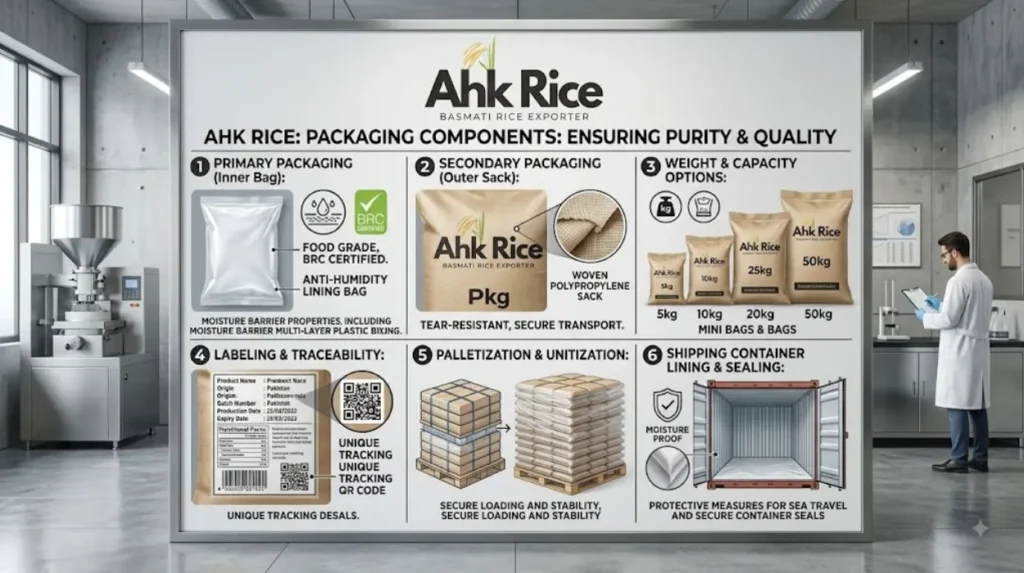
The main components are food-contact material, pack size, sealing, label information, date coding, origin details, storage instructions, and traceability markings. Each component supports compliance or product protection.
What Does Food-Contact Packaging Mean?
Food-contact packaging is material designed for direct contact with food. UK guidance requires packaging used for food to be suitable for that purpose.
Packaging suppliers can provide a declaration of compliance for materials covered by specific food-contact rules. This evidence becomes important during buyer and supplier approval.
For rice, the material must protect the grain without introducing contamination. The packaging also needs adequate strength for handling and transport.
What Label Information Does Rice Need?
UK food labelling rules require specific information on prepacked food. The requirements include:
- Food name
- Net quantity
- Best-before date
- Lot number
- Origin information where required
- Storage conditions
- Cooking instructions where necessary
- Responsible business name and address
UK guidance states that packaged food above 5 g or 5 ml generally requires a net quantity declaration. The quantity must appear close enough to the food name for both details to be viewed together.
Mandatory information also needs suitable legibility. The general minimum x-height for mandatory food information is 1.2 mm. A reduced 0.9 mm minimum applies to packaging with a largest surface area below 80 cm².
How Does Traceability Work?
Traceability connects the finished pack to a production or shipment record. Lot information provides a practical identification method for stock control and investigations.
A retailer can use a lot reference to identify affected stock. An importer can connect that reference with shipment documents and supplier records.
With the main components identified, the next question is how correct packaging benefits the UK rice supply chain.
What Benefits Do Correct Rice Packaging Requirements Provide?
Correct packaging reduces compliance errors, protects grain quality, supports traceability, improves warehouse handling, and presents consistent information to UK consumers. These benefits operate from import clearance through retail sale.
How Does Packaging Protect Rice?
Strong packaging reduces exposure to dust, moisture, handling damage, and contamination. Proper sealing also keeps the contents contained during loading and transport.
Rice is a dry agricultural product. Its quality depends on controlled storage conditions after milling and packing.
Packaging cannot compensate for poor milling or unsuitable storage. The pack must work with proper processing, inspection, warehouse handling, and transport.
How Does Packaging Support Retail Operations?
Standardised packaging creates predictable stock units. A retailer can assign consistent product codes, storage positions, and selling formats.
A 1 kg consumer pack serves a different retail purpose from a 20 kg food-service sack. Each format requires a packaging specification suited to its intended market.
Retail packaging also supports consumer decision-making. Product identity, quantity, origin, date, and storage information need clear presentation.
These benefits explain why packaging approval becomes part of procurement rather than a final shipping detail.
Which UK Rice Import Use Cases Require Packaging Control?
Packaging control applies to retail bags, private-label rice, food-service sacks, bulk shipments, and repacked products. Each use case creates different requirements for pack size, labelling, handling, and traceability.
How Does Retail Packaging Differ From Food-Service Packaging?
Retail packaging targets the final consumer. It requires consumer-facing mandatory information and a presentation suitable for retail shelves.
Food-service packaging targets professional kitchens and catering operations. Larger formats reduce handling frequency and support higher-volume consumption.
Private-label packaging adds another layer. The retailer’s brand, product specification, importer information, and approved artwork need alignment before production.
A retailer importing 5 kg 1121 Basmati bags therefore needs a different packaging specification from a catering buyer importing 40 kg sacks.
How Does Packaging Support Private-Label Rice?
Private-label packaging places the retailer’s approved artwork directly on the product. Artwork approval must match the final product specification.
The product name, net quantity, origin, date information, storage instructions, and responsible business details need checking before production.
For a detailed explanation of how export packaging protects grain during shipping, the related guide on [how export packaging protects Basmati rice during transport]([Insert Link to MOFU Article]) provides the next level of information.
With these use cases established, the next question is which packaging problems commonly delay rice imports.
What Common Packaging Problems Affect UK Rice Imports?
Common problems include missing mandatory information, incorrect net quantity, unsuitable food-contact materials, poor seals, unreadable labels, inconsistent artwork, and weak traceability. Each problem requires correction before retail distribution.
Which Labelling Mistakes Cause Problems?
Missing importer details can create a compliance issue. Incorrect net quantity can create a weights-and-measures issue. Poor date printing can create stock-control problems.
UK rules require mandatory food information to remain visible, legible, and difficult to remove.
Retailers also need accurate product descriptions. Food labels must not mislead consumers about the food’s nature, composition, quantity, or origin.
Which Packaging Misconceptions Should Importers Avoid?
One misconception is that packaging only protects rice. Packaging also carries legally required consumer information.
Another misconception is that a supplier-approved bag automatically satisfies every UK retail requirement. Final compliance depends on the finished product, label, market, and applicable rules.
A third misconception is that packaging approval happens after shipping. Retail buyers normally need artwork, material, pack-size, and labelling details before production and dispatch.
Rice classification also matters for import procedures. UK tariff guidance distinguishes paddy, husked, milled, broken, and parboiled rice under heading 1006.
For Pakistan-origin rice, importers also need to monitor current controls applying to specific food safety risks.
Correct packaging therefore starts with the product specification and continues through compliance, packing, transport, and retail handling.
What Certifications and Compliance Documents Relate to Rice Packaging?
Relevant documentation includes food-contact compliance evidence, product specifications, laboratory reports where required, import documents, and traceability records. The exact documents depend on the product, material, destination, and current UK controls.
Food-contact packaging can require a declaration of compliance from the packaging supplier. This document demonstrates conformity with applicable food-contact requirements.
Laboratory documentation becomes important for controlled food imports. UK high-risk food controls can require laboratory reports and official certificates for specified products.
Pakistan-origin rice also appears in UK high-risk food controls for specified contaminants. Importers therefore need to verify current requirements before shipment.
Certification should never be treated as a substitute for packaging compliance. A quality certificate does not automatically prove that consumer packaging carries every required label detail.
The final decision is simple: UK rice packaging needs to satisfy product protection, food-contact safety, consumer information, quantity control, and traceability before the shipment reaches retail distribution.
What Is the Main Reason UK Retailers Check Rice Packaging?
UK retailers check packaging before import because compliant packaging protects the rice and proves that the finished retail unit meets applicable UK information and food-contact requirements.
The packaging specification connects the rice variety with its grade, pack size, label, material, storage conditions, lot identification, and shipment.
For Pakistani Basmati rice, this process begins with the grain specification and continues through milling, grading, sorting, inspection, packing, sealing, documentation, and dispatch.
Retailers therefore treat packaging as a product specification rather than a simple shipping material.
Frequently Asked Questions
Why do UK retailers check rice packaging before import?
UK retailers check packaging to confirm food-contact suitability, mandatory labelling, net quantity, traceability, storage information, and product protection before distribution.
What information must appear on UK rice packaging?
Required information generally includes the food name, net quantity, date marking, lot information, applicable origin details, storage conditions, and responsible business information.
Does rice packaging need to be food-contact compliant?
Yes. Food packaging must be suitable for food use. Certain packaging materials also require documented compliance evidence from the packaging supplier.
Does Pakistani rice face additional UK import controls?
Yes. Certain rice from Pakistan falls under UK controls covering specified contaminants. The current FSA information includes aflatoxins and ochratoxin A.
Does packaging protect Basmati rice during transport?
Yes. Suitable packaging contains the grain and reduces exposure to contamination, moisture, dust, and handling damage during loading, shipping, and warehouse storage.
What packaging sizes are used for UK rice?
Common formats include consumer retail bags and larger food-service sacks. The correct size depends on the retailer, product positioning, handling system, and customer segment.