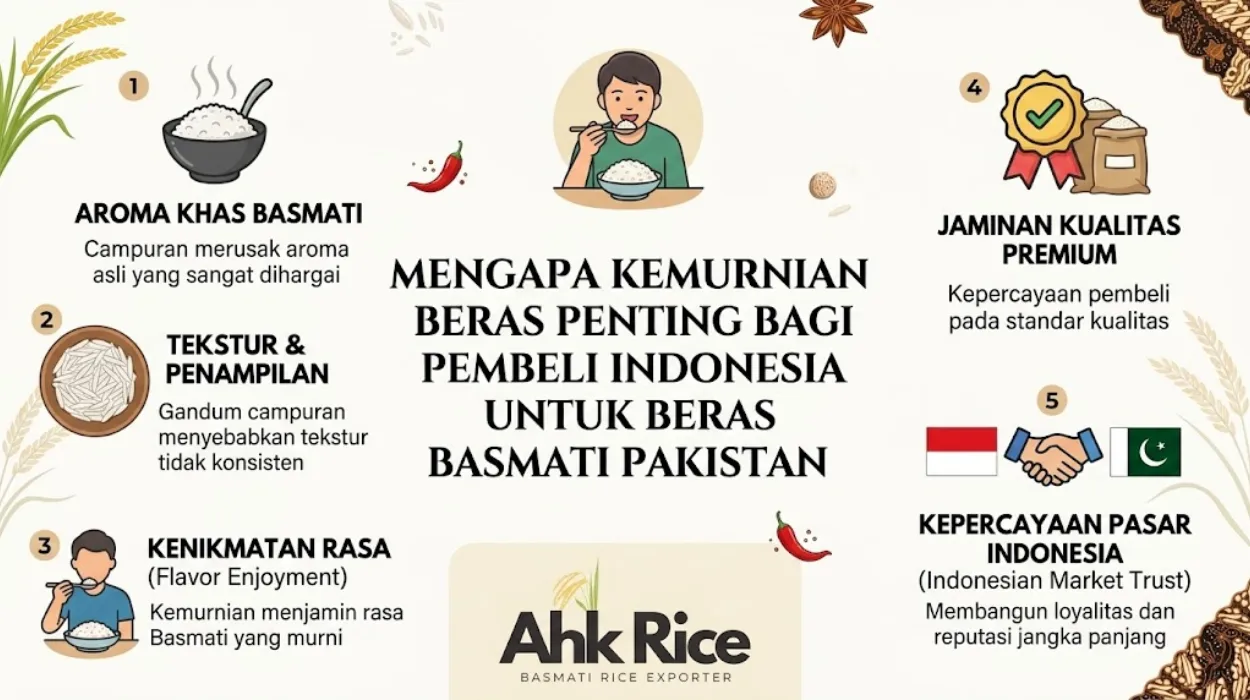
Why Does Rice Purity Matter to Indonesian Buyers of Pakistan Basmati?
Rice purity matters to Indonesian buyers because foreign matter, damaged kernels, moisture, contamination, varietal identity, and broken-grain levels directly determine food safety, grade consistency, processing yield, and commercial acceptance. Here is why: purity converts a shipment from a bulk commodity into a controlled food-grade specification.
Pakistan Basmati rice is cultivated mainly in Punjab, where varieties such as 1121, Super Kernel, and 1509 Basmati rice are grown, harvested, milled, graded, and prepared for export. Indonesia buyers evaluate these attributes against their purchase specification and applicable food-control requirements.
Purity does not mean grain colour alone. It covers physical cleanliness, varietal consistency, moisture, defects, foreign matter, chemical residues, insects, and processing condition. Codex maintains an international Standard for Rice, CXS 198-1995, which provides a global reference for rice quality and safety.
What is rice purity in Pakistan Basmati?
Rice purity is the measured absence or controlled level of unwanted material, defective kernels, excessive moisture, contamination, and non-conforming grains within a defined rice shipment specification. Buyers use these measurements to determine whether rice matches contractual quality requirements.
Which factors define purity?
Foreign matter includes soil, stones, weed seeds, rice-stalk fragments, dust, husk, and dead insects. These materials reduce cleanliness and can interfere with milling, storage, handling, and food preparation. FAO identifies foreign matter as a direct quality concern in milled rice.
Moisture is another core purity indicator. Excess moisture reduces storage stability and affects milling performance. A commonly referenced international specification sets milled rice moisture at a maximum of 14% on an as-received basis.
Kernel condition also matters. Damaged, discoloured, yellow, immature, chalky, and insect-affected kernels affect appearance and grade consistency. These defects require inspection because they change the physical composition of the finished lot.
Varietal purity controls whether the shipment contains the declared rice type. A shipment specified as 1121 Basmati must maintain consistent varietal identity rather than contain unrelated long-grain varieties.
With purity defined through measurable attributes, the next question is how those attributes develop during Pakistani rice processing.
How is purity controlled from paddy to export rice?
Purity is controlled through sequential cleaning, dehusking, milling, sorting, grading, inspection, testing, packing, and final shipment checks that remove or identify non-conforming material. Each stage controls a different quality risk.
How does the processing sequence work?
- Clean the paddy to remove stones, soil, straw, dust, and other field material before milling.
- De-husk the paddy to separate the outer husk from the rice kernel.
- Separate the husk from brown rice using controlled separation equipment.
- Mill the grain to remove bran layers and produce the required degree of milling.
- Polish the rice to establish the required surface appearance and commercial grade.
- Sort the kernels by length, size, colour, and physical condition.
- Grade the rice according to whole kernels, broken kernels, defects, moisture, and other contractual specifications.
- Inspect the finished lot for foreign matter, insects, damaged kernels, and visible inconsistencies.
- Test the shipment against applicable physical, chemical, and food-safety requirements.
- Pack the rice into the agreed packaging format with traceable shipment information.
Colour sorting provides another control layer. Optical systems identify grains with contrasting colours or visible defects and separate them from acceptable kernels. This process supports uniformity in premium Basmati shipments.
Why does milling affect purity?
Milling changes the physical condition of rice by removing the husk and bran layers. Codex terminology distinguishes undermilled, well-milled, and extra-well-milled rice according to the degree of milling.
Processing quality therefore affects both appearance and classification. A consistent milling process produces a more uniform lot, while uncontrolled milling increases broken kernels and visible defects.
The processing sequence establishes purity at physical level, while testing establishes whether the finished shipment meets measurable requirements.
Which purity components should Indonesian buyers specify?
Indonesian buyers should specify foreign matter, moisture, broken percentage, damaged kernels, varietal identity, colour, infestation status, and chemical-residue compliance before approving Pakistan Basmati rice. These components create an objective acceptance standard.
Which physical specifications matter most?
| Purity component | What the buyer checks | Why it matters |
|---|---|---|
| Foreign matter | Stones, soil, husk, seeds, insects | Cleanliness and food safety |
| Moisture | Water content percentage | Storage stability |
| Broken grains | Percentage of broken kernels | Grade and cooking presentation |
| Damaged kernels | Heat, insect, water, or mechanical damage | Appearance and quality |
| Varietal identity | Declared Basmati variety | Product authenticity |
| Colour | Uniformity and defect-free appearance | Retail and foodservice presentation |
| Infestation | Live insects and insect damage | Shipment acceptance |
| Chemical residues | Applicable maximum residue limits | Regulatory compliance |
Foreign matter deserves special attention because it includes materials outside the rice kernel itself. FAO specifically identifies stones, soil, weed seeds, stalk fragments, dust, husk, and dead insects as examples.
Moisture also deserves a defined contractual limit. Higher moisture increases storage risk and affects milling quality. Buyers therefore use moisture testing as part of pre-shipment quality verification.
These specifications give Indonesian importers a measurable basis for comparing samples, production lots, and shipped cargo.
Which Pakistan Basmati grades can Indonesian buyers evaluate?
Indonesian buyers can evaluate 1121, Super Kernel, and 1509 Basmati families, with Steam, White, Sella, Creamy Sella, and Brown processing grades selected according to the required application. Each grade has distinct processing characteristics.
What is 1121 Basmati?
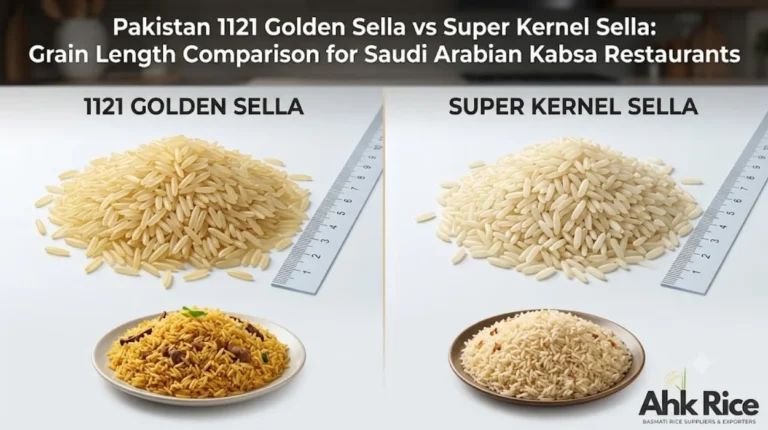
1121 Basmati is an extra-long Pakistani Basmati variety known for long slender kernels and strong elongation after cooking. Common export forms include 1121 White, 1121 Steam, 1121 Golden Sella, 1121 Creamy Sella, and 1121 Brown.
What is Super Kernel Basmati?
Super Kernel is a premium Pakistani Basmati type used for long-grain presentation and foodservice applications. Export forms include Super Kernel White, Super Kernel Steam, Super Kernel Sella, and Super Kernel Parboiled.
What is 1509 Basmati?
1509 is a Pakistani Basmati variety used in export markets where long grain, cooking performance, and price positioning are important. Available forms include 1509 White, 1509 Steam, and 1509 Golden Sella.
Grade selection should follow the buyer’s cooking, packaging, storage, and market specification. Purity requirements apply across these grades, but the acceptable physical characteristics differ according to the declared product.
Which markets use purity controls for imported rice?
Rice purity controls support international trade because importing markets require food products to meet defined safety, labelling, quality, and documentation requirements before commercial distribution. Indonesian buyers therefore treat purity as part of import compliance.
Which standards provide reference points?
Codex Alimentarius maintains CXS 198-1995 as the Standard for Rice. Codex also maintains CXS 1-1985 for pre-packaged food labelling and CXS 193-1995 for contaminants and toxins in food and feed.
These standards provide international reference points. Indonesian importers still need to apply the requirements established by Indonesian authorities and the agreed commercial specification.
Pakistan exporters also work with export documentation and inspection requirements. Typical shipment documentation includes commercial invoices, packing lists, certificates, shipping documents, and applicable health, phytosanitary, or inspection certificates.
Certification does not replace laboratory testing. A certificate confirms a defined condition or process. A test report provides measured analytical results. Buyers should review both according to the contract.
What are the main benefits of high-purity Basmati rice?
High-purity Basmati reduces foreign-material risk, improves lot consistency, protects cooking presentation, supports storage stability, and gives importers objective evidence for shipment acceptance. These benefits affect purchasing, distribution, retail, and foodservice operations.
How does purity benefit different buyers?
Retail buyers require consistent appearance because consumers compare grains visually. Foodservice buyers require predictable cooking performance because large batches depend on uniform grain behaviour.
Distributors require stable specifications across repeated shipments. A consistent specification simplifies inventory management, customer complaints, quality claims, and supplier comparisons.
Importers also benefit from documented testing. A laboratory report creates measurable evidence rather than relying only on visual inspection.
Purity therefore connects physical rice quality with commercial risk. A clean, consistent shipment is easier to evaluate, document, store, distribute, and sell.
What purity problems do Indonesian buyers commonly encounter?
Common purity problems include excessive foreign matter, high moisture, mixed varieties, inconsistent broken percentages, damaged kernels, infestation, incomplete testing, and unclear contractual specifications. These problems usually begin with weak quality definitions.
Which misconceptions create problems?
One misconception is that long grain automatically means high purity. Grain length describes one physical attribute. It does not confirm foreign matter, moisture, residues, infestation, or varietal consistency.
Another misconception is that visual inspection proves food safety. Visual inspection identifies physical defects. Laboratory analysis is required for attributes such as chemical residues and other analytical parameters.
A third misconception is that certification alone guarantees every shipment specification. Certification addresses its defined scope. Contract specifications and shipment testing address the actual lot.
A fourth misconception is that purity can be checked only after arrival. Pre-shipment inspection gives buyers an earlier control point. Sample approval, specification sheets, laboratory reports, and loading inspections establish evidence before cargo reaches Indonesia.
How should Indonesian buyers evaluate purity before shipment?
Indonesian buyers should approve a written specification, review a representative sample, define acceptance limits, request relevant test reports, verify documentation, and inspect the finished lot before shipment. This sequence creates traceable quality control.
What should the buyer request?
Request a product specification showing variety, grade, moisture, broken percentage, foreign matter, damaged kernels, packaging, crop information, and applicable safety requirements.
Request representative samples from the production lot. Compare the sample against the agreed specification rather than evaluating appearance alone.
Request relevant laboratory reports for parameters covered by the purchase contract. Confirm that laboratory results identify the tested product and applicable test methods.
Verify export documents before loading. Match product description, quantity, packaging, lot information, and shipping documentation.
Inspect the cargo during loading. Confirm packaging condition, lot identification, container cleanliness, and product conformity.
For a deeper evaluation workflow, Indonesian buyers can review how importers verify purity in Pakistan Basmati rice shipments through the related consideration-stage guide.
Frequently Asked Questions About Pakistan Basmati Rice Purity
Why does rice purity matter to Indonesian buyers?
Rice purity determines cleanliness, consistency, storage stability, food-safety control, and compliance with the buyer’s agreed specification. Indonesian importers use measurable purity indicators to evaluate whether Pakistan Basmati rice matches their purchasing requirements.
What does foreign matter mean in rice?
Foreign matter means material other than rice kernels, including stones, soil, weed seeds, stalk fragments, dust, husk, and insects. These materials reduce cleanliness and can affect milling, storage, and food preparation.
What moisture level is commonly referenced for milled rice?
A commonly referenced international specification sets milled rice moisture at a maximum of 14% on an as-received basis. Buyers should still use the moisture limit written in their commercial specification and applicable Indonesian requirements.
Which Basmati varieties can Indonesian buyers source from Pakistan?
Common Pakistani Basmati export varieties include 1121, Super Kernel, and 1509, with White, Steam, Sella, Creamy Sella, and Brown forms available. The selected grade should match the buyer’s intended application.
Does certification prove rice purity?
Certification supports documented compliance within its defined scope, but it does not replace shipment-specific inspection and laboratory testing. Buyers should compare certificates, test reports, samples, specifications, and shipment records before acceptance.
What should an Indonesian importer check before loading?
The importer should check product identity, grade, moisture, foreign matter, broken percentage, damaged kernels, packaging, laboratory reports, documentation, and container condition before loading. These checks create evidence before the shipment leaves Pakistan.