
How Do Importers Align Forecasts with International Rice Supply?
Importers align forecasts with international rice supply most effectively by combining demand history, inventory targets, supplier capacity, production cycles, shipment lead times, and market-specific grade requirements into one rolling supply plan. A forecast becomes commercially useful when it is converted into monthly purchase quantities, shipment windows, quality specifications, and reorder triggers.
Demand forecasting estimates how much rice a business expects to sell during a defined period. Supply planning converts that expected demand into procurement and shipment requirements. International rice procurement adds another layer because the product must move from cultivation and milling in the origin country through export documentation, ocean freight, customs clearance, and inland distribution.
For a deeper foundation, understanding:
Why demand forecasting matters for rice import businesses helps buyers distinguish sales forecasts from actual procurement requirements. The distinction matters because a forecast of 500 MT does not automatically mean an importer should purchase 500 MT at one time.
In 2026, this planning discipline is especially important for U.S. importers. USDA’s August 2026 outlook keeps U.S. all-rice imports at a record 49.8 million hundredweight for 2026/27, while projected ending stocks remain 33% below the previous year. International buyers therefore need supply programs that respond to demand without creating unnecessary inventory exposure.
What are the available solutions for aligning rice forecasts with international supply?
Importers can align forecasts through spot purchasing, scheduled replenishment, annual contracts, rolling forecasts, supplier capacity reservations, or hybrid programs that combine fixed commitments with flexible purchase volumes. The right solution depends on demand stability, inventory tolerance, lead time, and product specifications.
Spot purchasing
Spot purchasing means the importer buys rice when inventory or immediate customer demand requires it. The buyer compares available offers, confirms specifications, negotiates price, and places an order.
This method works for irregular demand or market testing. It gives buyers flexibility because they are not committed to a long-term volume.
The weakness is planning visibility. If demand suddenly rises, the importer must locate suitable stock, obtain approval samples, arrange production if necessary, and secure shipping capacity. Price and availability can also change between purchase cycles.
Scheduled replenishment
Scheduled replenishment converts the forecast into recurring shipment windows. An importer may forecast 600 MT for six months and divide the requirement into six 100-MT purchasing cycles.
This structure reduces the difference between expected demand and actual procurement. It also lets the supplier plan milling, grading, packaging, inspection, and container loading around known shipment dates.
Annual or seasonal contracts
A contract-based program establishes product specifications, estimated volumes, shipment windows, packaging, quality tolerances, and commercial terms before repeated shipments begin.
It suits distributors, retailers, foodservice operators, and private-label buyers with predictable consumption. The main advantage is continuity. The importer can reserve supply capacity instead of repeatedly entering the market for every container.
Rolling forecast programs
A rolling forecast updates expected demand every month or quarter. The importer provides a forward-looking estimate while confirming only the near-term quantity.
For example, an importer may communicate a 12-month forecast of 1,200 MT but formally release only the next 200 MT. The supplier uses the broader forecast for planning while the buyer preserves flexibility.
Hybrid supply programs
A hybrid program combines committed baseline volume with flexible additional quantities. An importer may contract 70% of expected annual demand and leave 30% for market-driven purchases.
This approach is useful when core demand is predictable but promotions, restaurant contracts, weather, currency movements, or retail expansion can change monthly requirements.
How do different international rice supply approaches compare?
The strongest comparison is based on forecast accuracy, price exposure, supply security, inventory risk, flexibility, lead-time control, and supplier capacity rather than purchase price alone. Stable buyers benefit from planned programs, while volatile buyers need flexible procurement structures.
| Attribute | Spot Purchase | Scheduled Replenishment | Annual Contract | Rolling Forecast | Hybrid Program |
|---|---|---|---|---|---|
| Forecast accuracy required | Low | Medium | High | Medium-High | Medium |
| Supply security | Low | High | Very High | High | Very High |
| Price visibility | Low | Medium | High | Medium | Medium-High |
| Inventory flexibility | Very High | High | Medium | High | High |
| Supplier planning visibility | Low | High | Very High | Very High | High |
| Suitable demand pattern | Irregular | Stable | Highly stable | Changing but predictable | Mixed |
| Operational complexity | Low | Medium | Medium | High | High |
The table shows why no single procurement model fits every importer. Spot buying maximizes immediate flexibility but provides the weakest supply visibility. Annual contracts provide stronger continuity but require more accurate planning.
Rolling forecasts create a useful middle ground. The importer communicates future demand without committing the full forecast as an immediate purchase order. This gives the exporter a planning signal while preserving commercial flexibility.
A hybrid model becomes stronger when demand has a predictable base but also contains seasonal peaks. It separates committed demand from uncertain demand instead of forcing both into one purchasing structure.
Which rice grades should importers match to their forecasts?
Grade selection should follow the end market, cooking requirement, customer segment, and forecasted sales mix because 1121, Super Kernel, and 1509 serve different commercial positions. Importers should forecast each grade separately rather than combining all Basmati demand into one purchasing number.
AHK Rice supplies Pakistani Basmati varieties including 1121, Super Kernel, and 1509, with processing and packaging options designed around international buyer specifications.
AHK Rice’s USA rice export service provides an example of how product selection can be connected with export documentation, packaging, shipping, and destination requirements.
1121 Basmati is commonly positioned as a premium extra-long-grain product. Importers serving restaurants, premium retail, catering, and private-label channels can forecast it according to customer demand for grain appearance, aroma, and cooking elongation.
Super Kernel provides another premium aromatic option. Its demand forecast should reflect the target market’s preferred grain profile, cooking performance, price point, and packaging format.
1509 Basmati can support buyers seeking long-grain appearance and a more cost-conscious premium positioning. Forecasting this grade separately prevents lower-priced demand from distorting the procurement plan for higher-value 1121 requirements.
Forecasting should also distinguish white, steam, Sella, creamy Sella, golden Sella, brown, and other processing forms where applicable. The processing method affects cooking characteristics, buyer preference, production planning, and commercial positioning.
How should Saudi Arabia and UAE importers align rice forecasts with supply?
Saudi Arabia and UAE buyers should build separate forecasts because both markets import Pakistani Basmati but serve different retail, foodservice, wholesale, and consumer requirements. Grade mix, shipment frequency, inventory coverage, packaging, and landed cost should therefore be planned by market.
Saudi Arabia
Saudi Arabian importers commonly require premium Basmati for retail, foodservice, restaurants, catering, and wholesale distribution. Forecasts should separate core retail demand from Ramadan, Eid, catering, and promotional demand.
For premium channels, 1121 Steam and other premium long-grain Basmati grades can form the core forecast. Buyers should then calculate additional quantities for seasonal consumption rather than treating seasonal demand as normal monthly demand.
A practical example is an importer forecasting 1,200 MT annually. If normal demand equals 80 MT per month but seasonal demand reaches 140 MT during peak periods, the procurement program should reserve additional production and shipping capacity before the peak rather than waiting for inventory to fall.
UAE
The UAE market combines retail, hospitality, catering, foodservice, wholesale, and re-export activity. Forecasts therefore need greater segmentation by customer type.
Premium 1121 grades can serve high-end retail and foodservice demand, while Super Kernel and 1509 can support different price-performance segments. The forecast should also account for re-export demand because UAE inventory can serve customers beyond the domestic market.
The key difference is not that one market uses only one grade. Both markets use multiple grades. The difference is the commercial demand structure and the way buyers should segment their forecasts.
Regional comparison
| Market | Common forecast focus | Grade preference | Indicative planning horizon | Inventory priority | Price position |
| Saudi Arabia | Retail, catering, foodservice, seasonal demand | 1121 Steam, premium Basmati | 6–12 months | Higher before seasonal peaks | Premium |
| UAE | Retail, hospitality, wholesale, re-export | 1121, Super Kernel, 1509 | 6–12 months | Balanced with faster replenishment | Premium to value-premium |
Actual prices must be quoted against the precise grade, crop, milling specification, packing format, Incoterm, destination, freight rate, and order quantity. Pakistan’s Federal Board of Revenue maintains customs valuation rulings, and a January 2026 rice valuation ruling was subsequently cancelled and withdrawn, demonstrating why buyers should not treat a single published valuation figure as a commercial export price.
For internal budgeting, importers should maintain a price-per-MT range rather than one fixed number. A forecast can then test whether a projected selling price remains viable under different FOB, freight, duty, insurance, and inland-cost scenarios.
How should shelf life influence international rice forecasting?
Shelf life should be incorporated into inventory planning because rice can remain commercially usable for extended periods when correctly processed, packed, stored, and protected from moisture, pests, heat, and contamination. Longer storage does not eliminate quality-management requirements.
Importers should calculate inventory coverage in months rather than simply counting containers. A buyer holding 300 MT with monthly consumption of 50 MT has approximately six months of theoretical inventory coverage.
That figure changes when demand accelerates. If consumption rises to 75 MT per month, the same 300 MT represents only four months of coverage.
A forecast should therefore connect projected consumption with stock on hand, confirmed purchase orders, goods in transit, supplier production capacity, and expected arrival dates.
For example, a distributor should not calculate available inventory only from warehouse stock. A more useful calculation is:
Projected available supply = opening inventory + confirmed incoming shipments + planned procurement − forecast consumption.
This model identifies future shortages before the warehouse reaches zero stock.
What are the pros and cons of each forecasting and supply approach?
Spot buying provides maximum flexibility but weak supply continuity; contracts provide strong continuity but require disciplined forecasting; rolling forecasts balance visibility and flexibility; hybrid programs provide the strongest structure when a buyer has stable base demand with uncertain seasonal or promotional volume.
Spot purchasing
The main advantage is freedom to change suppliers, grades, quantities, and purchase timing. It works well for new buyers testing a market.
The disadvantage is weak capacity planning. A sudden demand increase can create a supply gap, especially when the required grade needs production rather than immediately available stock.
Scheduled replenishment
The benefit is predictable inventory flow. The importer can align warehouse capacity, freight bookings, and sales planning with recurring shipments.
The limitation is that poor forecasts can create excess inventory. A buyer that schedules 100 MT every month despite declining sales can accumulate stock.
Annual contracts
Contracts provide strong supply continuity and clearer planning. They also help suppliers reserve production capacity.
The drawback is commitment. If the buyer overestimates demand, unused volume can become a commercial burden.
Rolling forecasts
Rolling forecasts provide regular updates. They are particularly useful when sales data changes frequently.
The disadvantage is administrative complexity. Forecasts must be updated, reviewed, and communicated consistently.
Hybrid programs
Hybrid programs separate stable demand from uncertain demand. This reduces the risk of committing the entire forecast.
The trade-off is greater planning work because the buyer must define which volume is firm and which volume remains flexible.
Which method works best for different importer cases?
The best method depends on demand stability, business scale, customer concentration, inventory capacity, product specificity, and acceptable price exposure. Importers should match procurement structure to forecast confidence instead of applying one purchasing model across every rice grade and customer channel.
A new importer with uncertain demand should begin with controlled spot purchases or small scheduled orders. The objective is to validate customer acceptance, grade specifications, packaging, and landed economics.
A growing distributor with stable monthly sales should move toward scheduled replenishment. Repeated orders create enough demand visibility for both buyer and supplier to plan production.
A large retailer or foodservice distributor with established annual consumption should consider an annual contract or rolling forecast program. The larger the volume, the greater the value of supplier capacity reservation.
A private-label importer should use a more structured model because packaging, artwork, labeling, production, and quality approval add lead-time requirements. Forecast errors can affect both rice availability and packaging inventory.
An importer with strong baseline demand but unpredictable promotions should use a hybrid program. Core volume receives supply protection, while promotional volume remains flexible.
What decision factors should importers use before choosing a supply model?
Importers should evaluate forecast accuracy, demand variability, inventory coverage, supplier capacity, lead time, product complexity, landed cost, and customer commitments before selecting a procurement structure. The decision should prioritize continuity and total supply economics rather than the lowest initial rice quotation.
| Decision factor | Question to evaluate | Preferred response |
| Forecast accuracy | How closely does projected demand match actual sales? | Use contracts when accuracy is consistently high |
| Demand variability | How sharply do monthly requirements change? | Use rolling or hybrid purchasing for variable demand |
| Inventory coverage | How many months of stock can the warehouse safely hold? | Increase shipment frequency when storage is constrained |
| Supplier capacity | Can the exporter process peak demand within the required window? | Reserve capacity for high-volume programs |
| Lead time | How long from order confirmation to destination availability? | Place orders before the inventory trigger is reached |
Supplier capacity should include more than milling output. It covers paddy sourcing, aging where applicable, milling, polishing, sortex cleaning, grading, packaging, inspection, documentation, container loading, and shipment preparation.
For international procurement, the forecast should also include the time required for ocean freight and destination clearance. A U.S. importer, for example, should treat the shipment as an end-to-end supply event rather than assuming the supply cycle ends when the container leaves Karachi.
USDA’s August 2026 outlook provides a useful market signal for this planning environment. U.S. 2026/27 all-rice imports remain projected at a record 49.8 million hundredweight, while ending stocks are projected at 36.0 million hundredweight. This combination reinforces the importance of planning imported supply around expected consumption rather than relying entirely on domestic availability.
How can importers turn a demand forecast into an international rice supply plan?
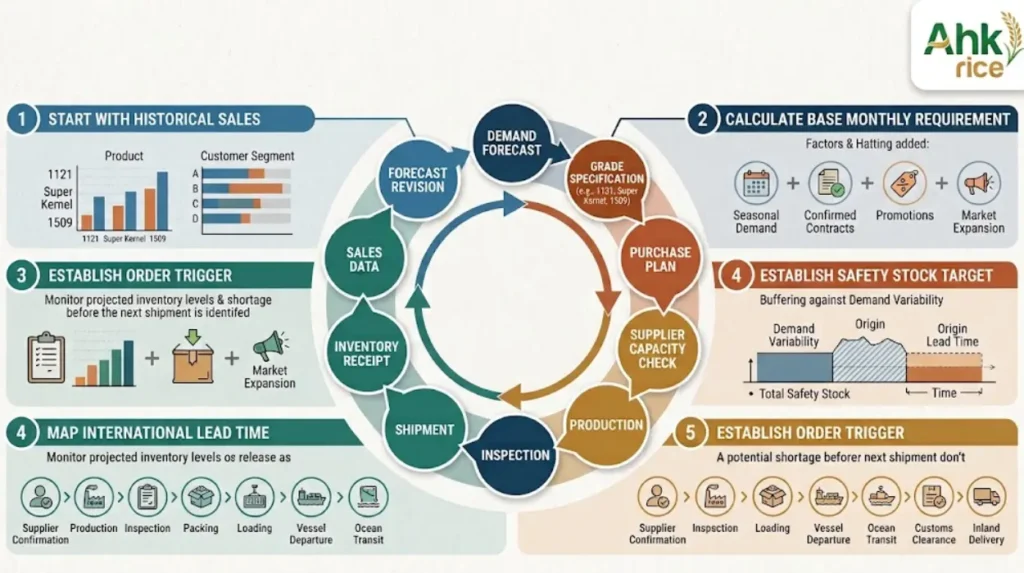
A practical supply plan converts the forecast into monthly grade requirements, minimum inventory levels, order triggers, production windows, shipment dates, documentation milestones, and contingency quantities. This connects sales planning directly with supplier operations and international logistics.
Start with historical sales by product and customer segment. Separate 1121, Super Kernel, 1509, and processing grades instead of using one total rice figure.
Next, calculate the base monthly requirement. Add seasonal demand, confirmed customer contracts, promotional volumes, and planned market expansion.
Then establish a safety-stock target. The safety stock should reflect demand variability and the time required to replace inventory from the origin country.
After that, map the international lead time. Include supplier confirmation, production, inspection, packing, container loading, vessel departure, ocean transit, customs clearance, and inland delivery.
Finally, establish an order trigger. If projected inventory will fall below the required coverage before the next shipment can arrive, the importer should release procurement before the shortage becomes visible in the warehouse.
The strongest forecasting process is therefore a continuous loop:
Forecast → specification → purchase plan → supplier capacity check → production → inspection → shipment → inventory receipt → sales data → forecast revision.
This loop prevents forecasting from becoming a static spreadsheet. It turns the forecast into an operational supply-control system.
For U.S. buyers evaluating the next conversion stage, the decision-focused article
AHK Rice Supports Forecast-Based Supply Programs for New Mexico, USA is best placed immediately after the section explaining how to convert a demand forecast into a supply plan. That placement moves the reader naturally from the general procurement method to a market-specific supplier program without interrupting the informational comparison.
Frequently Asked Questions
How do importers align rice demand forecasts with international rice supply?
Importers align forecasts with supply by converting expected sales into monthly rice quantities, grade requirements, inventory targets, production schedules, shipment windows, and reorder points. This connects demand planning with supplier capacity and international logistics.
What is the best procurement method for predictable rice demand?
Scheduled replenishment or a contract-based supply program works best when demand is stable. These methods allow importers to plan recurring shipments, reserve supplier capacity, manage inventory, and reduce the uncertainty associated with repeated spot purchases.
Should rice importers use spot purchases or long-term contracts?
Spot purchases provide flexibility for uncertain or occasional demand, while long-term contracts provide stronger supply continuity for predictable demand. Importers should select the method according to forecast accuracy, inventory capacity, required volume, and acceptable price exposure.
How does a rolling forecast help rice importers?
A rolling forecast allows importers to update expected demand regularly while giving suppliers forward visibility. For example, a buyer can provide a 12-month forecast but formally confirm only the next shipment or several months of committed volume.
Which Pakistani Basmati grades should importers include in their forecasts?
Importers should forecast 1121 Basmati, Super Kernel, and 1509 separately because each grade serves different customer segments and price-performance requirements. Processing forms such as Steam, White, Sella, or Creamy Sella should also be forecast separately.