Super Kernel Rice Price vs Quality Analysis for Buyers
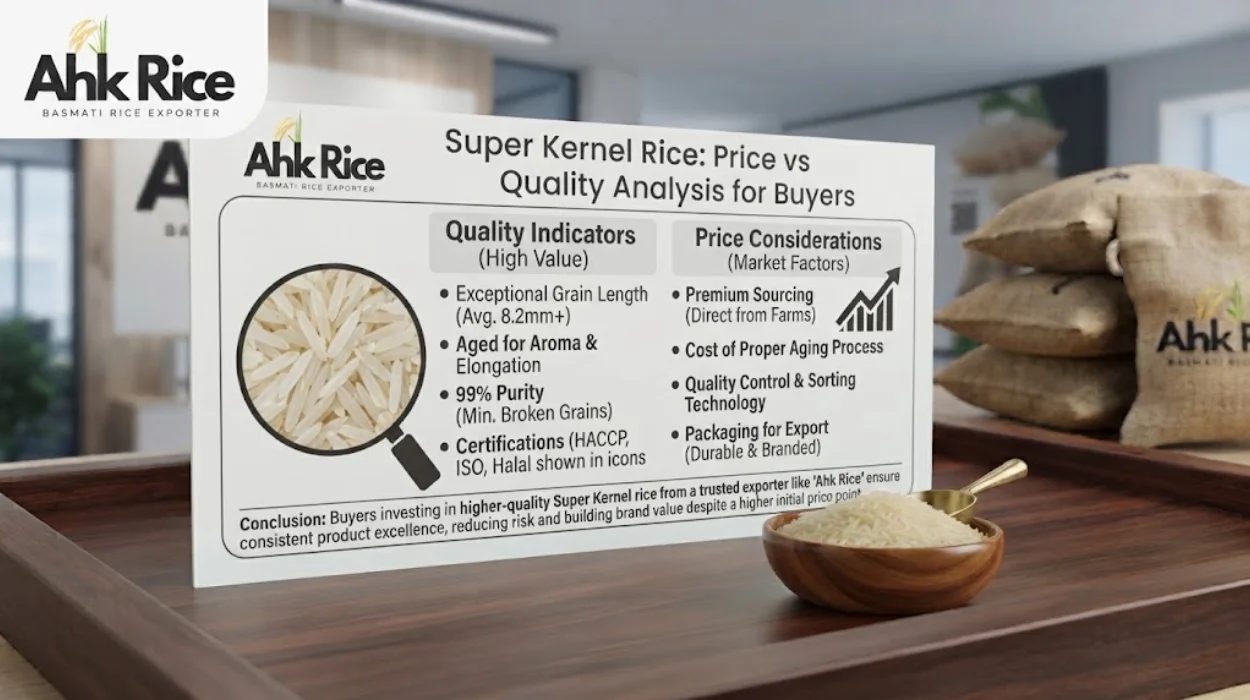
Super Kernel offers the strongest price-to-quality balance when buyers need traditional Basmati aroma, long grains, controlled breakage, and competitive FOB pricing without paying the premium associated with longer 1121 grades. Here is why: published 2026 indications place Super Kernel around $965–$1,205 per MT FOB Karachi, depending on specification, market, and quality level.
Super Kernel Basmati is a Pakistani aromatic rice variety associated with Punjab production. Buyers evaluate it through grain length, aroma, moisture, broken percentage, milling quality, purity, packaging, and cooking performance. Learn how Super Kernel compares with other Pakistani Basmati varieties before selecting a commercial specification.
AHK Rice supplies Super Kernel alongside 1121 and 1509 from Pakistan. Its export process covers sourcing, milling, grading, colour sorting, packaging, inspection, documentation, and container loading.
What are the available Super Kernel rice solutions for buyers?
Buyers can choose White, Steam, Sella, or customized Super Kernel specifications, with price determined by grain quality, broken percentage, moisture, processing, packaging, volume, and destination. Each solution serves a different commercial purpose, so the lowest FOB price does not automatically provide the lowest total procurement cost.
Super Kernel White Rice
Super Kernel White uses conventional milling followed by polishing, grading, and sorting. Typical commercial specifications include 7.0–7.35 mm grain length, moisture around 12–14%, and broken levels from 1–5%. Published specifications also show 7.25–7.35 mm grain length, 12% maximum moisture, and 2% maximum broken grains.
White rice suits retail packs, traditional Basmati cooking, restaurants, and distributors that prioritize aroma and soft cooked texture. Its specification becomes more valuable as broken percentage falls and grain uniformity improves.
Super Kernel Steam Rice
Steam processing exposes paddy or milled rice to controlled heat before drying and final milling. This process produces firmer cooked grains and supports applications requiring better grain separation.
AHK Rice product specifications published for Indonesia show 7.0–7.2 mm average grain length, ≤12% moisture, ≤3% broken grains, and nil foreign matter for Super Kernel Steam Rice.
Steam rice fits foodservice and wholesale buyers requiring consistent cooking performance. The processing cost increases compared with basic white rice, but the specification can justify a higher selling price.
Super Kernel Sella and Parboiled Rice
Parboiling partially cooks paddy before drying and milling. The process changes grain structure and creates firmer, less sticky cooked rice.
Parboiled Super Kernel can suit biryani, pulao, catering, and distribution channels where cooked-grain separation matters. AHK Rice’s published Indonesian specification lists 7.0–7.2 mm grain length, ≤12.5% moisture, and ≤2% broken grains.
Customized Export Specifications
Customized supply combines a defined grain length, broken percentage, moisture ceiling, milling degree, packaging format, crop requirement, and inspection basis. This approach gives importers greater control over the relationship between price and quality.
A buyer ordering 50 kg PP bags with 5% broken rice has a different cost structure from a retailer ordering 5 kg printed laminated bags with 1% broken rice. Packaging, sorting, filling, and handling all affect the final quotation.
With the available product formats established, the next step is comparing their specifications against actual procurement costs.
How do Super Kernel price and quality compare?
Super Kernel pricing increases as buyers tighten grain length, broken percentage, moisture, purity, processing, and packaging requirements. A specification-based comparison therefore gives more useful purchasing information than price per metric ton alone.
| Attribute | Standard Super Kernel White | Premium Super Kernel Steam |
|---|---|---|
| Grain length | 7.0–7.35 mm | 7.0–7.2 mm |
| Moisture | ≤12–14% | ≤12% |
| Broken grains | 2–5% | ≤2–3% |
| Processing | Milled and polished | Steamed and dried |
| Texture | Soft and fluffy | Firm and less sticky |
| Aroma | Traditional Basmati aroma | Aromatic with firm texture |
| Typical shelf-life planning | 12–24 months | 12–24 months |
Published commercial specifications support a 24-month shelf-life figure for some Super Kernel products under appropriate storage conditions, while other export listings specify shorter periods. Buyers should therefore contract the exact shelf-life requirement rather than assume one universal value.
Price also depends on market timing. A published 2026 Super Kernel price guide places premium Super Kernel around $965–$1,005/MT FOB Karachi, while another August 2026 market indication places Super Kernel around $1,165–$1,205/MT for a specified export segment.
The difference shows why buyers must compare specifications before comparing quotations. Grain length, broken content, packaging, crop, aging, inspection, and Incoterm can materially change the price.
With specification differences clear, market requirements determine which Super Kernel format creates the strongest commercial value.
Which Super Kernel specification suits GCC and European buyers?
GCC buyers commonly prioritize aromatic long-grain Basmati, Sella or Steam performance, and dependable cooking results, while European buyers place greater emphasis on traceability, residue compliance, packaging, and documented quality.
GCC market
GCC markets include the UAE, Saudi Arabia, Qatar, Kuwait, Bahrain, and Oman. Pakistani Basmati has established demand across these markets, with the UAE functioning as a major import and re-export hub.
Super Kernel suits buyers seeking traditional aroma at a lower grain-length premium than 1121. Steam and Sella formats also suit biryani, mandi, pulao, and catering applications where grain separation matters.
UAE shipping from Karachi can reach Jebel Ali in roughly 4–10 sailing days, according to current market information. Qatar and Bahrain routes commonly show approximately 7–18 days, depending on vessel schedules and port conditions.
Indicative UAE FOB market pricing for Pakistani rice sits around $1,135–$1,205/MT, with Super Kernel included among the traded Basmati varieties.
European market
European buyers commonly require stronger documentation around food safety, pesticide residues, traceability, and import compliance. The UK remains a major European destination for Pakistani rice, while Germany, Italy, the Netherlands, Belgium, and France are also important markets.
Super Kernel works well in European ethnic retail and gourmet channels where authentic Basmati aroma matters. Packaging and labeling become more important because the product often reaches branded retail shelves.
Rotterdam routes from Karachi can take approximately 24–45 days, while Felixstowe routes can take around 24–40 days.
A current Rotterdam indication lists Super Kernel at approximately $1,165–$1,205/MT FOB Karachi. The same source identifies Super Kernel at approximately 7.20 mm grain length and positions it as an aromatic alternative to longer 1121.
The GCC comparison emphasizes cooking performance and logistics, while Europe adds stronger compliance and documentation considerations.
What are the advantages and disadvantages of each approach?
White Super Kernel provides straightforward pricing and traditional aroma, while Steam and Sella provide firmer cooking performance; customized specifications provide control but require tighter quality verification.
White Super Kernel advantages
White Super Kernel offers traditional Basmati aroma, soft texture, flexible packaging, and straightforward milling requirements. It suits retailers and wholesalers selling conventional aromatic rice.
The main limitation is cooking firmness. Buyers serving large catering operations may prefer Steam or Sella where separate grains and stronger handling performance matter.
Steam Super Kernel advantages
Steam Super Kernel provides firmer cooked grains and stronger separation. This makes it suitable for biryani restaurants, catering companies, and foodservice distributors.
The main limitation is additional processing. Steam treatment increases production requirements and can raise the FOB quotation compared with a basic white specification.
Sella and parboiled advantages
Sella provides strong grain separation and commercial durability. It works particularly well for long distribution chains and foodservice applications.
The main limitation is consumer preference. Some traditional Basmati consumers prefer the aroma and texture profile of white rice.
Customized specifications advantages
Customized specifications let buyers control broken percentage, moisture, grain length, packaging, and inspection. This reduces ambiguity between the purchase order and delivered product.
The limitation is procurement complexity. Every additional specification must be tested and documented before loading.
These trade-offs show why buyers should select the specification around the sales channel rather than chase the lowest quoted MT price.
Which method works best for different buyer cases?
The right Super Kernel method depends on the buyer’s sales channel, cooking application, storage period, quality target, packaging model, and destination compliance requirements rather than one universal price point.
| Buyer decision factor | Best-fit approach | Reason |
|---|---|---|
| Retail aroma positioning | Super Kernel White | Traditional aroma and soft texture |
| Restaurant foodservice | Super Kernel Steam | Firmer grains and better separation |
| Biryani catering | Super Kernel Sella | Strong grain separation after cooking |
| Long distribution | Parboiled/Sella | Robust handling and storage profile |
| Premium private label | Customized specification | Controlled packaging and quality |
| Cost-sensitive wholesale | Standard White | Lower processing complexity |
A UAE restaurant distributor ordering large volumes can prioritize Steam or Sella. A UK ethnic retailer can prioritize White Super Kernel with controlled packaging and compliance documentation. A private-label importer can specify exact moisture, broken percentage, bag weight, and inspection requirements.
The decision becomes clearer when buyers calculate quality against landed cost instead of comparing FOB quotations alone.
What decision factors should buyers use before ordering Super Kernel?
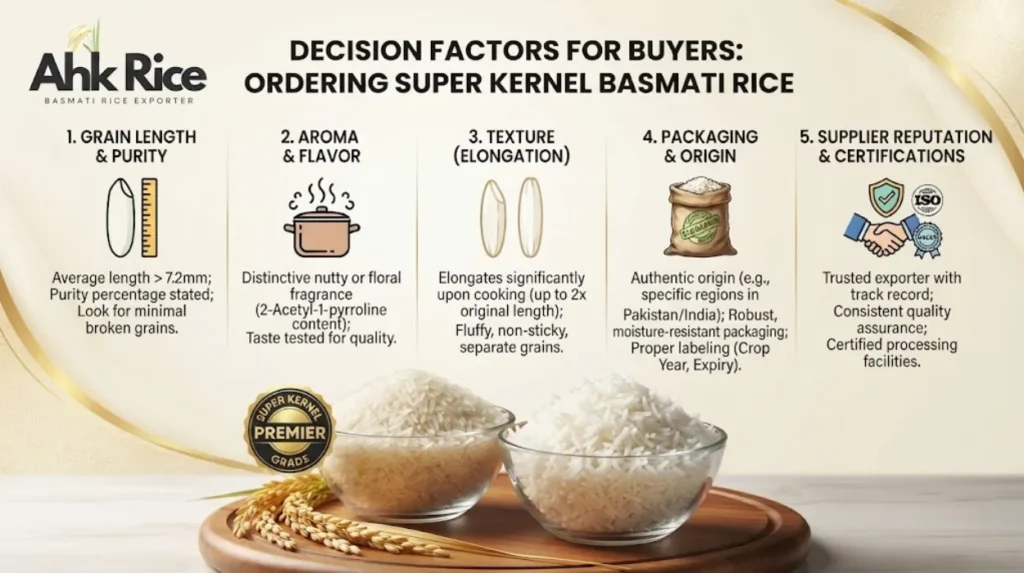
Buyers should compare seven commercial factors: grain specification, broken percentage, moisture, processing method, packaging, inspection basis, and landed cost. This framework converts a broad price comparison into a measurable procurement decision.
Grain specification
Grain length influences visual positioning and retail value. A 7.2 mm Super Kernel specification serves a different market position from longer 1121.
Broken percentage
Broken grains affect appearance and cooking consistency. Moving from 5% broken to 2% broken requires tighter grading and sorting.
Moisture level
Moisture affects storage stability and quality retention. A contracted maximum should appear on the specification sheet and certificate of analysis.
Processing method
White, Steam, and Sella products have different cooking characteristics. Buyers should match processing with the final food application.
Packaging
Packaging affects product protection, handling, branding, and landed cost. PP, laminated, kraft, jute, and private-label formats create different commercial costs.
Inspection basis
Inspection defines how quality is verified before loading. SGS, Bureau Veritas, Intertek, or an agreed laboratory can provide independent verification.
Landed cost
Landed cost combines FOB or CNF/CIF price, freight, insurance, port charges, customs, inspection, and local handling. This figure provides a better comparison than FOB alone.
AHK Rice supports specification-led sourcing across Super Kernel, 1121, and 1509. Its process includes milling, grading, colour sorting, customized packaging, inspection support, and export documentation. This structure helps buyers compare a defined product against a defined commercial requirement.
The final decision should therefore start with a written specification and sample approval before the buyer evaluates the final quotation.
How should buyers evaluate Super Kernel quality before a bulk order?
Buyers should approve a physical sample before bulk production and verify grain length, broken percentage, moisture, aroma, cooking performance, packaging, and laboratory results against the agreed specification.
Sample evaluation begins with a defined product sheet. The sheet should state variety, processing method, grain length, broken percentage, moisture, packing weight, crop requirement, and destination.
The buyer should inspect the physical sample for uniformity, colour, foreign matter, broken grains, aroma, and visible defects. Cooking tests should then measure expansion, separation, softness, aroma, and serving appearance.
Laboratory testing provides additional verification for moisture, purity, pesticide residues, aflatoxin, and other destination-specific requirements. European imports require particular attention to food-safety and residue controls.
AHK Rice states that its export process can include in-house testing and optional third-party inspection. Its published market pages also identify phytosanitary, certificate of origin, fumigation, Halal, and other documents according to destination requirements.
Sample approval creates the reference point for the production lot. The contract should then reproduce the approved specification so quality verification remains measurable.
With the specification, market, and quality checks defined, the buyer can move from comparison into commercial quotation.
What should buyers ask about Super Kernel price before purchasing?
A valid Super Kernel quotation should state specification, quantity, packing, Incoterm, origin port, destination port, inspection requirements, payment terms, and quotation validity so buyers can calculate comparable landed costs.
FOB Karachi pricing covers the rice and export-side loading responsibilities defined by the agreed Incoterm. CIF or CNF pricing adds destination-related freight components according to the commercial term.
Quantity changes the unit economics because production, packaging, inspection, and logistics costs distribute differently across full-container and smaller orders. Packaging also changes the final price through material and printing costs.
AHK Rice publishes examples showing tailored FOB and CIF quotations based on quantity, specifications, packing, and destination. Exact commercial pricing therefore requires a buyer-specific specification rather than a generic Super Kernel price.
For decision-stage buyers, the next useful step is to request a quotation against the approved Super Kernel specification rather than compare generic market prices.
Frequently Asked Questions
What is a competitive Super Kernel rice price per MT?
Published 2026 indications range from approximately $965 to $1,205 per MT FOB Karachi across different Super Kernel specifications and market references. Exact pricing depends on quality, packaging, volume, crop, and destination.
Is Super Kernel cheaper than 1121 Basmati?
Super Kernel commonly occupies a lower or comparable price position depending on specification. A longer 1121 specification can command a premium because buyers value its greater grain length and visual presentation.
What is the shelf life of Super Kernel rice?
Commercial Super Kernel products commonly use a 12–24 month planning range. Some published specifications state 24 months, while others state 12 months. Storage conditions, moisture, packaging, and processing determine the actual contract specification.
Which Super Kernel type suits restaurants?
Steam or Sella Super Kernel suits restaurants that require firm, separate grains. White Super Kernel suits restaurants that prioritize traditional aroma and softer cooked texture.
How can buyers reduce Super Kernel procurement risk?
Buyers can reduce risk by approving a physical sample, defining measurable specifications, testing the production lot, using independent inspection, and confirming the agreed Incoterm before shipment.
Does packaging affect Super Kernel rice price?
Yes. Bag material, weight, printing, liners, stitching, palletization, and private-label requirements all affect the final quotation. A 5 kg branded retail pack has a different cost structure from a 50 kg standard export bag.