How Do UK Food Import Rules Affect Basmati Rice Shipments?
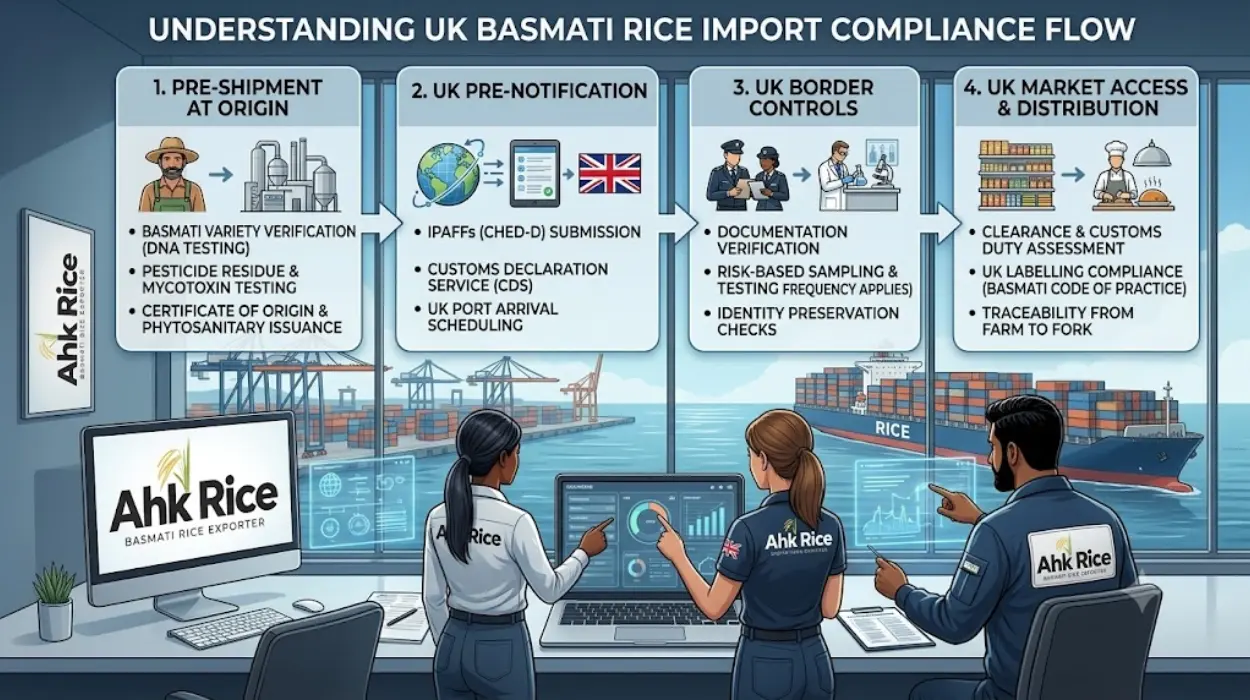
UK food import rules affect Basmati rice shipments through customs classification, food-safety controls, contaminant requirements, documentation, labelling, and tariff procedures. Here is why: Pakistani rice entering Scotland follows Great Britain food rules, while Scotland uses Food Standards Scotland for enforcement and imported-food oversight.
For a complete foundation, buyers should first understand how to import Pakistani Basmati rice into the UK in 2026. That guide establishes the product grades, documentation, processing stages, and UK procurement process needed before comparing compliance strategies.
What UK food import rules apply to Pakistani Basmati rice?
Pakistani Basmati rice must meet GB food standards, correct customs classification, applicable contaminant limits, accurate labelling, and import documentation requirements. Rice is a food of non-animal origin, so the compliance route differs from meat or dairy imports.
Food Standards Scotland states that imported food entering Scotland must meet GB standards for public and animal health. Scotland therefore does not operate a separate food-safety standard for Pakistani Basmati rice. Instead, Scottish authorities enforce the applicable Great Britain framework.
Customs classification also affects the shipment. HMRC places rice within heading 1006, with classifications covering husked rice, milled rice, broken rice, and parboiled rice. The correct classification supports accurate duty and customs declarations.
Pakistan-origin rice also receives specific regulatory attention. The current GB restricted-foods list identifies rice from Pakistan under controls for pesticide residues, aflatoxins, and Ochratoxin A. This update was published on 10 July 2026.
Import licensing creates another consideration for commercial volumes. UK agricultural guidance lists rice under the licensing framework, with an exemption for quantities of 1,000 kg or less and licensing requirements applying above that threshold under the relevant arrangements.
These requirements make specification and documentation part of the purchasing decision rather than separate administrative tasks.
What are the available solutions for compliant Basmati rice shipments?
The strongest solution combines compliant rice specifications, pre-shipment testing, accurate documentation, suitable packaging, customs classification, and controlled export logistics. This approach addresses product quality and border requirements through one coordinated procurement process.
Which compliance approach suits bulk imports?
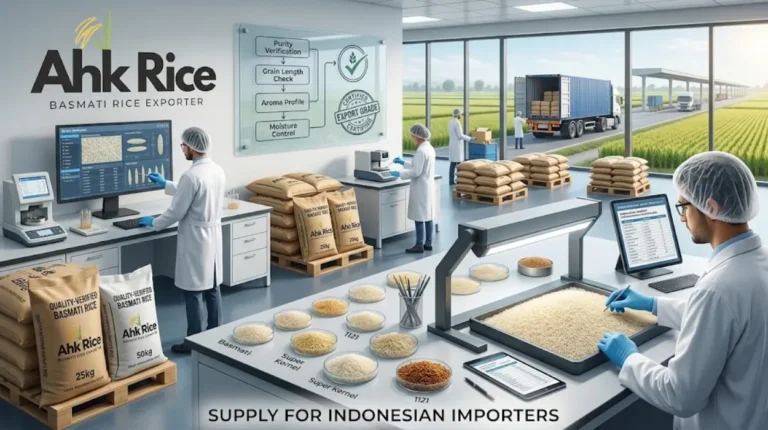
Direct export coordination suits bulk importers that need specification control, testing, packaging, and shipment documentation from one supply chain. The exporter can mill, grade, sort, inspect, pack, and prepare the required commercial documentation before dispatch.
AHK Rice supplies 1121, Super Kernel, and 1509 Basmati rice from Punjab with end-to-end processing and custom packaging. These capabilities allow buyers to establish specifications before production rather than correcting inconsistencies after arrival.
The main process is straightforward:
- Confirm the rice variety and processing type.
- Specify broken percentage and grain-length requirements.
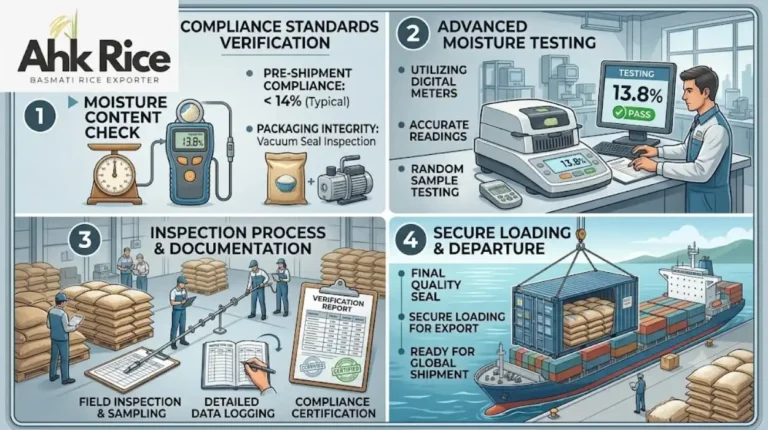
- Test moisture and relevant contaminants before dispatch.
- Verify packaging and label information for the UK market.
- Classify the product correctly under the UK tariff.
- Prepare commercial and export documents before loading.
- Dispatch the container with shipment records aligned.
Direct sourcing reduces the number of parties handling the product specification. It also creates a clearer audit trail between the mill, exporter, importer, customs broker, and final distributor.
Which approach suits private-label retail?
Private-label sourcing works best when the importer controls the product specification and packaging before production. Retail packaging must present required food information clearly, including food name, net quantity, origin where required, lot identification, storage conditions, and the responsible business address.
A 5 kg retail pack therefore requires more than a brand logo. The importer must verify the legal food name, net quantity, required origin information, storage instructions, and responsible business details before approving artwork.
Packaging becomes part of regulatory compliance because incorrect information can prevent retail distribution even when the rice itself meets quality requirements.
Which approach suits foodservice buyers?
Foodservice buyers benefit from durable grades, bulk packaging, documented testing, and consistent cooking performance. Golden Sella and Steam processing provide different product characteristics, so the buyer should select processing according to kitchen use and storage requirements.
Golden Sella uses parboiling to strengthen the grain structure. Steam rice uses controlled steaming to improve firmness while maintaining a lighter appearance. White Basmati retains the natural white appearance of milled rice without parboiling.
The correct solution therefore depends on the buyer’s distribution channel rather than regulation alone.
With the available compliance approaches established, the next step is comparing their commercial and regulatory performance.
How do different UK Basmati rice approaches compare?
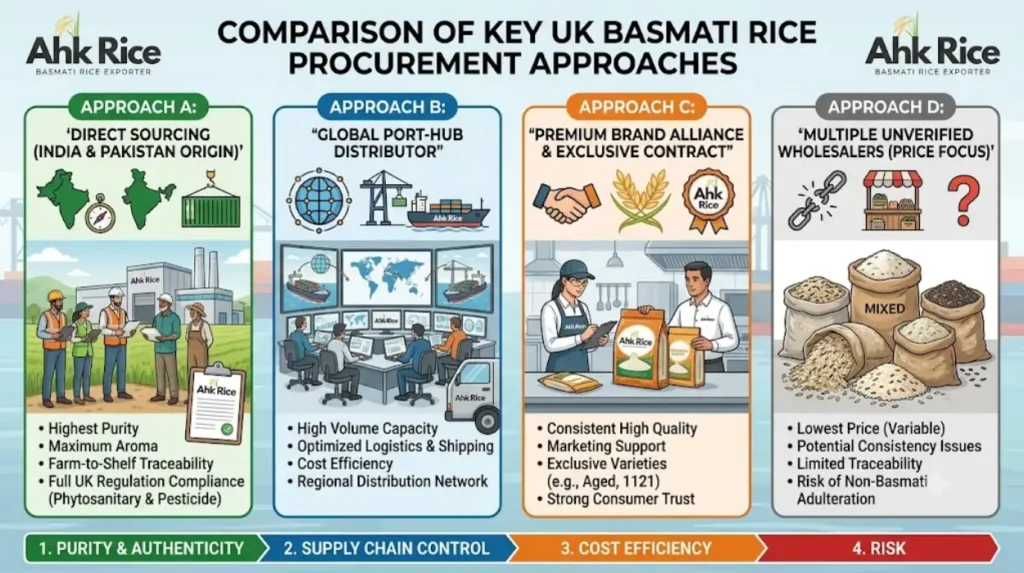
Direct sourcing provides the strongest specification control, private-label sourcing provides packaging control, and trading-agent sourcing provides procurement convenience but reduces production visibility. The correct approach depends on volume, retail requirements, documentation needs, and buyer involvement.
| Attribute | Direct Exporter | Trading Agent | Private-Label Program |
|---|---|---|---|
| Specification control | High | Medium | High |
| Documentation visibility | High | Medium | High |
| Packaging control | High | Medium | Very high |
| Pre-shipment testing | Directly coordinated | Supplier-dependent | Contract-defined |
| Customs coordination | Exporter-supported | Agent-supported | Exporter/importer coordinated |
| Best buyer type | Wholesaler | Small importer | Retail/private label |
| Main commercial advantage | Consistency | Convenience | Brand control |
Direct exporter sourcing gives the importer direct access to milling and grading specifications. Trading agents simplify communication but can add another information layer between buyer and mill.
Private-label programs provide the strongest control over packaging. They also require earlier artwork approval because label information must be correct before the product enters commercial distribution.
The regulatory outcome depends on execution. A trading agent can still provide compliant rice, while direct sourcing can still fail when documentation contains inconsistent information.
The best comparison therefore focuses on process control rather than supplier category alone.
How do Scotland and England and Wales compare for Basmati rice buyers?
Scotland and England and Wales operate under the same Great Britain food standards, but the enforcement authority and commercial logistics can differ by destination. Food Standards Scotland oversees imported-food requirements in Scotland, while Port Health Authorities conduct relevant checks in England.
What grades suit Scottish buyers?
1121 Steam, 1121 White, Super Kernel, and 1509 can serve Scottish retail and foodservice channels, with 1121 grades suited to premium long-grain positioning. Buyers should select the processing type according to cooking performance, packaging format, and storage requirements.
Scottish wholesalers serving South Asian grocery channels can prioritize aromatic long-grain specifications. Foodservice distributors can prioritize grades that maintain structure during bulk cooking.
What grades suit England and Wales buyers?
1121 Steam and White Basmati suit premium retail, while Golden Sella suits catering and bulk foodservice applications. England and Wales offer a larger distribution network, making retail packaging and wholesale replenishment important purchasing considerations.
How does price per MT compare?
The product benchmark is approximately $1,135–$1,205 per MT FOB Karachi for major 1121 Basmati grades in July 2026. Destination pricing then changes according to freight, port charges, customs treatment, packaging, inspection, and inland delivery.
| Market region | Common grade preference | Indicative FOB benchmark | Shelf-life planning |
|---|---|---|---|
| Scotland | 1121 Steam, White, Super Kernel | $1,135–$1,205/MT | 12–24 months depending on grade and storage |
| England & Wales | 1121 Steam, White, Golden Sella | $1,135–$1,205/MT | 12–24 months depending on grade and storage |
The FOB benchmark remains origin-based rather than Scotland-specific. A Scottish importer must add the agreed ocean freight, UK port costs, customs charges, and inland transport to calculate the actual landed cost.
Shelf life also depends on processing, moisture, packaging, warehouse conditions, and crop age. Golden Sella generally provides stronger grain stability than untreated White rice because parboiling changes kernel structure.
Scotland therefore does not require a different Basmati grade because of food law. The commercial choice changes according to retail, wholesale, catering, and storage requirements.
With the regional comparison established, the next decision is selecting the method for each buyer situation.
Which method works best for different UK buyer cases?
Retail buyers should prioritize White or Steam Basmati, catering buyers should prioritize structurally durable grades, and private-label buyers should prioritize packaging control. Each route connects the rice specification with its final commercial use.
Which method suits supermarket retail?
1121 Steam and 1121 White work well for premium retail because appearance, grain length, aroma, and packaging presentation influence consumer choice. Retail buyers should establish broken percentage, moisture, crop year, pack weight, and label artwork before contracting.
Which method suits restaurants?
1121 Golden Sella suits high-volume catering because parboiling strengthens the kernel and supports consistent bulk cooking. Restaurants should compare cooked yield, grain separation, storage requirements, and pack size before selecting the grade.
Which method suits ethnic wholesalers?
Super Kernel and 1121 Basmati provide strong options for ethnic wholesalers because aroma, long grain appearance, and cooking familiarity influence repeat demand. Wholesale buyers should negotiate specifications rather than purchasing solely on the lowest quoted MT price.
Which method suits private-label distributors?
A private-label export program provides the strongest control over packaging, label information, batch identification, and product positioning. Buyers should approve the finished artwork before production and match every printed specification with the commercial contract.
These cases show why regulatory compliance cannot be separated from product selection.
What are the pros and cons of each Basmati sourcing approach?
Direct sourcing offers maximum specification visibility, private-label sourcing offers maximum packaging control, and agent sourcing offers convenience with less direct production oversight. Buyers should weigh these advantages against their volume, compliance workload, and distribution model.
What are the advantages of direct sourcing?
Direct sourcing creates a shorter communication path between the importer and exporter. Product specifications can move directly into milling, grading, sorting, inspection, and packing instructions.
The main advantage is traceability. A buyer can establish the variety, processing method, broken percentage, moisture specification, packaging, and shipment documentation before loading.
The limitation is buyer responsibility. Importers must still coordinate customs clearance, UK food-business obligations, and destination requirements.
What are the advantages of private-label sourcing?
Private-label sourcing gives retailers control over branding and pack configuration. It supports 1 kg, 5 kg, 10 kg, 20 kg, or other contract-specific formats.
The limitation is longer preparation. Artwork, label checks, product specifications, packaging procurement, and production approval must occur before dispatch.
What are the advantages of trading-agent sourcing?
Trading agents can simplify supplier communication and procurement. They can combine supplier selection, negotiation, and shipment coordination.
The limitation is reduced production visibility. Buyers should request mill-level specifications, test reports, packing details, and shipment documentation before approving the purchase.
The strongest solution depends on how much control the importer needs across the supply chain.
What decision factors should UK Basmati rice importers use?
UK buyers should evaluate regulatory risk, product specification, testing, documentation, packaging, landed cost, and storage performance before approving a Pakistani Basmati supplier. A five-factor framework makes supplier comparison more objective.
| Decision factor | What to verify | Why it matters |
|---|---|---|
| Food safety | Contaminant and residue testing | Supports UK compliance |
| Product specification | Variety, broken percentage, moisture | Protects commercial consistency |
| Documentation | Invoice, packing list, origin and shipment records | Supports customs clearance |
| Packaging | Legal food information and importer details | Supports retail distribution |
| Landed cost | FOB, freight, duty, port and inland charges | Measures true procurement cost |
Food safety should receive the highest priority because Pakistani rice is subject to controls concerning pesticide residues, aflatoxins, and Ochratoxin A.
Documentation should then match the physical shipment. Product descriptions, quantities, country of origin, tariff classification, and packaging information should remain consistent across records.
Packaging requires separate verification. UK food labelling rules require the food name, required date information, net quantity, necessary warnings, ingredients where applicable, origin where required, lot information, storage conditions, and responsible business details.
Landed cost should also replace FOB price as the final purchasing metric. A $1,180/MT FOB offer does not represent the final cost after freight, customs, port handling, and inland delivery.
For regulated shipments, compliance should therefore become a procurement specification rather than a final-stage inspection.
How should buyers prepare a regulation-compliant Basmati shipment?
Buyers should confirm the rice specification first, verify testing second, approve packaging third, align customs documents fourth, and inspect the final shipment before dispatch. This sequence prevents specification and documentation conflicts.
- Confirm the variety such as 1121, Super Kernel, or 1509.
- Confirm the processing as White, Steam, Golden Sella, or another contracted grade.
- Confirm the broken percentage against the purchase specification.
- Test the shipment for required food-safety parameters.
- Verify the packaging against UK food-information requirements.
- Classify the rice under the correct UK tariff code.
- Align the documents with the physical shipment.
- Inspect the container before loading and dispatch.
IPAFFS should not be treated as a universal requirement for every rice shipment. GOV.UK specifically requires IPAFFS pre-notification for high-risk food and feed imports, while ordinary rice imports follow the applicable food and customs framework.
Pakistan-origin rice now appears in the GB restricted-foods framework for pesticide residues, aflatoxins, and Ochratoxin A. Buyers should therefore confirm the current control status before each shipment rather than relying on an older supplier checklist.
The final purchasing decision should combine compliance evidence with the commercial specification.
What is the final decision for UK Basmati rice importers?
The best approach is a specification-led export program that combines tested Pakistani Basmati, compliant packaging, accurate documentation, correct classification, and controlled shipment execution. This model addresses the regulatory and commercial requirements together.
Scotland and England and Wales operate within the same Great Britain food standards framework. Their principal difference is enforcement administration and destination logistics rather than the underlying Basmati food standard.
For premium retail, 1121 Steam and White Basmati provide strong options. For foodservice, Golden Sella provides stronger structural performance. For ethnic wholesale, Super Kernel and 1121 provide established aromatic long-grain choices.
AHK Rice supplies Pakistani Basmati from Punjab across 1121, Super Kernel, and 1509 varieties. Its end-to-end processing model covers milling, grading, sorting, quality inspection, custom packaging, and export shipment preparation.
For buyers now comparing suppliers and ready to move from regulation analysis to a purchasing decision, Source regulation-compliant Pakistani Basmati rice for Scotland through AHK Rice is the logical BOFU-stage resource to connect next.
Frequently Asked Questions
Does Scotland have separate Basmati rice import rules?
Scotland applies Great Britain food-import standards, with Food Standards Scotland responsible for food-import oversight and enforcement within Scotland. Northern Ireland follows a different regulatory framework.
Is Pakistani Basmati rice subject to special controls?
Pakistan-origin rice is currently listed under GB controls covering pesticide residues, aflatoxins, and Ochratoxin A. Buyers should verify the current official control requirements before each shipment.
What HS code covers Basmati rice?
Milled Basmati rice generally falls within UK tariff heading 1006, with the precise classification depending on processing and product form. HMRC provides separate classifications for milled, broken, husked, and parboiled rice.
Does rice always require IPAFFS notification?
IPAFFS applies to specified high-risk food and feed imports, not automatically to every rice shipment. Importers should check the current commodity-specific control status before dispatch.
What information must UK rice packaging show?
UK food labels must provide required information such as food name, net quantity, applicable date information, origin where required, lot information, storage conditions, and responsible business details.
Which Basmati grade suits Scottish restaurants?
1121 Golden Sella is a strong foodservice option because parboiling creates a firmer grain structure suited to bulk cooking. Buyers should still specify moisture, broken percentage, packaging, and testing requirements contractually.
What is the current Basmati price per MT?
Indicative July 2026 FOB Karachi prices for major 1121 Basmati grades range from approximately $1,135 to $1,205 per MT. Final UK landed cost depends on freight, customs, packaging, inspection, and inland delivery.
Where should the BOFU article link be inserted?
Place the BOFU link in the final decision section, immediately after the paragraph explaining that buyers are moving from regulatory evaluation to supplier selection. The anchor should read naturally as “Source regulation-compliant Pakistani Basmati rice for Scotland through AHK Rice” and should remain the second and final internal link in this MOFU article.