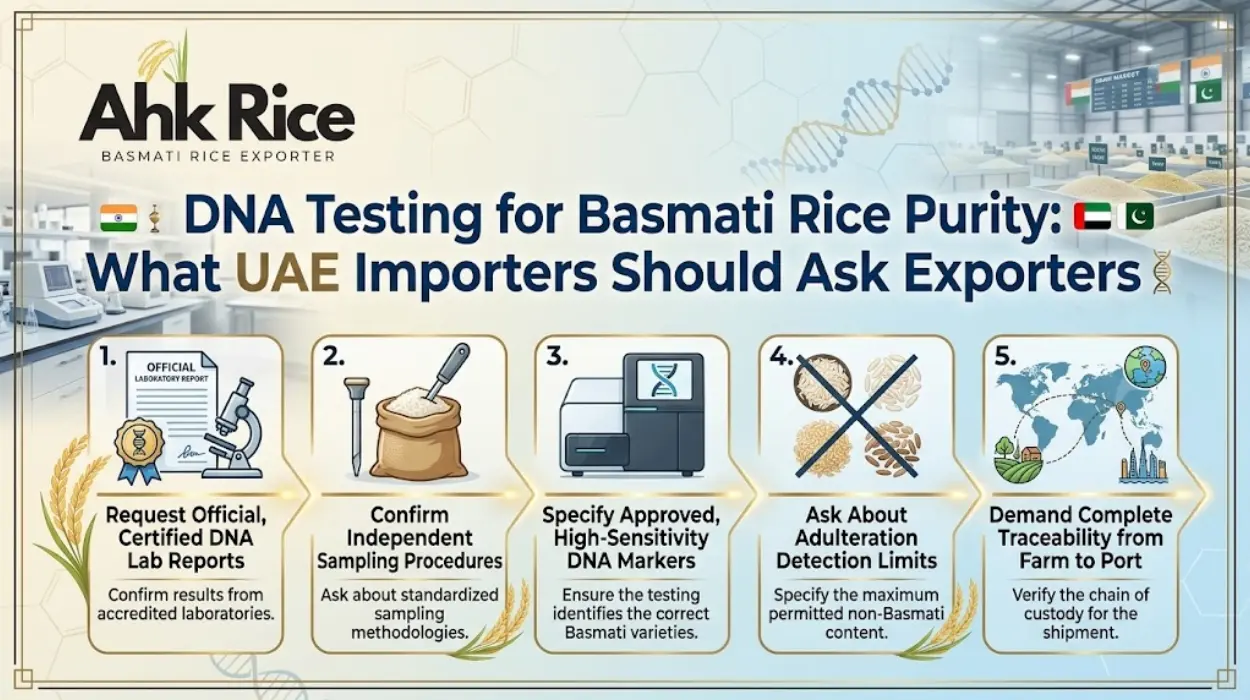
DNA Testing for Basmati Rice Purity: What UAE Importers Should Ask Exporters
DNA testing provides stronger evidence of rice variety identity than visual inspection alone, while the most reliable purchasing decision combines genetic testing, physical quality checks, laboratory analysis, and shipment documentation. UAE importers should select the verification method according to product claims, private-label requirements, and commercial risk.
Basmati rice purity matters because grain appearance, aroma, and length do not independently establish genetic identity. Importers evaluating Pakistani Basmati should first understand what Basmati rice purity means and how adulteration is detected, then assess which verification methods provide suitable evidence for their purchasing requirements. The educational link should point to the published TOFU article, “What Is Basmati Rice Purity and How Is Adulteration Detected?” Replace the homepage URL above with the article’s exact URL before publishing.
For UAE distributors, supermarket suppliers, wholesalers, and private-label brands, the central question is not simply whether a rice sample looks authentic. It is whether the supplier can demonstrate variety identity, meet agreed specifications, maintain batch consistency, and provide traceable records from sample approval through container dispatch. These checks help buyers distinguish premium Basmati positioning from unsupported product claims.
What solutions can UAE importers use to verify Basmati rice purity?
UAE importers can verify Basmati purity through DNA fingerprinting, physical grain inspection, cooking tests, and laboratory quality analysis. DNA testing identifies genetic characteristics, while the other methods assess appearance, cooking performance, and composition. Combining these checks provides stronger evidence than relying on any single test.
1. DNA fingerprinting
DNA fingerprinting examines genetic markers in rice samples to identify variety characteristics and detect certain non-Basmati admixtures. Simple Sequence Repeat (SSR) analysis uses differences in repeated DNA sequences to produce genetic profiles. Polymerase Chain Reaction (PCR) amplifies selected DNA regions so laboratories can detect and compare these markers.
A quantitative DNA test estimates the proportion of detectable adulterant rice when the method supports that measurement. Importers should request the tested variety, marker method, detection limits, reference varieties, and reported adulteration percentage. DNA methods have demonstrated their value in Basmati authentication research, although the result depends on the assay and the varieties included in its reference database.
2. Physical grain inspection
Physical inspection measures grain length, width, broken-grain percentage, chalkiness, colour, and visible foreign material. It helps buyers confirm whether a shipment matches its commercial specification, such as a long-grain 1121 grade or a selected Super Kernel grade.
Its main limitation is that unrelated rice varieties can share similar physical characteristics. A shipment can meet a grain-length specification without proving that every grain belongs to the declared variety. Physical inspection therefore complements DNA verification rather than replacing it.
3. Cooking and sensory tests
Cooking tests evaluate aroma, elongation, texture, grain separation, and consistency after preparation. These attributes matter to UAE retailers, restaurants, caterers, and private-label brands because they influence consumer experience.
A cooking test also helps buyers compare pre-shipment samples with their approved product. However, cooking performance alone cannot establish genetic purity. Water ratios, soaking time, cooking temperature, ageing, and processing affect the results.
4. General laboratory quality analysis
Laboratory analysis measures commercial and food-safety parameters such as moisture, broken grains, foreign matter, and other buyer-specified criteria. Depending on the contract and destination requirements, testing may also cover pesticide residues, heavy metals, or microbiological concerns where applicable.
These tests answer different questions from DNA analysis. A moisture result establishes a moisture measurement, not varietal identity. A residue report assesses specified contaminants, not whether the rice is authentic Basmati.
How do the available verification methods compare?
DNA fingerprinting provides the strongest direct evidence of genetic identity, while physical inspection and cooking tests verify commercial performance. General laboratory analysis addresses quality and safety parameters. Importers should combine methods according to the risk, grade, intended market, and claims printed on the retail package.
| Comparison attribute | DNA fingerprinting | Physical inspection | Cooking test | General laboratory analysis |
|---|---|---|---|---|
| Main purpose | Genetic identity and detectable admixtures | Grain appearance and grade | Aroma, elongation, texture | Moisture, defects, specified contaminants |
| Measures DNA | Yes | No | No | Only if a DNA assay is included |
| Detects certain non-Basmati admixtures | Yes, method-dependent | Not reliably | Not reliably | Not unless specifically designed |
| Measures broken-grain percentage | No | Yes | No | Yes, if included in the test scope |
| Confirms cooking performance | No | No | Yes | No |
| Identifies geographical origin | Not independently | No | No | Requires separate suitable evidence |
| Best purchasing use | Authenticity verification | Grade acceptance | Sample approval | Quality and safety compliance |
The methods work best as a coordinated verification plan. DNA analysis addresses authenticity, inspection checks the contracted grade, cooking tests confirm usability, and laboratory analysis checks the parameters specified in the purchase agreement. No single report automatically establishes every aspect of product quality.
Which Basmati verification method works best for UAE importers?
The best method depends on the purchase risk. DNA testing suits premium Basmati sold with explicit variety claims, while physical and cooking checks support routine grade acceptance. Large private-label contracts benefit from all three, supported by relevant laboratory reports and documented batch traceability.
Premium 1121 Basmati
DNA testing is valuable when a buyer pays a premium for a declared 1121 variety and needs evidence beyond long-grain appearance. Pair the test with grain-length measurements, broken-grain limits, moisture results, and a cooking assessment.
Super Kernel Basmati
Distributors serving established South Asian grocery channels should assess aroma, grain uniformity, purity claims, and cooking performance. DNA verification is particularly useful when the retail positioning depends on the declared variety.
1509 Basmati
Buyers targeting value-conscious retail or foodservice should compare the agreed grade, yield, cooking performance, and price. DNA testing remains relevant when the contract specifies 1509 identity, even when price competitiveness drives the purchase.
What should UAE importers ask Pakistani rice exporters before ordering?
Importers should ask exporters which variety was tested, which laboratory performed the analysis, which DNA method was used, and whether the tested sample represents the shipment batch. They should also establish acceptance limits, sample-retention procedures, report validity, and responsibility for resolving failed results.
Use these questions during supplier evaluation:
- Which variety is declared? Confirm whether the product is 1121, Super Kernel, or 1509 and record the processing type, such as white, steam, or parboiled.
- Which DNA method was used? Request the method name, marker panel, and explanation of what the assay can and cannot distinguish.
- Does the report quantify admixture? A statement that a sample was tested is not equivalent to a quantified purity result.
- Who tested the sample? Request the laboratory’s identity, relevant accreditation scope, report number, sample identification, and test date.
- How is the batch connected to the sample? Match the sample reference to the production lot, packing records, inspection documents, and shipment identification.
- What happens if the shipment fails? Agree on retesting, independent inspection, acceptance thresholds, and contractual remedies before dispatch.
These questions turn a general authenticity claim into a verifiable procurement process. Buyers should also check whether the chosen laboratory’s method covers the particular variety and any likely substitute varieties. A certificate is only as useful as its scope and the connection between the tested sample and the delivered goods.
How do UAE and other regional markets differ in Basmati verification requirements?
UAE buyers commonly balance premium retail authenticity, wholesale pricing, foodservice performance, and reliable re-export documentation. European buyers often place additional emphasis on formal authenticity protocols and market-specific controls. Both markets benefit from DNA testing, but importers must match the testing plan to their destination and customer requirements.
UAE market: retail, wholesale, and foodservice
UAE distributors supply supermarkets, ethnic grocery stores, restaurants, catering companies, and re-export businesses. Premium retail brands benefit from documented variety identity and consistent grain quality. Wholesale buyers often prioritise a combination of price, grade, broken-grain percentage, moisture, and repeatable cooking performance.
For a private-label launch, buyers should approve a representative sample, record the DNA and quality specifications, and establish how the commercial shipment will be checked against the approved reference. Packaging claims must match the evidence available for the product. Importers should also confirm the applicable UAE food import, labelling, and documentation requirements with their importer or regulatory adviser.
European market: formal authenticity and traceability
European importers may operate under buyer protocols that refer to recognised Basmati authenticity methods and market-specific controls. The European Code of Practice for Basmati Rice provides a useful reference for understanding variety authenticity and permitted Basmati claims.
A UAE buyer supplying European customers should therefore consider the requirements of the final destination, not just the rules for the first point of entry. A DNA report suitable for one purchasing specification does not automatically satisfy every other buyer’s protocol or regulatory requirement.
How do prices per metric ton and shelf life compare across markets?
Price per metric ton depends on variety, processing, grade, packaging, quantity, shipment terms, and destination. Shelf life depends on the product, packaging, storage conditions, and declared best-before period. Buyers should compare equivalent quotations and documented shelf-life specifications rather than assume that DNA verification determines price or storage life.
Indicative commercial comparison
The following table is a procurement comparison, not a live market quotation. The figures for DNA testing should be requested directly from laboratories, while rice prices should be confirmed against current exporter quotations.
| Purchasing factor | UAE import programme | European import programme |
|---|---|---|
| Price per MT | Request current FOB Karachi or CIF UAE quotation | Request current FOB Karachi or CIF destination quotation |
| Premium 1121 | Compare grain specifications, processing, and authenticity evidence | Compare equivalent specifications and any required authenticity protocol |
| Super Kernel | Compare aroma, grade, broken grains, and batch consistency | Compare grade, authenticity evidence, and customer specifications |
| 1509 | Assess price competitiveness and contracted variety identity | Assess price against equivalent grade and destination requirements |
| DNA testing cost | Obtain a laboratory quote for the sample and test scope | Obtain a quote for the destination-required method and reporting |
| Shelf life | Use the product-specific declared period and storage instructions | Use the product-specific declared period and destination requirements |
Do not compare an unverified FOB price with a DNA-tested CIF price as if the difference reflects the testing cost. FOB excludes the main ocean freight and destination charges paid by the buyer, whereas CIF includes freight and insurance to the named destination port under the agreed Incoterms. Compare the same variety, processing type, packing weight, quantity, testing scope, and Incoterm.
Shelf-life comparison
Shelf life is not determined by a DNA purity certificate. White, steam, and parboiled rice can have different product specifications, and packaging materials and storage conditions influence product stability.
For both UAE and European shipments, buyers should request the manufacturer’s declared shelf life, production or packing date, best-before date, storage instructions, and minimum remaining shelf life required on arrival. UAE warehouses and transport facilities must manage heat and humidity exposure carefully. European importers must likewise maintain suitable dry storage and comply with the product’s stated conditions.
For private-label orders, the purchase contract should define the minimum remaining shelf life at delivery. It should also specify how the exporter documents packing dates, lot numbers, and any agreed storage or handling conditions. These controls protect stock rotation and customer confidence more directly than DNA testing alone.
What are the advantages and limitations of DNA verification?
DNA verification strengthens evidence of variety identity and can reveal certain non-Basmati admixtures, but it does not establish every quality attribute or geographical origin. Its value depends on assay coverage, sample representativeness, and the accuracy of the reference database. Physical and laboratory checks remain necessary.
| Method | Advantages | Limitations | Example |
|---|---|---|---|
| DNA fingerprinting | Genetic evidence; can identify certain adulterants | Assay-specific; needs representative sampling | Checking a declared 1121 shipment |
| Physical inspection | Fast, practical, and useful for grading | Similar-looking varieties can be confused | Measuring grain length and broken grains |
| Cooking test | Evaluates consumer-facing performance | Results vary with cooking conditions | Comparing a private-label sample with an approved sample |
| General laboratory testing | Measures specified quality or safety parameters | Does not prove varietal identity unless DNA testing is included | Checking moisture or pesticide residues |
DNA testing also has technical limitations. A bulk sample can contain multiple varieties, and some complex mixtures require additional single-grain analysis to identify the admixtures accurately. Research published in 2022 examined this issue using selected individual grains from complex Basmati samples.
Importers should therefore ask whether a routine bulk-sample method is sufficient for their risk level. If results show an unexpected genetic profile, the contract should specify how the sample will be retested and who will authorise the final decision.
What five factors should determine the supplier decision?
Choose a supplier using five factors: authenticity evidence, specification compliance, traceability, commercial value, and shipment accountability. A low quotation alone does not establish value. The strongest offer matches the buyer’s grade and verification requirements while providing clear records and an agreed process for resolving discrepancies.
| Decision factor | What to evaluate | Evidence to request | Decision rule |
|---|---|---|---|
| 1. Authenticity | Declared variety and DNA method | DNA report and method scope | Reject unsupported purity claims |
| 2. Grade | Length, broken grains, moisture, processing | Specification sheet and inspection report | Accept only within agreed limits |
| 3. Traceability | Sample-to-batch relationship | Lot ID, packing records, sample reference | Require clear batch identification |
| 4. Commercial value | Price, packing, freight, and test costs | Comparable quotation by Incoterm | Compare equivalent delivered or FOB costs |
| 5. Accountability | Failed-test procedure and shipment controls | Contract clauses and inspection arrangements | Agree on retesting and remedies before dispatch |
How should importers implement these checks?
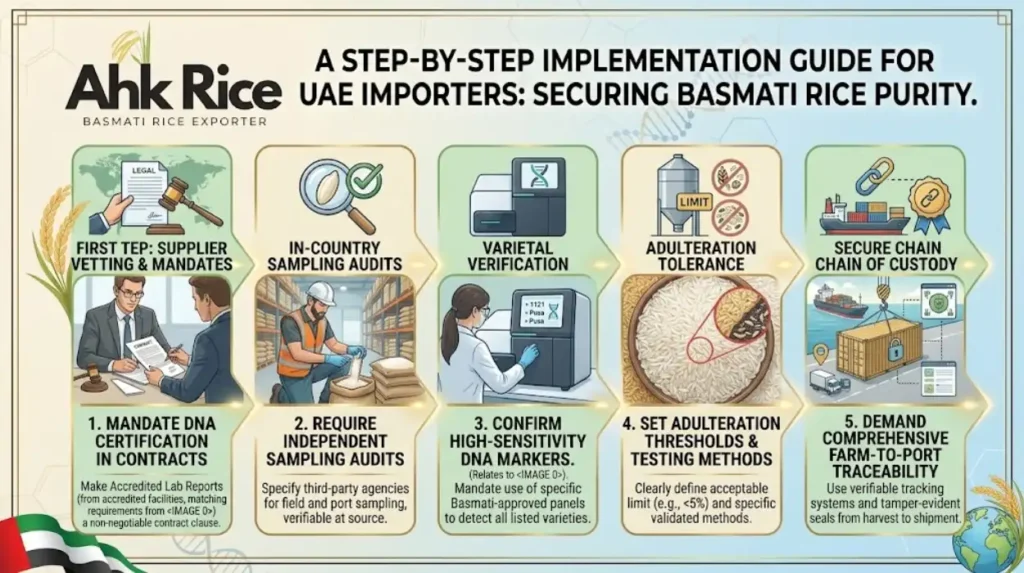
Start by defining the exact variety, processing type, grade, packaging, and purity claim. Request a representative commercial sample and relevant laboratory reports. Approve the sample against written specifications, then agree on pre-shipment inspection and batch traceability.
For repeat orders, retain the approved sample reference and compare each shipment against the same criteria. Escalate material differences through the agreed independent testing or inspection process. This system reduces disputes because both parties work from documented acceptance conditions rather than subjective expectations.
DNA testing gives UAE importers a stronger way to assess Basmati variety identity, but it works best as part of a broader quality assurance programme. Buyers should combine genetic verification with physical inspection, cooking tests, laboratory analysis, and traceable batch records. This approach supports more consistent purchasing decisions across 1121, Super Kernel, and 1509 Basmati rice.
AHK Rice is a Pakistani Basmati rice exporter based in Punjab, supplying these varieties to international markets with processing, custom packaging, and export coordination. Importers evaluating suppliers should establish their required variety, specifications, testing scope, and acceptance criteria before approving a commercial shipment.
For buyers ready to move from evaluation to supplier selection, the next step is to review how to buy DNA-verified pure Pakistani Basmati rice for UAE private-label brands and define the evidence required before placing an order.
Frequently asked questions
Can DNA testing prove that Pakistani Basmati rice is 100% pure?
DNA testing can identify genetic profiles and detect certain non-Basmati admixtures within the method’s scope. A claim of 100% purity requires a defined acceptance criterion, a suitable validated method, and representative sampling. Buyers should review the report’s detection limits before accepting the claim.
Is a DNA certificate enough to approve a Basmati rice shipment?
No. A DNA certificate supports variety authenticity, but it does not establish moisture, broken-grain percentage, pesticide residue compliance, cooking performance, or shipment condition. Importers should combine DNA verification with relevant quality tests, inspection, and traceability documents.
Which DNA method should UAE importers request?
Importers should request a validated DNA fingerprinting method, such as an appropriate SSR-PCR assay, that covers the declared variety and relevant potential adulterants. The laboratory should explain its reference database, detection capability, and whether it can quantify admixture.
Should importers DNA-test every shipment?
The decision depends on the contract, supplier history, risk assessment, and private-label claims. Buyers can establish a risk-based testing schedule, with stronger verification for new suppliers, premium products, disputed batches, and significant changes in sourcing or processing. Contractual or regulatory requirements take priority over a general sampling schedule.
Does DNA testing increase the shelf life of Basmati rice?
No. DNA testing verifies genetic characteristics, not storage stability. Shelf life depends on the rice product, packaging, moisture control, storage conditions, and declared product specification. Importers should request documented shelf-life information and specify the minimum remaining period required at delivery.
What documents should UAE importers request from a Pakistani rice exporter?
Request a product specification sheet, relevant DNA report, quality analysis, packing details, batch identification, sample approval record, and applicable export and food-safety documentation. Confirm additional documents with the importer, freight forwarder, and relevant UAE authorities according to the shipment and product requirements.