Why Do Welsh Buyers Value Export Documentation Accuracy?
Welsh buyers value export documentation accuracy because accurate documents reduce customs delays, prevent compliance issues, and protect supply chain continuity. Here is why: importers in Wales depend on correct certificates, shipping records, and product specifications to clear goods efficiently, meet UK regulations, and maintain predictable inventory planning.
What Is Export Documentation Accuracy?
Export documentation accuracy means all trade documents contain correct product, shipment, certification, and compliance information without discrepancies.
Export documentation refers to the records used during international trade. These records identify the product, exporter, importer, shipment details, quality standards, and regulatory compliance status.
Documentation accuracy ensures that every document contains matching information. Product descriptions, HS codes, weights, quantities, certificate numbers, and consignee details must remain consistent across all records.
Welsh importers rely on accurate documentation because UK customs authorities verify shipment information before cargo clearance. A mismatch creates delays, inspections, and additional costs.
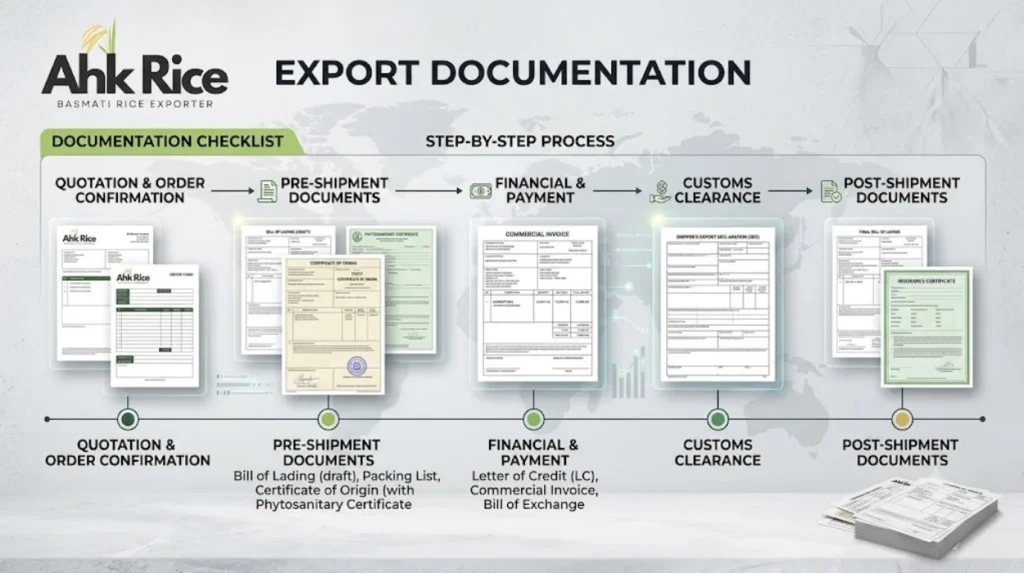
Common export documents include:
- Commercial Invoice
- Packing List
- Bill of Lading
- Certificate of Origin
- Phytosanitary Certificate
- Health Certificate
- Insurance Certificate
- Fumigation Certificate
Documentation forms the foundation of international trade. Understanding its role leads directly to understanding how documentation works throughout the export process.
How Does Export Documentation Work During International Trade?
Documentation works by recording, verifying, certifying, and tracking every stage of an international shipment.
International trade involves multiple stakeholders. Exporters, freight forwarders, shipping lines, customs authorities, inspection agencies, and importers use the same document set.
How Are Documents Created and Verified?
Exporters prepare commercial documents first. These documents describe the cargo and transaction details.
Quality inspectors verify product specifications. Government agencies certify regulatory compliance.
Shipping companies issue transport documents after loading cargo. Customs authorities review documents before export clearance.
A typical workflow follows these steps:
- Prepare the commercial invoice
- Prepare the packing list
- Inspect the cargo
- Issue quality certificates
- Obtain regulatory certificates
- Load the container
- Issue the bill of lading
- Clear export customs
- Dispatch shipment documents
Each document supports another document. Consistency across all records prevents clearance issues.
Documentation workflow explains the process. The next question concerns the specific components Welsh buyers examine most closely.
What Are the Key Components Welsh Buyers Check?
Product descriptions, HS codes, origin certificates, health certificates, and shipment records receive the highest level of scrutiny.
Welsh buyers operate within the UK’s import framework. Compliance requirements demand detailed verification of imported goods.
Product Description Accuracy
Product descriptions must match the actual cargo. Rice varieties, grades, packaging formats, and weights require precise identification.
A shipment declared as 1121 Steam Basmati must match inspection reports, packing records, and certificates.
HS Code Accuracy
HS codes classify products for customs purposes.
Incorrect codes affect duties, import procedures, and customs processing.
Accurate classification helps authorities process cargo efficiently.
Certificate of Origin
Certificate of Origin documents confirm the exporting country.
Importers use origin verification to satisfy regulatory requirements and procurement policies.
Phytosanitary and Health Certificates
Agricultural products require health-related documentation.
Authorities inspect certificates to confirm compliance with import regulations.
Transport Documentation
Bills of lading confirm cargo ownership and shipment details.
Transport records verify:
- Container numbers
- Vessel details
- Departure ports
- Arrival ports
- Shipment dates
These components support compliance and logistics performance. Their value becomes clearer when examining the benefits accurate documentation delivers.
What Benefits Does Accurate Export Documentation Provide?
Faster customs clearance, lower costs, improved compliance, better traceability, and stronger supply chain reliability are the primary benefits.
Accurate documentation creates operational efficiency.
Faster Customs Clearance
Customs officers process complete documentation more quickly.
Reduced inspections shorten cargo release times.
Faster clearance supports inventory planning.
Lower Financial Risk
Documentation errors generate correction fees.
Incorrect records create storage charges and demurrage costs.
Accurate documentation reduces avoidable expenses.
Improved Regulatory Compliance
UK import regulations require documented compliance.
Accurate records demonstrate conformity with official requirements.
Importers reduce audit risks through complete documentation.
Better Product Traceability
Traceability identifies product origins and processing history.
Food importers increasingly require detailed traceability systems.
Traceability supports quality assurance and consumer confidence.
Stronger Supplier Relationships
Reliable documentation demonstrates operational competence.
Importers prefer suppliers that consistently provide complete records.
Documentation performance often influences long-term procurement decisions.
These benefits explain why documentation matters operationally. The next question explores where Welsh buyers apply these requirements most frequently.
Where Do Welsh Buyers Use Documentation Accuracy Most?
Food imports, agricultural products, retail supply chains, wholesale distribution, and public procurement programs depend heavily on documentation accuracy.
Different industries apply documentation requirements differently.
Food Import Operations
Food products face strict regulatory oversight.
Documentation verifies product identity, origin, and compliance status.
Importers use records to maintain food safety standards.
Agricultural Commodity Imports
Agricultural products require phytosanitary verification.
Authorities inspect certificates before cargo entry.
Accurate records support uninterrupted trade flows.
Retail Distribution Networks
Retail supply chains depend on predictable inventory movement.
Documentation delays affect warehouse planning and stock availability.
Accurate records support delivery schedules.
Wholesale Procurement
Wholesalers source products from multiple countries.
Consistent documentation simplifies supplier management.
Standardized records improve procurement efficiency.
Government and Institutional Procurement
Public organizations often require documented traceability.
Compliance verification supports purchasing transparency.
Documentation requirements remain strict throughout procurement cycles.
These use cases demonstrate practical importance. The next section addresses common misconceptions surrounding export documentation.
What Common Problems and Misconceptions Exist About Export Documentation?
Many buyers assume documentation is administrative paperwork, but documentation directly affects customs clearance, compliance, costs, and supply chain performance.
Several misconceptions persist within international trade.
Misconception: Documents Only Matter at Customs
Documentation influences the entire supply chain.
Importers use records for inventory control, auditing, procurement, and quality verification.
Customs clearance represents only one function.
Misconception: Minor Errors Have No Impact
Minor discrepancies create significant problems.
Differences in product weight, packaging details, or certificate numbers trigger additional reviews.
Correction procedures consume time and resources.
Misconception: Digital Systems Eliminate Errors
Digital platforms improve efficiency.
Human review remains essential.
Accurate data entry determines document quality.
Misconception: Documentation Is the Freight Forwarder’s Responsibility
Documentation accuracy requires cooperation.
Exporters, inspectors, logistics providers, and importers contribute information.
Every stakeholder influences document quality.
Misconception: Compliance Ends After Cargo Arrival
Importers retain records after delivery.
Audits, inspections, and regulatory reviews often require historical documentation.
Record retention remains a critical compliance requirement.
Understanding these challenges helps buyers evaluate suppliers more effectively. The final topic examines why documentation expertise strengthens international rice imports specifically.
Why Is Documentation Expertise Important for International Rice Imports?
Documentation expertise improves compliance, traceability, shipment visibility, and customs efficiency throughout rice import operations.
Rice imports involve agricultural regulations, quality verification, and origin documentation.
Rice shipments typically require multiple certificates. Importers verify grain specifications, origin information, health status, and transport records before cargo acceptance.
Documentation expertise reduces processing delays. Accurate records help authorities inspect shipments efficiently.
Documentation expertise also supports traceability. Importers can track rice from cultivation and harvesting through milling, grading, loading, shipping, and delivery.
Understanding documentation requirements helps buyers assess supplier reliability. Readers who want to explore this topic in greater detail should continue with the article discussing how experienced documentation management improves international rice purchasing decisions.
Frequently Asked Questions
Why do Welsh importers require accurate export documentation?
Welsh importers require accurate documentation to meet UK import regulations, reduce customs delays, and verify product compliance.
Which export document is most important for customs clearance?
The commercial invoice, bill of lading, certificate of origin, and regulatory certificates collectively support customs clearance.
How do documentation errors affect import costs?
Documentation errors create storage charges, amendment fees, inspection costs, and shipment delays.
Why is traceability important in rice imports?
Traceability identifies product origin, processing history, certification status, and supply chain movement.
What certificates are commonly required for rice imports?
Common certificates include the Certificate of Origin, Phytosanitary Certificate, Fumigation Certificate, Health Certificate, and quality inspection reports.
How does documentation expertise improve international trade?
Documentation expertise improves compliance management, customs efficiency, shipment visibility, and supply chain reliability.