Jute, Non-Woven, BOPP and Zipper Pouch Bags: Choosing Retail and Bulk Rice Packaging
BOPP laminated woven polypropylene bags offer the strongest balance of print quality, moisture resistance, and durability for many retail and bulk rice applications, while zipper pouches suit premium small packs, jute supports natural positioning, and non-woven bags serve reusable packaging needs. The right choice depends on rice grade, pack weight, destination market, storage conditions, and total packaging cost.
Rice packaging affects product protection, shelf presentation, transportation efficiency, and customer convenience. Importers, wholesalers, supermarket suppliers, and private-label brands must compare packaging materials before confirming an order. A bag that performs well on a retail shelf may not provide the best cost per tonne for a bulk shipment.
For a broader understanding of rice packaging materials, barrier properties, and packaging formats, read this educational guide to rice packaging options and their practical applications. This foundation helps buyers distinguish between material appearance, actual protective performance, and the requirements of their target market.
What packaging solutions are available for retail and bulk rice?
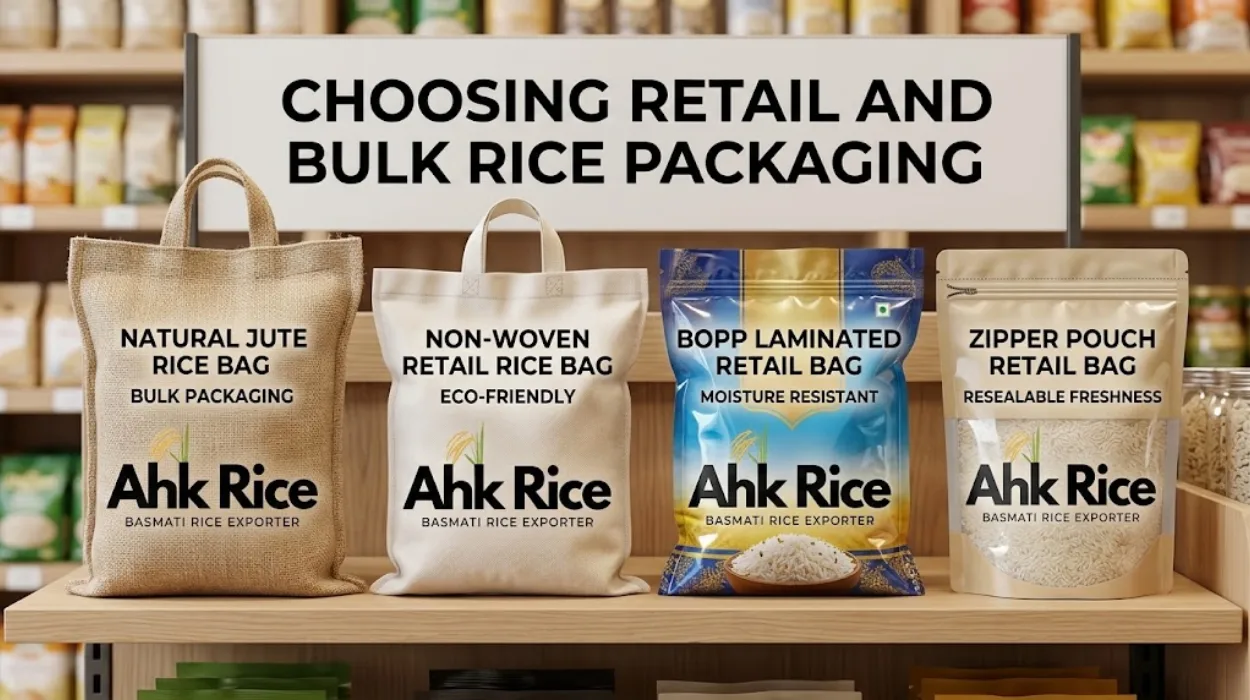
Rice buyers can choose jute sacks, non-woven polypropylene bags, BOPP laminated woven bags, and flexible zipper pouches. Each format serves a different combination of weight, presentation, protection, and reuse. Material selection must match the product, distribution channel, and expected storage conditions.
What are jute rice bags?
Jute bags are made from natural plant fibres and provide a textured, traditional appearance. They suit specialty rice brands, gift packs, and retailers that want a natural visual identity. Their woven structure provides ventilation, but untreated jute offers limited resistance to moisture and contamination.
A food-grade inner liner improves separation between rice and the outer material. However, the liner adds cost and does not eliminate the need for dry storage. Jute is less suitable for environments with high humidity unless the complete packaging system provides adequate protection.
What are non-woven rice bags?
Non-woven bags commonly use polypropylene fibres bonded into a fabric-like sheet rather than woven into a conventional textile. They support colourful printing, lightweight construction, and reusable shopping applications. Retailers often use them for promotional rice packs or packaging designed for repeated handling.
Their performance depends on fabric weight, seam strength, handle construction, and any inner liner. Standard non-woven material does not automatically provide a hermetic seal or a strong moisture barrier. Buyers must confirm food-contact suitability and the actual protective properties of the finished bag.
What are BOPP laminated woven rice bags?
BOPP stands for biaxially oriented polypropylene, a film stretched in two directions to improve strength and optical properties. In rice packaging, printed BOPP film is laminated to woven polypropylene fabric, combining a high-quality printed surface with a strong outer structure.
These bags support detailed product graphics, brand colours, product specifications, and handling information. Their woven construction withstands demanding transport, while the laminate improves resistance to surface moisture and abrasion. Actual protection depends on the laminate, seams, closure, and any additional liner.
What are zipper pouch rice bags?
Zipper pouches are flexible packs with a resealable closure. They commonly use multilayer plastic films designed to provide selected moisture, oxygen, and aroma barriers. They suit premium retail products, specialty rice, and smaller household quantities.
The zipper allows consumers to close the pack after opening, but it does not replace the original heat seal. Film composition, zipper quality, seal width, and pack dimensions determine performance. Buyers should also consider the higher packaging cost per kilogram compared with larger woven sacks.
How do different rice packaging methods compare?
The four formats differ in durability, printing, moisture protection, resealability, and cost per packed kilogram. BOPP woven bags usually suit high-volume distribution, zipper pouches support premium small packs, jute offers traditional presentation, and non-woven bags favour reusable retail applications.
| Comparison attribute | Jute bags | Non-woven bags | BOPP woven bags | Zipper pouches |
|---|---|---|---|---|
| Main material | Natural jute fibre | Bonded polypropylene fibres | Woven polypropylene with BOPP film | Flexible multilayer film |
| Typical use | Specialty retail and gift packs | Promotional and reusable retail packs | Retail, wholesale, and bulk rice | Premium small retail packs |
| Common pack sizes | 1–10 kg, depending on construction | 1–10 kg, depending on strength | 5–50 kg | 250 g–5 kg |
| Print quality | Rustic, limited detail | Moderate to high | High-resolution graphics | High-resolution graphics |
| Moisture protection | Low without a suitable liner | Low without a suitable liner | Good surface protection; depends on construction | Potentially high with suitable barrier film |
| Resealability | Requires a separate closure | Requires a separate closure | Usually requires a separate closure | Built-in resealable zipper |
| Relative packaging cost | Medium to high | Low to medium | Low to medium at scale | Medium to high per kilogram |
These are general comparisons, not universal specifications. Suppliers can manufacture different weights, liners, closures, and barrier structures. Buyers should request samples and technical specifications before treating a packaging format as suitable for a particular rice grade or export destination.
Which packaging method works best for different rice grades?
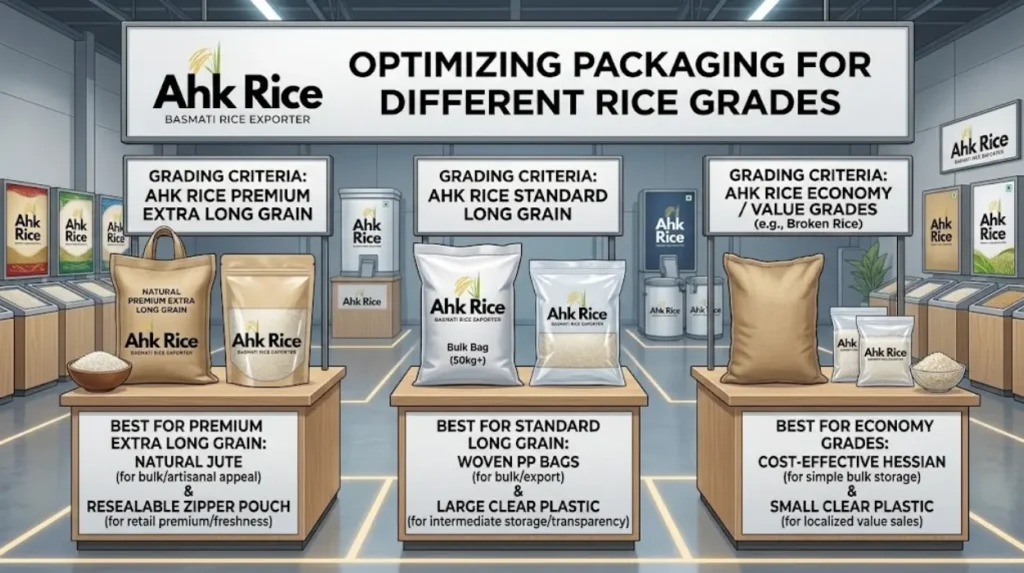
Packaging should reflect the rice variety, selling price, expected handling, and consumer use. Premium long-grain Basmati benefits from clear product presentation, while high-volume wholesale rice requires strong seams and efficient stacking. The best format protects product quality without adding unnecessary cost.
How should buyers package 1121 Basmati rice?
1121 Basmati is valued for its long grain, aroma, and cooked elongation. Premium retailers can use zipper pouches for smaller specialty packs and printed BOPP bags for larger retail formats. The printed surface helps communicate the variety, origin, cooking instructions, and brand identity.
For wholesale and foodservice shipments, woven bags in suitable weights provide a practical balance of strength and cost. Packaging specifications should identify the exact rice grade, pack weight, closure, and required food-contact compliance. Product claims must match the actual specification and supporting documentation.
Which bags suit Super Kernel Basmati?
Super Kernel Basmati serves ethnic grocery stores, distributors, and household consumers who value aroma and familiar cooking characteristics. BOPP laminated woven bags suit 5 kg, 10 kg, and larger retail or wholesale formats. Smaller zipper pouches work for premium trial packs and speciality product ranges.
AHK Rice supplies Pakistani Basmati varieties, including 1121, Super Kernel, and 1509, with packaging options determined by buyer requirements and shipment specifications. Buyers can review Basmati rice varieties and export supply options when comparing product grades with their packaging plans.
How should buyers package 1509 Basmati rice?
1509 Basmati appeals to buyers balancing long-grain presentation with purchasing efficiency. BOPP woven bags suit wholesale distribution, restaurants, catering businesses, and supermarket packs. Smaller flexible pouches serve retail channels that sell trial quantities or premium convenience packs.
For parboiled 1509, packaging must also suit the product’s handling and storage requirements. The bag should remain intact during stacking, loading, and distribution. Buyers should verify moisture limits, closure integrity, and the agreed grade before approving production.
What are the packaging requirements in the Gulf and North American markets?
Gulf buyers often need durable, clearly labelled packs for supermarkets, wholesalers, restaurants, and re-export channels. North American buyers place additional emphasis on retail presentation, traceability, food-contact compliance, and applicable labelling rules. Both markets require packaging decisions that reflect the importer’s actual distribution model.
Which packaging works best in the UAE and wider Gulf?
In the UAE and neighbouring Gulf markets, BOPP woven bags are practical for 5 kg, 10 kg, 25 kg, and 50 kg rice shipments. These sizes serve supermarkets, ethnic retailers, wholesale distributors, and foodservice operators. Printed graphics support brand recognition in competitive retail environments.
Zipper pouches fit premium small packs, while jute works for selected gift or speciality products. Arabic and English labelling may be required according to the product and applicable local rules. Importers should confirm label content, net weight, origin, dates, storage instructions, and relevant conformity requirements with their importer or regulatory adviser.
Which packaging works best in the USA and Canada?
BOPP woven bags suit bulk distribution and larger retail formats, while multilayer zipper pouches support smaller premium products. Private-label buyers can specify artwork, product identity, net quantity, country of origin, and other required label information. The final packaging must comply with applicable destination-country requirements.
US importers should assess FDA food-contact requirements and applicable food labelling rules. Canadian importers must check relevant Canadian food packaging and labelling requirements. A supplier’s general claim that a bag is food-grade does not replace the documentation needed to establish suitability for the intended use.
How should shelf life affect the choice?
Shelf life depends on rice moisture, initial quality, storage temperature, humidity, pests, and the complete packaging system. A well-selected barrier pack helps preserve quality, but no bag guarantees a fixed shelf life under every condition. Buyers should evaluate packaging alongside storage and stock-rotation procedures.
| Packaging format | General shelf-life considerations | Main limitation |
|---|---|---|
| Jute | Requires dry storage and often a suitable inner liner | Moisture and pest exposure through openings or unsuitable construction |
| Non-woven | Needs an appropriate liner or barrier layer for demanding conditions | The fabric itself may provide limited moisture protection |
| BOPP woven | Suitable for many dry-rice applications when laminate and closures are properly specified | Performance varies with seams, closures, and barrier design |
| Zipper pouch | Multilayer barrier films can protect smaller packs; the original heat seal is important | Zipper and seal quality must be verified |
Do not assign shelf-life periods based solely on the outer bag material. Establish the product’s validated shelf life through appropriate quality controls, storage conditions, and packaging assessment.
How do packaging costs compare per metric tonne?
Packaging cost per metric tonne depends on bag size, material weight, print coverage, order volume, liner requirements, closure type, and manufacturing location. Large woven bags usually achieve lower packaging cost per kilogram, while zipper pouches carry a higher unit cost because they use more specialised film and closures.
The following figures are illustrative planning ranges in US dollars, not supplier quotations or verified current market prices. Actual quotations vary by specification and order quantity.
| Packaging format | Illustrative cost per bag | Example pack size | Illustrative packaging cost per MT |
|---|---|---|---|
| Jute bag | $0.40–$1.20 | 10 kg | $40–$120 |
| Non-woven bag | $0.20–$0.70 | 5 kg | $40–$140 |
| BOPP woven bag | $0.15–$0.45 | 25 kg | $6–$18 |
| Zipper pouch | $0.08–$0.25 | 1 kg | $80–$250 |
These ranges use example bag prices and weights to demonstrate the calculation. They exclude rice, filling, palletisation, freight, duties, and other export costs. They also do not represent equivalent packaging specifications: a premium laminated bag and a basic woven sack provide different levels of presentation and protection.
To calculate packaging cost per metric tonne, divide the bag price by the kilograms per bag and multiply by 1,000. For example, a $0.30 bag holding 25 kg costs $12 per metric tonne in packaging. This calculation helps buyers compare alternatives on a consistent basis.
What are the advantages and disadvantages of each packaging method?
No packaging format wins in every category. Jute offers a natural appearance but needs protection against moisture; non-woven bags support reuse but require careful barrier design; BOPP woven bags balance strength and print quality; zipper pouches provide convenience at a higher cost per kilogram.
Jute bags: Their natural texture differentiates speciality products and gift packs. Their disadvantages include higher cost in some specifications, limited moisture protection without a liner, and less efficient premium printing.
Non-woven bags: Their lightweight construction and reusable design suit promotional retail applications. Their disadvantages include variable seam strength and limited barrier performance unless additional layers are incorporated.
BOPP woven bags: Their key strengths are durable construction, strong graphics, and efficient packaging economics at scale. Their disadvantages include limited resealability in standard designs and the need to assess multilayer material recovery where recycling is available.
Zipper pouches: Their advantages include resealability, attractive shelf presentation, and the ability to use tailored barrier films. Their disadvantages include higher packaging cost per kilogram, more specialised manufacturing, and additional material complexity.
How should importers select the right rice packaging?
Importers should compare product value, pack size, moisture protection, distribution conditions, branding needs, and total landed cost before selecting a bag. A written specification prevents misunderstandings between the rice supplier, packaging manufacturer, importer, and retailer.
The following five-row decision framework connects common business requirements with practical packaging choices.
| Decision factor | Buyer requirement | Preferred starting point | Reason |
|---|---|---|---|
| Lowest cost at high volume | Wholesale or foodservice distribution | BOPP woven or suitable woven bags | Efficient cost per kilogram and robust handling |
| Premium shelf presentation | Branded retail rice | BOPP woven bags or zipper pouches | High-quality printing and clear product communication |
| Natural visual identity | Gift packs or speciality retail | Jute with an appropriate food-contact liner | Distinctive natural appearance |
| Reusable promotional packaging | Retail campaigns and shopping use | Non-woven bags with suitable inner packaging | Lightweight construction and reuse potential |
| Small packs and resealing | Household convenience | Zipper pouches | Convenient closure after opening |
After choosing the format, confirm bag dimensions, material composition, film or fabric thickness, safe working load, closure type, printing artwork, food-contact documentation, and packing quantity. Request a physical sample or approved pre-production sample when the order depends on specific appearance or performance.
What should buyers confirm before placing a custom rice packaging order?
Buyers should finalise the rice variety, grade, pack weight, packaging material, artwork, labelling, quantity, and destination requirements before production. Written approval of the specification reduces rework and helps ensure that the delivered packaging matches the intended retail or wholesale application.
The order specification should also state whether the rice is raw, steamed, or parboiled; the required grain grade; the packaging format; and the closure method. Export buyers should coordinate the bag specification with the shipment plan, including carton or pallet requirements where applicable, container loading, and destination labelling.
AHK Rice provides Pakistani Basmati rice varieties with packaging arrangements tailored to buyer requirements. Importers should submit their target market, product variety, bag size, artwork, and estimated order volume to obtain a specification-based quotation. Final pricing depends on the confirmed rice grade, packaging design, quantity, and agreed trade terms.
Frequently asked questions
Which rice packaging bag is best for wholesale orders?
BOPP laminated woven bags are a strong starting point for wholesale rice because they combine durable construction, printed branding, and competitive packaging cost at scale. The final choice depends on bag weight, stacking conditions, required barrier performance, and destination requirements.
Are zipper pouches suitable for Basmati rice?
Yes. Zipper pouches suit small retail packs of Basmati rice, particularly when resealability and premium presentation matter. Buyers should specify a suitable food-contact film, barrier properties, and a reliable heat seal for the original unopened pack.
Do jute bags keep rice fresh?
Jute bags provide a natural outer appearance but do not automatically deliver strong moisture protection. A suitable food-contact liner, controlled rice moisture, clean storage, and effective closure help protect product quality.
Which packaging is most economical per metric tonne?
Large woven bags generally provide lower packaging cost per metric tonne than small zipper pouches. Buyers should calculate cost using the actual bag price and net weight, then include printing, liners, filling, handling, and other relevant expenses.
Can rice exporters provide custom-printed packaging?
Yes. Exporters and packaging suppliers can arrange custom-printed bags with brand artwork, product names, net weight, origin information, and other required details. Buyers should approve the final artwork and compliance requirements before mass production.
What information is needed for a packaging quotation?
Provide the rice variety, grade, pack sizes, packaging material, order quantity, destination country, artwork requirements, and preferred shipping terms. Include any liner, closure, certification, and labelling requirements to make quotations easier to compare.