What Is Pakistani Basmati Rice and How Is It Different from Indonesian Beras?
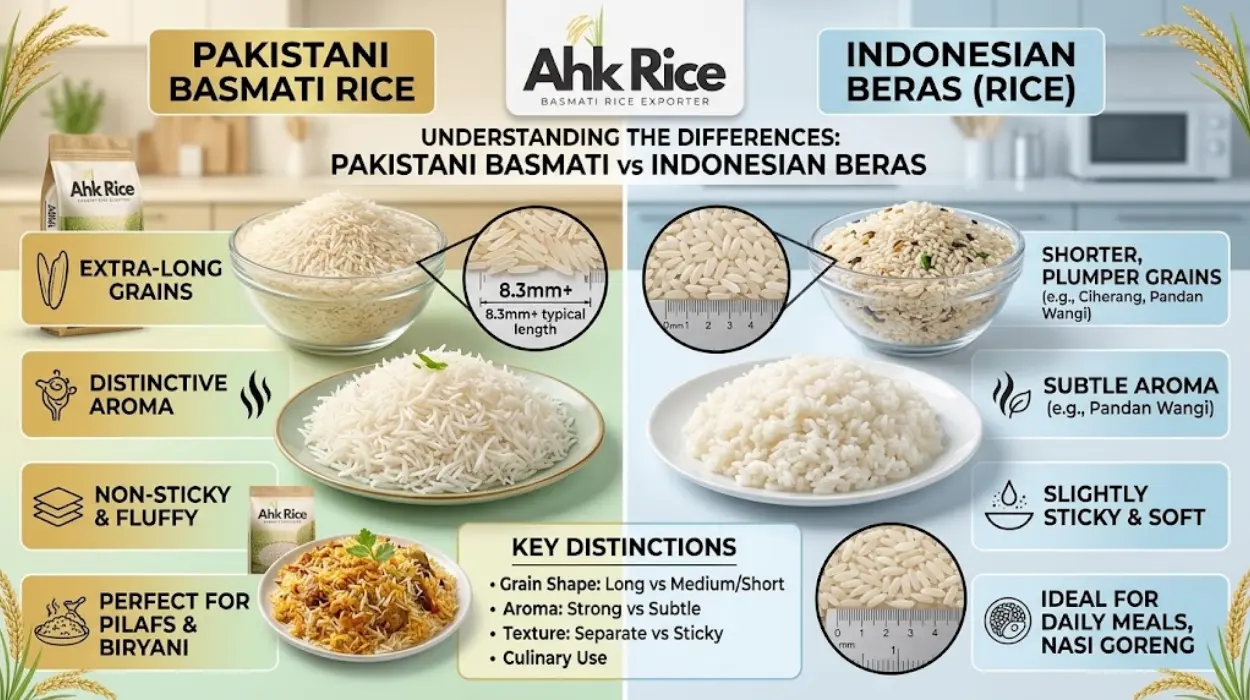
Pakistani Basmati rice is a premium, long-grain aromatic rice cultivated in the Indo-Gangetic Plains of Pakistan. Indonesian Beras refers to rice in general, rather than one specific rice variety. The main differences involve grain characteristics, aroma, starch composition, cooking texture, agricultural origin, and culinary applications.
Both products belong to the Oryza sativa species. However, Pakistani Basmati has a distinctive identity based on its genetic characteristics, growing environment, traditional cultivation, and cooking performance. Indonesian Beras includes several rice categories, such as local white rice, brown rice, red rice, black rice, and sticky rice.
Understanding these differences helps consumers, food manufacturers, restaurants, and international rice buyers select rice according to their requirements.
What Is Pakistani Basmati Rice?
Pakistani Basmati rice is a naturally aromatic, slender-grain rice grown in designated areas of Pakistan. It features distinctive fragrance, elongated kernels, delicate sweetness, and separate cooked grains, making it suitable for biryani, pulao, and premium rice dishes.
Basmati belongs to the Oryza sativa species and is recognised through its characteristic grain structure and aroma. Its fragrance primarily comes from a volatile compound called 2-acetyl-1-pyrroline (2AP).
Pakistan cultivates Basmati mainly in Punjab, particularly in agricultural districts such as Gujranwala, Hafizabad, Sheikhupura, Narowal, and Sialkot.
The region’s soil, climate, irrigation conditions, and seasonal growing patterns contribute to the rice’s agricultural characteristics. The traditional cultivation environment forms an important part of Pakistani Basmati’s geographical identity.
According to Pakistan’s Basmati geographical indication specifications, authentic Basmati has a minimum milled grain length of 6.50 mm and a minimum length-to-breadth ratio of 3.50.
Its cooked grains retain their individual shape, develop a soft texture, and elongate lengthwise.
What Is Indonesian Beras?
Indonesian Beras is the Indonesian term for milled rice consumed as a staple food. It describes multiple rice categories rather than one botanical variety, including ordinary white rice, brown rice, red rice, black rice, and glutinous rice.
Indonesia has a diverse rice-growing environment supported by tropical temperatures, seasonal rainfall, irrigation networks, and fertile agricultural land.
Rice production takes place across several islands, including Java, Sumatra, Sulawesi, and Bali.
Indonesian consumers commonly use white rice as their everyday staple. Popular local rice varieties include Ciherang, IR64, and Inpari varieties.
These varieties serve different agricultural and culinary requirements. Some produce soft, slightly sticky cooked rice, while others offer firmer grains.
The Indonesian term Beras also describes different processing conditions. For example:
- Beras putih: Polished white rice with most bran layers removed.
- Beras merah: Red rice containing naturally coloured bran.
- Beras hitam: Black rice with dark pigmentation.
- Beras coklat: Brown rice retaining its bran layer.
- Beras ketan: Glutinous rice with a high amylopectin content.
Therefore, comparing Pakistani Basmati with Indonesian Beras requires identifying the particular Indonesian variety and processing type.
How Is Pakistani Basmati Rice Different from Indonesian Beras?
Pakistani Basmati generally offers longer, slenderer grains, stronger characteristic aroma, and greater lengthwise elongation after cooking. Indonesian Beras varies considerably, with many everyday varieties producing softer, stickier rice suited to local meals.
The distinction becomes clearer when examining their physical and cooking characteristics.
| Characteristic | Pakistani Basmati | Indonesian Beras |
|---|---|---|
| Product identity | Specific aromatic rice category | General Indonesian term for rice |
| Grain shape | Long and slender | Short, medium, or long, depending on variety |
| Aroma | Distinctive natural Basmati fragrance | Varies by variety |
| Cooked texture | Soft, fluffy, separate grains | Often softer and slightly sticky |
| Grain elongation | Characteristic lengthwise elongation | Depends on variety |
| Starch behaviour | Intermediate amylose characteristics | Varies by rice type |
| Common dishes | Biryani, pulao, pilaf | Nasi goreng, nasi uduk, steamed rice |
| Agricultural origin | Pakistani Indo-Gangetic Plains | Multiple Indonesian rice-growing regions |
One important difference is that Indonesian Beras does not represent a single grain specification. Its characteristics depend on the cultivar, milling degree, and cooking method.
Pakistani Basmati has a more defined aromatic and grain-quality identity.
Where Is Pakistani Basmati Rice Grown?
Pakistani Basmati rice grows primarily across the Punjab region’s traditional rice-producing areas. Districts such as Gujranwala, Hafizabad, Sheikhupura, Narowal, and Sialkot support cultivation through suitable soils, irrigation, and seasonal agricultural conditions.
Punjab provides the agricultural environment associated with Pakistan’s traditional Basmati production.
Rice cultivation follows a seasonal cycle. Farmers prepare fields, establish seedlings or direct-seed crops, manage irrigation, control weeds, and monitor crop maturity.
The monsoon season supports the rice-growing cycle, while irrigation systems provide additional water management.
Important Basmati-growing districts
- Gujranwala: An established agricultural district associated with traditional Basmati cultivation.
- Hafizabad: Known for rice cultivation, processing, and commercial rice trading.
- Sheikhupura: An important rice-producing district in Punjab.
- Narowal: Part of the traditional Basmati-growing belt.
- Sialkot: Supports cultivation within Punjab’s aromatic rice-producing region.
Indonesia has a different agricultural geography. Its rice production is distributed across tropical islands and irrigation-based farming systems.
This geographical difference helps explain the distinct agricultural identities of Pakistani Basmati and Indonesian rice.
How Is Pakistani Basmati Rice Processed Step by Step?
Pakistani Basmati processing transforms harvested paddy into export-ready rice through drying, cleaning, dehusking, milling, grading, optical sorting, quality inspection, and packaging. Each stage controls grain integrity, moisture, purity, and commercial consistency.
The processing sequence begins after farmers harvest mature rice crops.
1. Paddy harvesting
Farmers harvest mature rice plants when the crop reaches its appropriate maturity stage. Harvested paddy contains rice grains protected by their outer husks.
2. Drying and moisture control
Freshly harvested paddy contains moisture that requires controlled reduction before storage and milling.
Drying helps prevent fungal growth, deterioration, and excessive grain breakage during subsequent processing.
3. Cleaning and pre-processing
Cleaning equipment removes unwanted materials, including stones, dust, straw, and other foreign particles.
This stage prepares the paddy for mechanical processing.
4. Dehusking
Dehusking machines remove the outer husk from paddy grains.
The resulting brown rice contains the bran layer and germ surrounding the edible endosperm.
5. Whitening and polishing
Milling equipment removes bran layers to produce white rice.
The milling degree determines the appearance and surface characteristics of the finished grain.
6. Grading and length separation
Grading machines separate whole kernels from broken grains and classify rice according to size and commercial specifications.
This stage helps maintain consistent grain quality.
7. Sortex optical sorting
Optical sorting equipment identifies and removes defective or discoloured grains.
Double Sortex processing provides an additional sorting stage to improve visual uniformity and remove unwanted particles.
8. Final inspection and packaging
The finished rice undergoes quality inspection before packaging.
Export specifications cover grain length, broken percentage, moisture, foreign matter, and other agreed parameters.
Packaging options include retail bags and bulk sacks in different weights.
What Are the Main Pakistani Basmati Rice Varieties?
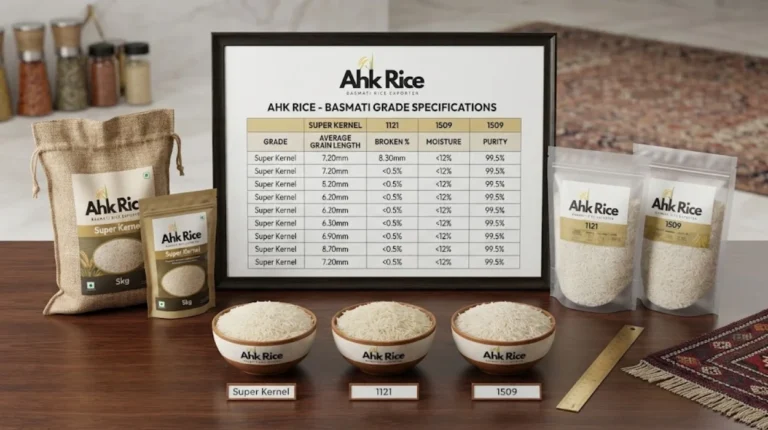
Pakistan commercially produces several Basmati varieties, each offering different grain lengths, aroma profiles, processing characteristics, and price positions. The major export varieties include 1121, Super Kernel, and 1509 Basmati.
These varieties serve different retail, wholesale, restaurant, and institutional markets.
1121 Basmati Rice
1121 is recognised for its exceptionally long slender grains and substantial elongation after cooking.
It is available in several processing forms:
- 1121 Steam Basmati
- 1121 Golden Sella Basmati
- 1121 Creamy Sella Basmati
- 1121 Brown Basmati
- 1121 Broken Rice
Steam processing preserves the characteristic white appearance, while Golden Sella processing produces a yellowish colour and a firmer cooked texture.
Super Kernel Basmati Rice
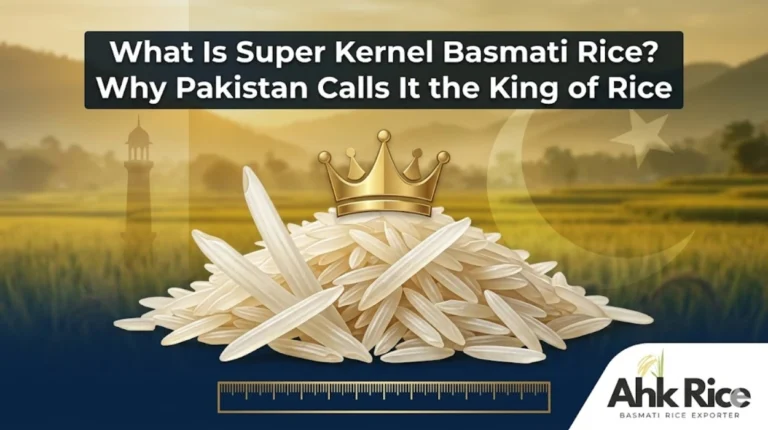
Super Kernel is a traditional Pakistani aromatic rice variety associated with Punjab.
Its principal characteristics include:
- Raw grain length around 7.0–7.5 mm.
- Distinctive natural aroma.
- Slender grain structure.
- Soft and fluffy cooked texture.
- Good grain separation after cooking.
It is commonly used in biryani, pulao, and premium household rice preparations.
1509 Basmati Rice
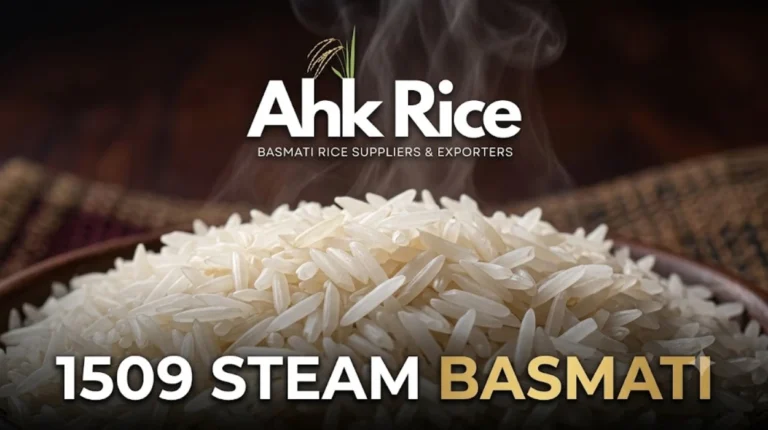
1509 is an export-oriented Basmati variety known for its long grain, comparatively shorter growing cycle, and commercial production efficiency.
Its agricultural maturity generally takes approximately 95–105 days, depending on growing conditions.
Available commercial forms include:
- 1509 White Basmati.
- 1509 Steam Basmati.
- 1509 Golden Sella Basmati.
- 1509 Creamy Sella Basmati.
These processing variations provide different cooking characteristics and market applications.
What Are the Benefits of Pakistani Basmati Rice?
Pakistani Basmati provides distinctive aroma, long grain appearance, lengthwise cooked elongation, and separate grain texture. These characteristics support premium food preparation, international retail positioning, restaurant applications, and traditional South Asian culinary requirements.
Its principal benefits relate to grain quality and cooking performance.
Distinctive fragrance: The natural 2AP compound contributes to Basmati’s characteristic aroma.
Long grain appearance: Slender kernels create an attractive presentation in prepared dishes.
Cooked elongation: Basmati expands lengthwise during cooking while retaining its characteristic grain shape.
Grain separation: Properly cooked Basmati produces individual grains instead of a uniformly sticky mass.
Versatile processing: Raw, Steam, Golden Sella, and Creamy Sella products provide different preparation characteristics.
International recognition: Pakistani Basmati has established demand among consumers and food businesses in the Middle East, Europe, North America, and other international markets.
Which Markets Import Pakistani Basmati Rice?
Pakistani Basmati serves international markets where consumers value aromatic long-grain rice. Major destination markets include the United Arab Emirates, Saudi Arabia, the United Kingdom, the United States, and other countries across Europe, Africa, and Asia.
Each market has different consumer preferences and commercial requirements.
- United Arab Emirates: Retailers, wholesalers, restaurants, and catering businesses purchase aromatic Basmati for household and foodservice consumption.
- Saudi Arabia: Basmati is widely used in traditional rice dishes, including kabsa and biryani.
- United Kingdom: South Asian grocery retailers and foodservice operators supply Basmati to established consumer communities.
- United States: Importers distribute Pakistani rice through ethnic grocery stores, private-label brands, restaurants, and wholesale channels.
- European markets: Importers require appropriate food safety documentation, traceability, and product specifications.
- African markets: Rice distributors serve wholesale, retail, and institutional demand.
Indonesia also imports and consumes different rice products according to domestic supply, market requirements, and consumer demand.
What Certifications and Quality Standards Apply to Pakistani Basmati?
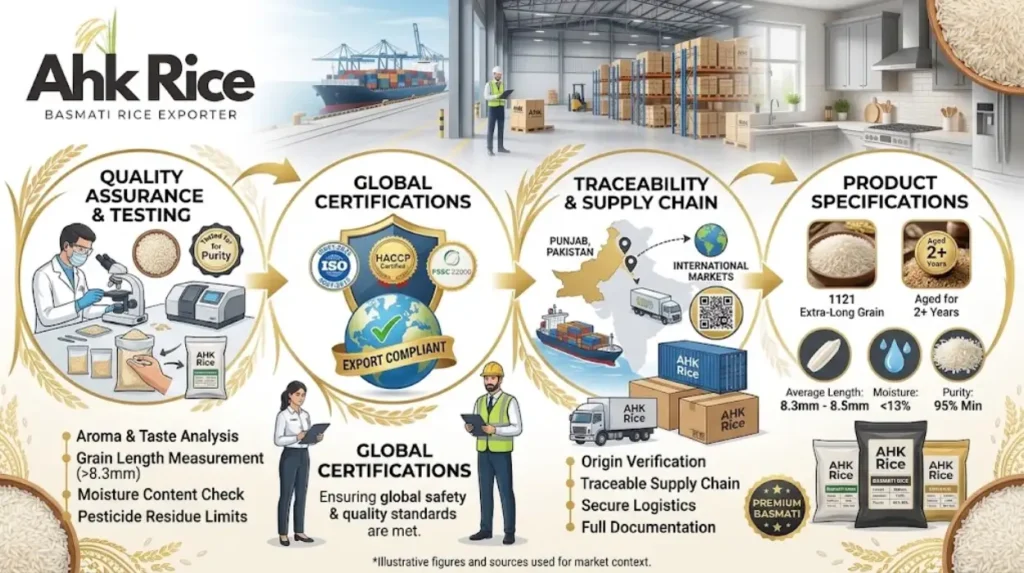
Pakistani Basmati exporters follow applicable food safety, origin, quality, and destination-market requirements. Relevant documentation includes Certificates of Origin, phytosanitary certificates, inspection records, and food safety certifications where required by buyers.
International rice trade requires accurate product identification and documentation.
Important quality and compliance requirements include:
- Geographical Indication: Pakistan’s Basmati GI framework identifies the geographical origin and product characteristics associated with authentic Basmati.
- HACCP: A food safety management approach that identifies and controls potential food hazards.
- ISO 22000: An international food safety management system standard.
- Phytosanitary Certificate: Official documentation confirming applicable plant-health requirements.
- Certificate of Origin: Identifies the declared country of origin.
- Laboratory testing: Verifies agreed parameters such as moisture, pesticide residues, heavy metals, and microbiological quality.
- Halal certification: Applies when required by the destination market or buyer.
The exact certification requirements depend on the importing country’s regulations and the commercial agreement.
For example, rice entering the United States must comply with applicable FDA food facility registration, Prior Notice, and importer FSVP requirements. European shipments must satisfy relevant EU food safety and contaminant regulations.
What Are the Common Misconceptions About Pakistani Basmati and Indonesian Beras?
The biggest misconception is treating Indonesian Beras as one specific rice variety. It represents a broad category of rice products. Pakistani Basmati, in contrast, has identifiable aromatic and grain characteristics linked to particular varieties and geographical origins.
Several misunderstandings affect rice comparisons.
Misconception 1: All Indonesian Beras is short-grain rice.
Indonesian rice includes different grain lengths and varieties. Not every Indonesian rice product has the same physical characteristics.
Misconception 2: All long-grain rice is Basmati.
Long-grain classification alone does not establish Basmati identity. Aroma, varietal characteristics, geographical origin, and applicable product specifications also matter.
Misconception 3: Basmati and Indonesian rice have identical cooking results.
Different rice varieties contain different starch compositions. Their water absorption, stickiness, aroma, and cooked texture also differ.
Misconception 4: Steam and Sella rice are identical.
Steam and Sella involve different processing approaches. Parboiled Sella rice undergoes soaking and heat treatment before drying and milling, changing its cooking behaviour.
Misconception 5: Higher grain length always means better rice.
Grain length is only one quality parameter. Aroma, broken percentage, moisture, purity, grain integrity, and cooking performance also determine commercial quality.
How Should Buyers Select Between Pakistani Basmati and Indonesian Beras?
Buyers should select rice according to grain preference, aroma, cooking application, target consumers, processing requirements, and purchasing specifications. Pakistani Basmati suits aromatic separate-grain dishes, while Indonesian varieties serve a wider range of everyday local meals.
The intended application determines the most suitable product.
For biryani, pulao, and premium pilaf, Pakistani Basmati offers characteristic fragrance and lengthwise grain elongation.
For everyday Indonesian meals, locally preferred Beras varieties provide familiar softness and texture.
For wholesale buyers, product selection should also consider crop year, variety, grain length, moisture, broken percentage, milling quality, packaging, and laboratory documentation.
A representative sample and agreed technical specification provide a reliable basis for evaluating commercial rice shipments.
Understanding these characteristics allows importers, distributors, retailers, and foodservice businesses to make informed purchasing decisions based on measurable product quality rather than country names alone.
Frequently Asked Questions
What is the main difference between Pakistani Basmati and Indonesian Beras?
Pakistani Basmati is a specific aromatic rice category with long, slender grains and distinctive fragrance. Indonesian Beras is a general term covering multiple rice varieties with different grain lengths, aromas, and cooking textures.
Is Pakistani Basmati rice longer than Indonesian rice?
Pakistani Basmati generally has longer, slenderer kernels than many commonly consumed Indonesian rice varieties. However, Indonesian rice also includes long-grain varieties, so comparisons depend on the specific cultivar.
Why does Pakistani Basmati rice have a distinctive aroma?
Pakistani Basmati contains 2-acetyl-1-pyrroline (2AP), a naturally occurring aromatic compound responsible for its characteristic fragrance.
Is Indonesian Beras suitable for biryani?
Certain Indonesian long-grain varieties are suitable for rice-based dishes. However, Pakistani Basmati is particularly valued for biryani because of its aroma, grain elongation, and separate cooked texture.
What are the main Pakistani Basmati rice varieties?
The major commercial varieties include 1121 Basmati, Super Kernel Basmati, and 1509 Basmati. Each offers different grain characteristics, processing options, and commercial applications.