BPJPH Halal Requirements and Foreign Halal Certificate Recognition for Imported Rice
Indonesian rice importers should distinguish between natural rice, processed rice products and products requiring formal halal certification because BPJPH applies different compliance requirements to each category. For Pakistani Basmati exporters, the most practical approach combines product classification, foreign halal certificate verification, halal-compliant packaging and documented supply-chain controls.
Indonesia’s Halal Product Assurance Organizing Agency (BPJPH) administers the national halal assurance system. Its regulations govern halal certification, foreign certificate recognition and the requirements for products entering the Indonesian market. Foreign exporters must understand how their products fit within this framework before agreeing to certification arrangements with Indonesian importers.
What are BPJPH halal requirements for imported rice?
BPJPH regulates imported food products through Indonesia’s halal assurance framework, but natural rice receives an exemption from product-level halal certification. Exporters must still control direct-contact packaging, storage, transportation and contamination risks throughout the supply chain.
BPJPH stands for Badan Penyelenggara Jaminan Produk Halal. It operates under Indonesia’s Ministry of Religious Affairs and administers the national halal certification system.
The main legal framework includes Law No. 33 of 2014 on Halal Product Assurance, Government Regulation No. 42 of 2024 and its 2026 amendment, Government Regulation No. 40 of 2026.
The framework distinguishes between products requiring halal certification and naturally occurring products that qualify for an exemption. BPJPH specifically identifies natural rice, onions, garlic, fruits and vegetables as products excluded from product-level halal certification.
However, the exemption does not remove every halal-related responsibility. Direct-contact packaging must meet halal requirements. Transportation, storage and packaging operations must prevent cross-contamination with non-halal materials. These controls remain relevant when Pakistani rice enters Indonesia.
Exporters should also distinguish plain milled rice from seasoned rice, ready-to-eat rice, flavoured rice mixes and other processed food products. Processing ingredients and manufacturing operations can change the applicable halal classification.
For a broader explanation of the Indonesian regulatory framework, readers can first understand what mandatory halal certification means for food imported into Indonesia.
What is the 2026 deadline for foreign food products?
Government Regulation No. 40 of 2026 changed the implementation schedule for foreign food and beverage products. The mandatory halal-certification requirement for imported food, beverages, slaughter products and slaughtering services begins on 18 October 2028, following consideration of mutual-recognition arrangements.
The earlier implementation schedule had pointed to October 2026. The revised deadline gives foreign halal-certification institutions and Indonesian authorities additional time to establish recognition arrangements.
This change does not mean exporters should ignore halal compliance until 2028. Importers still need to classify products correctly, maintain supporting documents and verify applicable import conditions.
BPJPH also announced changes affecting the previous foreign-product conformity assurance arrangements. Regulation No. 4 of 2026 was scheduled for withdrawal following the regulatory adjustment. Exporters should therefore avoid treating earlier implementation guidance as the current final position.
What are the available solutions for halal compliance when exporting rice to Indonesia?
Exporters have three practical approaches: rely on the natural-rice exemption, register a recognised foreign halal certificate when certification applies, or obtain Indonesian BPJPH certification when foreign recognition is unavailable or unsuitable. Product classification determines the correct route.
1. Use the natural-rice exemption
Plain natural rice is the simplest category from a product-certification perspective. BPJPH guidance expressly excludes natural rice from mandatory product-level halal certification.
A Pakistani exporter supplying plain 1121, Super Kernel or 1509 Basmati rice should document the product’s identity and processing characteristics. The specification should establish that the shipment contains rice rather than a formulated food product containing additional ingredients.
The exporter should also maintain packaging declarations, storage procedures and transport records. These documents demonstrate that halal integrity remains protected despite the product-level exemption.
This approach avoids unnecessary certification expenses for a product that already qualifies for an exemption.
2. Use a recognised foreign halal certificate
A foreign halal certificate provides an alternative when the imported product falls within a category requiring certification.
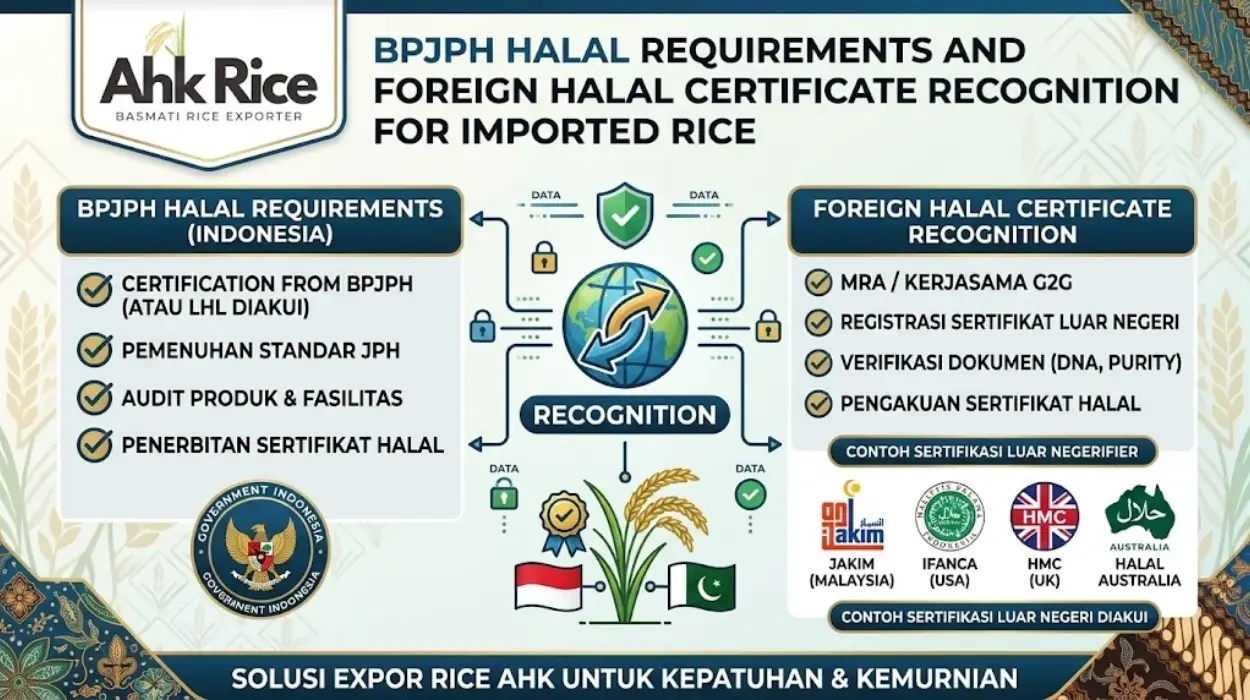
BPJPH recognises foreign halal certificates through cooperation arrangements with foreign halal institutions. These arrangements operate through Mutual Recognition Agreements (MRAs) or equivalent mutual-recognition cooperation.
The foreign halal institution must have an applicable recognition arrangement with BPJPH. Its recognised scope must cover the relevant product category and certification activities.
Under the foreign certificate registration framework, products covered by a recognised certificate do not need a separate Indonesian product certificate. However, the foreign certificate must be registered with BPJPH before the product is distributed in Indonesia.
The Indonesian importer or its authorised representative normally handles this registration through the SIHALAL system.
3. Obtain halal certification directly from BPJPH
Direct BPJPH certification provides another route when the country of origin lacks a suitable foreign halal institution, the institution lacks the required product scope, or an applicable recognition arrangement does not exist.
The foreign business submits its application through an Indonesian importer or official representative domiciled in Indonesia.
This approach places the certification process directly within Indonesia’s national halal assurance framework. It also requires greater administrative coordination and may involve additional audit arrangements.
For processed rice products, exporters should evaluate this route when foreign certificate recognition does not cover the relevant ingredients, manufacturing process or product category.
How do different halal compliance approaches compare?
The natural-rice exemption offers the simplest route for plain Basmati rice, foreign certificate registration suits covered processed products with recognised certification, and direct BPJPH certification addresses products without an applicable foreign recognition arrangement.
| Comparison attribute | Natural-rice exemption | Foreign certificate registration | Direct BPJPH certification |
|---|---|---|---|
| Main application | Plain natural rice | Covered imported food products | Covered imported food products |
| Certification authority | No product-level certificate required under the exemption | Recognised foreign halal institution | BPJPH |
| Recognition requirement | Product must qualify as natural rice | Applicable BPJPH recognition arrangement | No suitable foreign recognition route |
| Indonesian registration | No foreign halal certificate registration solely for exempt rice | Registration through SIHALAL | Indonesian certification process |
| Main documentation | Product specifications and supply-chain controls | Foreign certificate and registration documents | Application and halal assurance documentation |
| Administrative complexity | Low | Medium | High |
| Best application | Plain 1121, Super Kernel and 1509 rice | Processed products with recognised foreign certification | Products lacking suitable foreign recognition |
The table demonstrates why exporters should not purchase certification without checking product classification first. A certificate does not replace the need to establish whether a product is legally exempt or subject to a certification requirement.
How does foreign halal certificate recognition work in Indonesia?
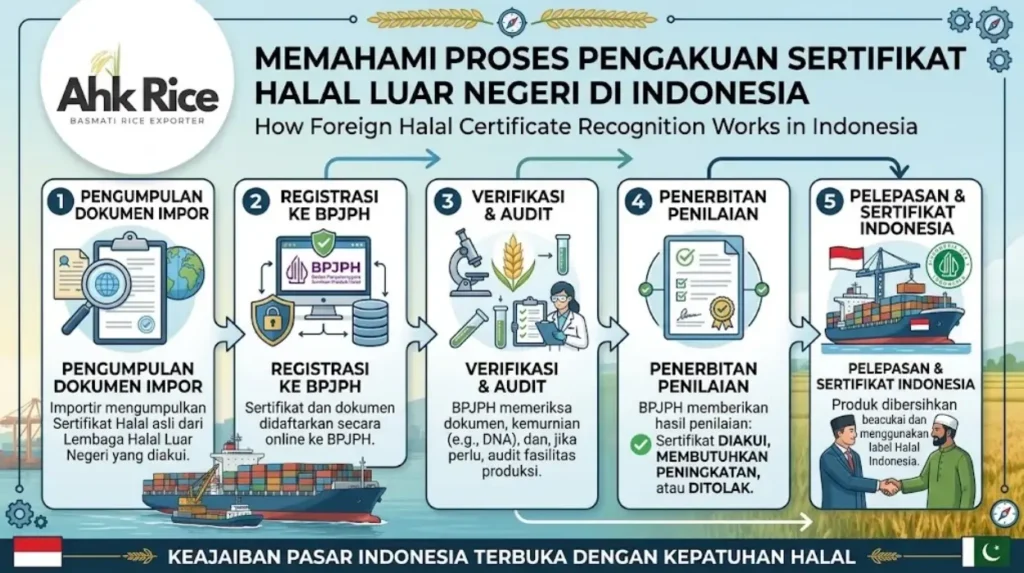
BPJPH recognises foreign halal certificates through formal cooperation with overseas halal institutions. An eligible certificate can be registered instead of obtaining a new Indonesian product certificate, provided its issuing institution and certification scope meet BPJPH recognition conditions.
A Mutual Recognition Agreement establishes acceptance between halal authorities or recognised certification institutions. It helps reduce duplicated certification work in international trade.
The recognition process involves several entities:
- BPJPH: Indonesia’s national halal assurance authority.
- Foreign Halal Institution (LHLN): An overseas institution authorised to issue halal certificates.
- Indonesian importer: The business responsible for importing and completing applicable Indonesian registration procedures.
- SIHALAL: BPJPH’s electronic platform for halal-related applications and registrations.
- MRA: A mutual-recognition arrangement supporting acceptance of eligible foreign halal certificates.
The importer must verify that the foreign certificate comes from an institution recognised by BPJPH. Recognition must cover the actual product category rather than merely the institution’s general halal activities.
A certificate issued by an institution without the necessary recognition does not automatically qualify for Indonesian registration. Exporters must also check certificate validity, product identity and manufacturing-site details.
What documents support foreign halal certificate registration?
For products requiring registration, the importer and exporter should prepare a coordinated document package.
Important records include:
- A valid foreign halal certificate.
- The foreign halal institution’s recognition details.
- Product names and specifications.
- Manufacturing-site information.
- Ingredient and processing information, where applicable.
- Packaging and labelling information.
- Importer identification and registration details.
- Supporting halal assurance documents.
The exact submission requirements depend on the product category and current BPJPH procedures. The importer should confirm the applicable SIHALAL requirements before shipment.
Indonesia removed the earlier general requirement to legalise foreign halal certificates through an apostille or Indonesian embassy legalisation under the 2024 regulatory framework. Exporters should follow the current document rules rather than automatically arranging an outdated legalisation procedure.
Which halal compliance method works best for different rice products?
Plain Pakistani Basmati rice generally fits BPJPH’s natural-rice exemption, while seasoned, flavoured and ready-to-eat rice products require a separate classification assessment. The appropriate method depends on ingredients, processing, foreign certificate recognition and Indonesian distribution plans.
Plain 1121, Super Kernel and 1509 Basmati
These varieties are sold as natural rice products. Their classification supports the natural-rice exemption when they remain plain rice rather than formulated food products.
The exporter should maintain grain specifications, milling records, packaging declarations and transport procedures. These records support product identification and supply-chain integrity.
Steam and Golden Sella rice
Steam and Golden Sella rice undergo parboiling-related processing. Their processing characteristics deserve specific classification review rather than an automatic assumption that every form receives the same treatment as ordinary milled rice.
Exporters should document the processing method, ingredients and any processing aids. The importer should confirm the product’s classification with BPJPH or an appropriate Indonesian regulatory adviser.
Seasoned and ready-to-eat rice
Products containing flavourings, seasoning blends, sauces, animal-derived ingredients or other formulated components require a more detailed halal assessment.
The exporter should evaluate ingredient sources, processing aids, manufacturing equipment and cross-contamination controls. Where certification applies, the foreign certificate must cover the relevant product and manufacturing activities.
What are the halal compliance advantages and disadvantages for rice exporters?
The exemption reduces unnecessary certification costs for plain rice, foreign certificate recognition avoids duplicate certification, and direct BPJPH certification provides a domestic compliance route. Each method has different documentation, administrative and operational requirements.
Natural-rice exemption
Advantages
- Avoids unnecessary product-level certification.
- Reduces administrative work for plain rice shipments.
- Supports straightforward export documentation.
- Allows exporters to concentrate on packaging and supply-chain controls.
Disadvantages
- Requires accurate product classification.
- Does not remove packaging and contamination-control responsibilities.
- Does not automatically cover seasoned or formulated rice products.
For example, a shipment of plain 1121 Basmati rice in clean, suitable packaging can use the natural-rice exemption. A seasoned rice product containing additional ingredients requires a separate assessment.
Foreign certificate registration
Advantages
- Avoids duplicate Indonesian product certification where recognition applies.
- Supports international halal trade.
- Allows exporters to use an eligible existing foreign certificate.
- Provides a documented recognition route.
Disadvantages
- Depends on BPJPH recognition of the issuing institution.
- Requires the correct product certification scope.
- Requires Indonesian registration before distribution.
- Creates additional coordination between the exporter and importer.
For example, a processed rice product covered by a recognised foreign halal certificate can use the registration route instead of obtaining a new Indonesian certificate.
Direct BPJPH certification
Advantages
- Provides certification under Indonesia’s national framework.
- Offers an option when foreign recognition is unavailable.
- Creates a formal route for products requiring halal certification.
Disadvantages
- Involves more administrative coordination.
- Requires detailed halal assurance documentation.
- Can involve audit and certification expenses.
- Requires coordination with an Indonesian importer or official representative.
This method is more appropriate for covered processed products whose foreign certification cannot qualify for recognition.
Which factors should Indonesian importers consider before selecting a halal compliance method?
Importers should prioritise product classification, ingredient composition, recognition status, packaging integrity and registration requirements. These five factors determine whether a rice shipment needs product certification, foreign certificate registration or only documented halal supply-chain controls.
| Decision factor | What to examine | Recommended action |
|---|---|---|
| Product classification | Natural rice or processed food | Confirm the applicable BPJPH category |
| Ingredients | Plain rice, flavourings or additives | Maintain complete ingredient declarations |
| Certificate recognition | BPJPH recognition of the issuing institution | Verify the relevant MRA and product scope |
| Packaging and logistics | Direct-contact materials, transport and storage | Maintain halal contamination controls |
| Import documentation | SIHALAL registration and supporting records where applicable | Coordinate requirements with the Indonesian importer |
The first decision should always concern the actual product. Exporters should not treat plain rice, parboiled rice and formulated rice products as interchangeable regulatory categories.
The second decision concerns the issuing institution. A foreign certificate only provides the recognition advantage when BPJPH accepts the institution and relevant certification scope.
The third decision concerns the physical supply chain. Packaging materials, warehouses, handling equipment and transport arrangements must preserve halal integrity.
How can Pakistani Basmati exporters prepare shipments for Indonesian importers?
Pakistani exporters should establish product specifications, document processing methods, verify packaging materials and coordinate import requirements with Indonesian buyers before loading. This approach supports consistent product identification and reduces avoidable regulatory delays.
AHK Rice is a Pakistani Basmati rice exporter based in Punjab, supplying 1121, Super Kernel, and 1509 Basmati rice to more than 15 countries.
Its end-to-end processing model covers sourcing, grading, processing, custom packaging and export coordination. For Indonesian buyers, product specifications and shipment documentation should identify the exact rice variety, processing type, grain quality and packaging configuration.
A practical export preparation process includes:
- Confirm the rice variety and product classification.
- Prepare the technical specification and ingredient declaration.
- Verify direct-contact packaging materials.
- Maintain cleaning, storage and transport procedures.
- Prepare commercial invoice, packing list and applicable origin and phytosanitary documentation.
- Confirm whether the shipment falls under the natural-rice exemption or requires another halal compliance route.
- Coordinate any foreign halal certificate registration with the Indonesian importer.
- Approve the final shipment documents before container loading.
For importers purchasing plain Basmati rice, the priority is accurate classification and documented halal supply-chain controls. For processed rice products, certificate recognition and registration require additional attention.
The decision-focused next step is to source halal-certified Pakistani Basmati rice from AHK Rice for Indonesia after confirming the product category, applicable halal documentation and import specifications.
Frequently Asked Questions
Does plain Basmati rice require BPJPH halal certification?
No. BPJPH identifies natural rice as exempt from product-level halal certification. Direct-contact packaging, storage, transportation and contamination controls must still satisfy applicable halal requirements.
Can Pakistan’s foreign halal certificates be recognised in Indonesia?
Yes, provided the issuing foreign halal institution has an applicable mutual-recognition arrangement with BPJPH and the certificate covers the relevant product category. The certificate must be registered before the product is distributed in Indonesia when registration applies.
What is SIHALAL?
SIHALAL is BPJPH’s electronic platform for halal certification and related registration services. Indonesian importers or authorised representatives use the platform for applicable foreign halal certificate registration.
What is the new Indonesian halal deadline for imported food?
Government Regulation No. 40 of 2026 moves the mandatory halal-certification implementation date for imported food, beverages, slaughter products and slaughtering services to 18 October 2028, subject to the relevant mutual-recognition arrangements.
Does the natural-rice exemption cover Golden Sella and Steam Basmati?
Processing affects product classification. Exporters should document the parboiling method, ingredients and processing aids and obtain confirmation of the applicable BPJPH classification rather than automatically assuming every processed rice product qualifies for the natural-rice exemption.
Must foreign halal certificates be legalised by an Indonesian embassy?
The 2024 regulatory framework removed the previous general certificate-legalisation requirement. Importers should follow current BPJPH registration and documentation procedures.
Can Indonesian importers distribute rice without registering a foreign halal certificate?
Plain natural rice qualifies for the product-level halal certification exemption under BPJPH guidance. For products relying on a recognised foreign halal certificate, registration must be completed before distribution in Indonesia.
What documents should Pakistani rice exporters prepare for Indonesia?
Exporters should prepare product specifications, commercial invoices, packing lists, applicable certificates of origin, phytosanitary documentation, transport documents and relevant halal assurance records. Additional documents depend on product classification and importer requirements.