Launch USA Private Label Basmati Rice with AHK Rice
Launching a USA private-label Basmati rice brand is most effective when the importer controls rice specifications, packaging, compliance, sampling, and shipment planning through one origin supplier, rather than buying generic bulk rice and managing multiple intermediaries. For market context, see the guide on:
Why private-label Basmati brands are expanding in the USA.
The commercial decision is not simply which rice is cheapest. A private-label program must produce the same grain appearance, cooking performance, packaging quality, and documentation across repeat shipments. The earlier comparison stage:
How importers select Basmati rice for private-label programs should therefore be completed before approving the first commercial batch.
For USA buyers, AHK Rice’s USA export service provides access to Pakistani 1121, Super Kernel, and 1509 Basmati options, customized packaging, export documentation, inspection, and container logistics. AHK Rice states that its USA program supports retail and wholesale packing formats and shipment coordination from Pakistan to US ports.
What is the best solution for launching a USA private-label Basmati brand?
The strongest solution is direct private-label sourcing from a Pakistani exporter that controls procurement, milling, grading, testing, packaging, documentation, and shipping, because one specification system reduces quality variation, communication gaps, compliance risk, and landed-cost uncertainty.
A direct-origin model gives the importer more control than buying an existing branded product through a distributor. The buyer defines the variety, grain length, processing grade, broken percentage, moisture target, retail pack size, artwork, labeling requirements, and shipment terms before production.
AHK Rice operates an integrated processing and export model covering paddy procurement, cleaning, de-husking, whitening, polishing, grading, length sorting, custom packaging, documentation, and container loading. This allows AHK Rice to connect the commercial specification with the physical product instead of treating packaging and rice sourcing as separate activities.
For a premium USA brand, 1121 Basmati is generally suitable when long grain appearance and premium positioning are priorities. Super Kernel can provide a cost-conscious premium option. 1509 can be evaluated when the buyer wants competitive pricing while retaining Basmati characteristics.
The correct choice depends on the target retail segment rather than the variety name alone. A premium supermarket may justify 1121. An ethnic grocery distributor may prioritize Super Kernel. A value-focused private label may compare 1509 against other grades.
Why should USA importers choose AHK Rice for private-label supply?
AHK Rice provides a single-source export structure combining Pakistani Basmati varieties, processing, grading, private-label packaging, inspection, export documentation, and USA shipment coordination, giving importers greater control over product consistency and commercial execution.
AHK Rice is based in Punjab, Pakistan, where its supply network supports Pakistani Basmati procurement. The company currently identifies 1121, Super Kernel, and 1509 among its principal varieties and supplies international markets including the USA.
The main advantage for a private-label buyer is specification control. AHK Rice can work around defined grain length, moisture, broken percentage, processing grade, packaging format, and destination requirements. The buyer can therefore approve a product specification before committing to recurring shipments.
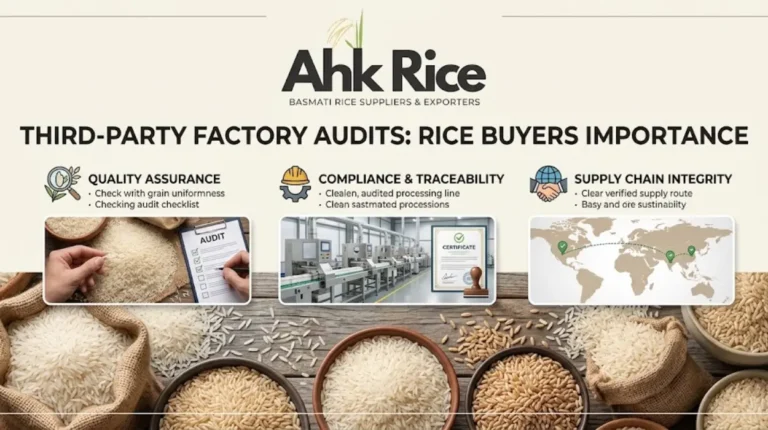
Quality assurance is also important for private-label brands because the consumer sees the retailer’s name, not the exporter, on the package. AHK Rice states that pre-shipment inspections can be conducted through organizations such as SGS and Bureau Veritas.
AHK Rice also supports customized retail packaging. Available USA-oriented formats include 5 kg and 10 kg PP bags, while broader packaging options can include smaller retail packs and larger wholesale formats.
This structure makes AHK Rice more suitable for importers who want to establish a repeatable SKU rather than purchase one-off commodity containers.
What product specifications should a USA private-label buyer approve?
A USA private-label buyer should approve variety, grain length, processing grade, moisture, broken percentage, foreign matter, packaging, labeling, and inspection requirements before production, because these specifications determine product identity, cooking performance, compliance, and repeat-order consistency.
A practical commercial specification can begin with the following framework:
| Attribute | Private-label decision |
|---|---|
| Variety | 1121, Super Kernel, or 1509 |
| Average grain length | Defined target before production |
| Processing | White, Steam, Sella, or agreed grade |
| Moisture | Contract-specific target |
| Broken grains | Contract-specific maximum |
| Packaging | Retail or wholesale format |
| Inspection | Pre-shipment inspection and laboratory documentation |
AHK Rice’s USA service page currently lists a specification example for 1121 Steam Basmati with an average grain length of 8.3 mm+, moisture under 12.5%, and broken grains under 1%. These figures should be treated as a product specification example, not automatically applied to every private-label order.
This distinction matters because private-label contracts should not rely on generic claims such as “premium quality.” The purchase agreement should identify measurable tolerances.
AHK Rice can then produce the agreed specification, allowing the importer to compare the pre-production sample against the final shipment. This creates a measurable quality baseline for future containers.
What results can USA importers expect from AHK Rice?
A properly controlled private-label program can give USA importers consistent retail presentation, predictable cooking performance, stronger control over pricing, scalable packaging, and a repeatable supply specification that supports additional containers as distribution expands.
The first result is product consistency. If each shipment follows the same variety and quality specification, retailers can maintain a stable consumer experience.
The second result is brand control. Instead of selling another company’s rice brand, the importer owns the packaging identity, positioning, retail price strategy, and distribution relationship.
The third result is scalability. A successful first container can become a repeat procurement specification. AHK Rice supports container-level export programs and identifies a 20-foot container as a typical starting quantity of approximately 20 metric tons for USA buyers.
The fourth result is logistics visibility. AHK Rice reports approximately 28–35 days for East Coast USA ports such as New York and Savannah and approximately 20–28 days for West Coast ports such as Los Angeles, depending on the shipping cycle. Its broader USA page gives a 25–35-day door-to-door estimate, showing why the final timeline must be confirmed against the destination and freight plan.
These timelines are planning ranges, not guaranteed arrival dates. Vessel schedules, port congestion, customs processing, transshipment, and inland delivery can change the final date.
How long does the complete USA private-label process take?
A realistic private-label program requires time for specification approval, sampling, packaging preparation, production, inspection, documentation, container loading, ocean freight, customs processing, and inland delivery; USA port selection can materially change the final logistics timeline.
The process normally follows this sequence:
- Requirement submission: The buyer provides variety, grade, quantity, packaging, destination port, and target specification.
- Commercial quotation: AHK Rice prepares pricing based on the selected product and shipment requirements.
- Sample approval: The buyer receives rice samples for physical inspection and cooking evaluation.
- Specification confirmation: Grain length, moisture, broken percentage, packaging, and labeling requirements are finalized.
- Artwork approval: Private-label artwork and required product information are reviewed before printing.
- Production: Rice is processed, graded, sorted, and packed according to the approved specification.
- Inspection: Quality checks and third-party inspection can be completed before loading.
- Documentation: Commercial and export documents are prepared, including relevant certificates.
- Container loading: The approved product is loaded and shipment documentation is completed.
- Ocean transportation: Cargo moves from Karachi toward the selected USA port.
- USA import handling: Customs, inspection, port handling, and inland transportation occur before final delivery.
AHK Rice’s USA export workflow states that samples can be shipped by air courier and that 1–5 kg sample parcels may reach USA buyers in approximately 5–7 days. The company also states that up to 20 kg of rice can be supplied as a sample while the buyer covers shipping costs; phytosanitary certificate costs may also apply.
How does the sample process work, and what does it cost?
The sample stage should verify the exact commercial product before production; AHK Rice can provide rice samples, while the buyer normally pays courier and applicable phytosanitary costs, making sampling a low-cost quality-control step before container commitment.
A professional sample process should start with the buyer’s intended specification rather than requesting an unspecified “premium sample.”
The buyer should identify the variety, processing grade, grain-length requirement, packaging concept, destination, and intended retail positioning. AHK Rice can then identify the closest available production specification.
The sample should be evaluated in four ways:
- Physical inspection: grain length, appearance, uniformity, broken grains, and foreign matter.
- Cooking test: elongation, aroma, texture, separation, and cooking yield.
- Packaging review: pack size, material, artwork, labeling, and barcode requirements.
- Commercial comparison: sample quality against the agreed target and quoted specification.
AHK Rice states that sample rice can be free up to specified quantities, while the buyer covers courier costs and applicable phytosanitary certification. The exact courier charge depends on destination, parcel weight, courier service, and documentation requirements, so it should be quoted rather than treated as a fixed 2026 fee.
This approach prevents a common private-label mistake: approving the packaging before approving the rice.
What factors determine USA private-label Basmati rice pricing?
USA private-label pricing depends on rice variety, processing grade, crop and market conditions, order volume, grain specifications, packaging material, printing, inspection, freight, destination, payment terms, and Incoterms rather than one fixed price per metric ton.
Rice itself is only one component of landed cost. Premium 1121 generally carries a different commercial value from Super Kernel or 1509 because grain length, market positioning, and supply conditions differ.
Processing also affects cost. White, Steam, Golden Sella, and Creamy Sella grades require different processing workflows and may target different consumer segments.
Packaging becomes significant when an importer orders custom printed retail bags. A 1 kg or 5 kg branded package requires different material, printing, packing, palletization, and handling economics than a 25 kg or 40 kg bulk sack.
Freight is another major variable. Karachi-to-USA ocean freight changes according to destination port, carrier, container availability, season, and booking conditions.
For this reason, AHK Rice’s USA program uses destination port, product, packing, quantity, and Incoterm information when preparing a customized quotation.
A private-label importer should compare landed cost per sellable kilogram, not merely FOB rice price. A cheaper rice specification can become less competitive if it produces higher breakage, weaker shelf positioning, poor packaging economics, or inconsistent cooking results.
What should USA buyers check before signing a private-label contract?
Before signing, buyers should confirm the approved rice specification, sample reference, packaging artwork, inspection standard, documentation responsibility, Incoterm, payment structure, shipment schedule, claims procedure, and tolerance limits for every measurable quality parameter.
The contract should identify the exact product rather than simply stating “Pakistan Basmati rice.”
The sample approved by the buyer should be retained as a reference. The commercial specification should then define measurable tolerances for grain length, moisture, broken grains, foreign matter, color, processing grade, and packaging weight.
AHK Rice’s USA program identifies 30% advance payment with the remaining 70% against scanned documents as one available payment structure, while LC at sight is also listed for certain USA product quotations. Payment terms should therefore be agreed in the individual contract rather than assumed universally.
The buyer should also confirm whether the quotation is FOB, CFR, CIF, or another agreed Incoterm. This determines which party controls and pays for particular stages of transportation, insurance, and destination handling.
Finally, USA importers should verify their own regulatory responsibilities with the appropriate US authorities and customs professionals. Exporter documentation support reduces risk, but the importer remains responsible for ensuring its market-entry obligations are satisfied.
How can a USA importer start a private-label Basmati program with AHK Rice?
Start with one defined SKU, one approved specification, and one representative sample; then validate cooking performance, packaging, documentation, landed cost, and shipment timing before scaling the approved specification into recurring container orders.
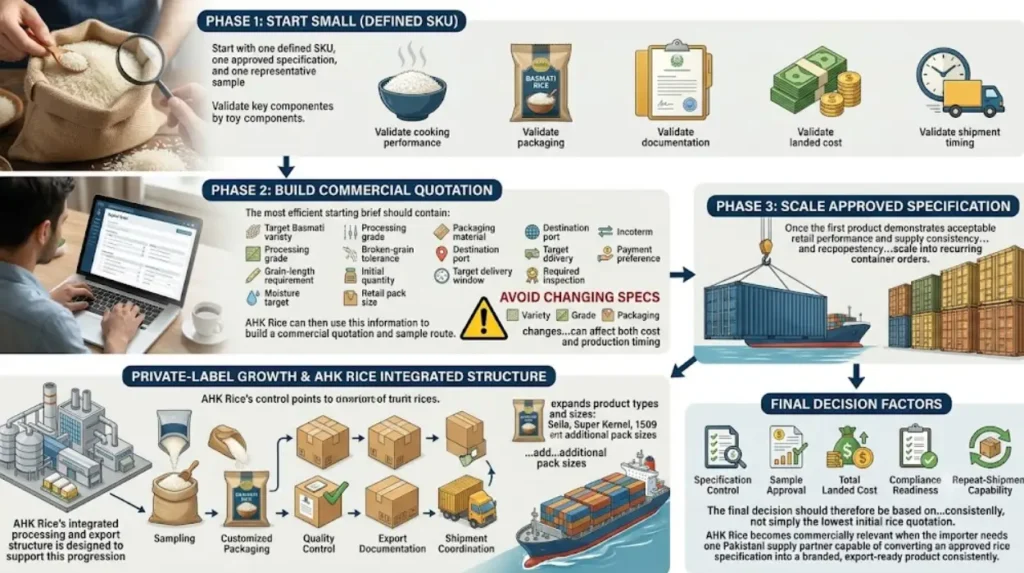
The most efficient starting brief should contain:
- Target Basmati variety
- Processing grade
- Grain-length requirement
- Moisture target
- Broken-grain tolerance
- Initial quantity
- Retail pack size
- Packaging material
- Destination port
- Target delivery window
- Required inspection
- Incoterm
- Payment preference
AHK Rice can then use this information to build a commercial quotation and sample route. The buyer should avoid changing several specifications after sample approval because changes in variety, grade, packaging, or artwork can affect both cost and production timing.
For a first USA launch, a controlled single-SKU approach is usually easier to manage than launching multiple varieties simultaneously. Once the first product demonstrates acceptable retail performance and supply consistency, the importer can add Super Kernel, 1509, Sella, or additional pack sizes.
AHK Rice’s integrated processing and export structure is designed to support this progression from specification approval to repeat container supply. Its USA service covers product selection, sampling, customized packaging, quality control, export documentation, and shipment coordination.
The final decision should therefore be based on specification control, sample approval, total landed cost, compliance readiness, and repeat-shipment capability, not simply the lowest initial rice quotation. For a USA private-label brand, AHK Rice becomes commercially relevant when the importer needs one Pakistani supply partner capable of converting an approved rice specification into a branded, export-ready product consistently.
To start the commercial specification and quotation process, use AHK Rice’s request-a-quote page.
Frequently Asked Questions
What Basmati rice varieties can AHK Rice supply for USA private-label brands?
AHK Rice supplies Pakistani Basmati varieties including 1121, Super Kernel, and 1509. The suitable variety depends on the private-label brand’s target price, grain-length requirement, cooking performance, and retail positioning.
What is the minimum order quantity for USA private-label Basmati rice?
A typical commercial starting point can be a 20-foot container, with approximately 20 metric tons depending on the selected product and packaging. The exact MOQ should be confirmed with AHK Rice based on the SKU, packaging, and shipment requirements.
How long does Basmati rice shipping from Pakistan to the USA take?
Ocean transit varies by destination and shipping conditions. Current planning ranges can be approximately 20–28 days for West Coast ports and 28–35 days for East Coast ports, excluding additional customs, port, and inland delivery time.
Can AHK Rice provide private-label packaging for USA buyers?
Yes. AHK Rice supports customized packaging for private-label programs. Buyers can specify pack sizes, packaging materials, branding artwork, and other requirements before production and printing.
How does the AHK Rice sample process work?
The buyer first provides the required rice variety and specifications. AHK Rice then prepares a representative sample for evaluation. The buyer checks grain appearance and cooking performance before approving the commercial specification and proceeding toward production.
Who pays for private-label rice samples?
Sample rice may be supplied under AHK Rice’s sample policy, while the buyer generally covers courier and applicable phytosanitary costs. Exact charges depend on sample weight, destination, courier service, and documentation requirements.
What factors affect private-label Basmati rice pricing in the USA?
Pricing depends on variety, processing grade, grain specifications, quantity, packaging, printing, inspection, freight, destination port, Incoterms, payment terms, and prevailing rice and shipping market conditions.
Can USA importers request specific Basmati rice specifications?
Yes. Importers can define requirements such as variety, grain length, moisture, broken percentage, processing grade, packaging format, and inspection requirements. These specifications should be finalized before commercial production.
Can AHK Rice arrange quality inspection before shipment?
AHK Rice supports quality-control and pre-shipment inspection processes. Depending on the contract, buyers can request inspection or laboratory documentation through appropriate third-party or approved inspection arrangements.
What payment terms are available for USA private-label rice orders?
Payment terms depend on the commercial agreement. AHK Rice lists structures such as advance payment with the balance against scanned shipping documents and LC at sight for applicable orders. The final terms should be confirmed in the quotation and contract.
What documents are required for importing Basmati rice into the USA?
Commercial shipments normally require appropriate shipping, commercial, packing, origin, and product-related documentation. The exact requirements depend on the shipment, product, importer, and current US regulatory obligations, so the importer should verify requirements before shipment.
How should a USA importer choose between 1121, Super Kernel, and 1509?
The choice should match the brand’s positioning. 1121 is suitable for premium long-grain positioning, Super Kernel can target premium value segments, and 1509 can provide a competitive option where pricing and cooking performance must be balanced.
How can a USA company start a private-label Basmati rice order with AHK Rice?
The buyer should provide the preferred variety, grade, quantity, packaging, destination port, specifications, and target delivery schedule. AHK Rice can then prepare a quotation, arrange sampling, finalize the specification, and proceed toward private-label production and export.