What Documents Are Needed to Export Basmati Rice from Pakistan to Indonesia?
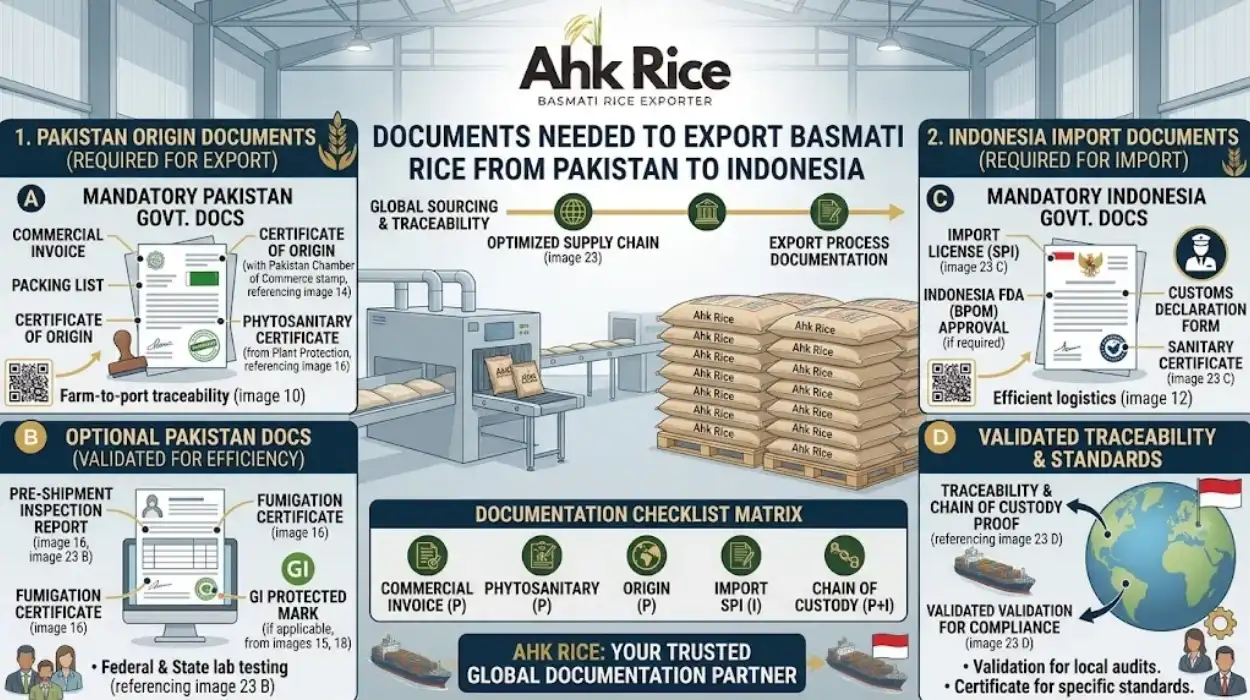
Exporting Basmati rice from Pakistan to Indonesia requires a coordinated set of commercial, customs, origin, food-safety, quarantine, shipping, and payment documents. The core documents include the commercial invoice, packing list, Certificate of Origin, phytosanitary certificate, Bill of Lading, export declaration, and supporting quality or halal documents where required.
For a Pakistani Basmati rice exporter, documentation connects the rice shipment with its exporter, importer, origin, quantity, quality, value, transport route, and regulatory status. Each document serves a different purpose during export clearance and import processing.
What is the documentation process for exporting Basmati rice from Pakistan to Indonesia?
The documentation process is a sequence of preparing commercial records, proving Pakistani origin, confirming plant health, declaring the shipment to customs, arranging transport documents, and supplying Indonesia-bound compliance documents before cargo clearance. Each record must match the shipment details.
The process begins after the exporter and Indonesian buyer agree on the rice variety, grade, quantity, packing, price, Incoterm, payment terms, and destination port.
The exporter then prepares commercial documents. These establish what is being sold and how much the shipment is worth.
The shipment also needs origin and quarantine documentation. The Certificate of Origin identifies Pakistan as the country of origin. The phytosanitary certificate confirms that the agricultural commodity meets applicable plant-health requirements.
Transport documentation follows cargo loading. The shipping line issues the Bill of Lading after the rice is loaded on the vessel. The document identifies the cargo, shipper, consignee, port of loading, destination, and shipment details.
Indonesia’s importer uses these records for customs, quarantine, food-import, and commercial procedures. The exact document set depends on the rice product, importer status, shipment arrangement, and applicable Indonesian requirements.
What commercial documents are required for a Pakistani Basmati rice shipment?
Commercial documents identify the buyer, seller, rice quantity, value, packaging, payment terms, and shipment contents. The main records include the commercial invoice, packing list, sales contract, and export declaration, with consistent information across every document.
Commercial Invoice
The commercial invoice records the transaction between the Pakistani exporter and Indonesian importer.
It normally includes:
- Exporter name and address
- Importer name and address
- Invoice number and date
- Product description
- Basmati rice variety and grade
- Quantity and unit
- Price per unit
- Total invoice value
- Currency
- Incoterm
- Country of origin
- Port of loading
- Destination
For example, an invoice can describe 1121 Basmati Rice, Steam, 25 kg bags, 1,000 bags, Pakistan origin.
Packing List
The packing list explains how the cargo is physically packed. It includes the number of bags, net weight, gross weight, package type, dimensions where applicable, and container information.
For example, a shipment containing 1,000 bags of 25 kg rice has a net rice weight of 25,000 kg.
Sales Contract
The sales contract records the agreed commercial terms. It normally covers product specifications, quantity, price, packaging, delivery terms, payment method, inspection requirements, and claims procedure.
Export Declaration
The Pakistani exporter submits the required export declaration through the applicable customs process. It connects the commercial shipment with customs reporting and export clearance.
Why is the Certificate of Origin important for Basmati rice exports?
A Certificate of Origin establishes that the exported Basmati rice originates from Pakistan. It connects the shipment with its producing country and supports customs, import documentation, trade verification, and buyer records in Indonesia.
The Certificate of Origin is particularly important for agricultural commodities because the buyer and authorities need a clear statement of origin.
For Pakistani Basmati rice, the document identifies Pakistan as the country of origin. It should match the exporter, product description, quantity, invoice, and shipment information.
Origin documentation also supports traceability. A buyer purchasing Punjab-origin Basmati rice needs commercial records that connect the finished shipment with Pakistan.
The document is separate from the phytosanitary certificate. The Certificate of Origin proves where the product originates, while the phytosanitary certificate addresses plant-health status.
This distinction prevents a common documentation mistake. One certificate does not replace the other.
What is a phytosanitary certificate for Pakistani Basmati rice?
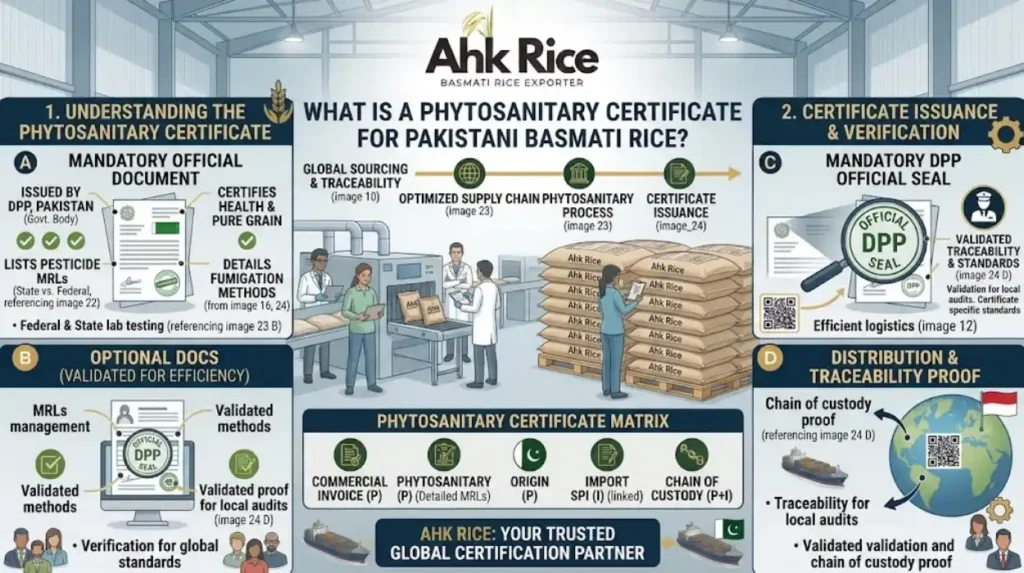
A phytosanitary certificate confirms that an agricultural shipment has been inspected according to plant-health requirements and complies with applicable phytosanitary conditions for export. It accompanies the rice shipment as an official plant-health document.
Basmati rice is an agricultural product. Its movement between countries therefore involves plant quarantine controls.
The phytosanitary certificate is issued by the relevant plant-protection authority in Pakistan after the required inspection and procedures.
The document identifies the commodity and shipment details. It provides the plant-health certification needed for the destination country’s quarantine process.
For an Indonesian shipment, the exporter and importer must ensure that the certificate follows the requirements applicable to the specific rice consignment.
The phytosanitary document should remain consistent with the commercial invoice and packing list. Differences in product description, quantity, package information, or shipment details create clearance problems.
What does the Bill of Lading prove in a rice export shipment?
The Bill of Lading is the primary sea-transport document issued by the carrier for loaded cargo. It records the shipper, consignee, cargo description, vessel, ports, container details, and transport terms for the Basmati rice shipment.
The Bill of Lading connects the physical container with the international sea shipment.
Important information includes the:
- Shipper
- Consignee
- Notify party
- Vessel name
- Port of loading
- Port of discharge
- Container number
- Seal number
- Package count
- Gross weight
- Cargo description
For example, a shipment from Karachi to an Indonesian port has transport information that must correspond with the commercial documents.
The Bill of Lading also serves as evidence that the carrier received the cargo for transportation.
Different forms of Bill of Lading exist, including original Bills of Lading and electronic or surrendered arrangements. The correct format depends on the carrier, payment structure, and buyer-seller agreement.
What halal documents apply to Basmati rice exports to Indonesia?
Halal documentation demonstrates that the rice and relevant production or handling processes satisfy applicable halal requirements. For Indonesia-bound rice, halal requirements depend on the product, importer, regulatory rules, certification status, and implementation requirements.
Halal compliance is separate from plant quarantine and customs documentation.
Plain rice is a simple agricultural food product, but the supply chain still requires attention to processing, handling, packaging, storage, and certification requirements applicable to the Indonesian market.
The Indonesian halal framework is administered through the country’s halal assurance system. Exporters and importers must therefore verify the current requirements for their specific rice product before shipment.
A halal certificate is also different from a Certificate of Origin. The first addresses halal status. The second establishes geographic origin.
This distinction matters when preparing a complete export file because different authorities use different documents for different compliance purposes.
What other documents support Basmati rice export clearance?
Supporting documents provide evidence about quality, quantity, packaging, inspection, and regulatory compliance. Common examples include a certificate of analysis, weight certificate, fumigation certificate, inspection certificate, insurance document, and laboratory reports when required.
Certificate of Analysis
A Certificate of Analysis, or COA, records laboratory results for specified product parameters.
For Basmati rice, buyers can specify parameters such as moisture, broken grains, grain length, foreign matter, and other agreed quality characteristics.
For example, a contract can require a defined moisture limit and maximum broken percentage.
Fumigation Certificate
A fumigation certificate records treatment performed on the cargo where fumigation is required by the applicable shipment or destination conditions.
The certificate should identify the treated cargo and treatment details.
Weight Certificate
A weight certificate confirms cargo weight. Weight records support commercial settlement, customs documentation, and shipping records.
Inspection Certificate
An inspection certificate records findings from an agreed inspection process. The inspection scope depends on the sales contract.
Insurance Certificate
When the shipment is insured, the insurance certificate provides evidence of cargo insurance under the agreed coverage.
These supporting documents are not automatically identical for every shipment. The required set depends on the contract, shipment method, destination requirements, and importer instructions.
How are Basmati rice export documents connected?
Every export document should describe the same physical and commercial shipment. Product name, grade, quantity, package count, weight, exporter, importer, container details, and destination should remain consistent across the documentation set.
Documentation works as a chain rather than a collection of unrelated papers.
The commercial invoice establishes the transaction.
The packing list establishes the physical packing.
The Certificate of Origin establishes Pakistani origin.
The phytosanitary certificate establishes plant-health certification.
The Bill of Lading establishes sea transportation.
The export declaration supports customs reporting.
Quality documents establish agreed product characteristics.
Halal documentation addresses halal compliance where applicable.
When these records contain conflicting information, the importer faces additional verification and clearance work.
For example, if the invoice states 25,000 kg but another document states 24,500 kg, the discrepancy needs to be resolved before the documentation is treated as consistent.
What are the main benefits of complete Basmati rice export documentation?
Complete documentation creates traceability, supports customs and quarantine procedures, protects the commercial transaction, and gives the Indonesian importer evidence about origin, product identity, transportation, quantity, and compliance with agreed shipment conditions.
The first benefit is traceability. Documents connect the shipment with the exporter, product, destination, and container.
The second benefit is clear customs processing. Customs authorities use commercial and transport documents to assess the shipment.
The third benefit is quarantine compliance. Plant-health documentation supports inspection and release procedures for agricultural cargo.
The fourth benefit is commercial protection. The invoice, contract, packing list, and transport documents establish what the buyer purchased and what the exporter shipped.
The fifth benefit is buyer confidence. A complete document file allows the importer to verify the shipment before and after arrival.
What are common documentation problems when exporting Basmati rice to Indonesia?
The most common problems are inconsistent quantities, incorrect product descriptions, missing certificates, incorrect consignee information, incomplete customs declarations, and documents prepared without checking the latest Indonesian import and quarantine requirements.
A frequent mistake is using a generic product description. A shipment should identify the relevant Basmati variety, processing type, grade, packing, and quantity according to the commercial agreement.
Another problem is inconsistent weights. Net weight, gross weight, and package count must be checked across the invoice, packing list, Bill of Lading, and other relevant documents.
Incorrect consignee information creates another risk. The importer details should match the buyer’s official import documentation.
Late phytosanitary documentation can also disrupt agricultural cargo clearance.
A separate misconception is that one certificate replaces the entire export file. It does not. A Certificate of Origin does not replace a phytosanitary certificate. A Bill of Lading does not replace a commercial invoice. A halal certificate does not replace customs documentation.
The safest approach is to build the documentation file from the sales contract and verify each document against the final shipment before vessel departure.
Where should exporters learn about the main certificates used in Indonesia-bound rice shipments?
The document set becomes easier to understand when each certificate is examined according to its specific purpose. A dedicated guide covering the Certificate of Origin, phytosanitary certificate, halal documentation, Bill of Lading, and commercial invoice should be placed immediately after the section explaining document relationships.
Recommended internal link placement: Insert [Insert Link to MOFU Article] after the paragraph beginning “Documentation works as a chain rather than a collection of unrelated papers.” Use the contextual anchor text “understanding the key certificates and shipping documents for Basmati rice exports” rather than inserting the raw MOFU title.
The MOFU article should then explain each document at a deeper commercial and operational level, while this TOFU article remains focused on the complete documentation framework.
What should an exporter check before shipping Basmati rice to Indonesia?
Before shipment, the exporter should verify the commercial contract, invoice, packing list, Certificate of Origin, phytosanitary certificate, customs declaration, Bill of Lading instructions, quality documents, halal requirements, and importer-specific documentation against the final cargo details.
A practical document check starts with the product.
Confirm the Basmati variety, processing type, grade, packaging, quantity, moisture specification, and quality terms.
Next, verify the parties.
Check the exporter, Indonesian importer, consignee, notify party, and relevant contact information.
Then verify the cargo.
Check package count, net weight, gross weight, container number, seal number, and shipping route.
Finally, verify regulatory documents.
Check the Certificate of Origin, phytosanitary certificate, customs declaration, halal documentation where applicable, and any certificates required by the importer or Indonesian authorities.
This process creates one consistent shipment record from Pakistani processing facility to Indonesian port.
Primary Keyword
documents needed to export Basmati rice from Pakistan to Indonesia
Secondary Keywords
- Basmati rice export documents from Pakistan
- Pakistan to Indonesia rice export requirements
- Certificate of Origin for Basmati rice
- phytosanitary certificate for rice export
- Basmati rice Bill of Lading
- halal certificate for rice export
- Pakistan rice export documentation
- Indonesia rice import documents
- Basmati rice customs documents
- commercial invoice for rice export
Meta Title
Basmati Rice Export Documents to Indonesia
Meta Description
Learn which documents are needed to export Basmati rice from Pakistan to Indonesia, including the Certificate of Origin, phytosanitary certificate, invoice, halal documents, and Bill of Lading.
Frequently Asked Questions
1. What documents are needed to export Basmati rice from Pakistan to Indonesia?
Common documents include the commercial invoice, packing list, Certificate of Origin, phytosanitary certificate, export declaration, Bill of Lading, and applicable quality, inspection, fumigation, insurance, and halal documents.
2. Is a Certificate of Origin required for Pakistani Basmati rice?
A Certificate of Origin establishes Pakistan as the country of origin and forms an important part of the export documentation file for an Indonesia-bound shipment.
3. What is the purpose of a phytosanitary certificate?
A phytosanitary certificate provides official plant-health certification for agricultural commodities and supports the destination country’s quarantine procedures.
4. Is a halal certificate required for Basmati rice exported to Indonesia?
Halal requirements depend on the product, certification status, importer requirements, and Indonesian regulatory implementation applicable to the shipment. Exporters should verify the current requirements before shipping.
5. What does the Bill of Lading contain?
The Bill of Lading records the shipper, consignee, cargo description, vessel, ports, container information, package count, and weight for the sea shipment.