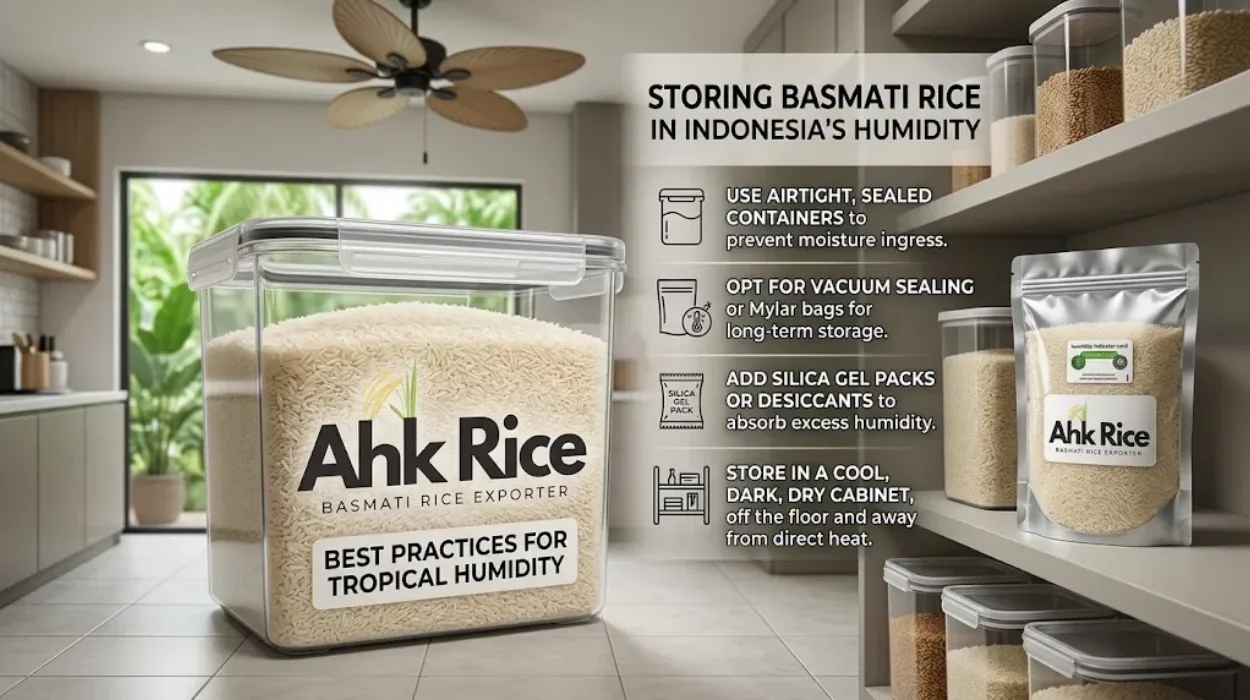
How Should Basmati Rice Be Stored in Indonesia Tropical Humidity?
Basmati rice is stored successfully in Indonesia when moisture, temperature, airflow, sanitation, and pest exposure remain controlled from port arrival to warehouse dispatch. Tropical humidity increases moisture absorption risk, so imported rice needs dry, ventilated, clean, pest-managed storage with stable conditions.
What is tropical-humidity storage for Basmati rice?
Tropical-humidity storage means keeping Basmati rice in a clean warehouse where moisture, heat, airflow, pests, and packaging are controlled to protect grain quality. In Indonesia, this system prevents moisture uptake, insect activity, mold growth, caking, odor absorption, and deterioration during storage.
Indonesia has a tropical climate with high humidity across major rice-importing regions. Jakarta, Surabaya, Medan, Makassar, and other commercial centers experience conditions that require careful warehouse management.
Rice is hygroscopic. This means the grain exchanges moisture with surrounding air. When warehouse relative humidity rises, rice absorbs moisture through its packaging and exposed grain surfaces.
Moisture control therefore starts before storage. The importer should verify the moisture percentage stated on the commercial specification, inspection report, or Certificate of Analysis (COA). For export-grade Basmati, a controlled moisture level around 12–13% supports stable storage when warehouse conditions are also controlled.
The storage objective is not simply to keep rice dry. It is to keep the grain within a stable moisture and temperature environment while preventing contamination and insect infestation.
How does Basmati rice storage work in Indonesia?
Proper Basmati storage follows a controlled sequence: receive the shipment, inspect packaging, verify moisture, isolate damaged bags, clean the warehouse, stack rice correctly, maintain airflow, monitor humidity and temperature, control insects, and rotate stock using FIFO.
1. Receive and inspect the shipment
Warehouse staff inspect containers immediately after unloading. They check bags for tears, wet patches, stains, damaged seals, unusual odors, and visible insects.
A container showing condensation or water damage receives additional inspection before entering normal stock.
2. Verify grain condition
The receiving team checks the product specification against the shipment documents. Important parameters include moisture, broken percentage, grain length, variety, packing weight, crop information, and lot identification.
Examples include 1121 Basmati, Super Kernel Basmati, and 1509 Basmati.
3. Prepare the warehouse
The warehouse floor must remain clean and dry. Rice bags should not sit directly on a damp floor.
Pallets create separation between bags and the floor. They also improve inspection access and airflow.
4. Build stable stacks
Rice bags should be stacked securely without blocking walls, doors, ventilation points, fire equipment, or inspection paths.
A practical warehouse layout leaves inspection space around stacks. This makes insect monitoring and stock rotation easier.
5. Control environmental conditions
Humidity and temperature require regular measurement. A digital thermo-hygrometer records relative humidity and temperature at different warehouse points.
The warehouse should avoid sudden temperature changes because condensation can form when warm humid air contacts cooler surfaces.
6. Monitor inventory
Each lot should retain its identity from receipt through dispatch. Stock records should include arrival date, lot number, product variety, packaging format, quantity, and inspection status.
FIFO, or First In, First Out, moves older stock before newer stock.
What are the key components of a Basmati rice storage system?
The key components are moisture control, warehouse ventilation, pallets, sealed packaging, temperature monitoring, humidity monitoring, sanitation, insect monitoring, stock rotation, and lot traceability. Each component addresses a specific quality risk in Indonesia’s humid environment.
Moisture control
Moisture is one of the most important storage variables. Excess moisture creates conditions that support microbial activity, quality deterioration, and clumping.
Warehouse operators should measure grain moisture rather than judging dryness by appearance alone.
Ventilation
Air movement reduces stagnant humid air around rice stacks. Ventilation also helps maintain a more stable warehouse environment.
Ventilation does not replace dehumidification when indoor humidity remains excessively high.
Packaging
Packaging acts as a barrier between rice and the warehouse environment. Common commercial formats include 5 kg, 10 kg, 25 kg, and 50 kg bags.
Packaging should remain intact throughout storage.
Pest monitoring
Stored rice attracts pests when sanitation and environmental controls fail. Common stored-product insects include rice weevils, lesser grain borers, and warehouse moths.
Monitoring traps provide an early warning system before an infestation becomes visible throughout a stack.
Sanitation
Food-grade warehouses require regular cleaning. Spilled grains should be removed immediately because residues provide food for insects and complicate pest control.
Traceability
Lot numbers connect physical stock with export documents and quality records. Traceability becomes especially important when several Basmati varieties or crop lots occupy one warehouse.
What are the benefits of controlled Basmati rice storage?
Controlled storage preserves Basmati rice quality by limiting moisture absorption, pest activity, contamination, odor transfer, and packaging damage. It also supports consistent cooking performance, longer inventory stability, accurate stock rotation, and reliable quality control for imported rice.
Basmati rice has distinctive aroma, grain length, texture, and cooking characteristics. Poor storage can affect these qualities even when the rice initially meets export specifications.
Moisture control protects grain stability. Pest prevention protects physical quality. Sanitation protects food safety and warehouse hygiene.
Stable storage also helps distributors maintain consistent product presentation. A retail pack should arrive in good condition without excessive dust, damaged bags, insect evidence, or moisture-related caking.
For foodservice buyers, storage stability supports predictable kitchen performance. Restaurants, caterers, hotels, and institutional kitchens require rice that performs consistently across repeated cooking cycles.
For private-label importers, controlled warehouse conditions also protect the packaged product before distribution to supermarkets and specialty stores.
Where is properly stored Basmati rice used?

Stored Basmati rice serves retail, wholesale, foodservice, catering, hospitality, institutional, and private-label markets. In Indonesia, importers distribute rice through urban wholesalers, supermarkets, specialty food channels, restaurants, hotels, caterers, and commercial kitchens.
Retail distribution
Retailers require intact consumer packaging and stable product quality. Imported Basmati is commonly positioned as a specialty rice for households seeking long-grain aroma and distinct cooking characteristics.
Foodservice
Restaurants and catering businesses purchase larger packs for repeated kitchen use. Storage conditions become important because commercial buyers often hold inventory before consumption.
Hotels and hospitality
Hotels use Basmati in buffet service, banquet menus, Indian and Middle Eastern dishes, and international cuisine.
Wholesale distribution
Wholesalers store larger quantities before selling to downstream retailers and foodservice operators. Their warehouses therefore require stronger inventory control and pest monitoring.
Private-label programs
Importers selling rice under their own brand need consistent packaging, lot identification, product specifications, and warehouse controls.
What are the common Basmati storage problems and misconceptions?
The most common problems are high warehouse humidity, direct floor contact, damaged packaging, poor ventilation, weak pest monitoring, condensation, mixed lots, and delayed stock rotation. Dry-looking rice does not prove that storage conditions are suitable.
“Rice is dry, so humidity does not matter”
This is incorrect. Rice can absorb moisture from humid air even when the grain looks dry.
The packaging system and warehouse environment both influence moisture movement.
“Pallets are only for convenience”
Pallets provide a physical barrier between rice bags and the warehouse floor. They also improve inspection and cleaning access.
“Visible insects are the first sign of infestation”
Insects can remain inside or around stored products before an obvious infestation appears. Regular monitoring provides earlier detection.
“Ventilation alone solves humidity”
Ventilation improves airflow, but outdoor Indonesian air can also contain high moisture. Warehouse operators need measured humidity control rather than relying only on open doors or fans.
“All Basmati varieties store identically”
Different varieties share basic storage requirements, but their commercial specifications, packaging, crop age, and intended market can differ.
1121, Super Kernel, and 1509 Basmati should therefore remain separately identified by lot and specification.
What storage conditions should Indonesian Basmati rice importers prioritize?
Indonesian importers should prioritize grain moisture around 12–13%, dry floors, palletized storage, controlled humidity, adequate airflow, intact packaging, regular pest inspection, clean facilities, temperature monitoring, and FIFO stock rotation for every imported rice lot.
The warehouse should operate as a controlled food-storage environment rather than a simple commodity holding area.
Inspection begins at container unloading. The receiving team checks packaging and shipment condition. The warehouse then maintains separation from floors and walls while preserving airflow around stacks.
Humidity and temperature readings should be recorded rather than estimated. Pest monitoring should follow a documented schedule. Cleaning should remove spilled grain and dust before they accumulate.
These controls connect storage quality with the wider import process. Imported Basmati reaches Indonesia after processing, grading, packaging, documentation, transportation, and customs procedures. Storage is the stage that protects those earlier quality controls until the rice reaches the final buyer.
The same principle applies across major Basmati categories. 1121 is valued for its long grain and aroma. Super Kernel is recognized for its aromatic Pakistani Basmati characteristics. 1509 provides another long-grain Basmati option used across commercial and foodservice markets.
Proper storage protects these product attributes without changing the underlying identity of the rice.
For importers planning warehouse operations, the next step is to connect humidity control with warehouse design, moisture specifications, and insect-prevention procedures. A detailed guide on moisture control, warehouse conditions and insect prevention for imported rice fits naturally at this point.
Frequently Asked Question
Can Basmati rice be stored directly on the floor?
Rice should not be stored directly on the warehouse floor. Pallets provide separation from floor moisture and improve cleaning and inspection access.
Which insects affect stored Basmati rice?
Common stored-product pests include rice weevils, lesser grain borers, and warehouse moths. Regular inspection and monitoring help detect activity early.
How long can imported Basmati rice be stored?
Storage life depends on moisture, packaging, temperature, humidity, sanitation, crop age, and warehouse conditions. The commercial shelf-life specification should guide inventory planning.
Why is FIFO important for imported Basmati rice?
FIFO moves older lots before newer lots. It reduces prolonged storage and supports systematic inventory management.
Do 1121, Super Kernel, and 1509 require different storage?
All require controlled dry storage, but each lot should retain its individual product specification, packaging identity, moisture record, and traceability information.