Why Does Basmati Rice Elongation Matter to USA Foodservice Buyers?
USA foodservice buyers evaluate Basmati rice using measurable quality standards before signing supply contracts. One of the most important indicators is grain elongation after cooking. Elongation directly affects plate presentation, serving consistency, customer satisfaction, and food cost management. Restaurants, catering companies, institutional kitchens, hotel groups, airline caterers, and meal-preparation businesses purchase premium Basmati because long, separate grains create a recognizable dining experience that customers expect from South Asian, Middle Eastern, and fusion cuisine.
Cooking performance depends on more than raw grain length. Buyers also examine cooking yield, water absorption, grain integrity, aroma retention, and texture. These quality characteristics work together during cooking, but elongation remains one of the easiest features to measure visually. Importers that understand elongation standards also gain a better understanding of the testing methods used before international purchases. Readers interested in how importers measure post-cooking performance should also read our guide explaining:
How importers evaluate cooking yield before approving premium Basmati rice shipments.
In 2026, authentic Pakistani Basmati continues to supply the United States through established importers because its genetic characteristics naturally produce significant grain elongation after cooking. This characteristic distinguishes premium Basmati from ordinary long-grain rice and explains why foodservice purchasing teams include elongation specifications in procurement documents.
What Is Basmati Rice Elongation?
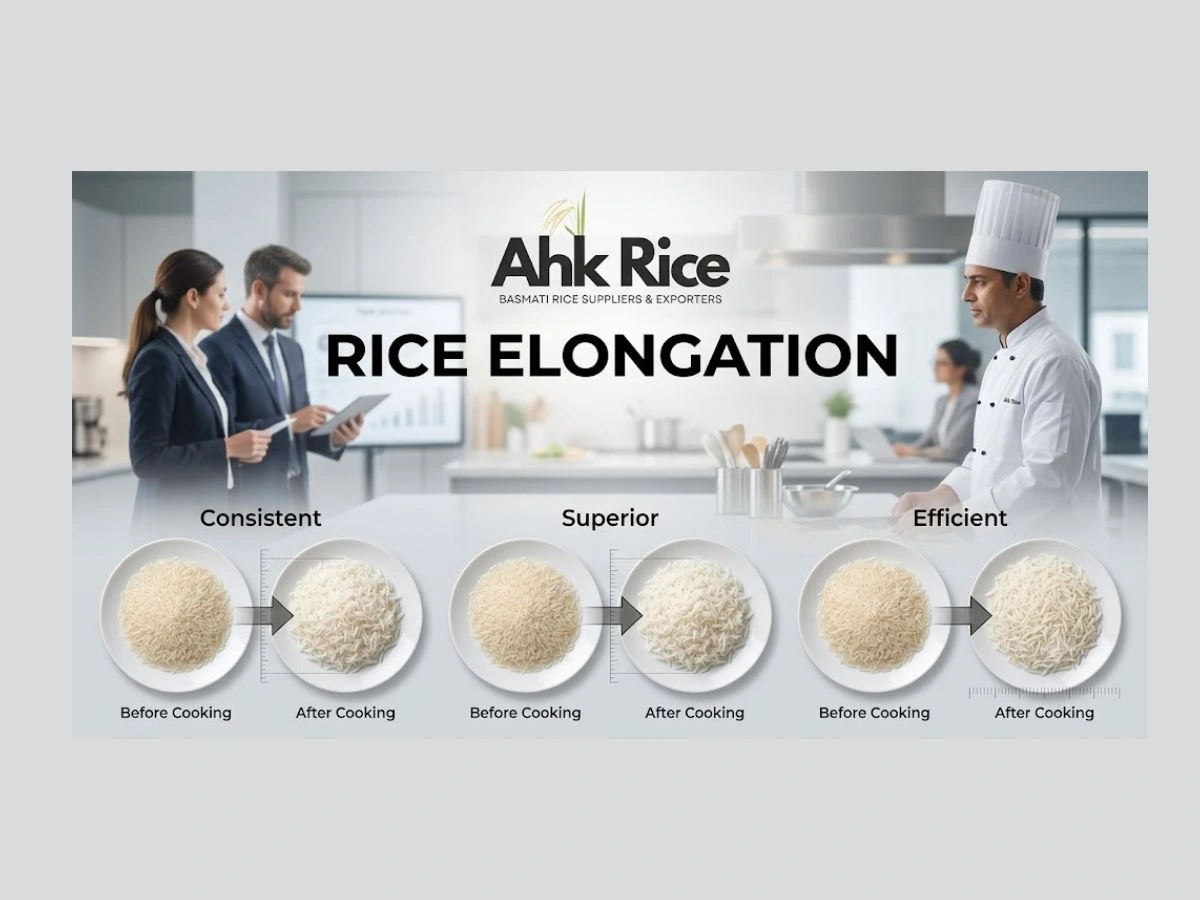
Basmati rice elongation is the measurable increase in grain length after cooking without excessive grain width expansion. Premium Pakistani Basmati commonly doubles or exceeds its original grain length while remaining slender, separate, aromatic, and visually attractive on the finished plate.
Elongation describes physical grain growth during cooking. Laboratories calculate elongation by measuring raw grain length, cooking representative samples under standardized conditions, and measuring the cooked grains again.
For example, a raw grain measuring 8.3 millimeters that reaches approximately 17 millimeters after cooking demonstrates an elongation ratio of about 2.0. Buyers compare these measurements between suppliers using identical cooking procedures.
Elongation differs from swelling. Ordinary long-grain rice often becomes wider during cooking. Premium Basmati primarily increases in length while maintaining its slender appearance.
This distinction influences food presentation. Individual grains remain separate instead of clustering together, producing a premium appearance expected by restaurants serving biryani, pulao, grilled meat platters, seafood dishes, and buffet meals.
How Does Basmati Rice Naturally Produce Long Cooked Grains?
Natural elongation results from Basmati genetics, grain structure, controlled cultivation, proper harvesting, scientific drying, careful milling, and appropriate aging. Each production stage preserves the internal grain characteristics responsible for length expansion during cooking.
The process begins before planting. Authentic Basmati varieties possess inherited characteristics that determine grain shape and cooking behavior.
Pakistani Punjab provides fertile alluvial soil, seasonal temperature variation, and irrigation systems that support premium Basmati cultivation. These growing conditions contribute to uniform grain development throughout the season.
After harvest, freshly collected paddy undergoes controlled drying until export-grade moisture levels are achieved. Stable moisture protects internal grain structure before milling.
Milling removes the husk while preserving grain integrity. Modern milling equipment minimizes broken kernels because broken grains reduce cooking consistency.
Many premium export lots then undergo controlled aging. Aging modifies internal starch characteristics, improves cooking stability, strengthens aroma development, and enhances elongation performance.
Processing concludes with grading, sorting, optical color separation, metal detection, laboratory testing, packaging, palletization, and container loading for international shipment.
Which Components Determine Cooking Elongation?
Several measurable grain characteristics determine elongation performance, including variety genetics, grain maturity, kernel length, starch composition, moisture content, milling quality, aging period, and storage conditions before cooking. Every factor contributes to consistent post-cooking performance.
Genetics establish the maximum elongation potential.
Uniform grain maturity ensures similar cooking behavior across the batch.
Long kernels provide greater elongation potential than shorter kernels.
Balanced starch composition influences water absorption and grain expansion.
Controlled moisture improves storage stability before cooking.
Minimal broken kernels increase consistency because whole grains elongate more uniformly.
Proper aging improves grain strength and cooking characteristics.
Correct warehouse conditions preserve quality until export.
Foodservice buyers review laboratory specifications covering these measurable attributes before purchasing container quantities.
Which Pakistani Basmati Varieties Show Strong Elongation?
Pakistani exporters supply several internationally recognized varieties.
1121 Basmati produces some of the world’s longest cooked grains.
Super Kernel Basmati combines aroma with excellent grain separation.
1509 Basmati offers high cooking performance and efficient production cycles.
Each variety serves different market segments based on customer preference, menu requirements, and regional demand.
Why Does Elongation Matter to USA Foodservice Buyers?
USA foodservice buyers prioritize elongation because longer cooked grains improve visual presentation, serving consistency, customer perception, buffet appearance, recipe reliability, and operational efficiency across restaurants, hotels, institutions, airlines, and commercial catering businesses.
Presentation influences customer expectations before tasting begins.
A biryani served with long, distinct grains appears premium compared with rice containing short or swollen kernels.
Consistent elongation also improves portion planning.
Foodservice operations prepare hundreds or thousands of meals daily. Uniform cooking behavior simplifies production scheduling and quality control.
Airline caterers require visually appealing rice after reheating.
Hotel buffet operators require grains that remain separate during extended service periods.
Institutional kitchens benefit from predictable cooking characteristics that reduce production variability.
Restaurant chains require standardized appearance across multiple locations.
These operational advantages explain why procurement teams evaluate elongation before approving suppliers.
How Do Importers Measure Elongation Before Purchasing Rice?
Importers evaluate elongation using standardized laboratory procedures, representative sampling, controlled cooking conditions, precision measurement equipment, statistical averaging, and documented quality reports that allow objective comparison between multiple export suppliers.
Representative grain samples are collected from export lots.
Laboratories measure uncooked grain length using calibrated digital instruments.
Technicians cook samples under standardized water ratios and cooking times.
Cooked grains cool before measurement.
Multiple grains are measured instead of relying on one sample.
Average elongation ratios are calculated and documented.
Importers compare laboratory reports from different suppliers before negotiating commercial contracts.
Independent inspection agencies also verify specifications when buyers request third-party quality confirmation before shipment.
Which Markets Value High-Elongation Pakistani Basmati?
Premium elongation receives strong demand across the United States, Canada, Saudi Arabia, United Arab Emirates, Qatar, Kuwait, Oman, the United Kingdom, Europe, Australia, and other premium foodservice markets where authentic Basmati quality influences purchasing decisions.
The United States imports premium Basmati for Indian restaurants, Pakistani restaurants, Middle Eastern restaurants, hospitality groups, wholesalers, supermarket distributors, and institutional foodservice.
Canada follows similar purchasing standards because of multicultural consumer demand.
Gulf countries purchase premium Basmati for hotels, catering companies, government institutions, and household consumption.
European importers emphasize authenticity, traceability, and quality documentation.
Australia imports premium varieties serving hospitality and retail markets.
Each destination evaluates measurable specifications rather than marketing claims.
Which Certifications Support Premium Export Basmati?
International Basmati exports rely on recognized quality, food safety, traceability, phytosanitary, and regulatory certifications that verify processing standards, product safety, and export compliance before international shipment reaches commercial buyers.
Food safety management systems maintain standardized processing procedures.
HACCP identifies and controls food safety risks during production.
ISO 22000 integrates comprehensive food safety management throughout processing.
Phytosanitary certification confirms compliance with importing country plant health requirements.
Fumigation documentation accompanies shipments when destination regulations require treatment.
Certificate of Origin verifies exporting country.
Laboratory reports document quality characteristics including moisture, broken kernels, purity, and grain dimensions.
Import documentation supports customs clearance according to destination regulations in 2026.
What Benefits Does High Elongation Provide During Commercial Cooking?
High elongation improves serving appearance, cooking consistency, grain separation, menu quality, customer satisfaction, portion control, operational efficiency, and premium product perception across professional foodservice environments serving large meal volumes every day.
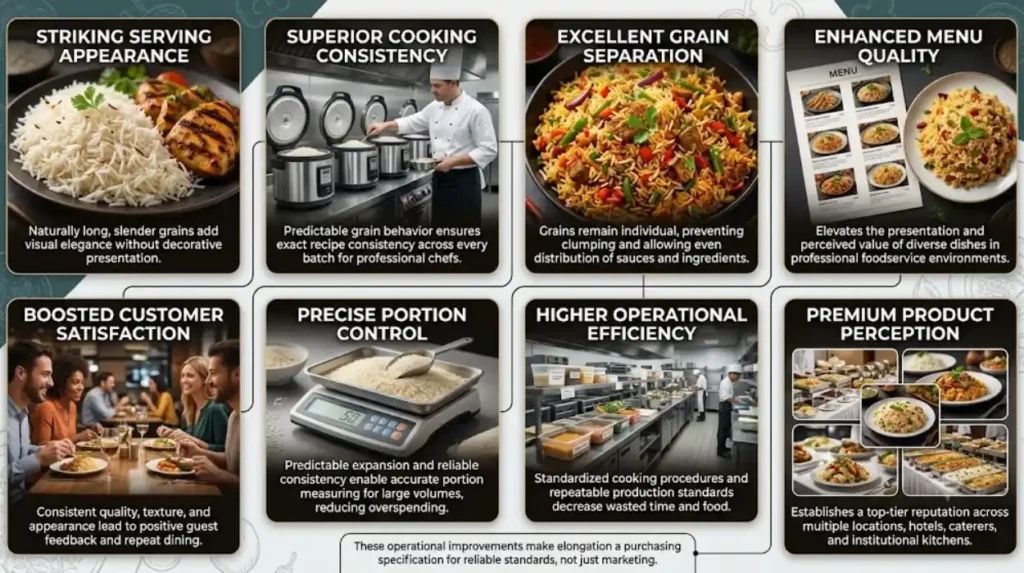
Long grains improve visual appeal without requiring decorative presentation.
Separate grains mix evenly with spices, vegetables, herbs, meat, seafood, and sauces.
Professional chefs maintain recipe consistency because grain behavior remains predictable.
Large catering operations reduce waste by following standardized cooking procedures.
Hotels maintain premium buffet presentation during service.
Restaurant brands achieve consistent customer expectations across locations.
Institutional kitchens benefit from repeatable production standards.
These operational improvements explain why elongation remains a purchasing specification rather than a simple marketing feature.
What Common Misconceptions Exist About Rice Elongation?
Several misconceptions create confusion because grain length, elongation, aroma, quality, and cooking yield describe different characteristics. Professional buyers evaluate each measurement independently before selecting premium export-grade Basmati rice.
Some buyers assume raw grain length automatically guarantees superior elongation.
Laboratory testing proves otherwise because genetics, aging, and processing influence final cooking performance.
Others believe wider cooked grains indicate premium quality.
Authentic Basmati increases primarily in length rather than width.
Another misconception suggests aroma determines elongation.
These characteristics develop independently, although premium Basmati generally delivers both strong aroma and impressive elongation.
Some people also assume every long-grain rice variety behaves like Basmati.
Ordinary long-grain rice lacks the distinctive genetic characteristics responsible for exceptional length expansion.
Professional purchasing teams therefore evaluate measurable laboratory data instead of relying on appearance alone.
Why Will Elongation Continue to Influence USA Basmati Imports?
Consumer demand for premium dining experiences, standardized foodservice operations, objective quality specifications, and authentic Basmati performance ensures elongation remains a critical purchasing factor for USA importers throughout 2026 and beyond.
American consumers increasingly recognize authentic Basmati through restaurant dining, international cuisine, and retail availability.
Foodservice businesses respond by sourcing rice that consistently delivers long, separate grains after cooking.
Procurement departments continue using measurable quality specifications because objective testing reduces purchasing risk and supports consistent menu quality.
As international food safety standards, laboratory verification, and supply chain transparency continue improving, elongation will remain one of the defining indicators separating authentic premium Pakistani Basmati from conventional long-grain rice.
Frequently Asked Questions
How much does premium Basmati rice elongate after cooking?
Premium Pakistani Basmati rice typically elongates to about twice its original raw grain length under standardized cooking conditions. The exact elongation depends on the variety, grain maturity, aging, and proper cooking methods.
Why do USA foodservice buyers check rice elongation?
USA foodservice buyers evaluate elongation because long, separate grains improve plate presentation, maintain serving consistency, enhance customer satisfaction, and support standardized recipe preparation across restaurants, hotels, and catering operations.
Does longer raw grain always mean better elongation?
No. Raw grain length alone does not determine cooking elongation. Genetics, aging, milling quality, moisture content, and starch composition all influence how much the grain extends during cooking.
Which Pakistani Basmati variety has the highest elongation?
1121 Basmati rice is widely recognized for producing some of the world’s longest cooked grains, making it a preferred choice for premium foodservice and export markets.
How is Basmati rice elongation measured?
Laboratories measure the length of representative raw grains, cook them under standardized conditions, then measure the cooked grains to calculate the elongation ratio using precise digital instruments.
Does rice elongation affect cooking yield?
Elongation and cooking yield are different measurements. Elongation measures grain length increase, while cooking yield measures the total cooked volume or weight produced from a specific quantity of raw rice.
Which international markets prefer high-elongation Basmati rice?
High-elongation Pakistani Basmati is widely imported by the United States, Canada, Saudi Arabia, the United Arab Emirates, Qatar, Kuwait, the United Kingdom, Australia, and several European markets.
What processing steps help preserve Basmati rice elongation?
Controlled drying, careful milling, proper grain aging, moisture management, accurate grading, and suitable storage conditions help preserve the natural cooking performance of premium Basmati rice.
Does aging improve Basmati rice elongation?
Yes. Proper aging improves grain stability and starch characteristics, helping the rice cook into longer, firmer, and more separate grains while enhancing its natural aroma.
Why is grain separation important for foodservice operations?
Separate grains improve the appearance of dishes such as biryani, pulao, and rice platters, simplify portion control, and maintain consistent quality across high-volume commercial kitchens.