Supply Indonesian Middle Eastern and Biryani Restaurants with AHK Basmati Rice
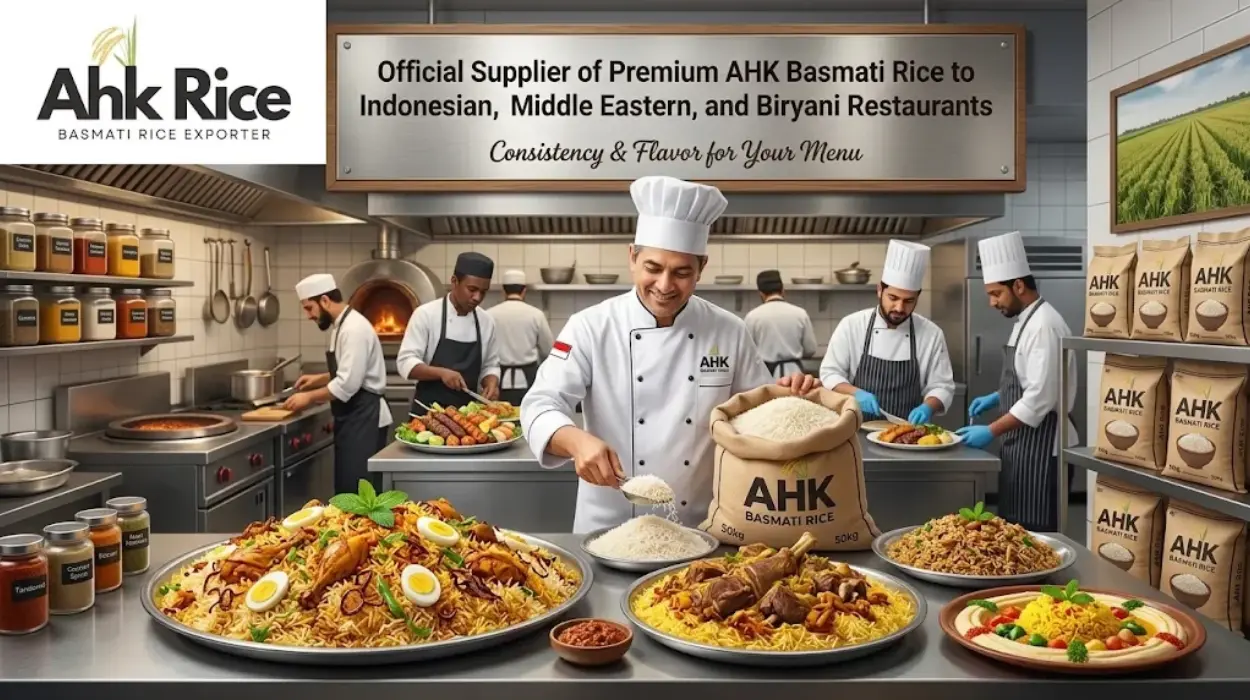
Indonesian Middle Eastern and biryani restaurants need Basmati rice that delivers consistent aroma, grain separation, elongation, cooking performance, and supply reliability. The right rice also needs to arrive with commercial specifications that match restaurant production, not only retail packaging requirements.
For restaurants serving Nasi Kebuli, Nasi Mandhi, Nasi Biryani, and related rice dishes, Pakistani Basmati provides a practical sourcing option. The decision depends on grade, grain profile, processing, moisture, broken percentage, packaging, quantity, and delivery terms.
For the background, see why Basmati rice is used for Nasi Kebuli and Nasi Biryani in Indonesia. For buyers comparing grades, the best Pakistani Basmati grade for Nasi Kebuli, Nasi Mandhi and Biryani restaurants provides the decision framework.
What is the best solution for Indonesian Middle Eastern and Biryani restaurants?
The best solution is a Pakistani Basmati supply program matched to each restaurant’s recipe, daily volume, required grain profile, packaging format, delivery port, and quality specification, with samples approved before commercial production and shipment.
Restaurants should not select rice only by grain length or price per tonne. A rice that looks premium before cooking can still produce inconsistent results if moisture, broken grains, purity, aging, or milling quality varies between lots.
AHK Rice supplies Pakistani Basmati rice for commercial buyers, including 1121, Super Kernel, and 1509 varieties. Each grade serves a different purchasing objective. Premium 1121 is suitable where long cooked grains and presentation are central. Super Kernel provides a strong balance of aroma, grain appearance, and commercial positioning. 1509 provides an efficient option for high-volume restaurant operations.
The supply decision should begin with the restaurant’s menu. Nasi Kebuli and Nasi Mandhi require rice that holds its shape during cooking while absorbing spices and stock without becoming excessively soft. Biryani operations require separate, elongated grains that remain visually distinct after cooking.
Why choose AHK Rice for restaurant supply?
AHK Rice provides Pakistani Basmati sourcing with grading, processing, packaging, documentation, sampling, and export coordination, allowing Indonesian restaurants and distributors to evaluate rice before committing to regular commercial orders.
The key advantage is process control. A restaurant buyer can specify grain length, broken percentage, moisture target, packing format, quantity, and destination before receiving a commercial quotation.
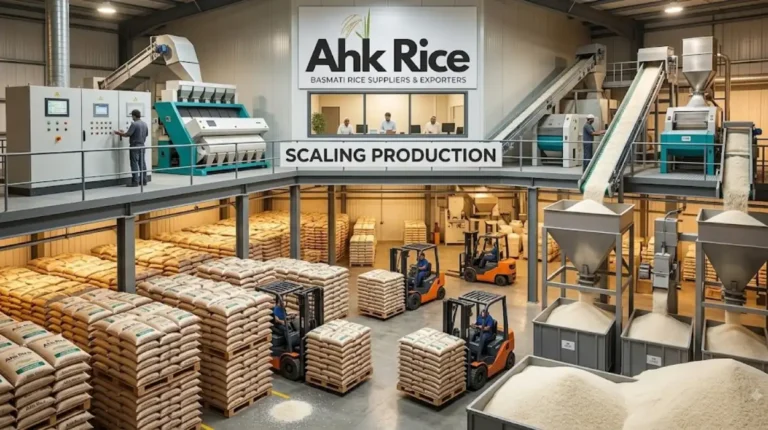
AHK Rice operates from Punjab, Pakistan, where Pakistani Basmati production is concentrated. The supply process can include cleaning, grading, Sortex processing, packing, export documentation, and container preparation.
For restaurant groups, consistency matters more than a single low quotation. A lower-priced rice becomes expensive when it increases cooking losses, changes portion presentation, or forces chefs to adjust recipes between shipments.
AHK Rice can structure supply around the restaurant’s operating model. A restaurant requiring 25 kg or 50 kg foodservice packs has different requirements from a distributor supplying multiple restaurant branches. Private-label packaging can also be considered where the buyer wants a branded retail or foodservice product.
Which Basmati grade should restaurants buy?
The correct Basmati grade depends on the restaurant’s recipe, presentation standard, purchasing volume, and target food cost, with 1121, Super Kernel, and 1509 providing different combinations of length, aroma, yield efficiency, and commercial value.
1121 is the strongest choice when extra-long cooked grains and premium presentation drive the menu. It works well for premium biryani and restaurant concepts where the visual appearance of the rice is part of the customer experience.
Super Kernel is suitable when the buyer wants aromatic Pakistani Basmati with strong grain appearance and balanced commercial positioning. It is particularly useful for restaurants and South Asian foodservice buyers that need premium performance without selecting the highest-priced specification for every menu.
1509 provides an efficient option for high-volume foodservice. Its shorter crop cycle and commercial availability make it useful where restaurants prioritize consistent supply and cost control alongside Basmati characteristics.
The final choice should be confirmed through a cooking test. A sample allows the chef to evaluate soaking, boiling, steaming, elongation, aroma, grain separation, and finished texture under the restaurant’s actual recipe.
What results can restaurants expect?
A properly matched Basmati supply program gives restaurants more predictable cooking performance, consistent plate presentation, controlled food costs, and fewer quality variations between purchase lots.
Consider a restaurant preparing several hundred portions of Nasi Kebuli each week. Small differences in grain absorption or breakage can change the cooked yield and serving appearance. A consistent specification reduces those operational variables.
For biryani restaurants, grain separation is especially important. Long, intact grains create the visual structure expected from premium biryani. For Nasi Mandhi and Nasi Kebuli, the rice must also support the cooking method and absorb the intended stock, spices, and aromatic ingredients.
AHK Rice supports this decision through sample evaluation before the commercial shipment. Buyers can compare the supplied rice against their existing restaurant rice instead of selecting entirely from a specification sheet.
How much does Pakistani Basmati rice cost for restaurants?
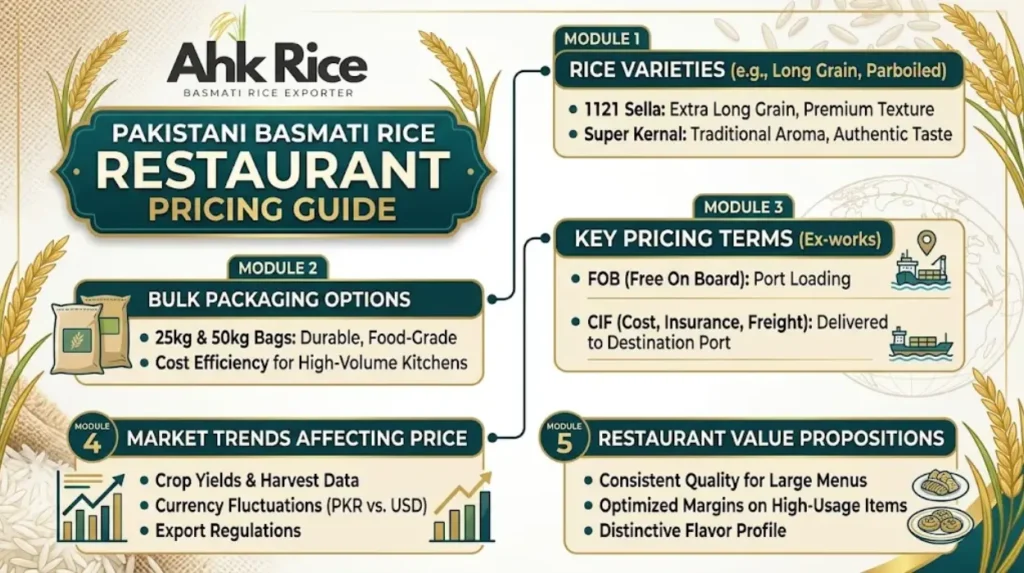
Commercial Basmati pricing depends on grade, grain length, broken percentage, moisture, processing, packaging, order quantity, destination, freight, and Incoterm, so restaurants should request a specification-based quotation rather than rely on a generic per-tonne price.
FOB pricing and delivered pricing are different purchasing decisions. FOB Karachi focuses on the rice and export loading point, while CIF pricing incorporates ocean freight and insurance to the agreed destination port.
For Indonesian buyers, the final landed cost can therefore change according to shipment size, destination, freight conditions, customs costs, and local handling. Jakarta and Surabaya can also involve different logistics arrangements.
Packaging affects the commercial quotation as well. Bulk restaurant supply may use larger foodservice bags, while distributors may require smaller retail-ready packs. Private-label printing and packaging specifications add further cost considerations.
The most useful quotation compares the same grade and specification. A buyer should request moisture, broken percentage, grain specification, packing weight, quantity, Incoterm, loading port, and destination in the quotation.
How long does shipment to Indonesia take?
A practical commercial planning window includes production and packing time plus ocean transit, with the exact schedule depending on the loading port, destination, shipping line, container availability, customs procedures, and documentation readiness.
For planning purposes, buyers should allow several weeks rather than treating rice procurement as an immediate purchase. A typical commercial shipment from Pakistan to Indonesia can involve roughly 20–30 days of ocean transit, while the complete order cycle becomes longer when production, inspection, documentation, port handling, and customs clearance are included.
Jakarta and Surabaya should be planned separately because inland distribution after port arrival depends on the restaurant’s warehouse or branch network.
Restaurant groups should therefore place repeat orders before existing inventory reaches its minimum level. A supply schedule based on monthly consumption is more reliable than emergency purchasing.
How does the sample process work?
The sample process should verify cooking performance before commercial shipment, starting with the required grade and specification, followed by sample dispatch, restaurant cooking tests, buyer approval, commercial quotation, production, inspection, packing, and shipment.
First, the buyer provides the required grade, quantity, packaging format, destination, and cooking application. AHK Rice then prepares the appropriate sample specification.
Where available under the agreed sampling arrangement, Super Kernel samples can be supplied for testing. The buyer covers courier shipping and applicable phytosanitary charges. The sample is then tested by the restaurant’s chef or quality team.
The test should cover aroma, grain appearance, cooking time, elongation, separation, texture, broken grains, and performance in the restaurant’s actual recipe.
Once the sample is approved, the buyer confirms the commercial specification and order quantity. AHK Rice can then proceed with quotation, production or allocation, quality checks, packaging, export documentation, and container loading.
This sequence reduces the risk of purchasing a full container before the kitchen has validated the rice.
How should restaurants start sourcing?
Start with the restaurant’s monthly consumption and cooking requirements, select two suitable Pakistani Basmati grades, test commercial samples, approve the specification, and then request an FOB or CIF quotation for the required Indonesian destination.
The first step is to calculate consumption. A restaurant should identify monthly rice usage, average portions, peak demand, preferred pack size, and current purchasing cost.
Next, compare grades based on the menu. Premium biryani restaurants can prioritize 1121. Restaurants seeking a balanced premium specification can test Super Kernel. High-volume operations can evaluate 1509 alongside the other options.
Then conduct a controlled cooking test. Use the same water ratio, soaking period, cooking equipment, spice base, and serving conditions used in normal production.
AHK Rice should receive the approved specification before the final commercial quotation. This creates a clear purchasing standard and makes future repeat orders easier to compare.
For restaurant groups, the strongest approach is a repeat supply agreement based on approved specifications rather than changing grades whenever market prices move.
What should Indonesian restaurant buyers decide before ordering?
Indonesian restaurant buyers should approve the rice through cooking tests, confirm the commercial specification, compare FOB and CIF costs, plan inventory around shipping time, and establish a repeat supply schedule before placing a container order.
The purchasing decision should cover five points: grade, specification, quantity, destination, and delivery term.
Grade determines the cooking and presentation profile. Specification controls measurable quality. Quantity determines commercial pricing and shipment efficiency. Destination affects freight and inland logistics. Incoterm determines which costs are included in the quoted price.
AHK Rice can then structure the order around the buyer’s approved requirements rather than supplying an unspecified commodity.
For Middle Eastern restaurants, Indonesian Biryani operators, Nasi Kebuli concepts, Nasi Mandhi restaurants, distributors, and multi-branch foodservice groups, this approach creates a repeatable procurement process.
The objective is not simply to buy Pakistani Basmati rice. The objective is to secure a grade that performs consistently in the kitchen, arrives under controlled commercial specifications, and supports the restaurant’s food-cost target.
Frequently Asked Questions
Which Pakistani Basmati is best for Indonesian biryani restaurants?
1121 is a strong option for premium biryani.
It provides long cooked grains and strong visual presentation.
Super Kernel offers a balanced premium alternative.
1509 suits restaurants focused on volume and cost efficiency.
Final selection should be confirmed through a cooking test.
Can AHK Rice supply restaurants in Indonesia?
Yes, AHK Rice supplies Pakistani Basmati for international commercial buyers.
Restaurants can specify grade, packing, quantity, and destination.
FOB and CIF quotations can be considered.
Samples can be tested before a commercial order.
Shipment planning should account for production and ocean transit.
How much does a Basmati sample cost?
Sample arrangements depend on the selected product and shipment requirements.
Super Kernel sampling can be available under agreed sampling terms.
The buyer covers courier shipping and applicable phytosanitary charges.
The restaurant then performs its own cooking evaluation.
Commercial pricing is provided after specification and quantity confirmation.
How long does Pakistani rice take to reach Indonesia?
Ocean transit can take roughly 20–30 days depending on routing.
The complete order cycle takes longer than ocean transit alone.
Production, packing, inspection, documentation, and port handling add time.
Jakarta and Surabaya schedules can differ.
Buyers should maintain inventory before the existing stock becomes critical.
Can restaurants request private-label Basmati rice?
Yes, private-label packaging can be considered for suitable commercial orders.
The buyer specifies pack size, branding, and packaging requirements.
The rice specification should be approved before production.
Packaging costs depend on format and order quantity.
Private-label supply is best planned as a repeat purchasing program.