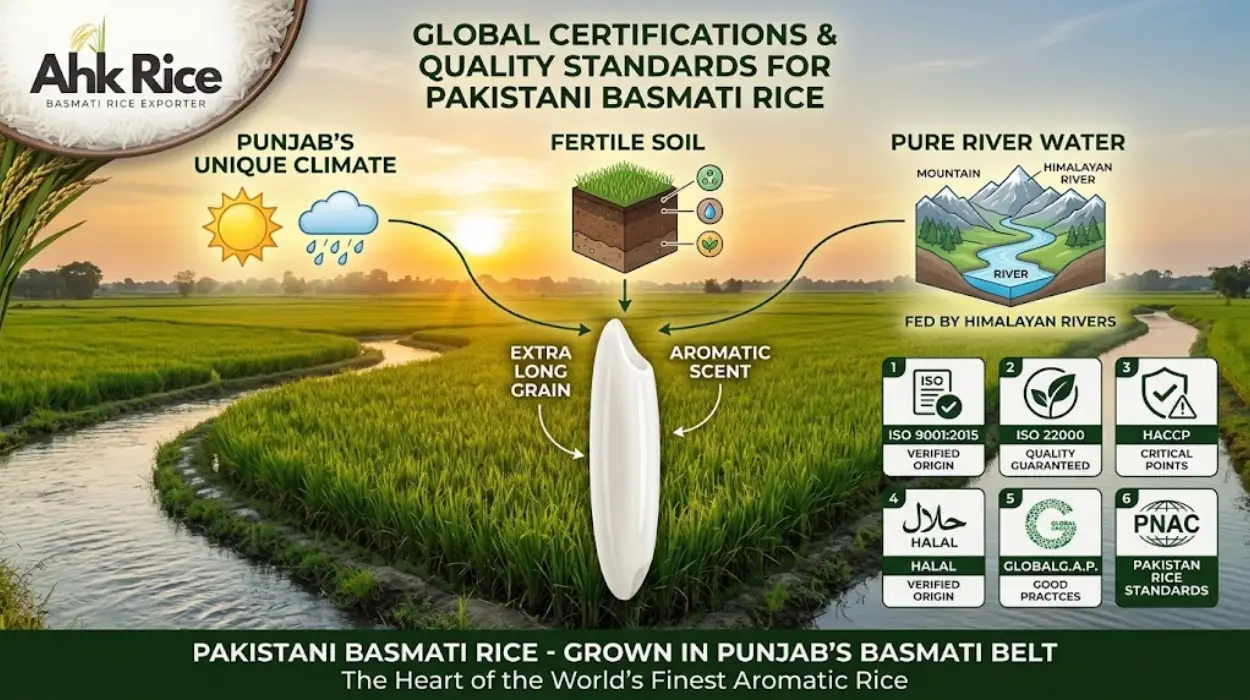
How Punjab’s Climate, Soil and River Water Create Basmati’s Long Grain and Aroma
Punjab-origin Basmati rice combines distinctive aroma, slender grains and characteristic cooking performance through the interaction of rice genetics, seasonal temperatures, soil conditions, water management and post-harvest handling. Buyers comparing suppliers must evaluate these factors together because growing conditions influence quality, while processing and storage determine how consistently that quality reaches export markets.
Understanding Pakistani Basmati rice varieties, their origins and defining characteristics helps importers connect agricultural conditions with commercial specifications. Climate and soil explain the production environment, but variety selection, milling standards, moisture control and shipment traceability determine whether a particular consignment meets the buyer’s requirements. Punjab’s agricultural geography therefore provides a starting point for evaluating Basmati, not a substitute for inspecting the finished product.
Punjab’s Basmati-growing areas include districts such as Gujranwala, Hafizabad, Sheikhupura, Narowal and Sialkot. These areas have established rice-growing traditions and access to irrigation infrastructure. Their agricultural conditions support traditional aromatic Basmati varieties, including Super Kernel and premium long-grain types such as 1121. However, individual fields differ in soil composition, drainage, water availability and cultivation practices, so geographical origin alone does not guarantee identical grain quality.
How Does Punjab’s Climate Influence Basmati Grain Length and Aroma?
Punjab’s seasonal climate supports the growth cycle required by traditional Basmati varieties, from vegetative development to flowering and grain filling. Appropriate temperatures, sunlight and crop duration influence grain development and aroma expression. Variety genetics remain fundamental, while heat stress, water shortages and poorly timed harvesting can reduce grain quality and increase inconsistencies between production lots.
Basmati cultivation follows a seasonal pattern in which farmers establish crops during the warmer months and harvest mature grain later in the season. The crop needs sufficient warmth during early development and suitable conditions during flowering and grain filling. Excessive heat around flowering can interfere with pollination, while stress during grain filling can increase chalkiness, immature kernels and broken grains after milling.
Traditional Basmati varieties generally have longer crop durations than early-maturing alternatives. The 1121 and Super Kernel varieties serve different commercial specifications, while 1509 offers a shorter-duration production option. Typical maturity periods vary with variety and local conditions; 1509 commonly matures in approximately 95–105 days, while traditional types can require around 135–145 days.
Temperature also influences aroma development, but it does not create aroma independently. Basmati’s characteristic fragrance is associated with the compound 2-acetyl-1-pyrroline, commonly abbreviated as 2AP. Genetic characteristics, growing conditions, crop maturity and post-harvest management collectively affect the resulting aromatic profile. Buyers should assess actual aroma and cooking performance through representative samples rather than relying exclusively on claims about the growing region.
Which Soil Conditions Support Punjab’s Basmati Production?
Basmati performs well in suitable alluvial soils that provide adequate nutrient availability, moisture retention and drainage. Punjab’s river plains contain diverse soil profiles developed through sediment deposition. Soil texture, organic matter, salinity, pH and field drainage influence crop establishment, nutrient uptake and grain development, making field-level management more informative than a general claim about fertile Punjab soil.
Alluvial soil contains mineral material deposited by rivers and associated flooding processes. Its properties vary by location, depth and cultivation history. Loam and clay-loam soils can provide a useful balance between water retention and aeration, while heavier soils retain more water and require careful drainage management. Sandy soils generally lose water more quickly and may require more frequent irrigation.
Soil salinity is a significant consideration because excess soluble salts interfere with water uptake and can restrict plant growth. Poor drainage can also create prolonged waterlogging, while unsuitable nutrient application can affect crop development and grain uniformity. Farmers manage these risks through soil assessment, land levelling, balanced fertilisation and irrigation scheduling.
The relationship between soil and grain quality is indirect rather than absolute. Soil conditions influence plant health and grain filling, but the selected variety establishes much of the potential grain shape, length and aromatic character. Export buyers should therefore distinguish between the natural characteristics of a variety and the quality controls applied during cultivation, drying, storage and milling.
How Does River Water Irrigation Affect Basmati Quality?
Punjab’s river system and canal networks support irrigated agriculture by delivering water across rice-producing areas. Reliable irrigation helps farmers maintain crop growth during critical stages, but water quality, timing and field drainage determine how effectively it supports Basmati production. Appropriate irrigation protects yield and grain development, while inefficient water management increases production risks and resource costs.
The Indus River system includes major rivers such as the Jhelum, Chenab, Ravi and Sutlej, alongside an extensive network of canals and distributaries. This infrastructure supports agricultural production across Punjab. However, not every Basmati field receives direct river water. Irrigation sources vary and include canal water, groundwater and combinations of these supplies.
Rice requires sufficient water during important growth stages, particularly around establishment and reproductive development. Water shortages can restrict plant growth and reduce grain filling. Excessive or poorly managed irrigation can waste resources, increase drainage problems and contribute to soil salinity under unsuitable conditions.
Water quality also matters. Salinity and contaminants can affect soil conditions and crop performance. For export-oriented production, irrigation management forms part of broader agricultural risk control, although the presence of river or canal irrigation does not independently establish food safety, pesticide compliance or export certification. Those requirements need separate monitoring, testing and documentation.
What Are the Available Solutions for Sourcing Consistent Punjab-Origin Basmati?
Importers can improve sourcing consistency through variety selection, field-level production controls, processor quality assurance and documented traceability. Each approach addresses a different risk. Variety selection defines expected grain characteristics, cultivation controls support crop quality, processing establishes measurable specifications, and traceability connects the finished shipment to identifiable production and handling records.
Four practical sourcing approaches serve different procurement needs.
1. Variety-based sourcing: Buyers select 1121, Super Kernel or 1509 according to grain appearance, aroma, cooking behaviour, price target and intended use. This approach establishes the product category before commercial negotiations.
2. Agricultural and supplier assessment: Buyers review growing-region information, cultivation practices, harvest timing and the supplier’s ability to maintain consistent procurement standards. This approach improves visibility into production risks but does not replace finished-product testing.
3. Processor-led quality control: Buyers specify grain length, broken percentage, moisture, foreign matter, milling quality and packaging requirements. The processor uses grading, sorting and inspection to bring the finished lot within the agreed specification.
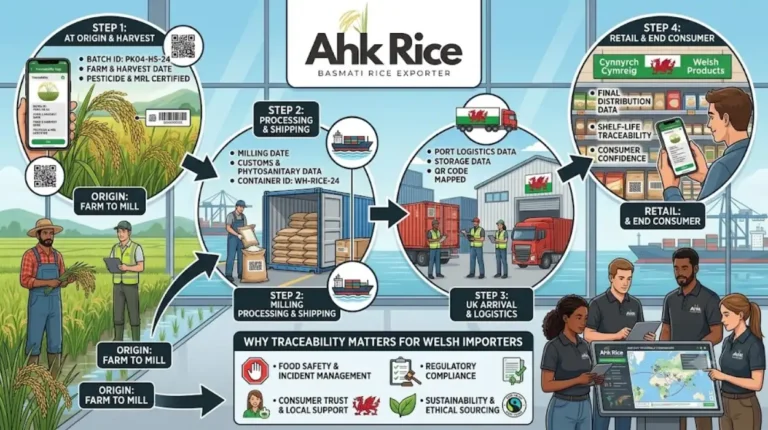
4. Farm-to-port traceability: Buyers require linked records for procurement, lot identification, processing, quality approval, packing, container loading and export documentation. This approach improves accountability and helps investigate discrepancies between an approved sample and a delivered shipment.
The strongest sourcing system combines all four approaches. Agricultural origin explains where the rice comes from, processing determines its measurable condition, and traceability helps buyers verify how the product moved through the supply chain.
How Do Different Basmati Sourcing Approaches Compare?
Variety-based sourcing offers a clear starting point, while agricultural assessment provides production context and processing controls deliver measurable quality assurance. Farm-to-port traceability connects these elements through documented records. Importers handling large volumes or supplying multiple distributors benefit from combining all four methods because no single control verifies origin, grain specifications, food safety and shipment integrity independently.
Punjab-Origin Basmati Specification Comparison
The following table compares representative varieties and sourcing controls. Grain-length figures are indicative raw-grain ranges and must be confirmed against the supplier’s actual grade specification.
| Attribute | 1121 Basmati | Super Kernel Basmati | 1509 Basmati |
|---|---|---|---|
| Grain profile | Extra-long, slender grain | Long, slender grain | Extra-long, slender grain |
| Typical raw grain length | Approximately 8.0–8.3 mm or according to grade | Approximately 7.0–7.5 mm | Approximately 8.1–8.4 mm |
| Main commercial strength | Premium length and presentation | Traditional aroma and balanced value | Shorter crop duration and competitive sourcing |
| Aroma | Characteristic Basmati fragrance | Characteristic traditional fragrance | Characteristic Basmati fragrance |
| Cooking application | Premium retail and foodservice | Retail, wholesalers and restaurants | Volume retail and institutional foodservice |
| Key quality checks | Length, broken percentage, moisture | Length, aroma, broken percentage | Length, moisture, uniformity |
| Main buying consideration | Premium grade consistency | Balance of aroma, grade and price | Yield economics and application suitability |
These ranges are indicative, not universal contractual standards. Buyers must specify whether measurements refer to raw grain, milled grain or another defined measurement method. Steam, white and parboiled processing also affect product appearance and cooking behaviour, so processing type belongs in the purchase specification.
A reliable comparison includes a representative sample, agreed laboratory or inspection methods, a defined moisture limit, a maximum broken percentage, packaging requirements and an acceptance procedure. Many commercial specifications use moisture limits of 12–13% and broken-rice limits of 2–3% for selected grades, but these figures are buyer-defined targets rather than automatic guarantees for every variety or shipment.
Which Basmati Sourcing Method Works Best for Different Cases?
The best sourcing method depends on the buyer’s market, product positioning, volume and tolerance for quality variation. Premium retailers need consistent grain appearance and aroma, while bulk distributors prioritise repeatable specifications and landed cost. Buyers entering a new market benefit from samples and supplier verification before committing to container-scale orders.
Premium retail brands should begin with variety selection and cooking tests. The buyer can compare 1121 and Super Kernel for grain presentation, aroma, cooked elongation and consumer expectations. Processing controls and packaging consistency become essential when the same product must be reproduced across multiple shipments.
Wholesale distributors should prioritise repeatable grading, volume availability and documented lot controls. A lower quoted price per metric tonne does not necessarily provide better value when the consignment contains excess broken grains, inconsistent moisture or a specification mismatch. A written specification and inspection procedure make supplier comparisons more meaningful.
Hotels, caterers and institutional kitchens should test the rice under their actual cooking conditions. Water ratios, cooking time, holding periods and serving methods affect operational results. Sella rice can suit applications requiring firm, separate grains and extended holding, while steam or white rice can serve other menu and presentation requirements.
New importers should begin with samples, document checks and a clear commercial specification. The approved sample should represent the grade to be supplied, and the contract should define how disputes are resolved if the delivered product differs from the agreed standard.
How Do USA and Gulf Markets Compare in Basmati Requirements?
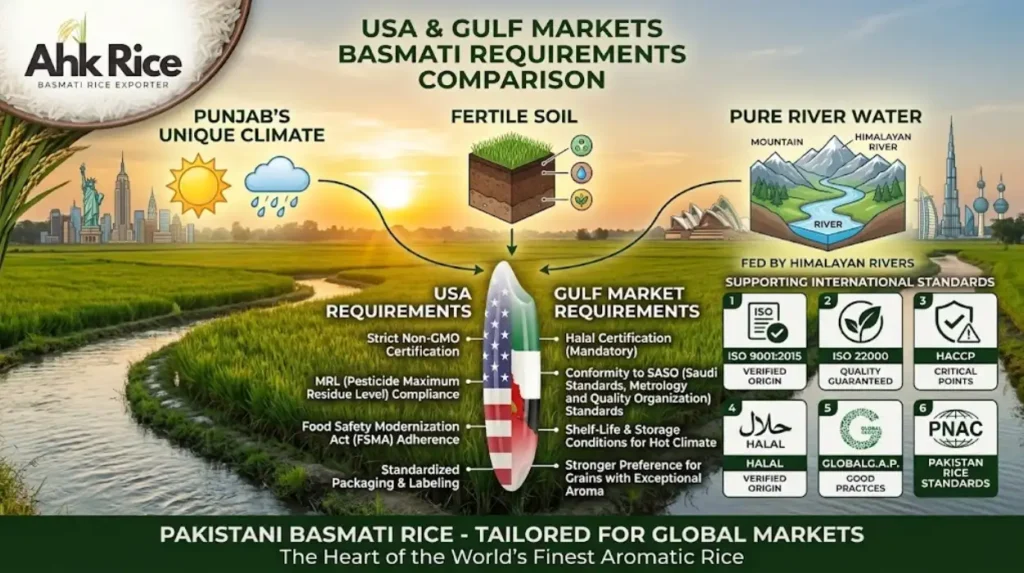
USA and Gulf importers both value reliable Basmati quality, but their product positioning, packaging and compliance procedures differ. USA distributors often focus on retail consistency, importer requirements and traceable supply records. Gulf buyers commonly serve a combination of ethnic retail, wholesale distribution and foodservice, creating demand for premium long-grain and value-oriented grades.
USA Market: Retail Consistency and Traceability
USA importers can position 1121 for premium long-grain retail and foodservice, while Super Kernel can serve buyers seeking traditional aroma and established South Asian consumer appeal. The 1509 variety offers an alternative for price-sensitive channels when the grade and cooking performance match the buyer’s requirements.
USA-bound shipments require attention to applicable US food-import requirements, including relevant Food and Drug Administration requirements, facility registration where applicable, prior notice and foreign-supplier verification obligations. Importers should confirm the requirements that apply to their specific transaction rather than treating a supplier’s general export experience as proof of compliance.
Farm-to-port traceability helps link procurement records, processing lots, packaging details, inspection documents and container information. This supports product investigations and commercial accountability. Traceability does not automatically establish compliance, so importers must separately verify applicable food-safety documentation, labelling and entry requirements.
Gulf Market: Grade Versatility and Foodservice Demand
Gulf markets, including the UAE and Saudi Arabia, accommodate premium Basmati retail, wholesale distribution, catering and restaurant supply. 1121 serves premium presentation requirements, Super Kernel provides traditional aroma and value, and 1509 supports buyers who prioritise cost and volume efficiency.
Packaging decisions depend on the distribution channel. Retail programmes often use consumer-ready packs, while wholesale and foodservice orders commonly use larger bags. Buyers must agree on pack weight, material, printing, labelling language and storage requirements before production.
Gulf importers also need to verify destination-specific food registration, labelling and documentation requirements. Rules differ between markets and may change, so current requirements should be confirmed with the local importer and relevant authorities before shipment.
Price Per Metric Tonne and Shelf-Life Comparison
There is no reliable universal price per metric tonne for USA versus Gulf shipments without a dated supplier quotation. The final price depends on variety, grade, processing, quantity, packaging, inspection, freight, insurance, destination charges and Incoterms. USA quotations may carry different freight and compliance costs from Gulf orders, but the destination alone does not determine which shipment is more expensive.
| Buying factor | USA distribution | Gulf distribution |
|---|---|---|
| Grade preference | Premium 1121, Super Kernel and selected 1509 | 1121, Super Kernel and 1509 by channel |
| Price comparison | Obtain a dated FOB and destination-specific landed quote | Obtain a dated FOB and destination-specific landed quote |
| Shelf-life planning | Confirm the validated shelf life on the product specification | Confirm the validated shelf life on the product specification |
| Traceability priority | Lot records and importer compliance documentation | Lot records and destination documentation |
| Packaging priority | Retail, foodservice or wholesale requirements | Retail, wholesale and foodservice requirements |
Shelf life is not determined by destination alone. It depends on moisture at packing, processing, packaging integrity, storage temperature, humidity, pest control and the product’s validated specification. Properly dried and packaged white rice can have a long storage life under suitable conditions, while brown rice generally has a shorter shelf life because its higher oil content is more susceptible to rancidity. Buyers should agree on a documented shelf-life period and storage instructions rather than assume one universal duration for all Basmati products.
What Are the Advantages and Disadvantages of Each Approach?
Variety selection simplifies purchasing, agricultural assessment improves origin understanding, processing controls deliver measurable quality, and traceability strengthens accountability. Each approach also has limitations. A dependable sourcing programme balances the cost of verification against the commercial impact of inconsistent grain, rejected shipments, regulatory problems and customer complaints.
| Approach | Advantage | Limitation | Example |
|---|---|---|---|
| Variety-based sourcing | Establishes expected grain and cooking profile | Variety name alone does not guarantee grade | Selecting 1121 for premium retail |
| Agricultural assessment | Improves understanding of production conditions | Field information may not represent the final lot | Reviewing cultivation and harvest records |
| Processor quality control | Measures actual grain and moisture characteristics | Testing is only as reliable as its sampling and methods | Checking broken percentage before packing |
| Farm-to-port traceability | Connects records across the supply chain | Requires disciplined documentation and lot management | Linking a packed lot to container records |
| Sample-based approval | Tests suitability before bulk purchasing | A sample must represent the production lot | Cooking a sample before confirming a contract |
The most effective programme combines sample approval, written specifications, appropriate inspection and traceability. These controls address different risks and provide a clearer basis for accepting or rejecting a shipment.
What Factors Should Buyers Include in a Basmati Procurement Decision?
Buyers should compare variety suitability, measurable quality, total landed cost, compliance requirements and supplier traceability before placing an order. A five-part decision framework prevents procurement teams from choosing solely on price or country of origin. Each factor should have a defined acceptance criterion and supporting evidence before the buyer approves the commercial contract.
| Decision factor | Question to resolve | Evidence required |
|---|---|---|
| Variety and application | Does the grade match the target customer? | Product specification and cooking sample |
| Grain quality | Are length, moisture and broken percentage acceptable? | Agreed testing and inspection results |
| Total cost | Does the price meet the target landed cost? | Quotation with Incoterms and freight assumptions |
| Regulatory compliance | Does the shipment meet destination requirements? | Applicable certificates and import documentation |
| Traceability and delivery | Can the supplier link the lot to shipment records? | Lot identification, packing records and shipping documents |
The decision should be recorded in a purchase specification covering variety, processing type, grain length, broken percentage, moisture, packing, quantity, inspection arrangements, destination and delivery terms. The contract should also identify the approved sample, documentary requirements, payment conditions and the process for handling non-conforming goods.
How Can Importers Verify Farm-to-Port Traceability for USA Distribution?
Importers can assess traceability by checking whether supplier records connect the declared origin, procured rice lot, processing batch, finished packaging and export shipment. A documented chain supports investigation when a specification or compliance issue arises. It also helps buyers compare suppliers using verifiable evidence rather than general claims about regional quality.
A practical traceability review begins with the origin and procurement records available for the consignment. The buyer then checks processing batch identification, quality-control results, packing dates, packaging details and the relationship between finished lots and container loading records. Export documents should agree with the product, quantity, packaging and consignee information stated in the contract.
AHK Rice is a Pakistani Basmati rice exporter based in Punjab, supplying 1121, Super Kernel and 1509 varieties to international markets. Its sourcing evaluation should follow the same commercial principles expected of any exporter: confirm the agreed specification, review available lot documentation, approve a representative sample and establish the inspection and shipment-document requirements before dispatch.
For USA distribution, buyers should separately verify applicable food-import obligations and the documentation required for their particular product and transaction. An origin statement or traceability record does not replace regulatory compliance. Buyers should request evidence that matches the shipment and confirm any additional requirements with their US importer or compliance specialist.
Importers planning a purchase can use the USA Basmati rice export and sourcing requirements as a starting point for evaluating product specifications, documentation and shipment arrangements. The final supplier decision should depend on verifiable evidence, a commercially suitable grade and an agreed process for controlling quality from procurement through delivery.
Punjab’s climate, alluvial soils and irrigation infrastructure support the cultivation of aromatic, long-grain Basmati rice, but these agricultural advantages do not guarantee a uniform export product. Variety genetics, crop management, processing, moisture control and packaging determine the quality buyers ultimately receive. Importers should compare 1121, Super Kernel, and 1509 Basmati rice against their intended market and cooking requirements before selecting a grade.
For consistent procurement, buyers should combine a representative sample, measurable product specifications, transparent pricing and documented farm-to-port traceability. USA and Gulf buyers should assess their respective import requirements, packaging needs and landed costs before finalising a contract. This approach turns Punjab-origin sourcing into a verifiable purchasing decision based on product performance, documentation and commercial suitability.
Frequently Asked Questions
Does Punjab’s climate determine Basmati grain length?
Climate affects crop growth and grain filling, but variety genetics establish much of the grain’s potential length and shape. Suitable temperatures, crop management and harvesting practices help preserve grain quality and reduce inconsistencies.
Why is Punjab known for aromatic Basmati rice?
Punjab has established Basmati-growing areas, suitable agricultural conditions and a long cultivation tradition. Aroma results from varietal genetics, growing conditions, maturity and post-harvest handling rather than from soil or river water alone.
Which Basmati variety is best for USA importers?
1121 suits premium long-grain positioning, Super Kernel serves buyers seeking traditional aroma and value, and 1509 can suit price-sensitive distribution. The best choice depends on customer expectations, cooking tests and the agreed grade specification.
Does river water guarantee better Basmati quality?
No. Irrigation supports crop development when water quantity, timing and quality are suitable. Soil conditions, crop genetics, nutrient management, harvesting and processing also affect the finished rice.
How can buyers verify Punjab-origin Basmati rice?
Buyers should review available origin and procurement records, processing-lot identification, quality results, packing details and shipment documentation. Independent inspection and sample approval provide additional checks against the contractual specification.
How should importers compare Basmati prices per metric tonne?
Compare equivalent varieties, processing types, grades, packaging and quantities using dated quotations. Include freight, insurance, destination charges, inspection costs and the applicable Incoterms to calculate a meaningful landed-cost comparison.
How long does Punjab-origin Basmati rice remain usable?
Shelf life depends on rice type, moisture, packaging integrity and storage conditions. Importers should follow the supplier’s validated shelf-life specification, maintain dry and pest-controlled storage, and apply appropriate stock rotation.
Why is farm-to-port traceability important for USA distribution?
Traceability links product lots with processing, quality, packing and shipment records. It improves accountability and supports investigations, but importers must also meet applicable US food-safety, labelling and import requirements.