1509 Brown Basmati Rice: Nutrition Profile and Global Demand Trends in 2026
1509 brown basmati rice delivers wholegrain nutrition with intact bran layers and high fiber density. Here is why: it retains germ and bran after dehusking without polishing, preserving micronutrients and slow-digesting carbohydrates that global buyers prioritize in 2026 health-driven grain markets.
What is 1509 Brown Basmati Rice and how does it differ from white basmati?
1509 brown basmati rice is a long-grain, wholegrain basmati variant harvested from Punjab cultivation systems and processed without polishing, retaining bran layers that white basmati removes through milling and polishing stages. It delivers higher fiber, slower starch release, and denser micronutrient composition.
1509 brown basmati originates from cultivated paddy fields where farmers irrigate controlled basmati zones in Punjab plains. The grain is harvested at maturity and dried under regulated moisture thresholds before milling begins.
Brown basmati retains the outer bran layer after dehusking. White basmati removes this layer through polishing, producing a lighter texture but reducing fiber content.
Key differences include:
- Wholegrain retention: Bran layer preserved in brown rice
- Milling intensity: Minimal polishing in brown rice
- Digestion rate: Slower glucose release in brown rice
- Texture profile: Chewier grain structure in brown basmati
1509 brown basmati rice maintains grain integrity with average kernel length ranging between 6.8–7.0 mm after milling, depending on moisture and storage conditions.
White basmati variants prioritize appearance and fluffiness, while brown basmati prioritizes nutrient density and functional food positioning.
With the structural identity of brown basmati established, the next focus shifts to how processing converts harvested paddy into export-grade wholegrain rice.
How is 1509 brown basmati rice processed from paddy to export grade?
1509 brown basmati rice is processed through controlled cleaning, dehusking, grading, and minimal polishing stages that preserve bran integrity while ensuring export compliance for moisture, purity, and grain uniformity standards.
Processing begins immediately after harvest when paddy is transported to milling facilities for controlled conversion.
Clean paddy handling steps include:
- Clean paddy reception and impurity removal
- Dry paddy conditioning to stabilize moisture levels
- De-husk grain to separate husk from brown rice
- Sort kernels by length and density
Modern milling systems maintain bran layers by skipping full polishing cycles used in white rice production.
Core processing components include:
- Colour sorting to remove discolored kernels
- Moisture control to maintain 12–13% export standard
- Grading systems that classify long and broken grains
- Fumigation protocols for export certification compliance
Export-ready 1509 brown basmati passes inspection and certification stages involving quality verification and microbiological safety testing.
Common export grades include:
- Grade A wholegrain 1509 brown basmati
- Medium broken 1509 brown basmati
- Industrial catering grade brown basmati
Certifications applied in export flows include HACCP systems, ISO 22000 food safety standards, and phytosanitary certification required by importing countries in the EU and GCC.
It provides a structured comparison of brown and white basmati demand patterns in European retail markets.
With processing clarified, the nutritional structure explains why global demand continues to expand in health-driven segments.
What are the key nutritional components of 1509 brown basmati rice?
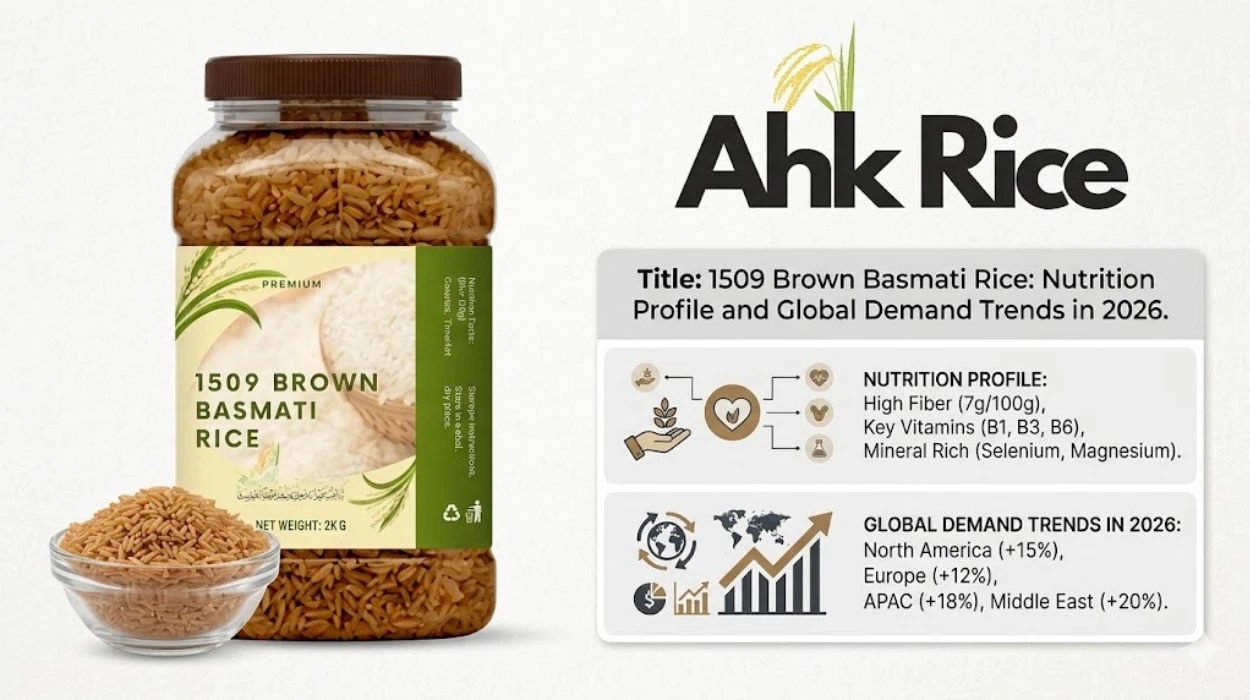
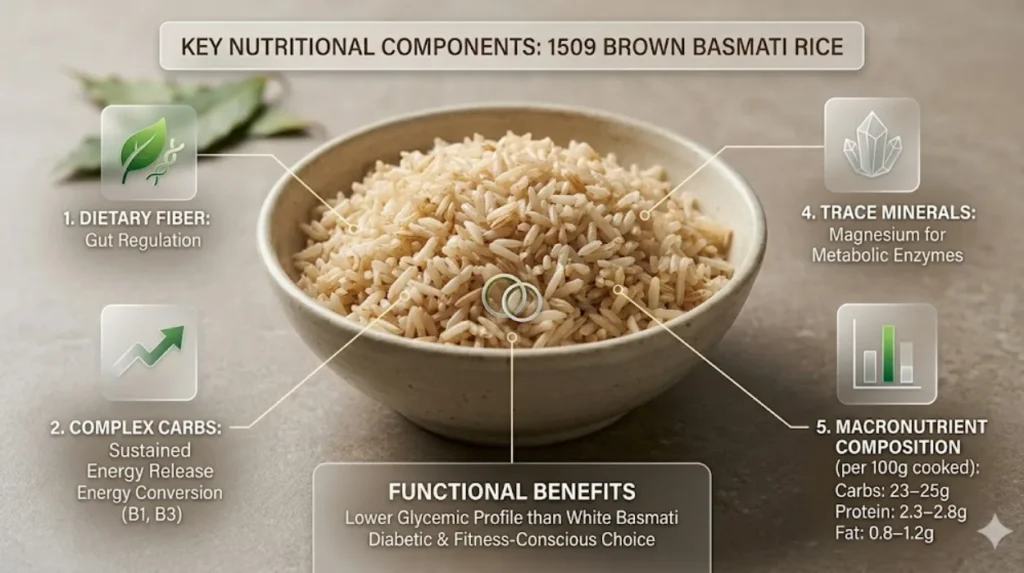
1509 brown basmati rice contains high dietary fiber, complex carbohydrates, B-complex vitamins, and trace minerals retained in the bran layer, creating slower digestion and sustained energy release compared to polished rice.
Nutritional retention remains highest in unpolished rice because milling does not strip bran and germ layers.
Key components include:
- Dietary fiber concentration supporting gut regulation
- Magnesium content contributing to metabolic enzyme activity
- Vitamin B1 and B3 supporting energy conversion pathways
- Complex starch structure reducing rapid glucose spikes
Brown basmati delivers a glycemic profile lower than white basmati due to intact outer layers.
Typical composition per 100g cooked grain includes:
- Carbohydrates: 23–25 g
- Fiber: 1.6–2.2 g
- Protein: 2.3–2.8 g
- Fat: 0.8–1.2 g
Micronutrient density increases when rice is consumed without polishing, especially in populations requiring stable energy intake across long working hours.
Functional nutrition positioning has expanded demand in fitness-oriented and diabetic-conscious markets.
With nutritional composition defined, the next focus shifts to functional benefits driving consumption behavior.
What benefits does wholegrain 1509 basmati provide for global consumers?
Wholegrain 1509 basmati provides sustained energy release, higher satiety, improved digestive fiber intake, and stable glycemic response, making it a preferred staple in health-conscious consumer segments across global markets.
Benefits emerge from bran retention and minimal processing intensity.
Functional advantages include:
- Slow carbohydrate absorption supporting energy stability
- Increased satiety reducing total meal intake frequency
- Improved digestive fiber supporting intestinal health
- Nutrient retention enhancing micronutrient intake per serving
In high-temperature logistics environments such as Gulf warehouses, brown basmati maintains quality stability under controlled humidity storage systems.
Consumer-driven applications include:
- Fitness meal planning in European retail markets
- Diabetic-friendly diets in urban Asian populations
- Institutional catering in healthcare and wellness facilities
- Organic food retail channels requiring wholegrain labeling
Brown basmati shows stronger nutritional positioning than white basmati in premium health categories, while white basmati dominates sensory-driven consumption segments.
Storage behavior differs significantly; brown rice requires tighter moisture control to prevent bran oxidation during long shipment cycles.
With benefits established, the next focus shifts to how global demand patterns evolve in 2026.
What are the global demand trends for 1509 brown basmati rice in 2026?
Global demand for 1509 brown basmati rice in 2026 increases across Europe, the Middle East, and North America due to rising wholegrain consumption, regulatory labeling shifts, and health-focused retail expansion.
Demand growth is driven by dietary transitions toward fiber-rich staples.
Key market regions include:
- European Union organic and health retail chains
- Gulf Cooperation Council catering and hospitality sectors
- United States health food distribution networks
- Southeast Asia premium urban retail segments
EU markets show increased preference for wholegrain rice due to front-of-pack nutrition labeling regulations that encourage fiber-rich food selection (source: EU Food Information Regulation trends, 2025 updates).
GCC markets prioritize long-grain consistency for catering operations serving large-scale institutional dining.
Demand segmentation includes:
- Retail packaging for organic supermarkets
- Bulk supply for hospitality procurement contracts
- Private label sourcing for health brands
- Institutional procurement for hospitals and wellness centers
1509 brown basmati demand rises faster than white basmati in health segments but slower in traditional rice consumption markets due to cooking preference differences.
Export logistics depend on moisture-controlled shipping, fumigation certification, and containerized load balancing for long-haul sea freight routes.
With demand structure clarified, trade challenges and misconceptions shape how buyers evaluate quality and sourcing.
What are common misconceptions and problems in 1509 brown basmati trade?
Common misconceptions in 1509 brown basmati trade include assumptions about storage instability, nutritional equivalence with white rice, and uniform grain quality across milling grades, while real trade depends on moisture control and grading precision.
Misunderstandings arise from differences in processing and shelf-life behavior.
Frequent misconceptions include:
- Storage instability assumption without moisture control context
- Nutritional equivalence assumption between brown and white basmati
- Uniform grain quality assumption across broken and whole grades
- Cooking similarity assumption despite bran-induced texture changes
Brown basmati requires stricter warehouse conditions because bran layers contain natural oils that oxidize under heat exposure.
In 40°C Gulf storage environments, brown basmati maintains quality for approximately 10–14 months, while white basmati extends to 18–24 months under similar conditions.
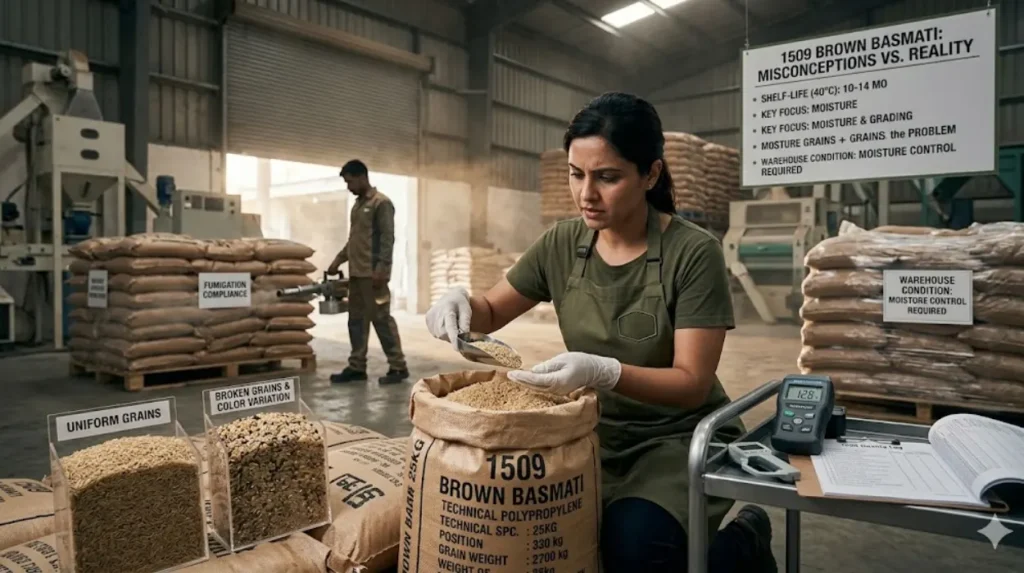
Processing problems include uneven dehusking when paddy moisture exceeds optimal thresholds and color variation when drying cycles remain inconsistent.
Trade accuracy depends on:
- Grain length uniformity verification during grading
- Moisture stabilization before container loading
- Fumigation compliance for export certification clearance
- Broken percentage classification for contract pricing
Buyers evaluating export contracts prioritize consistent grading systems over raw harvest yield data.
With trade misconceptions clarified, the full value chain of 1509 brown basmati connects nutrition, processing precision, and global demand structure.
Frequently Asked Questions
What is 1509 brown basmati rice?
1509 brown basmati rice is a wholegrain rice variety where the outer bran layer remains intact after dehusking. It delivers higher fiber, slower digestion, and stronger micronutrient retention compared to polished white basmati rice.
Is 1509 brown basmati healthier than white basmati?
1509 brown basmati is healthier because it retains bran and germ layers. These layers increase fiber content, support better digestion, and reduce rapid blood sugar spikes compared to white basmati rice.
How is 1509 brown basmati processed?
1509 brown basmati is processed by cleaning paddy, de-husking the grain, and skipping full polishing stages. The bran layer remains intact while grading and sorting ensure uniform export quality and moisture control.
Which countries import 1509 brown basmati rice?
1509 brown basmati rice is exported mainly to Europe, the Middle East, North America, and Southeast Asia. These regions demand wholegrain rice for health-focused diets and premium retail packaging.
How should 1509 brown basmati rice be stored?
1509 brown basmati rice should be stored in cool, dry conditions with controlled moisture levels. Proper storage prevents bran oxidation and maintains quality during long export shipping cycles.