1509 Steam Basmati Rice: How Steaming Affects Grain Quality and Aroma
1509 steam basmati rice delivers 8.10–8.40 mm grain length, 2.5–3× elongation, and moderate aroma retention. Here is why: the steam process hardens the grain structure while preserving internal starch alignment, which directly improves cooking stability and export durability.
What is 1509 steam basmati rice and how does steaming affect grain quality and aroma?
1509 steam basmati rice is a long-grain aromatic rice processed through controlled steaming that improves grain strength, reduces breakage, and stabilizes aroma at a moderate level.
1509 steam basmati rice defines a specific processing category within basmati rice. The raw paddy originates from Punjab’s irrigated plains, where farmers cultivate short-duration basmati hybrids. Harvest cycles complete in 90–100 days, compared to 140 days for traditional basmati.
Steam processing transforms the grain without full parboiling. Millers expose paddy to pressurized steam for 5–10 minutes, followed by controlled drying at 12–14% moisture. This step gelatinizes the outer starch layer but preserves the inner core structure.
Grain quality improves because steaming strengthens the endosperm. Milling yield increases by 3–5% because fewer grains break during polishing. Exporters prefer this because broken percentage directly impacts price per metric ton.
Aroma stabilizes instead of intensifying. Steam reduces volatile aromatic compounds by 10–15%, which creates a consistent but lighter fragrance compared to white basmati. Buyers in bulk markets value this stability over intensity.
With the definition established, the next question is how the steam process actually works at each stage.
How does the steam process of 1509 basmati rice work step by step?
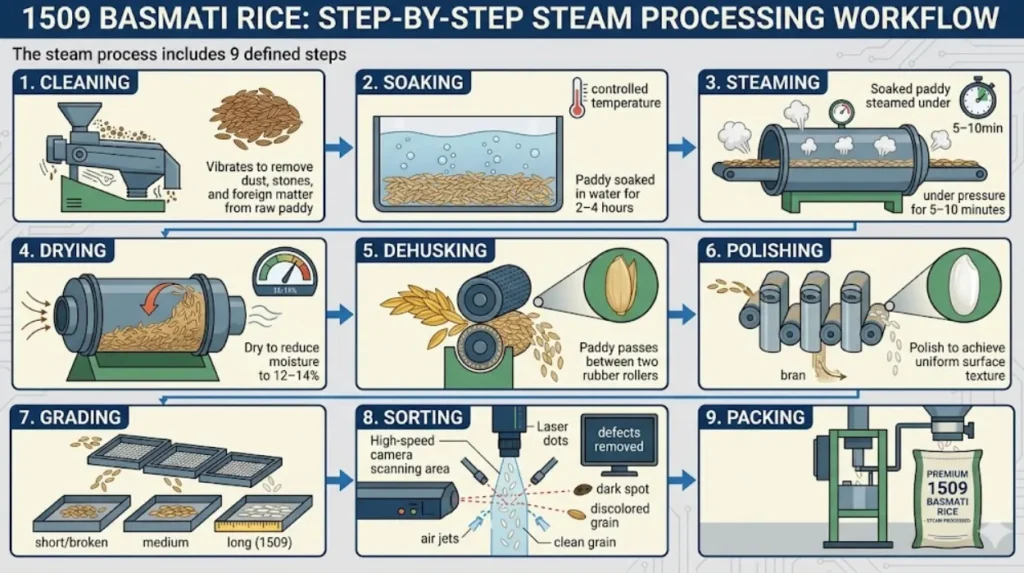
The steam process includes 9 defined steps: cleaning, soaking, steaming, drying, dehusking, polishing, grading, sorting, and packing.
Step-by-step steam processing workflow
- Clean the paddy to remove dust, stones, and foreign matter
- Soak the paddy in water for 2–4 hours at controlled temperature
- Steam the soaked paddy under pressure for 5–10 minutes
- Dry the paddy to reduce moisture to 12–14%
- Dehusk the grain to remove the outer husk
- Polish the rice to achieve uniform surface texture
- Grade the rice by length and thickness
- Sort the rice using color sorters to remove defects
- Pack the rice in export-grade bags
Steam processing differs from parboiling in intensity. Parboiling uses longer soaking and higher pressure, which fully gelatinizes the starch. Steam processing applies shorter exposure, which keeps the grain lighter in color and less rigid.
Grain structure changes at the molecular level. Heat aligns starch molecules, which reduces stickiness during cooking. This creates separate, non-clumping grains, which is essential for catering and bulk cooking.
Drying is critical for quality. Drying too fast creates cracks inside the grain. Controlled drying preserves integrity and prevents breakage during milling and transport.
This structured process explains performance, which leads directly to the components that define quality.
What are the key components that define 1509 steam basmati rice quality?
1509 steam basmati quality depends on grain length, moisture level, purity, broken percentage, chalkiness, and aroma retention.
Core quality specifications
Grain length defines premium classification. Export-grade 1509 steam rice measures 8.10–8.40 mm, with uniform thickness. Longer grains command higher prices in Gulf and African markets.
Moisture content controls shelf life. Standard export moisture remains 12–13%, which prevents fungal growth during shipping. High moisture above 14% leads to spoilage in humid ports.
Broken percentage determines grade. Premium export grades maintain 2–5% broken, while standard grades allow up to 10%. Lower broken ratios increase cooking consistency.
Purity level reflects sorting accuracy. Exporters maintain 95–98% purity, meaning minimal foreign grains or non-basmati admixture. High purity ensures consistent cooking results.
Chalkiness affects visual appeal. Low chalk content improves grain translucency. Buyers in Saudi Arabia and UAE prefer low chalk for premium retail packaging.
Aroma retention defines consumer experience. Steam processing delivers moderate aroma, which suits large-scale food service operations where strong fragrance is not required.
These components define measurable quality, which directly connects to the functional benefits of steam processing.
What benefits does steaming provide to 1509 basmati rice?
Steaming increases grain strength, reduces breakage by 30%, improves elongation, and stabilizes cooking performance under bulk conditions.
Steam processing enhances structural integrity. Stronger grains resist mechanical stress during milling and shipping. Exporters report 20–30% fewer broken grains compared to white basmati.
Cooking performance improves consistency. Steam-treated grains expand uniformly, reaching 2.5–3× elongation. This creates long, separate grains suitable for biryani and pulao.
Shelf life extends under high temperatures. Steam rice withstands storage in 35–45°C climates for 12 months without quality degradation. This suits Middle Eastern and African markets.
Water absorption improves efficiency. Steam rice absorbs water evenly, which reduces cooking errors in large kitchens. Catering operations rely on this consistency for batch cooking.
Color remains off-white instead of yellow. This makes steam rice visually closer to white basmati, which appeals to retail buyers who avoid golden sella appearance.
These benefits explain why buyers choose steam rice, which leads to its primary use cases across global markets.
Where is 1509 steam basmati rice used and which markets import it?
1509 steam basmati rice is used in catering, retail packaging, and bulk food service across the Middle East, Africa, and Europe.
Key use cases
Catering operations use steam rice for high-volume cooking. Hotels and restaurants require consistent grain separation and predictable cooking time. Steam rice meets both requirements.
Retail packaging uses steam rice for mid-range consumers. Buyers prefer long grains with moderate aroma at competitive prices. Steam rice fits this price-quality balance.
Food processing industries use steam rice in ready meals. Manufacturers require grains that maintain structure after reheating. Steam-treated rice performs well in frozen and packaged foods.
Major import markets
Saudi Arabia imports large volumes of 1509 steam rice for catering and retail distribution (source: REAP export data, December 2025). Buyers prioritize long grain and consistent cooking.
United Arab Emirates imports steam rice for hospitality sectors. Hotels require stable quality under high storage temperatures.
East African countries, including Kenya and Tanzania, import steam rice for affordability and durability (source: Pakistan Bureau of Statistics, FY2024-25). Transport conditions demand strong grains.
European markets import smaller volumes for ethnic food segments. Buyers focus on quality certification and residue compliance.
Buyers often compare steam and white basmati before purchasing. For a detailed comparison of buyer preferences and grade differences, read this analysis on how steam and white basmati differ across grades and markets.
Understanding usage highlights demand patterns, which leads to common misconceptions about steam rice.
What are common problems and misconceptions about 1509 steam basmati rice?
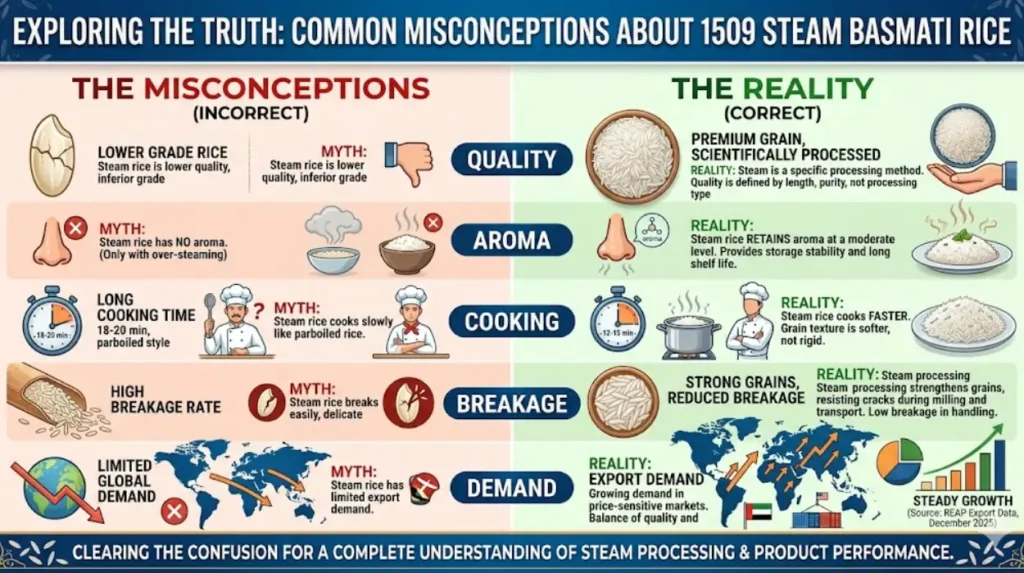
The main misconceptions are that steam rice is low quality, lacks aroma, or cooks like parboiled rice, which are incorrect based on processing and performance data.
Misconception 1: Steam rice is lower quality
Steam rice is not a lower grade. It is a different processing method. Quality depends on specifications such as grain length and purity, not processing type.
Misconception 2: Steam rice has no aroma
Steam rice retains aroma at a moderate level. Aroma reduction improves stability during storage and shipping. Strong aroma loss occurs only with over-steaming, which exporters avoid through controlled processing.
Misconception 3: Steam rice cooks like parboiled rice
Steam rice cooks faster than parboiled rice. Cooking time averages 12–15 minutes, while parboiled rice requires 18–20 minutes. Grain texture remains softer and less rigid.
Misconception 4: Steam rice breaks easily
Steam processing reduces breakage. Strengthened grains resist cracking during milling and transport. Breakage rates remain lower than white basmati in bulk handling.
Misconception 5: Steam rice has limited export demand
Steam rice demand continues to grow in price-sensitive markets. Buyers choose it for balance between cost and performance. Export data shows steady growth in Africa and the Middle East (source: REAP export data, December 2025).
These clarifications resolve confusion, which leads to a complete understanding of how steam processing defines product behavior.
How does steaming influence the overall value chain of 1509 basmati rice?
Steaming increases milling yield, reduces losses, stabilizes export quality, and aligns product performance with bulk market requirements.
Steam processing improves yield at the mill level. Higher head rice recovery increases profitability per ton. Exporters benefit from reduced waste and better grade consistency.
Logistics efficiency improves because stronger grains withstand handling. Rice travels long distances without significant quality loss. This supports exports to Africa and the Middle East.
Market alignment strengthens because steam rice fits mid-tier pricing. Buyers receive long grain quality at lower cost compared to premium white basmati.
Quality control becomes more predictable. Standardized processing ensures uniform output across batches. This consistency supports long-term contracts with international buyers.
With value chain impact defined, the product’s role in global trade becomes clear and measurable.
Frequently Asked Questions
What is the average grain length of 1509 steam basmati rice?
1509 steam basmati rice typically measures between 8.10 mm and 8.40 mm in length. This long grain structure defines its export grade and ensures uniform cooking results. Longer grains increase market value, especially in Gulf and African regions where visual quality matters.
How does steam processing affect the cooking time of 1509 rice?
Steam processing reduces cooking time to 12–15 minutes. The partial gelatinization of starch allows faster water absorption. This ensures consistent cooking in bulk kitchens, where time and uniformity directly impact operational efficiency.
Is 1509 steam basmati rice suitable for biryani?
1509 steam basmati rice performs well in biryani because it elongates 2.5–3 times after cooking. The grains remain separate and non-sticky. This structure supports layered cooking methods used in traditional biryani preparation.
What is the standard moisture level for export-quality steam rice?
Export-quality 1509 steam basmati rice maintains 12–13% moisture content. This level prevents fungal growth during shipping and storage. Proper moisture control ensures stability in high-temperature markets such as the Middle East and Africa.
Which countries import 1509 steam basmati rice the most?
Saudi Arabia, United Arab Emirates, Kenya, and Tanzania import large volumes of 1509 steam basmati rice. These markets prefer strong grains and consistent cooking performance. Demand remains high due to affordability and durability during transport.