AHK Rice 1121 Creamy Sella: CIF Dubai and CIF Jeddah Pricing Available
1121 Creamy Sella Basmati rice is the most stable export-grade option for Gulf buyers requiring consistent elongation, long shelf life, and controlled moisture under CIF Dubai and CIF Jeddah contracts. Here is why: parboiling locks starch, reduces breakage, and ensures predictable cooking performance across bulk shipments.
Buyers sourcing premium basmati often face inconsistency in grain performance after shipping. AHK Rice solves this with controlled parboiling, grading precision, and verified CIF pricing structures tailored for UAE and Saudi markets.
For foundational understanding of processing, review how parboiling transforms basmati structure in this guide on how parboiling creates creamy sella basmati rice.
What is the best solution for bulk buyers importing 1121 Creamy Sella rice?
1121 Creamy Sella Basmati offers 8.20–8.40 mm grain length, low breakage under 2%, and stable moisture at 12–13%, making it the safest bulk import solution for Gulf climates and storage conditions.
1121 Creamy Sella rice addresses the primary buyer problem: inconsistency after shipment. Bulk buyers in Dubai and Jeddah require rice that performs the same after 30–45 days in transit.
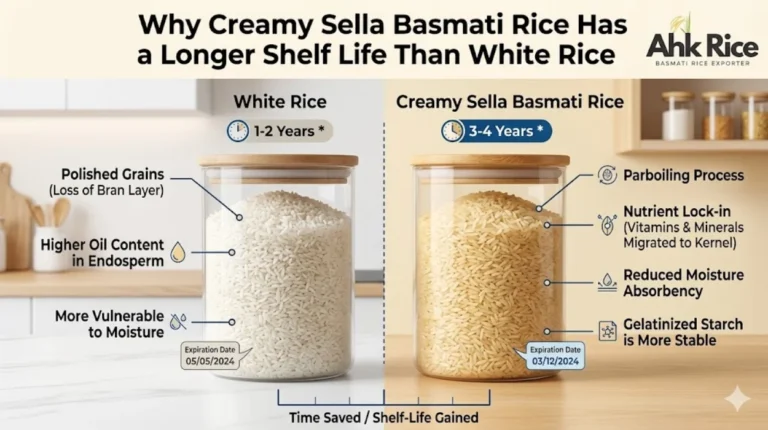
1121 Creamy Sella rice undergoes controlled parboiling. This process gelatinizes starch before milling. The grain hardens internally. This reduces breakage during handling and shipping.
AHK Rice processes 1121 Creamy Sella through 9 defined steps:
- Clean the harvested paddy
- Soak the grain under controlled temperature
- Steam the soaked paddy
- Dry the grain to target moisture
- Dehusk the outer husk
- Polish the kernel surface
- Grade by grain length
- Sort using color sorters
- Pack under export conditions
Each step directly impacts export performance. AHK Rice applies moisture control at drying stage because Gulf humidity fluctuations affect storage stability.
1121 Creamy Sella rice performs better than Steam rice under high heat conditions. In UAE warehouses reaching 40°C, Creamy Sella maintains structure for 18 months. Steam rice degrades faster under identical storage conditions.
Buyers comparing variants should review this breakdown of creamy sella vs steam 1121 basmati cooking market fit to align specification with end use.
With the best solution defined, the next step is selecting the right exporter and service structure.
Why choose 1121 Basmati Creamy Sella Rice Wholesale Suppliers & Exporters?
AHK Rice delivers 7 processing grades, CIF Dubai/Jeddah contracts, and export-compliant documentation, ensuring predictable quality and landed cost accuracy for importers and distributors.
The service structure matters more than the product alone. AHK Rice integrates sourcing, processing, inspection, and shipping into one controlled system.
Explore the full specification and supply capability here:
1121 Basmati Creamy Sella Rice Wholesale Suppliers & Exporters
AHK Rice offers 7 processing grades:
- Double sortex
- Triple sortex
- Silky polish
- Creamy finish
- Raw blend control
- Length-based grading
- Broken separation
Each grade serves a defined market. Saudi wholesale buyers prefer silky polish. UAE retail distributors prefer creamy finish for visual appeal.
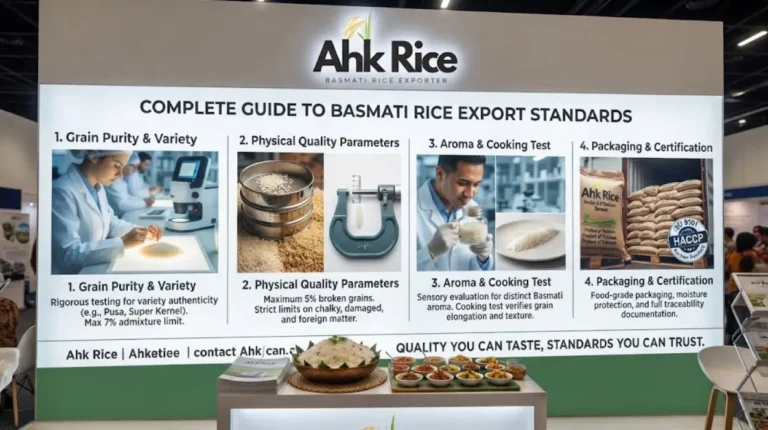
AHK Rice verifies quality through 5 control points:
- Moisture testing before packing
- Grain length verification using calibrated sieves
- Broken percentage inspection
- Color sorting accuracy validation
- Final batch certification
AHK Rice ensures compliance with export documentation:
- Commercial invoice
- Packing list
- Certificate of origin
- Phytosanitary certificate
- Fumigation certificate
- Bill of lading
Each document supports smooth customs clearance in Jeddah and Dubai ports.
AHK Rice structures CIF contracts with precise logistics control. The company loads containers at Karachi port and ships through major Gulf routes.
Shipping timelines per market:
- Dubai: 18–25 days transit
- Jeddah: 25–35 days transit
These timelines include port handling and clearance preparation.
AHK Rice maintains consistency because processing and logistics remain controlled internally. This reduces supplier dependency risk.
With supplier reliability established, the next question is measurable results.
What results can buyers expect from AHK Rice 1121 Creamy Sella?
Buyers achieve up to 2.5x grain elongation, less than 2% breakage, and uniform cooking across batches, resulting in higher resale value and reduced customer complaints.
1121 Creamy Sella rice delivers performance at both wholesale and foodservice levels. Restaurants require predictable cooking results. Distributors require visual consistency.
Grain elongation defines quality perception. AHK Rice ensures elongation through precise parboiling control. The grain expands without breaking.
Breakage reduction improves yield. AHK Rice maintains under 2% broken grains. This increases usable volume per shipment.
Cooking consistency drives repeat orders. AHK Rice ensures uniform starch structure because parboiling is standardized.
Example scenario:
A Dubai distributor imports 5 containers monthly. Inconsistent rice leads to customer returns. Switching to AHK Rice reduces complaints because each batch performs identically.
Example scenario:
A Saudi catering supplier stores rice in non-climate warehouses. Creamy Sella maintains quality for 18 months. This reduces stock loss.
Shelf-life advantage:
- Creamy Sella: 18–24 months stability
- Steam rice: 12 months stability
This difference matters for large-scale importers managing inventory cycles.
Market data supports demand growth. Pakistan exported over 5 million tons of rice in FY2024–25 (source: Pakistan Bureau of Statistics). Gulf markets remain primary buyers.
AHK Rice aligns its production to these demand patterns. This ensures consistent availability.
With performance outcomes clear, buyers must evaluate pricing and cost structure.
What factors affect CIF Dubai and CIF Jeddah pricing?
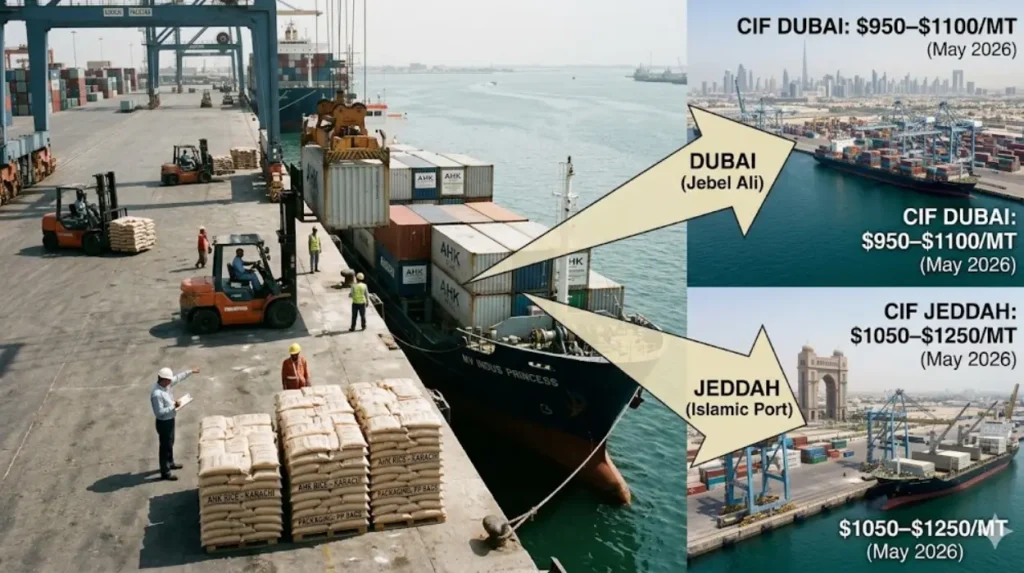
CIF pricing depends on paddy cost, processing grade, freight rates, and currency fluctuations, with 1121 Creamy Sella typically ranging between $950–$1250 per metric ton CIF Gulf ports.
Pricing transparency is critical for decision-stage buyers. AHK Rice structures pricing based on measurable inputs.
Key cost factors:
- Paddy procurement cost during harvest season
- Processing level and sortex requirement
- Packaging type such as PP bags or branded bags
- Freight rates from Karachi to Gulf ports
- Exchange rate fluctuations
Freight plays a major role. Shipping rates vary monthly. Dubai routes remain cheaper than Jeddah due to shorter transit distance.
Example pricing breakdown:
- FOB Karachi: base price
- Freight: added based on shipping line
- Insurance: included in CIF
- Total CIF: landed price
AHK Rice provides CIF quotes with validity windows. Buyers must confirm quickly because paddy prices change during harvest cycles.
Seasonal variation:
- Harvest season (Oct–Dec): lower prices
- Off-season (Mar–Aug): higher prices
This variation affects procurement strategy.
Packaging options also affect cost:
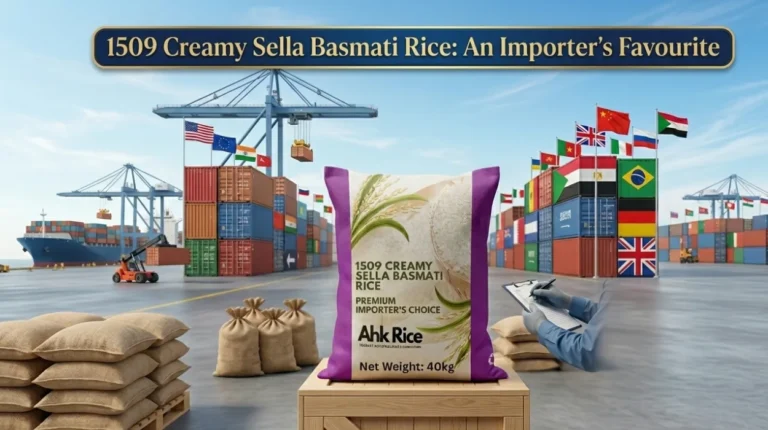
- 40 kg PP bags: standard export
- 50 kg PP bags: bulk buyers
- Private label bags: higher cost
AHK Rice supports private labeling for retail distributors. This increases brand value but raises unit cost.
Payment terms influence pricing flexibility:
- LC at sight: standard
- Deferred LC: slightly higher cost
- TT advance: negotiable rates
AHK Rice structures payment terms based on buyer history and volume.
With pricing clarified, the final step is understanding how to start the procurement process.
How to get started with AHK Rice for CIF export orders?
Start by confirming grade specification, target market, and order volume, then proceed through a sample approval process costing $150–$300, followed by contract finalization and shipment scheduling.
The onboarding process must be structured to reduce risk.
AHK Rice follows a defined sample process:
- Request product specification
- Receive physical sample via courier
- Test cooking performance locally
- Approve grain quality and grade
- Confirm final specification
Sample cost includes courier and preparation. Buyers typically pay $150–$300 depending on location.
After approval, AHK Rice initiates order execution:
- Confirm contract terms
- Issue proforma invoice
- Receive payment instrument
- Begin processing batch
- Load containers
- Dispatch shipment
Production timeline:
- Processing: 7–10 days
- Loading and dispatch: 3–5 days
Total pre-shipment time remains under 15 days.
AHK Rice maintains communication during each stage. Buyers receive updates on processing, loading, and shipment status.
Risk reduction comes from clarity. Each step is documented and verified.
AHK Rice supports long-term buyers with contract pricing agreements. This stabilizes cost across multiple shipments.
AHK Rice positions itself as a supply partner, not just a vendor. This ensures continuity in high-volume import operations.
With the full process defined, the next step is initiating a purchase decision with a verified supplier.
AHK Rice provides consistent 1121 Creamy Sella supply, verified processing, and CIF pricing tailored for Dubai and Jeddah markets. AHK Rice ensures product performance, logistics reliability, and cost transparency. AHK Rice aligns processing and shipping with Gulf market conditions. AHK Rice maintains strict quality control across all grades. AHK Rice supports scalable export operations for wholesalers and distributors. AHK Rice simplifies procurement through structured processes. AHK Rice delivers predictable results across shipments. AHK Rice remains a reliable partner for basmati rice exports.
Start your procurement process today by submitting your requirement at request-a-quote.
Frequently Asked Questions
What is the minimum order quantity for 1121 Creamy Sella rice?
Minimum order quantity starts at one 20-foot container, which carries approximately 24–26 metric tons depending on packaging format. Most buyers scale to 40-foot containers for cost efficiency because freight cost per ton decreases significantly at higher volumes.
How long does shipping take to Dubai and Jeddah?
Shipping to Dubai typically takes 18–25 days from Karachi port, while Jeddah shipments require 25–35 days depending on vessel schedules and port congestion. Transit time includes loading, sea freight, and standard port handling procedures.
What packaging options are available for export?
Packaging options include 40 kg and 50 kg PP bags for bulk distribution and private label bags for retail markets. Buyers selecting branded packaging must confirm artwork and specifications before production to avoid delays in dispatch.
How is quality verified before shipment?
Quality is verified through moisture testing, grain length measurement, broken percentage inspection, and color sorting validation. Each batch is inspected and certified before loading to ensure compliance with export-grade standards.
Can buyers request customized specifications?
Buyers can request customized specifications including grain length range, polish level, and broken percentage. Exporters adjust processing parameters based on confirmed requirements to match specific market demand.