AHK Rice 1121 Golden Sella: Minimum 24 MT Per Container — Get Pricing
AHK Rice 1121 Golden Sella is the strongest container-level choice when the buyer needs 24 MT minimum load discipline, stable long-grain quality, and predictable export pricing. AHK Rice structures the product around shipment planning, sample validation, and market-specific delivery terms so buyers can move from evaluation to order with clear cost control.
What is the best solution for bulk 1121 Golden Sella sourcing?
The best solution is a container-grade supply model that locks the specification, fixes the loading target at 24 MT or above, and ties pricing to FOB, CNF, or CIF terms before shipment.
Bulk rice sourcing becomes efficient when the buyer controls the commercial structure before the container moves. AHK Rice applies that structure to 1121 Golden Sella by defining grain length, moisture, breakage, packing format, and shipment quantity at the start. This reduces the risk of inconsistent lots and makes landed-cost calculations much clearer.

AHK Rice 1121 Golden Sella suits importers who need a stable parboiled Basmati format for retail, wholesale, and catering channels. The product performs well in long storage cycles because the parboiling process improves grain firmness and reduces breakage during handling. That matters when the rice moves through multiple checkpoints before arrival.
The 24 MT minimum container target also protects the buyer from under-loaded logistics. A partial container creates a higher freight cost per tonne and weakens the economics of the import. By working at minimum container scale, AHK Rice gives the buyer a cleaner pricing model and a more realistic supply plan.
For buyers new to the product, the 1121 parboiled basmati rice gives the processing background behind the product profile. That context matters because the export case only makes sense once the buyer understands why parboiling changes the grain’s storage and cooking behaviour.
Why choose AHK Rice Golden Sella for 24 MT container loads?
AHK Rice Golden Sella gives the buyer one controlled supply line from Punjab-origin Basmati to export-ready packing, which improves consistency, reduces quality drift, and supports clean container economics.
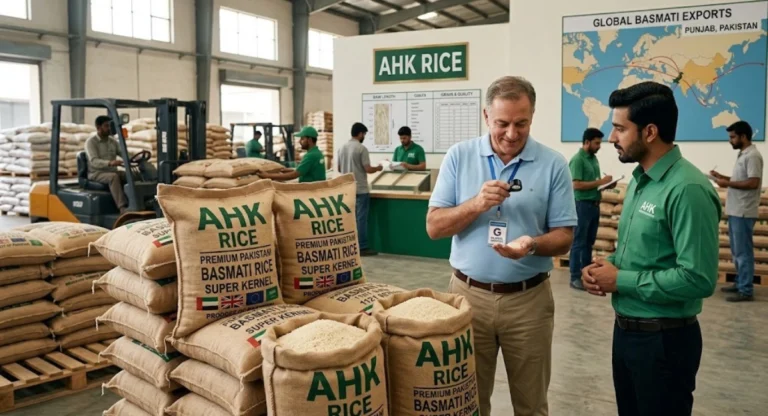
AHK Rice is based in Punjab and works across the full export chain. That means sourcing, milling, grading, packing, and shipment preparation sit inside one operational system. For 1121 Golden Sella, that end-to-end model reduces the variation that often appears when traders buy from fragmented suppliers.
The product itself is a strong fit for container trade because Golden Sella handles shipping better than raw polished rice. The parboiled grain holds shape well, keeps a stable cooked texture, and stores for longer periods under standard export conditions. That makes it suitable for importers who supply supermarkets, ethnic retail, or food-service distributors.
AHK Rice also gives the buyer more control over presentation. The rice can be packed in export bags, retail packs, or private-label formats depending on the market. That matters because packaging often determines shelf acceptance more than the grain grade alone. AHK Rice supports both bulk and branded formats within the same supply structure.
This service is also easier to compare against white rice when the buyer is choosing a catering-grade line. The MOFU comparison on 1121 parboiled vs white basmati bulk catering grade helps buyers evaluate the performance difference before committing to a container position.
What results can buyers expect from this supply model?
Buyers can expect consistent grain quality, predictable loading, lower breakage, and a clearer landed-cost structure across 24 MT or larger containers.
The first result is specification stability. AHK Rice keeps the 1121 Golden Sella product aligned with export requirements so the buyer receives the same general grain behaviour from one shipment to the next. That reduces complaints and helps the importer build repeat orders with confidence.
The second result is better shipping efficiency. A minimum 24 MT loading target creates a stronger freight-to-volume ratio. That lowers the transport cost per tonne and gives the buyer a more efficient unit economics model. It also supports more accurate stock planning at the destination port.
The third result is better cooking and storage behaviour. Golden Sella retains structure well after boiling, which makes it suitable for catering, institutional kitchens, and retail consumers who want separate grains. The parboiled format also improves shelf stability, which is useful when goods sit in distribution networks for weeks before final sale.
The fourth result is lower operational uncertainty. AHK Rice provides the type of export process that serious buyers need: clear packing, defined tonnage, and known shipment terms. That means fewer surprises during loading, freight booking, and customs handover.
How do shipping days vary by market and route?
Shipping days vary by market, but AHK Rice 1121 Golden Sella usually reaches the GCC fastest, Europe next, and North America or distant African routes in longer cycles depending on port rotation and vessel schedule.
For the GCC, shipping is usually the shortest. UAE, Saudi Arabia, Qatar, Kuwait, and Oman often fall within 7 to 14 days from Karachi or nearby export routes, depending on transshipment and carrier choice. These routes are attractive because buyers there often need faster replenishment and tighter warehouse rotation.
For North Africa, transit times usually sit in the 12 to 20 day range. Egypt, Morocco, Algeria, and Tunisia often depend on port routing and feeder schedules, which adds some variability. Buyers in these markets usually plan stock with a longer buffer because shipping lines and customs procedures can change the final arrival window.
For Europe, many routes fall in the 18 to 30 day range. The UK, Netherlands, Germany, France, and southern European ports usually require a longer sea leg and more predictable document handling. AHK Rice buyers in Europe often prioritise full-container consistency because the shipment is part of a larger retail or wholesale calendar.
For North America, delivery windows often extend further depending on routing and port congestion. The transit time depends heavily on whether the cargo moves direct or through transshipment hubs. Buyers in these markets usually use longer planning cycles and more detailed inventory forecasting.
Shipping days affect the price conversation as much as they affect the logistics conversation. A faster route can carry a higher freight rate, while a slower route can reduce cost but increase stock planning pressure. AHK Rice structures the quote around that trade-off so the buyer can compare total landed cost instead of looking only at rice price.
What sample process does AHK Rice follow and what does it cost?
AHK Rice uses a staged sample process that starts with a small lab sample, moves to a commercial pack sample, and then advances to a container-level confirmation sample when the buyer needs final approval.
The first step is the lab sample. This is usually a small quantity used for grain inspection, moisture testing, cooking tests, and visual review. Buyers use it to assess grain length, aroma, colour, and broken ratio before any commercial discussion starts. AHK Rice provides this stage so the buyer can eliminate unsuitable options early.
The second step is the commercial pack sample. This is more useful when the buyer needs to test retail presentation, bag quality, or private-label suitability. At this stage, the buyer checks how the product looks in the intended packaging format. That matters for supermarket importers and wholesalers who sell by appearance as much as by grain performance.
The third step is a container-level confirmation sample or lot reference. This is used when the buyer has moved beyond tasting and now needs batch confidence. It ties the sample to the likely shipment grade so the importer can align testing with actual supply. This stage reduces the risk of approving one grain and receiving another.
Sample costs depend on weight, shipping destination, and packaging type. Small lab samples often carry low handling cost but can still require courier charges, especially for Europe or North America. Commercial pack samples cost more because they use production-grade packaging and may require export documentation. AHK Rice usually structures these costs in a straightforward way so the buyer knows whether the sample is a soft approval step or part of the commercial order process.
The most useful sample discussions involve the actual use case. A buyer importing for retail in the GCC tests aroma, separation, and pack quality. A catering buyer tests cooking yield and grain stability. A private-label buyer tests appearance and shelf impact. AHK Rice keeps the sample route aligned with the buying objective so the test has commercial value.
What pricing factors affect 1121 Golden Sella container quotes?
Pricing depends on grain grade, container size, market destination, packing format, freight route, and whether the buyer wants FOB, CNF, or CIF terms.
The grade affects price first. 1121 Golden Sella usually sits above lower parboiled grades because it is a premium Basmati format with stronger export demand. The better the grain length, the lower the breakage, and the cleaner the finish, the stronger the market price. AHK Rice quotes according to the actual grade profile rather than using one flat market number.
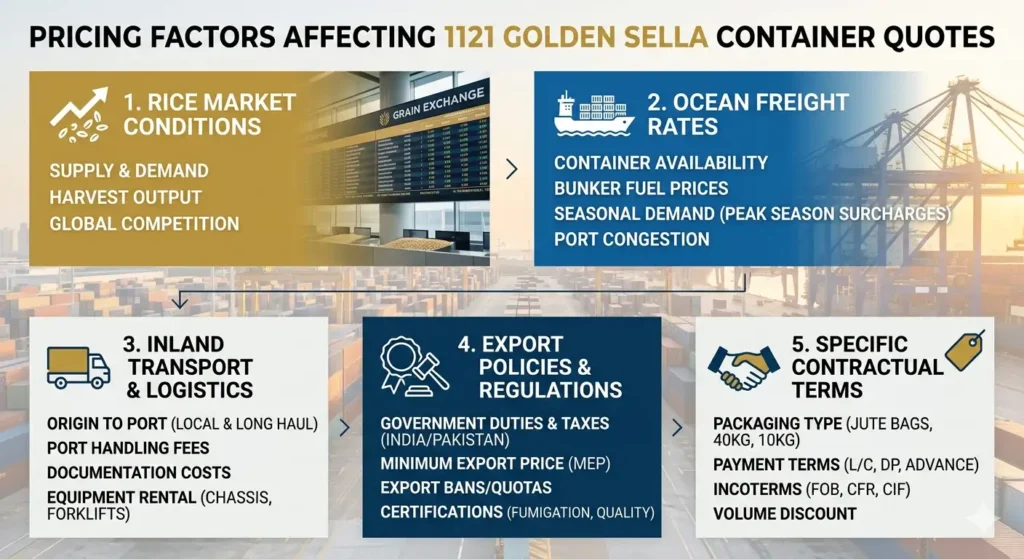
Container size also matters. A 24 MT minimum load uses freight more efficiently than a partial load. If the buyer increases volume beyond that threshold, the per-tonne freight effect can improve further. This is why container discipline is critical in export rice trade. Smaller loads usually weaken the economics of the order.
Destination market changes the quote as well. Freight to the Gulf is usually different from freight to Europe or North America. Customs requirements, insurance costs, and port charges all influence the final landed price. AHK Rice can structure the quote around the market so the buyer sees the actual landed economics rather than a simple origin price.
Packing format adds another layer. Bulk export bags are usually more cost-efficient than retail cartons or custom-designed private-label packs. If the buyer wants branded 1 kg, 5 kg, 10 kg, or 20 kg formats, the unit cost rises because of printing, packing, and handling. That is normal in export trade and should be modelled before final approval.
Incoterms shape the final number too. FOB leaves freight and insurance outside the rice price. CNF includes freight to the destination port. CIF includes freight and insurance together. AHK Rice uses these terms to help buyers compare container economics properly.
How should buyers choose between FOB, CNF, and CIF?
Buyers should choose FOB if they already control freight, CNF if they want freight included, and CIF if they want a full landed quote with insurance bundled into the shipment cost.
FOB works best for experienced importers. The buyer controls shipping and insurance and pays AHK Rice only for the rice and origin-side handling. This is useful when the importer has freight agreements already in place or wants direct control over the transport leg.
CNF works best for buyers who want a simpler freight arrangement. AHK Rice includes the ocean freight to the destination port, which makes budgeting easier. The buyer still handles destination charges and insurance if required, so CNF gives a middle position between control and simplicity.
CIF works best when the buyer wants the clearest all-in freight picture. The quote includes freight and insurance, which helps with budgeting and internal approval. This model is often easier for newer importers or buyers who need one line item to compare against alternative suppliers.
Each term affects how the buyer evaluates risk. FOB gives more buyer control. CNF reduces coordination work. CIF reduces uncertainty. AHK Rice can price all three so the buyer can compare the options before deciding.
What makes AHK Rice a practical decision for bulk buyers?
AHK Rice is practical because it combines product consistency, export control, and packaging flexibility with a minimum 24 MT container discipline that suits serious importers.
The first advantage is consistency. The rice is not sourced as a loose commodity without control. It is handled through a structured export process that keeps the grade, packing, and shipment assumptions close to the commercial quote. That matters because buyers lose money when the spec changes after approval.
The second advantage is flexibility. AHK Rice can supply 1121, Super Kernel, and 1509 varieties, so a buyer can adapt the rice line to different markets. That gives the importer more room to build category strategy. It also helps the buyer compare one grain against another using the same export partner.
The third advantage is process clarity. AHK Rice explains how the rice will be tested, packed, and shipped. That reduces confusion and shortens the path from enquiry to order. Buyers who work at container scale need that clarity because the order only works when logistics, cost, and market timing all line up.
The fourth advantage is export readiness. AHK Rice already works with international buyers across more than 15 countries, so the commercial process is familiar with customs, documentation, and container movement. That lowers friction and gives the buyer a more reliable route from sample approval to shipment.
How should a buyer move from enquiry to order?
A buyer should move from enquiry to sample approval, then to freight term selection, then to container booking, and finally to shipment confirmation.
The first step is to define the buying target. The buyer should decide whether the shipment is for retail, wholesale, or catering. That determines the pack size, moisture target, and destination market. Once that is clear, AHK Rice can issue the right sample and the right commercial quote.
The second step is sample testing. The buyer checks grain length, aroma, cooking result, and appearance. If the sample matches the target market, the buyer moves to price discussion. If not, the spec can be adjusted before any commercial commitment is made.
The third step is pricing format. The buyer chooses FOB, CNF, or CIF based on internal freight control and budgeting preferences. AHK Rice then maps the quote to the market destination and container size. That gives the buyer a real landing-cost view.
The fourth step is shipment execution. Once the container is approved, AHK Rice prepares the packing, document set, and loading schedule. The buyer then receives the shipment under the agreed term and can plan inventory against a known arrival window.
If you are ready to price 1121 Golden Sella at minimum 24 MT container level, the final step is to request a quote.