AHK Rice Morocco: 1509 and 1121 Basmati CIF Casablanca — Request Quote
Importers seeking reliable CIF Casablanca supply should choose 1121 Basmati for premium retail and foodservice demand and 1509 Basmati for competitive pricing and faster inventory turnover. Here is why: Moroccan buyers continue sourcing long-grain Pakistani Basmati for retail chains, wholesalers, and hospitality sectors, while freight efficiency, specification consistency, and documentation accuracy determine import success.
Moroccan rice buyers evaluating supply options should first understand market demand patterns and import specifications. Businesses looking at current consumption trends can review our analysis of Morocco’s changing rice market in the article about North Africa basmati rice trade Morocco demand import trends 2026.
1509 and 1121 Basmati remain the two most requested Pakistani rice categories for Morocco. Buyers require consistent grain length, verified quality certificates, dependable shipment schedules, and transparent CIF Casablanca pricing. AHK Rice’s Morocco export program supports importers with complete documentation, quality verification, container loading supervision, and direct CIF supply solutions.
AHK Rice supplies Moroccan importers through structured procurement processes. AHK Rice mills, grades, inspects, and ships rice according to buyer specifications. AHK Rice also supports sampling, laboratory testing, packaging customization, and freight coordination to Casablanca.
What is the best solution for importing 1509 or 1121 Basmati rice into Morocco?
1121 Basmati delivers premium positioning, while 1509 Basmati provides stronger price efficiency for volume-focused importers. Moroccan buyers should select the specification according to target customers, retail strategy, and inventory goals.
Moroccan importers commonly evaluate grain appearance, cooking performance, shelf life, and landed cost before placing contracts. Premium retailers often prefer 1121 because of its extra-long grain profile and strong visual presentation after cooking.
1121 Basmati Rice for Morocco
1121 Basmati offers raw grain lengths commonly exceeding 8.30 mm. The variety expands significantly during cooking and maintains grain separation. Moroccan retailers serving premium consumers often choose this specification.
1121 Basmati Typical Specifications
| Specification | Value |
|---|---|
| Grain Length | 8.30 mm+ |
| Moisture | 13% Max |
| Broken Grains | 2%–5% |
| Purity | 95%–99% |
| Crop Origin | Pakistan |
| Packaging | 5kg–50kg |
| Shelf Life | 18–24 Months |
1509 Basmati Rice for Morocco
1509 Basmati offers long grains with competitive pricing. The variety performs well in wholesale distribution and value-focused retail channels.
1509 Basmati Typical Specifications
| Specification | Value |
| Grain Length | 7.80–8.10 mm |
| Moisture | 13% Max |
| Broken Grains | 2%–5% |
| Purity | 95%–99% |
| Crop Origin | Pakistan |
| Packaging | 5kg–50kg |
| Shelf Life | 18–24 Months |
1121 commands a premium price because buyers value visual appearance and cooking elongation. 1509 reduces procurement costs while maintaining strong consumer acceptance.
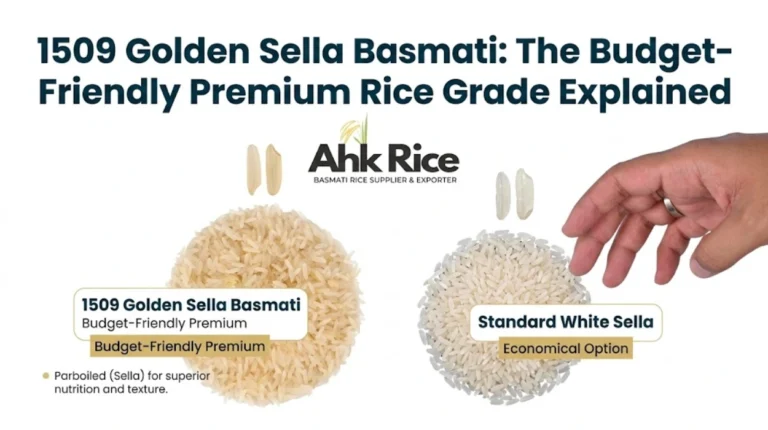
Moroccan distributors often compare these two grades before procurement decisions. Buyers seeking a deeper specification comparison can review our detailed guide covering the differences between 1509 and 1121 Golden Sella for Moroccan importers.
AHK Rice helps buyers match the correct grade with their target distribution channel. With product selection established, the next question concerns supplier capability and export execution.
Why choose Basmati Rice Exporter Pakistan to Morocco?
Direct procurement, verified quality control, complete export documentation, and predictable logistics create lower import risk and better supply continuity.
Moroccan importers face challenges beyond rice quality. Documentation errors, inconsistent specifications, shipment delays, and container loading issues can increase landed costs.
AHK Rice addresses these risks through a structured export process. AHK Rice manages procurement, milling, grading, quality inspection, container loading, freight coordination, and documentation preparation.
Quality Process Used by AHK Rice
Nine Processing Steps
- Clean the paddy.
- De-husk the grain.
- Dry the rice.
- Polish the kernels.
- Grade the grains.
- Sort by length.
- Inspect quality parameters.
- Test export specifications.
- Load containers for shipment.
Each step supports consistency across multiple shipments. Moroccan buyers receiving repeat orders benefit from predictable quality standards.
Export Documentation
Required Export Documents
- Commercial Invoice
- Packing List
- Certificate of Origin
- Phytosanitary Certificate
- Fumigation Certificate
- Bill of Lading
- Quality Inspection Report
- Health Certificate
AHK Rice verifies documents before dispatch. Accurate documentation reduces customs clearance delays at Casablanca port.
Packaging Options
Available Packaging Formats
- PP woven bags
- BOPP laminated bags
- Retail branded packs
- Private label packaging
- Bulk export bags
AHK Rice customizes packaging according to importer requirements and retail distribution strategies.
With supplier qualifications established, buyers naturally want to understand expected business outcomes.

What results can be expected from importing 1509 and 1121 Basmati into Morocco?
Consistent product quality, stable inventory planning, premium retail positioning, and reliable replenishment cycles represent the primary outcomes.
Importers selecting the correct specification generally achieve stronger customer retention. Premium retailers frequently prefer 1121 because visual grain quality supports higher shelf pricing.
1121 delivers longer cooked grains than 1509. In Moroccan premium retail channels, consumers often associate longer grain appearance with higher product quality. In hospitality applications, 1121 enhances plate presentation and perceived value.
1509 creates a different commercial advantage. The variety allows importers to offer competitive pricing while maintaining authentic Pakistani Basmati characteristics. Value-focused distributors often prioritize this balance.
Shipping Time to Casablanca
Estimated Transit Times
| Route | Transit Time |
| Karachi to Casablanca | 25–35 Days |
| Port Qasim to Casablanca | 25–35 Days |
| Inland Processing to Port Loading | 3–7 Days |
| Documentation Processing | 2–5 Days |
Transit schedules vary according to vessel availability, seasonal demand, and port congestion.
Shelf Life Comparison
Storage Performance
| Grade | Shelf Life |
| 1121 Basmati | 18–24 Months |
| 1509 Basmati | 18–24 Months |
1121 maintains premium shelf presentation throughout extended storage periods. 1509 provides comparable storage performance while lowering acquisition costs.
AHK Rice supports inventory planning through shipment scheduling and production forecasting. Understanding outcomes leads directly to the most important commercial question: pricing.
What factors affect CIF Casablanca pricing?
Rice grade, crop quality, freight costs, packaging requirements, and order volume create the largest impact on final CIF Casablanca pricing.
Rice pricing changes throughout the year. Harvest conditions, freight rates, container availability, and market demand influence quotations.
Product Grade
1121 generally costs more than 1509. Longer grain length and premium market positioning support the price difference.
Packaging Requirements
Custom retail packaging increases production costs. Bulk export packaging generally provides lower per-ton pricing.
Freight Market Conditions
Ocean freight fluctuations directly affect CIF Casablanca calculations. Freight markets may change monthly according to vessel capacity and fuel costs.
Order Quantity
Larger container volumes typically improve procurement efficiency. Full container orders often generate better pricing than smaller consolidated shipments.
Quality Specifications
Lower broken percentages and higher purity standards generally increase processing requirements and export pricing.
Typical Cost Factors
| Factor | Impact on Price |
| Rice Grade | High |
| Freight Cost | High |
| Packaging | Medium |
| Volume | Medium |
| Quality Level | Medium |
| Seasonal Demand | Medium |
| Currency Movement | Medium |
AHK Rice provides detailed quotations based on actual specifications instead of generic market estimates. Buyers receive transparent pricing structures that support procurement planning.
With pricing factors clarified, the final step is understanding how to begin the purchasing process.
How to get started with AHK Rice Morocco supply?
Sample approval, specification confirmation, quotation review, and shipment scheduling form the fastest path to successful procurement.
AHK Rice follows a structured onboarding process designed for importers, wholesalers, distributors, and retail brands.
Sample Process
Sample Approval Procedure
- Submit product requirements.
- Confirm desired grade.
- Receive physical sample.
- Test cooking performance.
- Verify specifications.
- Approve commercial terms.
- Confirm order quantity.
- Schedule production.
- Dispatch shipment.
Sample Costs
Sample costs depend on courier destination and package weight. Most Morocco-bound sample shipments range between USD 50–150 including courier charges. Sample rice value is usually nominal compared with freight expenses.
AHK Rice prepares representative export samples from production batches. Moroccan buyers can inspect grain length, cooking performance, aroma, moisture, and appearance before contract confirmation.
Order Execution Timeline
Standard Export Timeline
| Stage | Estimated Duration |
| Sample Preparation | 1–3 Days |
| Courier Delivery | 4–7 Days |
| Production Scheduling | 3–7 Days |
| Container Loading | 2–5 Days |
| Vessel Departure | Based on Schedule |
| Transit to Casablanca | 25–35 Days |
AHK Rice maintains communication throughout each stage. Buyers receive updates covering production, inspection, documentation, loading, and vessel departure.
Moroccan importers seeking dependable CIF Casablanca supply can reduce procurement risk through verified specifications, structured quality control, and professional export management. Contact AHK Rice today and submit your requirements through our quotation request form.
Frequently Asked Questions
How long does it take to ship Basmati rice from Pakistan to Casablanca?
Basmati rice shipments from Pakistan to Casablanca typically take 25–35 days after vessel departure. Production, quality inspection, and export documentation usually require an additional 5–12 days before loading. AHK Rice provides shipment updates throughout the export process to help importers plan inventory accurately.
Which Basmati rice grade is better for the Moroccan market, 1121 or 1509?
The best grade depends on the target market segment. 1121 Basmati is preferred for premium retail and hospitality businesses because of its extra-long grain length and superior presentation after cooking. 1509 Basmati is often selected by wholesalers and distributors seeking competitive pricing while maintaining authentic Pakistani Basmati quality.
What packaging options does AHK Rice offer for Morocco exports?
AHK Rice supplies rice in 5 kg, 10 kg, 25 kg, and 50 kg packaging formats. Buyers can choose PP woven bags, BOPP laminated bags, retail-ready packs, or private-label packaging. Packaging specifications can be customized according to retail, wholesale, or foodservice requirements.
Can Moroccan buyers request samples before placing an order?
Yes. AHK Rice provides export samples so buyers can evaluate grain length, cooking performance, aroma, moisture content, and overall quality. Sample shipments generally cost USD 50–150, depending on courier charges and destination. Sample approval helps buyers confirm specifications before finalizing contracts.
What documents are included with Basmati rice exports to Morocco?
AHK Rice provides all standard export documentation required for customs clearance and import procedures. These documents typically include the Commercial Invoice, Packing List, Certificate of Origin, Phytosanitary Certificate, Fumigation Certificate, Bill of Lading, and Quality Inspection Report. Proper documentation helps reduce delays during customs processing in Casablanca.