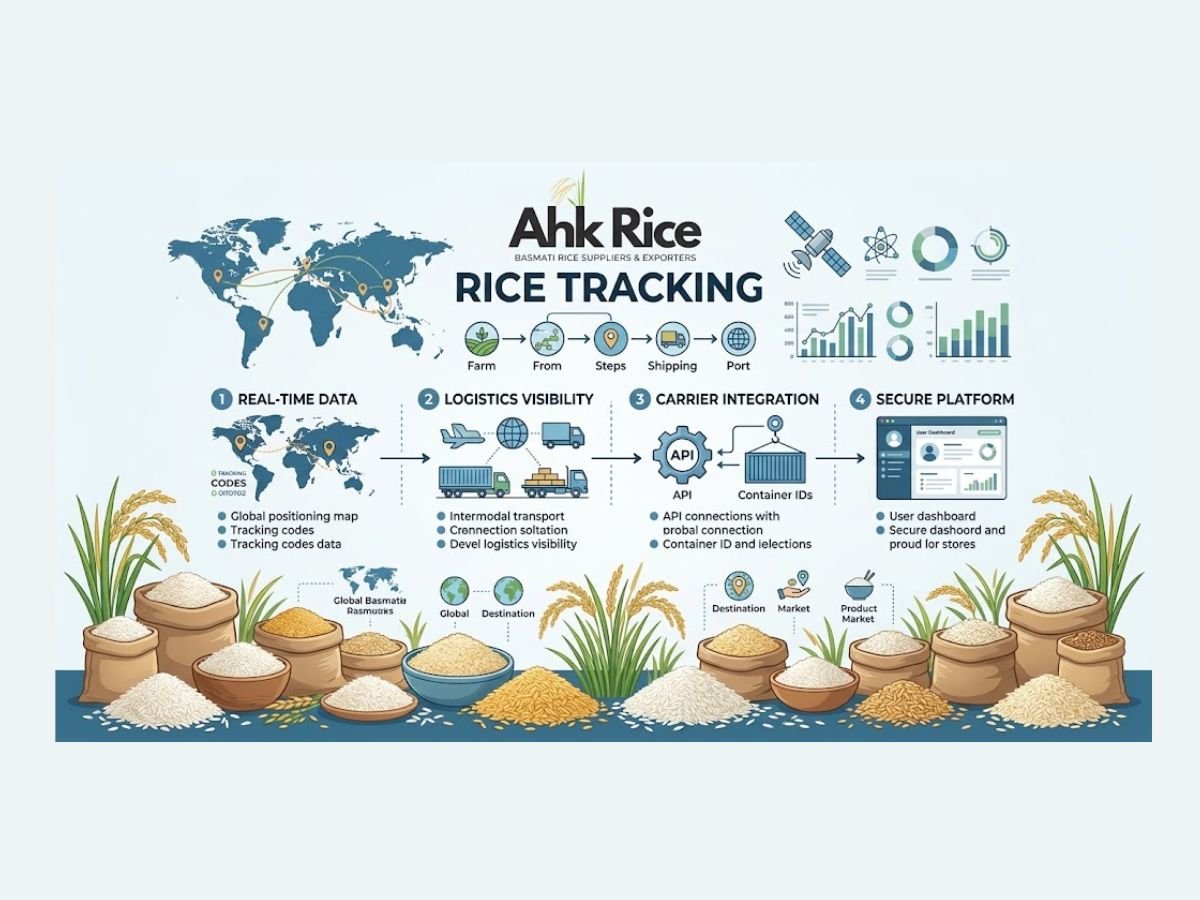
How Can Buyers Track International Rice Orders Effectively?
Buyers track international rice orders most effectively by combining purchase-order milestones, product and quality records, export documentation, container tracking, and delivery confirmation in one order-control process. Integrated visibility is stronger than relying on supplier messages or carrier tracking alone because it connects the physical rice with its commercial, quality, and logistics status.
International rice procurement involves several handoffs. A buyer may approve a sample in Punjab, confirm production, arrange inspection, receive export documents, monitor a container from Karachi, prepare customs clearance, and schedule warehouse receiving. Each stage can create a delay or information gap.
Supply chain visibility for rice importers explains why connecting these stages improves procurement control.
For buyers evaluating AHK Rice’s Pakistan rice export services, the same principle applies. AHK Rice supplies 1121, Super Kernel, and 1509 varieties and coordinates processing, grading, sorting, packaging, inspection, documentation, and container loading. The objective is not simply to show where a container is located. The objective is to show what was ordered, what was produced, what was inspected, what was shipped, and when it should arrive.
What Are the Available Solutions for Tracking International Rice Orders?
The main solutions are supplier milestone reporting, spreadsheets, freight-forwarder portals, carrier tracking, and integrated platforms; the strongest approach connects purchase orders, specifications, quality records, documents, container movement, customs status, and final delivery in one controlled workflow.
Supplier milestone reporting is the simplest method. The exporter provides updates for production, inspection, packing, loading, dispatch, vessel departure, arrival, and delivery. This approach works for buyers handling a limited number of containers because implementation is easy and operating costs are low.
Spreadsheets provide greater buyer control. A procurement team can create fields for purchase-order number, rice variety, grade, quantity, packing, batch number, inspection status, container number, vessel, estimated arrival date, document status, and delivery confirmation. The weakness is manual updating.
Freight-forwarder portals provide stronger logistics visibility. They can show booking confirmation, container events, vessel schedules, transshipment, estimated arrival, and destination milestones. They are useful when transportation is the main concern but do not automatically verify rice quality or production status.
Carrier tracking provides the most direct information about physical cargo movement. It is valuable after the container receives a booking or bill-of-lading reference. However, carrier systems normally cannot tell an importer whether the correct grade was packed or whether the laboratory report matches the loaded batch.
Integrated supply-chain platforms connect procurement, supplier, quality, documentation, logistics, inventory, and delivery data. They require more setup but provide the strongest control for repeat import programs.
How Do Different International Rice Order Tracking Approaches Compare?
Integrated tracking provides the broadest visibility, while supplier reporting provides the lowest complexity; spreadsheets suit smaller programs, freight portals strengthen transport control, and carrier systems work best for monitoring physical container movement.
| Attribute | Supplier Updates | Spreadsheet | Freight Portal | Carrier Tracking | Integrated Platform |
|---|---|---|---|---|---|
| Order visibility | Medium | Medium | High | Low | Very High |
| Quality visibility | High | High | Low | Low | High |
| Document control | Medium | High | Medium | Low | Very High |
| Shipment tracking | Medium | Low | High | Very High | Very High |
| Update control | Supplier-led | Buyer-led | Logistics-led | Carrier-led | Shared |
| Scalability | Medium | Low-Medium | High | High | Very High |
| Exception management | Medium | Medium | High | Medium | Very High |
The comparison shows why no single tracking tool covers the entire procurement chain. A carrier portal may provide excellent vessel information while offering no information about the approved rice sample. A supplier report may confirm production but provide limited live vessel data.
An effective buyer therefore combines information sources around one purchase order rather than treating every system as a separate record.
How Should Buyers Track an International Rice Order Step by Step?
Buyers should create one order record, define the approved rice specification, assign production and inspection milestones, collect export documents, record container events, monitor estimated arrival, and close the order only after warehouse receipt is verified.
The first step is to create an order-control record. Record the supplier, purchase-order number, rice variety, grade, quantity, packaging, destination port, Incoterm, target shipment date, and required delivery date.
The second step is specification control. Record measurable requirements such as grain length, broken percentage, moisture, purity, foreign matter, processing type, packaging weight, and crop year. The specification becomes the reference against which the commercial shipment is evaluated.
The third step is production monitoring. Record when paddy preparation, milling, sorting, grading, packing, and final inspection are scheduled. This separates production progress from transportation progress.
The fourth step is quality verification. Match the inspection or laboratory report to the batch reference and purchase order. This is especially important when an importer receives several rice varieties or grades from the same supplier.
The fifth step is document control. Track the commercial invoice, packing list, certificate of origin, phytosanitary documentation where required, inspection records, fumigation records where applicable, and bill of lading. Destination-specific documentation should be confirmed before shipment.
For U.S. food imports, FDA requires prior notice for covered imported food shipments, while imported food must meet applicable U.S. safety and labeling requirements. This makes document status part of order tracking rather than a separate administrative task.
The sixth step is container tracking. Record the container number, booking reference, vessel, loading date, departure, transshipment events, destination arrival, discharge, and final delivery.
The seventh step is exception management. Record the event, date, cause, responsible party, commercial impact, and corrective action. A production delay requires different action from a vessel delay.
The final step is delivery closure. Compare received quantity, packaging, product grade, and delivery date against the purchase order. This creates a supplier-performance record for future procurement.
Which Tracking Method Works Best for Different Import Cases?
Small importers benefit from supplier updates and structured spreadsheets, medium-volume buyers benefit from combining supplier reports with freight portals, and high-volume importers benefit from integrated systems connecting procurement, quality, documents, logistics, and inventory.
A small importer purchasing one or two containers per quarter does not need a complex enterprise platform. A structured spreadsheet can capture the essential milestones while the supplier provides production and documentation updates.
A medium importer managing several containers each month needs stronger separation between product and logistics data. Supplier reporting can manage production and quality, while a freight-forwarder portal manages booking and vessel movement.
A large distributor importing regular container volumes needs integrated order control. Multiple purchase orders, batches, containers, ports, and arrival dates make manual tracking increasingly difficult. Automated alerts and shared records become more valuable as volume rises.
A buyer importing private-label rice also needs stronger document control. Packaging artwork, approved specifications, batch references, inspection records, and shipment documentation must remain connected to the same commercial order.
For U.S. buyers, compliance visibility becomes particularly important because food importers remain responsible for ensuring imported food meets applicable U.S. requirements.
What Are the Pros and Cons of Each Rice Order Tracking Method?
Each tracking method solves a different visibility problem: supplier reporting is simple, spreadsheets are flexible, freight portals improve logistics control, carrier tracking provides direct movement data, and integrated platforms deliver the broadest visibility at greater implementation effort.
Supplier reporting has low setup requirements and works well when the exporter communicates consistently. Its main limitation is that the buyer depends on the supplier for timely updates.
Spreadsheets provide flexibility and can be customized around a buyer’s procurement process. They are inexpensive and transparent. Their weakness appears when several employees update different versions or when shipment events change faster than the spreadsheet.
Freight portals provide useful transportation information. They help buyers identify vessel changes, transshipment, estimated arrival changes, and destination events. They do not replace quality-control records.
Carrier tracking provides authoritative transportation milestones from the shipping line. It is especially useful after container loading. It remains limited because it does not cover production, inspection, packaging, or supplier performance.
Integrated platforms provide the highest level of visibility. They can connect purchase orders with inventory, documents, transportation, and supplier data. Their disadvantages are implementation time, data integration requirements, user training, and higher technology costs.
The correct decision therefore depends on order volume and the number of information sources that must be connected.
How Do Saudi Arabia and UAE Buyers Differ When Tracking Rice Orders?
Saudi Arabian buyers generally prioritize specification consistency, shipment timing, compliance documentation, and inventory continuity, while UAE buyers place strong emphasis on landed cost, port scheduling, flexible packaging, and rapid coordination through major logistics gateways.
Saudi Arabia is a major destination for Pakistani Basmati. Buyers commonly evaluate 1121, Super Kernel, and 1509 against grain length, purity, broken percentage, moisture, packaging, and cooking performance. A tracking process should therefore connect the approved specification with inspection and loading records.
UAE procurement is strongly influenced by the role of Dubai and Jebel Ali as regional distribution gateways. Buyers serving retail, hospitality, food service, and re-export markets need accurate arrival information because a port delay can affect downstream inventory.
The price comparison must also distinguish FOB from landed cost. A Pakistan FOB reference excludes destination freight and other destination-side costs. CIF adds freight and insurance to the destination port.
For 2026 planning, published Pakistan Basmati references place premium 1121 Steam around US$1,215–US$1,265 per MT FOB, while lower-cost grades and specifications can trade below that level. These are procurement references rather than fixed quotations because grade, packing, quantity, crop, freight, and contract terms change the final price.
AHK Rice’s current UAE pricing guidance similarly explains that FOB Pakistan and CIF UAE are different commercial measurements because CIF incorporates ocean freight and marine insurance.
| Market Region | Common Grade Preference | 2026 FOB Planning Reference | Storage/Shelf-Life Planning | Tracking Priority |
| Saudi Arabia | 1121, Super Kernel, 1509 | ~$1,100–$1,265/MT depending on grade | 12–18+ months by SKU and storage | Specification, documents, delivery |
| UAE | 1121, Super Kernel, 1509 | ~$1,100–$1,265/MT depending on grade | 12–18+ months by SKU and storage | Freight, landed cost, arrival |
Shelf life should never be treated as an independent fixed number. Packaging, moisture, warehouse temperature, humidity, pest control, and stock rotation influence actual storage performance. Golden Sella, for example, can provide stronger storage stability than Steam grades under appropriate conditions, while exact shelf-life claims should follow the product specification and packaging.
What Should Buyers Consider Before Choosing an Order-Tracking Strategy?
Buyers should evaluate tracking methods against order volume, specification complexity, shipment frequency, destination compliance, data accuracy, update speed, exception handling, supplier communication, and total operating cost before selecting a monitoring system.
| Decision Factor | What to Evaluate | Best Approach |
| Order volume | Containers and purchase orders per month | Scale technology with volume |
| Product complexity | Number of varieties, grades, and SKUs | Integrated specification records |
| Shipment visibility | Need for live vessel and container data | Carrier or freight portal |
| Compliance | Destination documents and food rules | Document-control workflow |
| Supplier performance | Delays, quality deviations, response time | KPI-based supplier dashboard |
The first decision factor is volume. One shipment can be managed manually. Dozens of shipments require structured data.
The second is specification complexity. Buyers handling 1121 Steam, 1121 White, Super Kernel, and 1509 should maintain separate specification references to prevent product mixing.
The third is destination compliance. U.S. buyers need food-import documentation and prior-notice controls. Gulf buyers need destination-specific import documentation and regulatory coordination.
The fourth is exception management. A useful system should identify when a shipment leaves its planned timeline rather than simply recording that it eventually arrived.
The fifth is supplier accountability. Tracking data becomes valuable when buyers use it to measure on-time shipment performance, document accuracy, specification conformity, and response time.
What Is the Best Decision Framework for Tracking International Rice Orders?
The best decision framework starts with the information the buyer must control, then matches that requirement to the simplest system capable of providing accurate updates across product, quality, documentation, transportation, customs, and final delivery.
Buyers should first identify which information gaps create the highest financial risk. For one importer, vessel delays may be the main problem. For another, inconsistent specifications may create more receiving disputes.
Next, define milestone ownership. The supplier should own production updates, the inspection party should own quality verification, the freight provider should own transportation milestones, and the importer should control the consolidated order record.
Then define update frequency. Production may require milestone-based updates, while vessel movement may require event-based updates. Customs and documentation should be monitored before arrival rather than after a problem occurs.
Finally, measure performance after delivery. Record planned versus actual shipment date, planned versus actual arrival, quantity variance, specification conformity, document completeness, and exceptions.
This creates a procurement feedback loop. The next purchase order can then be based on evidence from previous shipments instead of assumptions.
For Oregon buyers evaluating a transparent supplier relationship, the decision-focused article:
AHK Rice Provides Supply Chain Transparency for Oregon Buyers is best placed immediately after this section, because readers have now moved from general tracking methods to supplier-level evaluation.
How Can Buyers Use Tracking Data to Compare Rice Exporters?
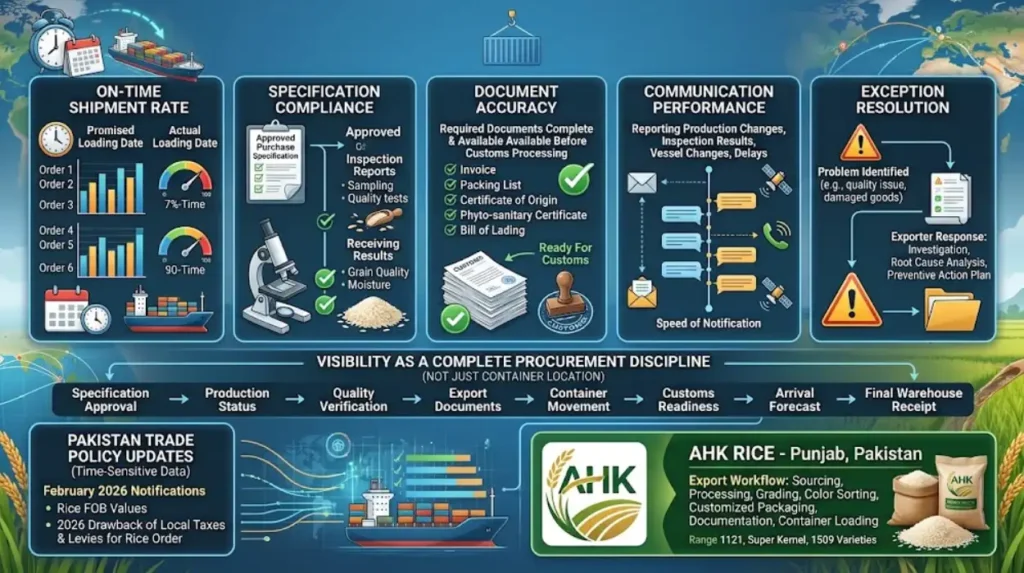
Tracking data allows buyers to compare exporters using measurable performance indicators instead of relying only on price, sales claims, or a single successful shipment.
The first indicator is on-time shipment rate. Compare the promised loading date with the actual loading date across several orders.
The second is specification compliance. Compare the approved purchase specification with inspection and receiving results.
The third is document accuracy. Record whether required documents were complete and available before customs processing.
The fourth is communication performance. Measure how quickly the supplier reports production changes, inspection results, vessel changes, and delays.
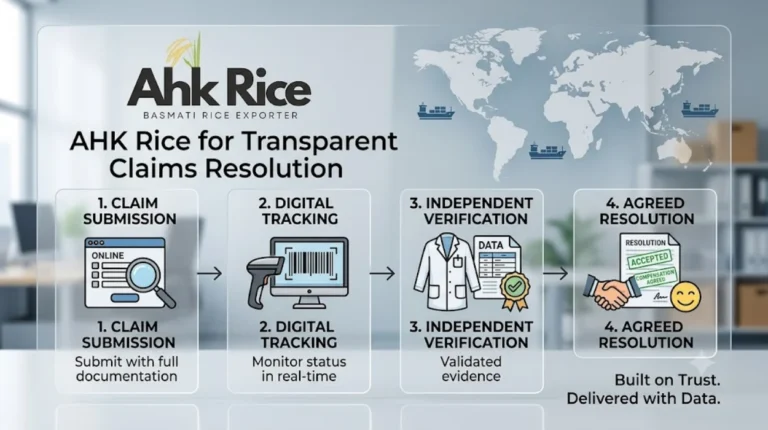
The fifth is exception resolution. A reliable exporter should provide a documented corrective response when a quality or logistics problem occurs.
AHK Rice operates from Punjab and states that its export workflow covers sourcing, processing, grading, color sorting, customized packaging, documentation, and container loading. Its product range includes 1121, Super Kernel, and 1509 varieties.
Pakistan’s Ministry of Commerce also continues publishing 2026 trade and rice-related policy updates, including February 2026 notifications concerning rice FOB values and the 2026 Drawback of Local Taxes and Levies for Rice Order. Buyers should therefore treat price and export-policy data as time-sensitive procurement inputs.
International rice order tracking works best when buyers treat visibility as a complete procurement discipline rather than a container-location service. The strongest system connects the approved rice specification, production status, quality verification, export documents, container movement, customs readiness, arrival forecast, and final warehouse receipt.
Frequently Asked Questions
How can buyers track international rice orders effectively?
Buyers can track international rice orders by monitoring purchase-order milestones, production, quality inspection, export documents, container movement, customs clearance, and final delivery in one structured workflow.
What information should an international rice order tracker include?
An effective tracker should include the purchase-order number, rice variety, grade, quantity, packaging, specification, inspection status, container number, vessel, shipping dates, documents, estimated arrival, and delivery confirmation.
Which rice order tracking method is best for small importers?
Small importers can use supplier milestone updates supported by a structured spreadsheet. This provides sufficient control for limited shipment volumes without requiring complex supply-chain software.
Why is container tracking important for rice importers?
Container tracking helps buyers monitor vessel departure, transshipment, port arrival, discharge, and delivery. It allows importers to identify schedule changes early and coordinate inventory and warehouse planning.
How does quality tracking improve international rice procurement?
Quality tracking connects the approved rice specification with inspection and shipment records. Buyers can verify parameters such as grain length, moisture, broken percentage, purity, foreign matter, and packaging before accepting the shipment.
What documents should buyers track for imported rice?
Common documents include the commercial invoice, packing list, certificate of origin, bill of lading, inspection records, phytosanitary documentation where applicable, fumigation records where required, and destination-specific import documentation.
How should U.S. rice importers track compliance?
U.S. rice importers should track supplier documentation, food-facility requirements, labeling compliance, and Prior Notice requirements alongside shipment milestones. FDA requirements apply to imported food entering the United States.